
 100% FREE ACCESS
11th Standard Syllabus & Materials
11th Standard
TN 11th Tamil இயற்கை வேளாண்மை,சுற்றுச்சூழல் -செய்யுள் - மனோன்மணீயம் Important Questions And Answers Study Material - QB365 Set A
NEW11th Standard
TN 11th Tamil என்னுயிர் என்பேன் -துணைப்பாடம் - இசைத்தமிழர் இருவர் Important Questions And Answers Study Material - QB365 Set A
NEW11th Standard
TN 11th Tamil மொழி கலை -செய்யுள் - ஒவ்வொரு புல்லையும் Important Questions And Answers Study Material - QB365 Set A
NEW11th Standard
TN 11th Tamil பீடு பெற நில் - இலக்கணம் - பகுபத உறுப்புகள் Important Questions And Answers Study Material - QB365 Set A
NEW11th Standard
TN 11th Tamil பீடு பெற நில் - துணைப்பாடம் - வாடிவாசல் Important Questions And Answers Study Material - QB365 Set A
NEW11th Standard
TN 11th Tamil பீடு பெற நில் - செய்யுள் - குறுந்தொகை Important Questions And Answers Study Material - QB365 Set A

Published on: 30/09/2018
Important 5mark -chapter 3,4
Download Tamil Nadu 11th Standard Physics question papers, model tests, one-mark questions, important questions, and public exam papers in PDF format. Free study materials and answer keys for TN State Board students.
Questions + Answers key
Take MCQ Physics Test1.
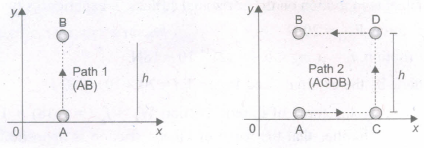
Show that the work done by the conservative force is independent of the path. Consider the following cases
2.
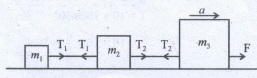
As shown In the diagram, three blocks connected together lie on a horizontal frictionless table and pulled to the right with a force F = 50N. If m1 = 5 kg, m2 = 10 kg and m3 = 15 kg. Find the tensions T1 and T2.
3.
Briefly explain how is a vehicle able to go round a level curved track. Determine the maximum speed with which the vehicle can negotiate this curved track safely.
4.
Two masses m1 and m2 m1 > m2 or in contact with each other on a smooth horizontal surface. Calculate the magnitude of contact force between them.
5.
Derive an expression for the acceleration of the body sliding down a frictionless surface.
6.
Derive an expression for the gravitational potential energy of a body of mass 'm' raised to a height 'h' above the earth's surface.
7.
Briefly explain how is a horse able to pull a cart.
8.
Using Newton's laws calculate the tension acting on the mango (mass m = 400g) hanging from a tree.
9.
Two springs have spring constant k1 and k2 (k1 > k2) on which spring is more work done, if
(i) They are stretched by the same force.
(ii) They are stretched by same amount.
10.
What happens to the object at rest if
(i) fs = 0
(ii) fs = Fext
(iii) fs = max.
11.
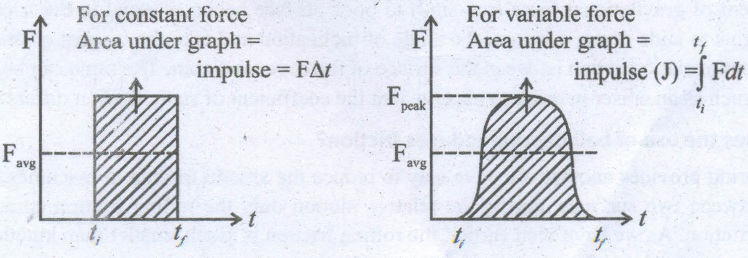
Show how impulse force can be measured graphically.
12.
Prove Impulse - Momentum equation.
13.
Describe Galileo's experiments concerning motion of objects on inclined planes?
14.
Find the work done in pulling and pushing another through 200 m horizontally when a force of 1000N is acting along a chain making an angle of 60° with ground. Assume the floor to be smooth frictionless surface.
15.
A body of mass 500 g initially at rest is moved by a horizontal force of 1 N. Calculate the work done by the force in 20s and show that is equal to the change in kinetic energy of the body.
16.
A body of mass 600 g travels in a straight line with velocity v = a\(\times \frac{3}{2}\) . a =3m-1/4s-1 What is the work done by the net force during its displacement from x = 0 to x = 3 m?
17.
Find the work done in moving a particle along a vectors \(\vec { S } =(\overset { \wedge }{ i } -2\overset { \wedge }{ j } +6\overset { \wedge }{ k } )\) m if applied force is \(\vec { F } =(2\overset { \wedge }{ i } +3\overset { \wedge }{ j } +\overset { \wedge }{ 5k } )\) N at an angle 60°.
18.
Find the work done in moving a particle along a vectors \(\vec { s } =(\overset { \wedge }{ i } -2\overset { \wedge }{ j } +3\overset { \wedge }{ k } )\)m if applied force is \(\vec { F } =(2\overset { \wedge }{ i } -3\overset { \wedge }{ j } +4\overset { \wedge }{ k } )\)N.
19.
A bullet of mass 25 g moving with a velocity of 400 ms-1 strikes a cardboard and goes out from the other end with a velocity of 300 ms-1, find out the work done in passing through the cardboard.
20.
Calculate work done to move a boy of mass 20 kg along an inclined plane (\(\theta\) = 45°) with constant velocity through a distance of 10 m.
21.
Find the work done if a particle moves from position \(\vec { { r }_{ 1 } } =(2\overset { \wedge }{ i } +\overset { \wedge }{ j } -\overset { \wedge }{ 3k } )\) to a position \(\vec { { r }_{ 2 } } =(4\overset { \wedge }{ i } +6\overset { \wedge }{ j } -7\overset { \wedge }{ k } )\) under the effect of force \(\vec {F } =(3\overset { \wedge }{ i } +2\overset { \wedge }{ j } -\overset { \wedge }{ 4k } )\)N.
22.
A body of mass of 3 kg initially at rest makes under the action of an applied horizontal force of 10 N on a table with co-efficient of kinetic friction = 0.3, then what is the work done by the applied force in 10s:
23.
Find the impulse of a constant force and variable force with diagrams.
24.
State and explain work energy principle. Mention any three examples for it.
25.
Briefly explain 'centrifugal force' with suitable examples.
26.
Briefly explain the origin of friction. Show that in an inclined plane, angle of friction is equal to angle of repose
27.
Two different unknown masses A and B collide. A is initially at rest when B has a speed v. After collision B has a speed v/2 and moves at right angles to its original direction of motion. Find the direction in which A moves after collision?
28.
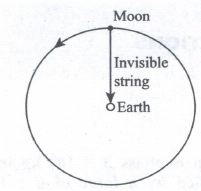
Imagine that the gravitational force between Earth and Moon is provided by an invisible string that exists between the Moon and Earth. What is the tension that exists in this invisible string due to Earth's centripetal force? (Mass of the Moon = 7.34\(\times\)1022 kg, Distance between Moon and Earth = 3.84 \(\times\) 108m).
29.
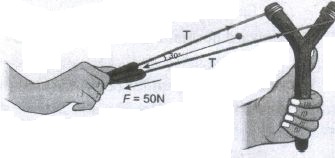
Apply Lami's theorem on sling shot and calculate the tension in each string?
30.
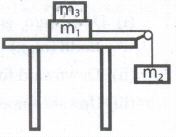
Two masses m1 and m2 are connected with a string passing over a frictionless pulley fixed at the corner of the table as shown in the figure. The coefficient of static friction of mass m1 with the table is μs, Calculate the minimum mass m3 that may be placed on m1 to prevent it from sliding. Check if m1= 15 kg, m2 = 10 kg, m3 = 25 and μs = 0.2.
31.
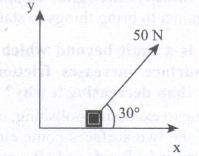
A force of 50N act on the object of mass 20 kg. shown in the figure. Calculate the acceleration of the object in x and y directions.
32.
An object of mass m is projected from the ground with initial speed v0. Find the speed at height h.
33.
An object of mass 1 kg is falling from the height h = 10m. Calculate
(a) The total energy of an object at h = 10 m.
(b) Potential energy ofthe object when it is at h = 4 m.
(c) Kinetic energy of the object when it is at h = 4 m.
(d) What will be the speed of the object when it hits the ground?
(Assume g = 10 m s-2)
34.
A body of mass m is attached to the spring which is elongated to 25 cm by an applied force from its equilibrium position.
(a) Calculate the potential energy stored in the spring-mass system?
(b) What is the work done by the spring force in this elongation?
(c) Suppose the spring is compressed to the same 25 cm, calculate the potential energy stored and also the work done by the spring force during compression. (The spring constant, k= 0.1 N m-1).
35.
If an object of mass 2 kg is thrown up from the ground reaches a height of 5 m and falls back to the Earth (neglect the air resistance). Calculate
(a) The work done by gravity when the object reaches 5 m height
(b) The work done by gravity when the object comes back to Earth
(c) Total work done by gravity both in upward and downward motion and mention the physical significance of the result.
36.
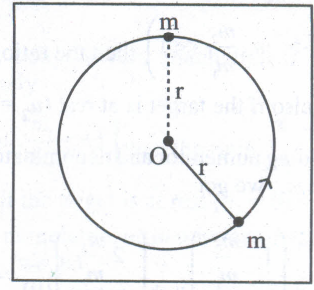
A bob of mass m is attached to one end of the rod of negligible mass and length r, the other end of which is pivoted freely at a fixed center O as shown in the figure. What initial speed must be given to the object to reach the top of the circle? (Hint: Use law of conservation of energy). Is this speed less or greater than speed obtained in the section 4.2.9?
37.
A car takes a turn with velocity 50 ms-1 on the circular road of radius of curvature 10m. calculate the centrifugal force experienced by a person of mass 60kg inside the car?
38.
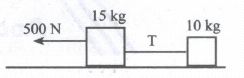
Two bodies of masses 15 kg and 10 kg are connected with light string kept on a smooth surface. A horizontal force F = 500 N is applied to a 15 kg as shown in the figure. Calculate the tension acting in the string.
39.
Arrive at an expression for power and velocity. Give some examples for the same.
40.
A bob attached to the string oscillates back and forth. Resolve the forces acting on the bob into components. What is the acceleration experienced by the bob at an angle ፀ.
1.
Force \(\overrightarrow { F } =mg\left( -\hat { j } \right) =-mg\hat { j } \)
Displacement vector \(d\vec{r}\) = dx\(\hat { i } \) + dy \(\hat { j } \)
(As the displacement is in two dimension; unit vectors \(\hat { j } \) and \(\hat { i } \) are used)
(a) Since the motion is only vertical, horizontal displacement component dx s zero. Hence, work done by the force along path 1 (of distance h).
\({ W }_{ push\ \ 1 }=\int _{ A }^{ B }{ \overrightarrow { F } .d\overrightarrow { r } =\int _{ A }^{ B }{ (-mg\hat { j } ).(dy\hat{j})=-mg\int _{ 0 }^{ h }{ dy=-mgh } } } \)
Total work done for path 2 is
\({ W }_{ push\ \ 2 }=\int _{ A }^{ B }{ \overrightarrow { F } .d\overrightarrow { r } =\int _{ A }^{ C }{ \overrightarrow { F } .d\overrightarrow { r } +\int _{ C }^{ D }{ \overrightarrow { F } .d\overrightarrow { r } +\int _{ D }^{ B }{ \overrightarrow { F } .d\overrightarrow { r } } } } } \)
But \(\int _{ A }^{ C }{ \overrightarrow { F } .d\overrightarrow { r } =\int _{ A }^{ B }{ (-mg\hat { j } ).(dx\hat { i } )=0 } } \)
\(\int _{ A }^{ D }{ \overrightarrow { F } .d\overrightarrow { r } =\int _{ C }^{ D }{ (-mg\hat { j } ).(dy\hat { j } )=-mg\int _{ 0 }^{ h }{ dy } =-mgh } } \)
\(\int _{ D }^{ B }{ \overrightarrow { F } .d\overrightarrow { r } =\int _{ A }^{ B }{ (-mg\hat { j } ).(dx\hat { i } )=0 } } \)
Therefore, the total work done by the force along the path 2 is
\({ W }_{ push\ \ 2 }=\int _{ A }^{ B }{ \vec { F } } .d\overrightarrow { r } =-mgh\)
Note that the work done by the conservative force is independent of the path.
2.
Given:
F = 50N
m1 = 5 kg
m2 = 10 kg
m3 = 15 kg
All the blocks move with common acceleration a under the force F = 50N
∴ F = (m1 + m2 + m3)a
or a = \(\frac { F }{ { m }_{ 1 }+{ m }_{ 2 }+{ m }_{ 3 } } =\frac { 50 }{ 5+10+15 } =\frac { 5 }{ 3 } \) ms-2
To determine T1 Refer to the free-body diagram for m1 shown in the diagram. Clearly, the tension T1 produces acceleration a in mass m1.
∴ T1 = m1a = \(5\times \frac { 5 }{ 3 } =\frac { 25 }{ 3 } \) = 8.33 N
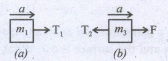
To determine T2 Refer to the free-body diagram for m3 shown in the diagram (b). Force F acts towards right and tension T2 acts towards left.
∴ F - T2 = m3 a (or) 50 - T2 = 15 x \(\frac { 5 }{ 3 } \) or T2 =25N
3.
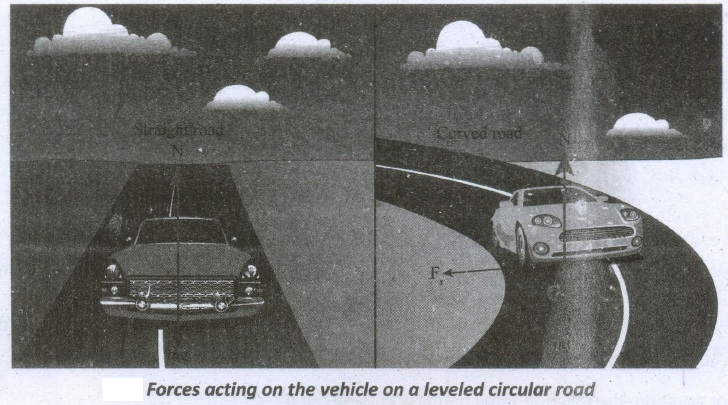
When a vehicle travels in a curved path, there must be a centripetal force acting on it. This centripetal force is provided by the frictional force between tyre and surface of the road. Consider a vehicle of mass 'm' moving at a speed 'v' in the circular track of radius 'r'. There are three forces acting on the vehicle when it moves as shown in the figure.
(i) Gravitational force (mg) acting downwards
(ii) Normal force (mg) acting upwards
(iii) Frictional force (Fs) acting horizontally inwards along the road
Suppose the road is horizontal then the normal force and gravitational force are exactly equal and opposite. The centripetal force is provided by the force of static friction Fs between the tyre and surface of the road which acts towards the center of the circular track,
\(\frac { m{ v }^{ 2 } }{ r } ={ F }_{ s }\)
As we have already seen in the previous section, the static friction can increase from zero to a maximum value
Fs ≤ μsmg
There are two conditions possible namely without skidding and skidding.
For without skidding \(\frac { m{ v }^{ 2 } }{ r } \le { \mu }_{ s }mg\), or \({ \mu }_{ s }\ge \frac { { v }^{ 2 } }{ rg } \) or \(\sqrt { { \mu }_{ s }rg } \ge v\)
The static friction would be able to provide necessary-centripetal force to bend the car on the road.
4.
Consider two blocks of masses m1 and m2 (m1 > m2) kept in contact with each other on a smooth, horizontal frictionless surface as shown in the figure.
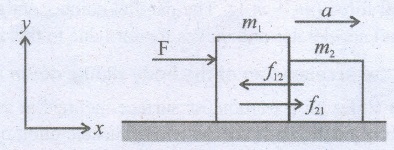
By the application of a horizontal force F, both the blocks are set into motion with acceleration 'a' simultaneously in the direction ofthe force F.
To find the acceleration \(\vec { a } \), Newton's second law has to be applied to the system (combined mass m = m1 + m2)
\(\vec { F } =m\vec { a } \)
If we choose the motion of the two masses along the positive x direction
\(F\hat { i } =ma\hat { i } \)
By comparing components on both sides of the above equation
F = ma where m = m1 + m2
The acceleration of the system is given by
∴ a = \(\frac { F }{ { m }_{ 1 }+{ m }_{ 2 } } \) ..............(1)
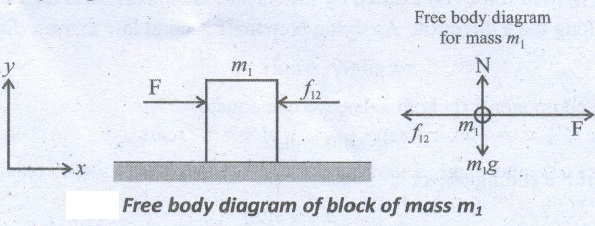
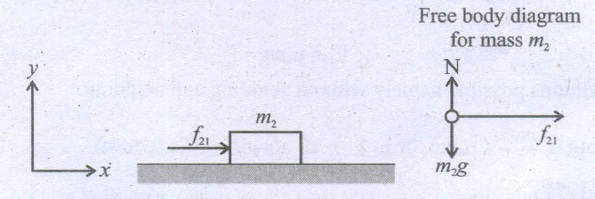
The force exerted by the block m1 on m2 due to its motion is called force of contact (\(\vec { f_{ 21 } } \)). According to Newton's third law, the block m2 will exert an equivalent opposite reaction force (\(\vec { f_{ 12 } } \)) on block m1..Figure shows the free body diagram of block m1.
Figure shows the free body diagram of block m1
∴ \(F\hat { i } ={ \vec { f } }_{ 12 }\hat { i } ={ m }_{ 1 }a\hat { i } \)
By comparing the components on both sides. of the above equation, we get
F-f12 = m1a
f12 = F-m1a .....(2)
Substituting the value of accelera~ion from equation (1) in (2) we get
f12= \(F-{ m }_{ 1 }\left( \frac { F }{ { m }_{ 1 }+{ m }_{ 2 } } \right) \)
f12=\(f\left[ 1-\frac { { m }_{ 1 } }{ { m }_{ 1 }+{ m }_{ 2 } } \right] \)
f12=\(\frac { F{ m }_{ 2 } }{ { m }_{ 1 }+{ m }_{ 2 } } \) ....(3)
Equation (3) shows that the magnitude of contact force depends on mass m: which provides the reaction force. Note that this force is acting along the negative x direction.
In vector notation, the reaction force on mass m1 is given by \(\vec { { fi }_{ 12 } } =\frac { F{ m }_{ 2 } }{ { m }_{ 1 }+{ m }_{ 2 } } \)
For mass m2 there is only one force acting on it in the x direction and it is denoted by f21 This force is exerted by mass m1. The free body diagram for mass m2 is shown in the figure.
Applying Newton's second law for mass m2
\(f_{ 21 }\hat { i } ={ m }_{ 2 }a\hat { i } \)
By comparing the components on, both sides of the above equation
f21 = m2a .....(4)
Substituting for acceleration from equation (1) in equation (4), we get \({ f }_{ 21 }=\frac { F{ m }_{ 2 } }{ { m }_{ 1 }+{ m }_{ 2 } } \)
In this case the magnitude of the contact force is \({ f }_{ 21 }=\frac { F{ m }_{ 2 } }{ { m }_{ 1 }+{ m }_{ 2 } } \).
Free body diagram of block of mass m2
5.
When an object of mass m slides on a frictionless surface inclined at an angle e as shown in the figure, the forces acting on it decides the
(a) acceleration of the object
(b) speed of the object when it reaches the bottom.
The force acting on the object is
(i) Downward gravitational force (mg)
(ii) Normal force perpendicular to inclined surface (N)
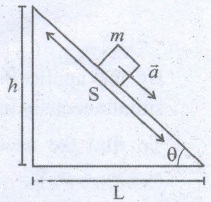
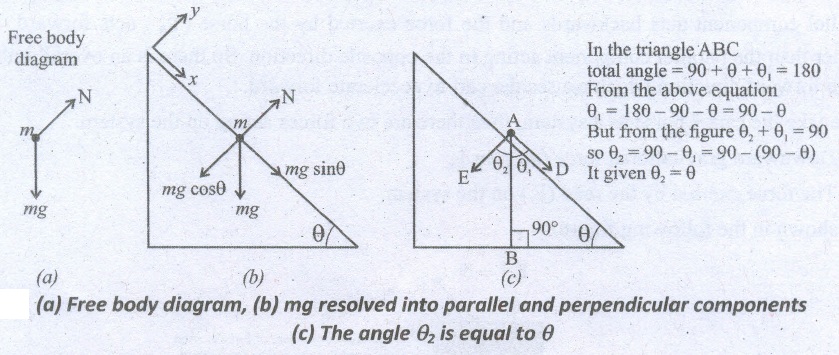
To draw the free body diagram, the block is assumed to be a point mass [in figure (a)]. Since the motion is on the inclined surface, we have to choose the coordinate system parallel to the inclined surface as shown
in the figure (b).
The gravitational force mg is resolved in to parallel component mg sine along the inclined plane and perpendicular component mg coss perpendicular to the inclined surface [figure (b)].
Note that the angle made by the gravitational force (mg) with the perpendicular to the surface is equal to the angle of inclination e' as shown in figure (c).
There is no motion (acceleration) along the y axis. Applying Newton's second law in the y direction
\(-mg\ cos\theta \hat { j } +N\hat { j } \) =0 (No acceleration)
By comparing the components on both sides, N-mg cos ፀ=0
N=mg cosፀ
The magnitude ~fnormal force (N) exerted by the surface is equivalent to mg cosፀ, Tlie object slides (with an acceleration) along the x direction. Applying Newton's second law in the x direction.
\(mg\ sin\theta\ \hat { i } =ma\hat { i } \)
By comparing the components on both sides, we can equate
mg sinፀ = ma
The acceleration of the sliding object is
a = g sinፀ
Note that the acceleration depends on the angle of inclination ፀ.
6.
The gravitational potential energy (U) at some height his, equal to the amount of work required to take the object from the ground to that height h.
\(U=\int{\bar{F}_a.d\bar{r}}=\int_{0}^{h}|\bar{F}_a||d\bar{r}|\cos\ \theta\)
Since the displacement and the applied force are in the same upward direction, the angle between them, \(\theta = 0°.\)Hence, cos°=1 and \(|\bar{F}_a|=mg\) and \(|d\bar{r}|=dr.\)
\(U=mg\int_{0}^{4}dr\Rightarrow mg {[r]}_{0}^{h} =mgh\)
7.
Consider the horse as the 'system', then there are three forces acting on the horse
(i) Downward gravitational force (mhg)
(ii) Force exerted by the road (Fr)
(iii) Backward force exerted by the cart (Fc)
It is shown in the following figure.
Fr - Force exerted by the road on the horse
Fc - force exerted by the cart on the horse
Fr丄 - Perpendicular component of Fr = N
Fr||-Parallel component of F, which is reason for forward movement.
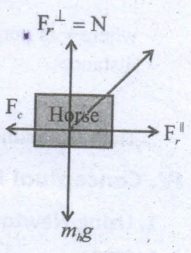
The force exerted by .the road can be resolved into parallel and perpendicular components, The perpendicular component balances the downward gravitational force. There is parallel component along the forward direction. It is greater than the backward force (Fc). So there is net force along the forward direction which causes the forward movement of the horse.
If we take the cart as the system, then there are three forces acting on the cart.
(i) Downward gravitational force (mcg)
(ii) Force exerted by the road (Fr')
(iii) Force exerted by the horse (Fh)
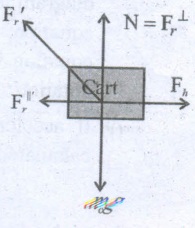
It is shown in the figure
The force exerted by the road (\(\vec { { F }_{ r } } \)) can be resolved into parallel and perpendicular components. The perpendicular component cancels the downward gravity (mcg)
Parallel component acts backwards and the force exerted by the horse (\(\vec { { F }_{ h } } \)) acts forward. Force (\(\vec { { F }_{ h } } \)) is greater than the parallel component acting in the opposite direction. So there is an overall unbalanced force in the forward direction which causes the cart to accelerate forward.
If we take the cart + horse as a system, then there are two forces acting on the system.
(i) Downward gravitational force (mh + mc)g
(ii) The force exerted by the road (Fr) on the system.
It is shown in the following figure.
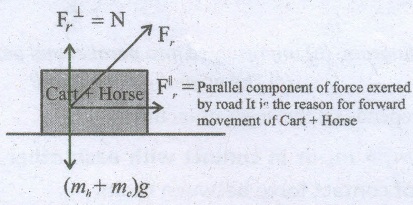
(iii) In this case the force exerted by the road (Fr) on the system (cart + horse) is resolved in to parallel and perpendicular components. The perpendicular component is the normal force which cancels the downward gravitational force (mh +mc)g. The parallel component of the force is not balanced, hence the system (cart + horse) accelerates and moves forward due to this force.
8.
(i) Choose a suitable inertial coordinate system to analyse the problem. For most of the cases we can take Earth as an inertial coordinate system.
(ii) Identify the system to which Newton's laws need to be applied. The system can be a single object or more than one object.
(iii) Draw the free body diagram.
(iv) Once the forces acting on the system are identified, and the free body diagram is drawn, apply Newton's second law. In the left hand side of the equation, write the forces acting on the .system in vector notation and equate it to the right hand side of equation which is the product of mass .and acceleration. Here, acceleration should also be in vector notation.
(v) If acceleration is given, the force can be calculated. If the force is given, acceleration can be calculated.
By following the above steps: We fix the inertial coordinate system on the. ground as shown in the figure.
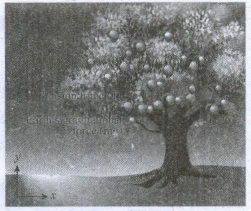
The forces acting on the mango are
(i) Gravitational force exerted by the Earth on the mango acting downward along negative y-axis.
(ii) Tension (in the cord attached to the mango) acts upward along positive y-axis.
The free body diagram for the mango is shown in the figure.
\(\vec { { F }_{ g } } =mg(-\hat { j } )=-mg\hat { j } \)
Here, mg is the magnitude of the gravitational force and \((-\hat { j } )\) represents the unit vector in negative y direction.
\(\vec { T } =T\hat { j } \)
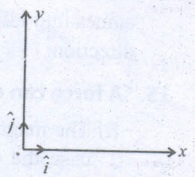
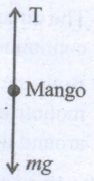

Here T is the magnitude of the tension force and \((-\hat { j } )\) represents the unit vector in positive y direction.
\({ \vec { F } }_{ net }={ \vec { F } }_{ s }+{ \vec { T } }_{ g }=-mg\hat { j } +T\hat { j } =(T-mg)\hat { j } \)
From Newton's second law \({ \vec { F } }_{ net }=m\vec { a } \)
Since the mango is at rest with respect to us (inertial coordinate system) the acceleration is zero (\(\vec { a } =0\))
So \({ \vec { F } }_{ net }=m\vec { a } =0\)
\((T-mg)\hat { j } =0\)
By comparing the components on both sides of the above equation, we get T - mg = 0
So the tension force acting on the mango is given by T - mg
Mass of the mango m = 400g and g = 9.8 ms-2 Tension acting on the mango is T = 0.4\(\times\)9.8 = 3.92 N.
9.
Suppose, they are stretched by same distance x1 and x2 by the same force F.
Then, F = k, x1 = k2 x2
\({W_1 \over W_2}={{{1\over 2}k_1{x}_{1}^{2}}\over{{1 \over 2}k_2{x}_{2}^{2}}}={{k_1.x_1.x_1}\over{k_2.x_2.x_2}}={F.x_1\over F.x_2}\)
\({W_1\over W_2}={x_1 \over x_2}\) ....(1)
k1x1 = k2x2
\({{x_1}\over{x_2}}={k_2\over k_1}\)
Equation (1) becomes, \({W_1 \over W_2}={k_2 \over k_1}\)
since, k1 > k2 W1 > W2
Suppose strings are stretched by same distance.
\({W_1 \over W_2}={{{1\over 2}k_1x^2}\over{{1\over 2}k_2}x^2}={k_1 \over k_2}\)
since k1 > k2 W1 > W2
10.
(i) If the object is at rest and no external force is applied on the object, the static friction acting on the object is zero (fs = 0).
(ii) If the object is at rest, and there is an external force applied parallel to the surface, then the force of static friction acting on the object is exactly equal to the external force applied on the object (fs = Fext). But still the static friction Is is less than μsN.
(iii) When object begins to slide, the static friction (fs) acting on the object attains maximum.
11.
12.
If a force (F) acts on the object in a very short interval of time (M), from Newton's second law in magnitude form
Fdt = dp
Integrating over time from an initial time ti to a final time tf, we get
\(\int _{ i }^{ f }{ dp } =\int _{ { t }_{ i } }^{ { t }_{ f } }{ Fdt } \)
pf-pi = \(\int _{ { t }_{ i } }^{ { t }_{ f } }{ Fdt } \)
pi = initial momentum of the object at time ti
Pt = final momentum of the object at time tf.
pf - pi = Δp change in momentum of the object during the time interval
tf - ti = Δt
The integral \(\int _{ { t }_{ i } }^{ { t }_{ f } }{ Fdt } \)=J is called the impulse and it is equal to change in momentum of the object.
If the force is constant over the time interval, then
\(\int _{ { t }_{ i } }^{ { t }_{ f } }{ F } dt=\int _{ i }^{ f }{ dp } \) = F(tf - ti) = FΔt
FΔt = Δp
13.
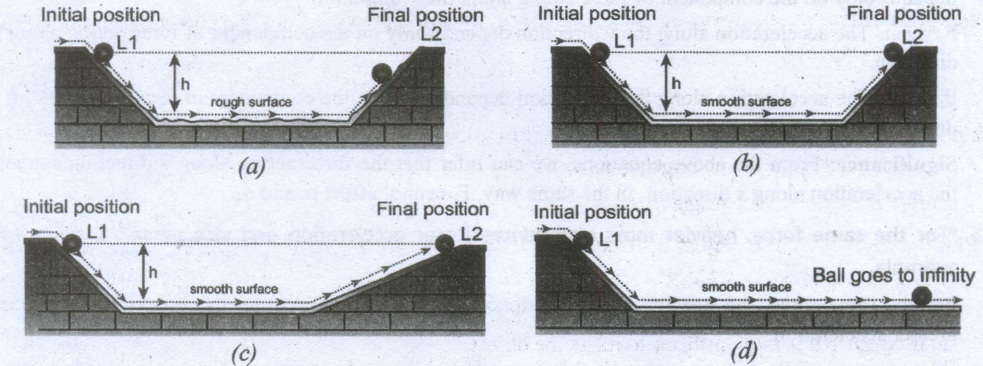
Galileo's experiment with. the second plane (a) at same inclination angle Cisthe first (b) with increased smoothness (c) with reduced angle of inclination (d) with zero angle of inclination
When a ball rolls from the top of an inclined plane to its bottom, after reaching the ground it moves some distance and continues to move on to another inclined plane of same angle of inclination as shown in the Figure (a). By increasing the smoothness of both the inclined planes, the ball reach almost the same height (h) from where it was released (L1) in the second plane (L2) [figure (b)]. The motion of the ball is then observed by varying the angle of inclination of the second plane keeping the same smoothness. If the angle of inclination is reduced, the ball travels longer distance in the second plane to reach the same height [figure (c)). When the angle of inclination is made zero, the ball moves forever in the horizontal direction [figure (d)]. If the Aristotelian idea were true, the ball would not have moved in the second plane even if its smoothness is made maximum since no force acted on it in the horizontal direction.
14.
Force, F = 1000 N
Displacement, s = 200 m
Angle e = 60°
Workdone =?
Workdone W = Fs cos ,
= 1000\(\times\)200\(\times\)cos 60°
= 1000\(\times\)200\(\times\)\(\frac{1}{2}\)
=1\(\times\)105 J = 1\(\times\)102 kJ
15.
Mass of a body(m) =\(\frac{500}{1000}\)kg = 0.5 kg
Horizontal Force (F) = 1N
Time(t) = 20s.
Therefore, acceleration of a body.
a = F/m =\(\frac{1}{0.5}=2ms^{-2}\)
Distance travelled s = ut+\(\frac{1}{2}+at^{2}\)
S =0 x 20 +\(\frac{1}{2}\times2\times(20)^{2}\)
= 0+\(\frac{1}{2}\times400\times2\)
Displacement s1= 400 m
Workdone = F\(\times\)s = 1\(\times\)400
\(\boxed{=400}\) J; v = u+at = 0+2\(\times\)20
v = 40
Change in k.E =\(\frac{1}{2}m(v^{2}-u^{2})\)
=\(\frac{1}{2}\times0.5\times(40^{2}-0)\)
=\(=\frac{1}{2}\times 0.5\times 1600\)
\(\boxed{=400\ J}\)
16.
Mass of a body(m) =\(\frac{600}{1000}\)kg=0.6 kg
Velocity (v) = ax \(\frac{3}{2}\) where a = 3m-1/4s-1
We know that work done by net force acting on a body is equal to its change in k.E. If velocity of body corresponding to x = D and x = 3m be u and v respectively than
Workdone W= \(\frac{1}{2}mv^{2}-\frac{1}{2}mv^{2}=\frac{1}{2}m(v^{2}-u^{2})\)
Initial velocityu = a.(0)3/2= 0 and v = a.(3)3/4
\(W=\frac { 1 }{ 2 } \times 0.6\left[ \left\{ a{ (3) }^{ \frac { 3 }{ 2 } } \right\} ^{ 2 }-0 \right] \)
=\(\frac{1}{2}\times0.6\times a^{2}\times 3^{\frac{3}{2}}\)
=\(\frac{1}{2}\times 0.6\times 3^{2}\times (3)^{3}\)
Workdone W = \(\frac{1}{2}\times 0.6 \times 9 \times 27 = 73J\)
17.
displacement \(\vec { S } =(\overset { \wedge }{ i } +2\overset { \wedge }{ j } +6\overset { \wedge }{ k } )\)m
Applied force \(\vec { F } =(2\overset { \wedge }{ i } +3\overset { \wedge }{ j } +\overset { \wedge }{ 5k } )\)N
Angle (9) = 60°
Work done in moving a particle,
\(W=\vec(F).\vec{S}cos 60^{o}\)
=\((2\overset { \wedge }{ i } +3\overset { \wedge }{ j } +\overset { \wedge }{ 5k } )\).\((\overset { \wedge }{ i } +2\overset { \wedge }{ j } +6\overset { \wedge }{ k } )\) cos 60o
=\((\overset { \wedge }{ i } .\overset { \wedge }{ j }. \overset { \wedge }{ k } )(2+6+30)cos 60^{o}\)
W=38\(\times cos 60^{o}\)
=\(38\times\frac{1}{2}=19J \) \([\because cos60^{o}=\frac{1}{2}]\)
Workdone W = 191.
18.
The work done in moving particle.
\(W=\vec{F}.\vec{s}\)
\(\vec { F } =(2\overset { \wedge }{ i } -3\overset { \wedge }{ j } +4\overset { \wedge }{ k } )\)
\(\vec { s } =(\overset { \wedge }{ i } -2\overset { \wedge }{ j } +3\overset { \wedge }{ k } )\)
Work done \(W=\vec{F}.\vec{s}\)
=\((2\overset { \wedge }{ i } -3\overset { \wedge }{ j } +4\overset { \wedge }{ k } ).(\overset { \wedge }{ i } -2\overset { \wedge }{ j } +3\overset { \wedge }{ k } )\)
=\((2\overset { \wedge }{ i } +6\overset { \wedge }{ j } +12\overset { \wedge }{ k } )\)
=\((\overset { \wedge }{ i } .\overset { \wedge }{ j } .\overset { \wedge }{ k } ).(2+6+12)\)
=1.(2+6+12)
Work done(W) = (20)J.
19.
Mass of the bullet (m) = 25 g
Initial velocity (m) = 400 ms-1
Final velocity (v) = 300 ms-1
Work done (w) =?
From work-energy theorem,
Work done = loss in kinetic energy,
\(W=\frac{1}{2}m(u^{2}-v^{2})\)
=\(\frac{1}{2}\times\frac{25}{100}kg\times(400^{2}-300^{2})\)
=\(\frac{1}{2}\times0.025\times(16\times10^{4}-9\times10^{4})\)
=\(\frac{1}{2}\times0.025\times(7\times10^{4})\)
= 0.0125\(\times(7\times10^{4})\)
Work done (W) = 875J
20.
Here the motion is not accelerated the resultant force parallel to the plane must be zero.
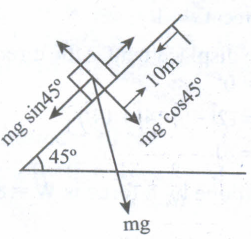
So,
F = Mg sin 45° = O.
Force, F = Mg sin 45°;
distance d = 10m
the workdone
W = Fd cos,
= (Mg sin 45°)d cos0° [ ∵ θ = 0° so, cos 0° = 1]
= 20\(\times\)10\(\times\)sin 45°\(\times\)10\(\times\)cos 0°
= 20\(\times\)10\(\times\)\(\frac{1}{\sqrt{2}}\)x 10\(\times\)1
= 1414J
Workdone W = 1414J
21.
\(\vec { { r }_{ 1 } } =(2\overset { \wedge }{ i } +\overset { \wedge }{ j } -\overset { \wedge }{ 3k } )\)
\(\vec { { r }_{ 2 } } =(4\overset { \wedge }{ i } +6\overset { \wedge }{ j } -7\overset { \wedge }{ k } )\)
The position vectors \(\vec{r}=\vec{r_2}-\vec{r_1}\)
=\(\left( 4\overset { \wedge }{ i } +\overset { \wedge }{ 6 } j-\overset { \wedge }{ 7k } \right) -\left( \overset { \wedge }{ 2i } +\overset { \wedge }{ j } -\overset { \wedge }{ 3k } \right) \)
\(=\overset { \wedge }{ 4i } +\overset { \wedge }{ 6j } -\overset { \wedge }{ 7k } -\overset { \wedge }{ 2i } -\overset { \wedge }{ j } +\overset { \wedge }{ 3k } \)
\(=\overset { \wedge }{ i } (4-2)+\overset { \wedge }{ j } (6-1)+\overset { \wedge }{ k } (-7+3)\)
\(=\overset { \wedge }{ i } (2)+\overset { \wedge }{ j } (5)+\overset { \wedge }{ k } (-4)\)
\(\vec { r } =\vec { { r }_{ 2 } } -\vec { { r }_{ 1 } } =2\overset { \wedge }{ i } +5\overset { \wedge }{ j } -\overset { \wedge }{ 4k } \)
The effect of force = \(\vec { F } =(3\overset { \wedge }{ i } +2\overset { \wedge }{ j } +\overset { \wedge }{ 4k } )N\)
Workdone W = \(\vec{F}.\vec{x}\)
\(=(3\overset { \wedge }{ i } +2\overset { \wedge }{ j } +\overset { \wedge }{ 4k } ).(2\overset { \wedge }{ i } +5\overset { \wedge }{ j } -\overset { \wedge }{ 4k } )\)
\(=\overset { \wedge }{ i } .\overset { \wedge }{ j } .\overset { \wedge }{ k } (6+10-16)\)
= 1(0)
Work done = 0.
22.
Applied force = 10 N
Opposing friction forcej= Mk. N = Mk·mg.
= 0.3\(\times\)3\(\times\)9.8 = 8.82 N.
Net accelerating forceF - f = 10N - 8.82N
=1.18N
Acceleration a =\(\frac{force}{mass}\)=\(\frac{8.82N}{3Kg}=2.94 ms^{-2}\)
Distance covered in 10s (assuming w = 0)
\(s=0+\frac{1}{2}at^{2}=\frac{1}{2}\times2.94\times(10^{2}) = 147 m\)
there force workdone by a applied force,
W = Fs = 10\(\times\)147
W = 1470 J
23.
(i) For a constant force, the impulse is denoted as \(j=F\triangle t\) and it is also equal to change in momentum \((\triangle p)\) of the object over the time interval \(\triangle t\)
Impulse is a vector quantity and its unit is Ns.
(ii) The average force acted on the object over the short interval of time is defined by
\({ F }_{ avg }=\frac { \triangle p }{ \triangle t } \) ..........(1)
(iii) From equation (1), the average force that act on the object is greater if t is smaller. Whenever the momentum of the body changes very quickly, the average force becomes larger.
(iv) The impulse can also be written in terms of the average force. Since \(\triangle\) p is change in momentum of the object and is equal to impulse (J), we have
\(j={ F }_{ avg }\triangle t\) .........(2)
(v) The graphical representation of constant force impulse and variable force impulse is given in Figure.
.png)
.png)
24.
Work-Kinetic Energy Theorem
Work and energy are equivalents. This is true in the case of kinetic energy also. To prove this, let us consider a body of mass m at rest on a frictionless horizontal surface.
The work (W) done by the constant force (F) for a displacement (s) in the same direction is,
W = Fs
The constant force is given by the equation,
F = ma
The third equation of motion can be written as,
\(v^{2} =u^{2}+2 a s \)
\(a =\frac{v^{2}-u^{2}}{2 s}\)
Substituting for a in equation (2),
\(F=m\left(\frac{v^{2}-u^{2}}{2 s}\right)\)
Substituting equation (2), (1)
\(w=m\left(\frac{v^{2}}{2 s} s\right)-m\left(\frac{u^{2}}{2 s} s\right) \)
\(w=\frac{1}{2} m v^{2}-\frac{1}{2} m u^{2}\)
The expression for kinetic energy:
The term \(\left(\frac{1}{2} m v^{2}\right)\) in the above equation is the kinetic energy of the body of mass (m) moving with velocity(v).
\(K E=\frac{1}{2} m v^{2}\)
Kinetic energy of the body is always positive. From equations (4) and (5)
\(\Delta K E =\frac{1}{2} m v^{2}-\frac{1}{2} m u^{2} \)
\(\text {Thus, } W =\Delta K E\)
The expression on the right hand side (RHS) of equation (6) is the change in kinetic energy (\(\Delta\)KE) of the body.
This implies that the work done by the force on the body changes the kinetic energy of the body, This is called work-kinetic energy theorem.
The work-kinetic energy theorem implies the following.
1. If the work done by the force on the body is positive then its kinetic energy increases.
2. If the work done by the force on the body is negative then its kinetic energy decreases.
3. If there is no work done by the force on the body then there is no change in its kinetic energy, which means that the body has moved at constant speed provided its mass remains constant.
25.
(i) Consider the case of a whirling motion of a stone tied to a string. Assume that the stone has angular velocity ω in the inertial frame (at rest).
(ii) If the motion of the stone is observed from a frame which is also rotating along with the stone with same angular velocity ω then, the stone appears to be at rest.
(iii) This implies that in addition to the inward centripetal force - mω2r there must be an equal and opposite force that acts on the stone outward with value + mω2r.
(iv) So the total force acting on the stone in a rotating frame is equal to zero (-mω2r + mω2r=0).
(v) This outward force + mω2r is called the centrifugal force.
26.
The force which always opposes the relative motion between an object and the surface where it is placed is called frictional force. Frictional force always acts on the object parallel to the surface on which the object is placed. During the time of Newton and Galileo, frictional force was considered as one of the natural forces like gravitational force. But now it is understood that frictional force is the electromagnetic force between the atoms on the two surfaces. Because of this even a well polished surfaces have frictional force. Frictional force is independent of surface area but depends on the normal force acting on it.
Angle of friction:
The angle of friction is defined as the angle between the normal force (N) and the resultant force (R) of normal force and maximum friction force (fsmax). from the figure, tan ፀ \(=\frac{f_s^{max}}{N}\)
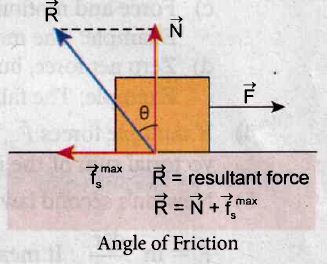
But fsmax = μs N where us is the coefficient of static friction.
∴ μs = tan ፀ
To show that angle of friction is equal to angle of repose
.JPG)
27.
After collision, along x-axis
\(m_{1} u_{1}=m_{1} v_{1} \cos \theta_{1}+m_{2} v_{2} \cos \theta_{2} \)
Along Y-axis
\(0 =m_{1} v_{1} \sin \theta_{1}-m_{2} v_{2} \sin \theta_{2} \)
\(m_{1} v_{1} \sin \theta_{1} =m_{2} v_{2} \sin \theta_{2} \)
\(m_{1} =m_{2} \)
\(\therefore v \sin \theta =\frac{v}{2} \sin 90^{\circ} \)
\(\sin \theta =\frac{1}{2} \times 1=\frac{1}{2} \)
\(\therefore \theta =\sin ^{-1}(0.5)=30^{\circ}\)
28.
Radius (r) of moon orbit from the centre of earth
\(r =(384,000 \mathrm{~km}) \times \frac{1000 \mathrm{~m}}{1 \mathrm{~km}} \)
= 384,000,000 m
Time Period (T) = (27 days ) \(\times \frac{24 \text { hours }}{1 \text { day }} \times \frac{60 \mathrm{~min}}{1 \mathrm{hr}} \times \frac{60 \mathrm{sec}}{1 \mathrm{~min}}\)
= 2,332,800 sec
\(velocity (v)=\frac{\text { circumference }}{\text { Time period }}=\frac{2 \pi \mathrm{r}}{\mathrm{T}}\)
\(=\frac{2 \pi \times 384,000,000 m}{2,332,800 \mathrm{~s}}=329 \pi \mathrm{m} / \mathrm{s}\)
Centripetal acceleration \(\left(a_{\perp}\right)=\frac{v^{2}}{r}=\frac{(329 \pi \mathrm{m} / \mathrm{s})^{2}}{384,000,000 \mathrm{~m}}\)
\(a_{\perp}=2.78 \times 10^{-3} \mathrm{~m} / \mathrm{s}^{2}\)
Tension due to Centripetal force
\(F_{c} =T=m a_{\perp}=7.34 \times 10^{22} \mathrm{~kg} \times 2.78 \times 10^{-3} \mathrm{~m} / \mathrm{s}^{2} \)
\(\mathrm{~T} =2.04052 \times 10^{20} N\)
29.
Force acting vertically to sling shot
Tension T in each string;
Now applying Lami's theorem, we get
\(\frac{2 T}{\sin \theta} =F
\)
\(\frac{2 T}{\sin (2 \times 30)} =50 N
\)
\(\frac{2 T}{\sin (60)} =50 N
\)
\(\frac{2 T}{\sqrt{3}} =50 N
\)
\(\frac{T}{2 T} =\frac{2}{\sqrt{3}} \times 50 N
\)
\(T=\frac{50 N}{\sqrt{3}}=28.268 N\)
30.
For the system to be in equilibrium for block of mass M1 frictionless Tension in the string T
T = μs (M3 + M1)g
For the equilibrium of block of mass M2
T = M2g .....(2)
(1) = (2)
μs (M3 + M1)g = M2g
M3 =\(\frac { { m }_{ 2 } }{ { \mu }_{ 2 } } -{ m }_{ 1 }\)
31.
\(F_{1 x} =F_{1} \cos (30)
\)
\(=50 \times \frac{\sqrt{3}}{2}
\)
\(m =20 \mathrm{~kg}
\)
\(\frac{F_{1 x}}{m} =a_{x} \Rightarrow a_{x}=\frac{25 \times \sqrt{3}}{20}=2.165 \mathrm{~ms}^{-1}
\)
\(F_{1 y} =F_{1} \sin (30)=50 \times \frac{1}{2}=25
\)
\(\frac{F_{1 y}}{m} =a_{y} \Rightarrow a_{y}=\frac{25}{20}=1.25 \mathrm{~ms}^{-1}\)
32.
Since the gravitational force is conservative; the total energy is conserved throughout the motion.
| Initial | Final | |
|---|---|---|
| Kinetic energy | \(\frac { 1 }{ 2 } { mv }_{ 0 }^{ 2 }\) | \(\frac { 1 }{ 2 } { mv }^{ 2 }\) |
| Potential energy | 0 | mgh |
| Total energy | \(\frac { 1 }{ 2 } { mv }_{ 0 }^{ 2 }+0=\frac { 1 }{ 2 } { mv }_{ 0 }^{ 2 }\) | \(\frac { 1 }{ 2 } { mv }^{ 2 }+mgh\) |
Final values of potential energy, kinetic energy and total energy are measured at the height h.
By law of conservation of energy, the initial and final total energies are the same.
\(\frac { 1 }{ 2 } { mv }_{ 0 }^{ 2 }=\frac { 1 }{ 2 } { mv }^{ 2 }+mgh\)
\({ v }_{ 0 }^{ 2 }={ v }^{ 2 }+2gh\)
\(v=\sqrt { { v }_{ 0 }^{ 2 }-2gh } \)
33.
(a) The gravitational force is a conservative force. So the total energy remains constant throughout the motion. At h = 10 m, the total energy E is entirely potential energy.
E = U = mgh = 1 × 10 × 10 = 100 J
(b) The potential energy of the object at h = 4 m is
U = -mgh = 1 \(\times\) 10 \(\times\) 4 = 40 J
(c) Since the total energy is constant throughout the motion, the kinetic energy at h = 4m must be KE = E - U = 100 - 40 = 60 J.
Alternatively, the kinetic energy could also be found from velocity of the object at 4 m. At the height 4 m, the object has fallen through a height of 6 m.
The velocity after falling 6 m is calculated from the equation of motion,
\(v=\sqrt { 2gh } =\sqrt { 2\times 10\times 6 } =\sqrt { 120 } \) ms-1
v2 = 120
The kinetic energy is KE = \(\frac { 1 }{ 2 } { mv }^{ 2 }=\frac { 1 }{ 2 } \times 1\times 120=60J\)
(d) When the object is just about to hit the ground, the total energy is completely kinetic and the potential energy, U = 0.
\(E=KE=\frac { 1 }{ 2 } { mv }^{ 2 }=100\quad J\)
\(v=\sqrt { \frac { 2 }{ m } KE } =\sqrt { \frac { 2 }{ 1 } \times 100 } =\sqrt { 200 } =14.12\) ms-1
34.
The spring constant, k = 0.1 N m-1
The displacement, x = 25 cm = 0.25 m
(a) The potential energy stored in the spring is given by
\(U=\frac { 1 }{ 2 } { kx }^{ 2 }=\frac { 1 }{ 2 } \times 0.1\times { (0.25) }^{ 2 }=0.0031J\)
(b) The work done Ws by the spring force \(\bar { F } \) is given by,
\({ W }_{ s }=\int _{ 0 }^{ x }{ \overrightarrow { { F }_{ s } } .\overrightarrow { dr } } =\int _{ 0 }^{ x }{ (-k\ x\hat { i } ).(dx\hat { i } ) } \)
The spring force \(\overrightarrow { { F }_{ s } } \) acts in the negative x direction while elongation acts in the positive x direction.
\({ W }_{ s }=\int _{ 0 }^{ x }{ (-kx)dx=-\frac { 1 }{ 2 } { kx }^{ 2 } } \)
\({ W }_{ s }=-\frac { 1 }{ 2 } \times 0.1\times { (0.25) }^{ 2 }=-0.0031\ J\)
Note that the potential energy is defined through the work done by the external agency. The positive sign in the potential energy implies that the energy is transferred from the agency to the object. But the work done by the restoring force in this case is negative since restoring force is in the opposite direction to the displacement direction.
(c) During compression also the potential energy stored in the object is the same.
\(U=\frac { 1 }{ 2 } { kx }^{ 2 }=0.0031\ J\)
Work done by the restoring spring force during compression is given by
\({ W }_{ s }=\int _{ 0 }^{ x }{ { \overrightarrow { F } }_{ s } } \overrightarrow { dr } =\int _{ 0 }^{ x }{ (kx\hat { i } ).(-dx\hat { i } ) } \)
In the case of compression, the restoring spring force acts towards positive x-axis and displacement is along negative x direction.
\({ W }_{ s }=\int _{ 0 }^{ x }{ (-kx)dx=-\frac { 1 }{ 2 } { kx }^{ 2 } } =-0.0031J\)
35.
When the object goes up, the displacement points in the upward direction whereas the gravitational force acting on the object points in downward direction. Therefore, the angle between gravitational force and displacement of the object is 180°.
(a) The work done by gravitational force in the upward motion.
Given that dr = 5m and F = mg
Wup = Fdr cosθ = mgdr cos 180°
Wup = 2\(\times\)10\(\times\)5\(\times\) (-1) = -100 joule
[cos 180° = -1]
(b) When the object falls back, both the gravitational force and displacement of the object are in the same direction. This implies that the angle between gravitational force an displacement of the object is 0°.
Wdown = Fdr cos 0°
Wdown = 2\(\times\)10\(\times\)5\(\times\)(1) = 100 joule
[cos 0° = -1]
(c) The total work done by gravity in the entire trip (upward and downward motion)
Wtotal,= Wup +Wdown
= -100 joule + 100 joule = 0
36.
Mass of a bob = m
Length of the rod = r
From the law of conservation of energy,
\(\frac{1}{2} m v_{1}^{2} =2 m g r+\frac{1}{2} m v_{2}^{2}
\)
\(\therefore \frac{1}{2} m\left(v_{1}^{2}-v_{2}^{2}\right) =2 m g r
\)
\(\therefore v_{1}^{2}-v_{2}^{2} =4 g r
\)
\(\text { If } v_{2} =0 \text { then }
\)
\(v_{1}^{2} =4 g r
\)
\(\therefore v_{1} =\sqrt{4 g r} m s^{-1}\)
37.
\(\text {Centrifugal force experience by person } =\frac{m v^{2}}{r}=\frac{60 \mathrm{~kg} \times(50 \mathrm{~m} / \mathrm{s})^{2}}{10 \mathrm{~m}} \)
\(=\frac{60 \times 2500}{10} \mathrm{~N} \)
\(=15000 \mathrm{~N}\)
38.
\(F-T =m_{1} a \ \& \ T=m_{2} a
\)
\(a =\frac{F}{m_{1}+m_{2}} \ \& \ T=\frac{m_{2} F}{m_{1}+m_{2}}
\)
\(T =\frac{10 k g \times 500 N}{(10 k g+15 k g)}
\)
\(T =\frac{5000}{25} N
\)
\(T =200 \mathrm{~N}\)
39.
Relation between power and velocity
The work done by a force \(\overrightarrow{\mathbf{F}}\) for a displacement \(d \vec{r}\) is
\(W=\int \overrightarrow{\mathrm{F}} \cdot d \vec{r}\) ......(1)
Left hand side of the equation (1) can be written as
\(W=\int d W=\int \frac{d W}{d t} d t\)
(multiplied and divided by dt) (2)
Since, velocity is \(\vec{v}=\frac{d \vec{r}}{d t} ; \overrightarrow{d r}=\vec{v} d t.\) Right hand side of the equation (1) can be written as
\(\int \overrightarrow{\mathrm{F}} \cdot d \vec{r}=\int\left(\overrightarrow{\mathrm{F}}, \frac{d \vec{r}}{d t}\right) d t=\int(\overrightarrow{\mathrm{F}} \cdot \vec{v}) d t\left[v=\frac{d \vec{r}}{d t}\right] \ldots \ldots\) (3)
Substituting equation (2) and equation (3) in equation (1), we get
\(\int \frac{d W}{d t} d t=\int(\overrightarrow{\mathrm{F}} \cdot \vec{v}) d t\)
Or
\(\int\left(\frac{d W}{d t}-\overrightarrow{\mathrm{F}} \cdot \vec{v}\right) d t=0\)
This relation is true for any arbitrary value of dt. This implies that the term within the bracket must be equal to zero, i.e.,
\(\frac{d W}{d t}-\overrightarrow{\mathrm{F}} \cdot \vec{v} =0 \)
\(\frac{d W}{d t} =\overrightarrow{\mathbf{F}} \vec{v}\)
Examples: Motors, Engines and Automobiles
A vehicle of mass 1250 kg is driven with an acceleration 0.2 ms-2 along a straight level road against an external resistive force 500 N. Calculate the power delivered by the vehicle's engine if the velocity of the vehicle is 30 ms-1.
Solution
The vehicle's engine has to do work against resistive force and make vehicle to move with an acceleration. Therefore, power delivered by the vehicle engine is
\(P =(\text { resistive force }+\text { mass } \times \text { acceleration }) \text { (velocity) } \)
\(P =\overrightarrow{\mathbf{F}}_{-\mathrm{ma}} \vec{v}=\left(F_{\text {reistie }}+F\right) \vec{v} \)
\(P =\overrightarrow{\mathbf{F}}_{\text {tot }} \vec{v}=\left(F_{\text {reithie }}+m a\right) \vec{v} \)
\(=500 \mathrm{~N}+\left((1250 \mathrm{~kg}) \times\left(0.2 \mathrm{~ms}^{-2}\right)\right)\left(30 \mathrm{~ms}^{-1}\right)=22.5 \mathrm{kw}\)
40.
(i) Tangential acceleration = g sin ፀ
(ii) mg cos ፀ acts along OP (outwards)
(iii) tension (T) acts along PO (inwards)
Net force on the body at P acting along
PO = T- mg cos ፀ
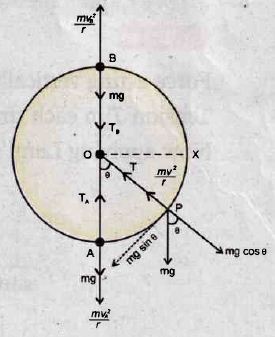
This must provide the necessary centripetal force. \(\frac{mv^2}{r}\)
\(\therefore T -mg \ cos \ \theta=\frac{mv^2}{r} \)
Centripetal acceleration (a⊥) = \(\frac { T-mg \ cos\theta }{ m } \)

11th Standard Syllabus & Materials
11th Standard
TN 11th Tamil பீடு பெற நில் - செய்யுள் - காவடிச்சிந்து Important Questions And Answers Study Material - QB365 Set A
NEW11th Standard
TN 11th Tamil பீடு பெற நில் - உரைநடை - மலை இடப்பெயர்கள் : ஓர் ஆய்வு Important Questions And Answers Study Material - QB365 Set A
NEW11th Standard
TN 11th Tamil மாமழை போற்றுதும் - துணைப்பாடம் - யானை டாக்டர் Important Questions And Answers Study Material - QB365 Set A
NEW11th Standard
TN 11th Tamil மாமழை போற்றுதும் - செய்யுள் - ஐங்குறுநூறு Important Questions And Answers Study Material - QB365 Set A



Tamilnadu Stateboard 11th Standard Subjects

Maths

Commerce

Economics

Biology

Business Maths and Statistics

Accountancy

Computer Science
Physics

Chemistry
Maths
Biology
Economics
Physics
Chemistry

History
Business Maths and Statistics

Computer Science
Accountancy

Computer Applications
History
Computer Technology
Commerce
Computer Applications
Computer Technology

Tamil

English

French
Tamilnadu Stateboard Standards

