
 100% FREE ACCESS
11th Standard Syllabus & Materials
11th Standard
TN 11th Tamil இயற்கை வேளாண்மை,சுற்றுச்சூழல் -செய்யுள் - மனோன்மணீயம் Important Questions And Answers Study Material - QB365 Set A
NEW11th Standard
TN 11th Tamil என்னுயிர் என்பேன் -துணைப்பாடம் - இசைத்தமிழர் இருவர் Important Questions And Answers Study Material - QB365 Set A
NEW11th Standard
TN 11th Tamil மொழி கலை -செய்யுள் - ஒவ்வொரு புல்லையும் Important Questions And Answers Study Material - QB365 Set A
NEW11th Standard
TN 11th Tamil பீடு பெற நில் - இலக்கணம் - பகுபத உறுப்புகள் Important Questions And Answers Study Material - QB365 Set A
NEW11th Standard
TN 11th Tamil பீடு பெற நில் - துணைப்பாடம் - வாடிவாசல் Important Questions And Answers Study Material - QB365 Set A
NEW11th Standard
TN 11th Tamil பீடு பெற நில் - செய்யுள் - குறுந்தொகை Important Questions And Answers Study Material - QB365 Set A

Published on: 07/06/2021
QB365 provides detailed and simple solution for every Book back Questions in class 11 Physics Subject. It will helps to get more idea about question pattern in every book back questions with solution.
Download Tamil Nadu 11th Standard Physics question papers, model tests, one-mark questions, important questions, and public exam papers in PDF format. Free study materials and answer keys for TN State Board students.
Questions + Answers key
Take MCQ Physics Test1.
Consider two springs with force constants 1 N m−1 and 2 N m−1 connected in parallel. Calculate the effective spring constant (kp) and comment on kp.
2.
500 g of water is heated from 30°C to 60°C. Ignoring the slight expansion of water, calculate the change in internal energy of the water? (specific heat of water 4184 J/kg.K)
3.
If excess pressure is balanced by a column of oil (with specific gravity 0.8) 4 mm high, where R = 2.0 cm, find the surface tension of the soap bubble.
4.
Two vectors \(\vec A\) and \(\vec B\) of magnitude 5 units and 7 units make an angle 60° with each other. Find the magnitude of the difference vector \(\vec A\) - \(\vec B\) and its direction with respect to the vector \(\vec A\).
5.
What is the difference between sliding and slipping?
6.
Show that impulse is the change of momentum.
7.
A student was asked a question ‘why are there summer and winter for us? He replied as since Earth is orbiting in an elliptical orbit, when the Earth is very far away from the Sun(aphelion) there will be winter, when the Earth is nearer to the Sun(perihelion) there will be winter. Is this answer correct? If not, what is the correct explanation for the occurrence of summer and winter?
8.
A body of mass m is attached to the spring which is elongated to 25 cm by an applied force from its equilibrium position.
(a) Calculate the potential energy stored in the spring-mass system?
(b) What is the work done by the spring force in this elongation?
(c) Suppose the spring is compressed to the same 25 cm, calculate the potential energy stored and also the work done by the spring force during compression. (The spring constant, k= 0.1 N m-1).
9.
Find the dimensions of a and b in the formula \(\left[ P+{{a\over V^2}} \right][V-b]=RT\) where P is pressure and V is the volume of the gas
10.
Explain in detail the Maxwell Boltzmann distribution function.
1.
k1 = 1 N m−1, k2 = 2 N m−1
kp = k1 + k2 N m−1
kp = 1 + 2 = 3 N m−1
kp > k1 and kp > k2
Therefore, the effective spring constant is greater than both k1 and k2.
2.
When the water is heated from 30°C to 60°C, there is only a slight change in its volume. So we can treat this process as isochoric. In an isochoric process the work done by the system is zero. The given heat supplied is used to increase only the internal energy.
ΔU = Q = msv ΔT
The mass of water = 500 g = 0.5 kg
The change in temperature = 30K
The heat Q = 0.5\(\times\)4184\(\times\)30 = 62.76 kJ
3.
The excess of pressure inside the soap bubble is
\(\Delta P={ P }_{ 2 }-{ P }_{ 1 }=\frac { 4T }{ R } \)
But \(\Delta P={ P }_{ 2 }-{ P }_{ 1 }=\rho gh\Rightarrow \rho gh=\frac { 4T }{ R } \)
\(\Rightarrow\) Surface tension,
\(T=\frac { \rho ghR }{ 4 } =\frac { (800)(9.8)(4\times { 10 }^{ -3 })\left( 2\times { 10 }^{ -2 } \right) }{ 4 } \)=T= 15.68\(\times\)10-2 N m-1
4.
Using the equation,
\(|\vec A-\vec B|=\sqrt{5^2+7^2-2\times 5\times 7\cos60^o}=\sqrt{25+49-35}=\sqrt{39}\) units
The angle that \(\vec A-\vec B\) makes with the vector \(\vec A\) is given by
\(\tan\alpha_2=\frac{7\sin60^o}{5-7\cos60^o}=\frac{7\sqrt{3}}{10-7}=\frac{7}{\sqrt{3}}\)= 4.041
\(\alpha_2=tan^{-1}(4.041)=76^o\)
5.
| S.No | Sliding | Slipping |
| 1. | In sliding the transitional motion is more than rotational motion. |
In slipping the rotation is more than |
| 2. | It happens when sudden brake is applied in a moving vehicles or when the vehicle enters into a slippery road. |
It happens when we suddenly start the vehicle from rest or the vehicle is stuck in mud. |
6.
Impulse: When a large force works on a body for very small time interval, it is called impulsive force. An impulsive force does not remain constant, but changes first from zero to maximum and then from maximum to zero. In such case we measure the total effect of force.
\(\vec{F} =\frac{d \vec{p}}{d t} \text { or }
\)
\(\int_{t_{1}}^{t_{2}} \vec{F} d t =\int_{p_{1}}^{p_{2}} d \vec{p} \Rightarrow \vec{I}=\overrightarrow{p_{2}}-\overrightarrow{p_{1}}=\overrightarrow{\Delta p}\)
\(\therefore\) the impulse of a force is equal to the change in momentum. This statement is known as Impulse momentum theorem. If no external force acts on a system (called isolated) of constant mass, the total momentum of the system remains constant with time. According to this law for a system of particles \(\vec{F}=0 \ then \ \vec{p}=\) constant.
Examples: Hitting, kicking, catching, jumping, diving, collision etc.
7.
The answer is wrong.
Actually, the seasons in the Earth arise due to the rotation of Earth around the sun with 23.5o tilt.
8.
The spring constant, k = 0.1 N m-1
The displacement, x = 25 cm = 0.25 m
(a) The potential energy stored in the spring is given by
\(U=\frac { 1 }{ 2 } { kx }^{ 2 }=\frac { 1 }{ 2 } \times 0.1\times { (0.25) }^{ 2 }=0.0031J\)
(b) The work done Ws by the spring force \(\bar { F } \) is given by,
\({ W }_{ s }=\int _{ 0 }^{ x }{ \overrightarrow { { F }_{ s } } .\overrightarrow { dr } } =\int _{ 0 }^{ x }{ (-k\ x\hat { i } ).(dx\hat { i } ) } \)
The spring force \(\overrightarrow { { F }_{ s } } \) acts in the negative x direction while elongation acts in the positive x direction.
\({ W }_{ s }=\int _{ 0 }^{ x }{ (-kx)dx=-\frac { 1 }{ 2 } { kx }^{ 2 } } \)
\({ W }_{ s }=-\frac { 1 }{ 2 } \times 0.1\times { (0.25) }^{ 2 }=-0.0031\ J\)
Note that the potential energy is defined through the work done by the external agency. The positive sign in the potential energy implies that the energy is transferred from the agency to the object. But the work done by the restoring force in this case is negative since restoring force is in the opposite direction to the displacement direction.
(c) During compression also the potential energy stored in the object is the same.
\(U=\frac { 1 }{ 2 } { kx }^{ 2 }=0.0031\ J\)
Work done by the restoring spring force during compression is given by
\({ W }_{ s }=\int _{ 0 }^{ x }{ { \overrightarrow { F } }_{ s } } \overrightarrow { dr } =\int _{ 0 }^{ x }{ (kx\hat { i } ).(-dx\hat { i } ) } \)
In the case of compression, the restoring spring force acts towards positive x-axis and displacement is along negative x direction.
\({ W }_{ s }=\int _{ 0 }^{ x }{ (-kx)dx=-\frac { 1 }{ 2 } { kx }^{ 2 } } =-0.0031J\)
9.
By the principle of homogeneity, a / V2 is of the dimensions of pressure and b is of the dimensions of volume.
[a] = [pressure] [V2] = [ML−1T−2] [L6]
= [ML5T-2]
[b] = [V] = L3
10.
In general our interest our interest is to find how many gas molecules have the range of speed from v to v + dv. This is given by Maxwell's speed distribution function.
\({ N }_{ v }=4\pi N{ \left( \frac { m }{ 2\pi KT } \right) }^{ \frac { 3 }{ 2 } }{ v }^{ 2 }{ e }^{ \frac { { mv }^{ 2 } }{ 2KT } }\) ....(1)
The above expression is graphically shown as follows
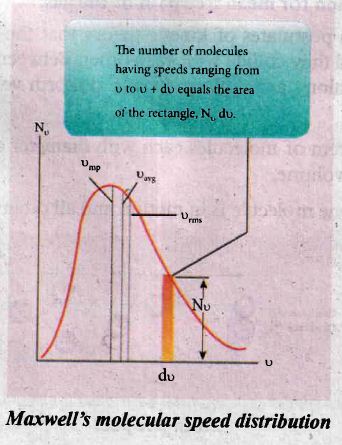
From the figure it is clear that, for a given temperature the number of molecules having lower speed increases parabolically but decreases exponentially after reaching most probable speed. The rms speed, average speed and most probable speed are indicated in the figure. It can be seen that the rms speed is greatest among the three. To Know the number of molecules in the range of speed between \(50 \mathrm{~m} \mathrm{~s}^{-1} \ and \ 60 \mathrm{~m}\mathrm{s}^{-1}\), we need to integrate \(\int_{50}^{60} 4 \pi N\left(\frac{m}{2 \pi k T}\right)^{\frac{3}{2}} v^{2} e^{\frac{m v^{2}}{2 k T}} d v=\mathrm{N}\left(50\right.\ to \ \left.60 \mathrm{~ms}^{-1}\right)\). In general the number of molecules within the range of speed v and v + dv is given by
\(\int_{v}^{v+d v} 4 \pi N\left(\frac{m}{2 \pi k T}\right)^{\frac{3}{2}} v^{2} e^{\frac{m v^{2}}{2 k T}} d v=N(v \text { to } v+d v)
\)
The exact integration is beyond the scope of the book. But we can infer the behaviour of gas molecules from the graph.
(i) The area under the graph will give the total number of gas molecules in the system.
(ii) Figure shows the speed distribution graph for two different temperatures. As temperature increases, the peak of the curve is shifted to the right. It implies that the average speed of each molecule will increase. But the area under each graph is same since it represents the total number of gas molecules.
.JPG)

11th Standard Syllabus & Materials
11th Standard
TN 11th Tamil பீடு பெற நில் - செய்யுள் - காவடிச்சிந்து Important Questions And Answers Study Material - QB365 Set A
NEW11th Standard
TN 11th Tamil பீடு பெற நில் - உரைநடை - மலை இடப்பெயர்கள் : ஓர் ஆய்வு Important Questions And Answers Study Material - QB365 Set A
NEW11th Standard
TN 11th Tamil மாமழை போற்றுதும் - துணைப்பாடம் - யானை டாக்டர் Important Questions And Answers Study Material - QB365 Set A
NEW11th Standard
TN 11th Tamil மாமழை போற்றுதும் - செய்யுள் - ஐங்குறுநூறு Important Questions And Answers Study Material - QB365 Set A



Tamilnadu Stateboard 11th Standard Subjects

Maths

Commerce

Economics

Biology

Business Maths and Statistics

Accountancy

Computer Science
Physics

Chemistry
Maths
Biology
Economics
Physics
Chemistry

History
Business Maths and Statistics

Computer Science
Accountancy

Computer Applications
History
Computer Technology
Commerce
Computer Applications
Computer Technology

Tamil

English

French
Tamilnadu Stateboard Standards



