
 100% FREE ACCESS
11th Standard Syllabus & Materials
11th Standard
TN 11th Tamil இயற்கை வேளாண்மை,சுற்றுச்சூழல் -செய்யுள் - மனோன்மணீயம் Important Questions And Answers Study Material - QB365 Set A
NEW11th Standard
TN 11th Tamil என்னுயிர் என்பேன் -துணைப்பாடம் - இசைத்தமிழர் இருவர் Important Questions And Answers Study Material - QB365 Set A
NEW11th Standard
TN 11th Tamil மொழி கலை -செய்யுள் - ஒவ்வொரு புல்லையும் Important Questions And Answers Study Material - QB365 Set A
NEW11th Standard
TN 11th Tamil பீடு பெற நில் - இலக்கணம் - பகுபத உறுப்புகள் Important Questions And Answers Study Material - QB365 Set A
NEW11th Standard
TN 11th Tamil பீடு பெற நில் - துணைப்பாடம் - வாடிவாசல் Important Questions And Answers Study Material - QB365 Set A
NEW11th Standard
TN 11th Tamil பீடு பெற நில் - செய்யுள் - குறுந்தொகை Important Questions And Answers Study Material - QB365 Set A

Published on: 07/06/2021
QB365 provides detailed and simple solution for every Book back Questions in class 11 Physics Subject. It will helps to get more idea about question pattern in every book back questions with solution.
Download Tamil Nadu 11th Standard Physics question papers, model tests, one-mark questions, important questions, and public exam papers in PDF format. Free study materials and answer keys for TN State Board students.
Questions + Answers key
Take MCQ Physics Test1.
Explain in detail the isochoric process.
2.
Derive the work done in an adiabatic process
3.
Derive the work done in an isothermal process.
4.
Derive Mayer’s relation for an ideal gas.
5.
Explain Joule’s Experiment of the mechanical equivalent of heat.
1.
This is a thermodynamic process in which the volume of the system is kept constant. But pressure, temperature and internal energy continue to be variables.
The pressure-volume graph for an isochoric process is a vertical line parallel to pressure axis as shown in Figure.
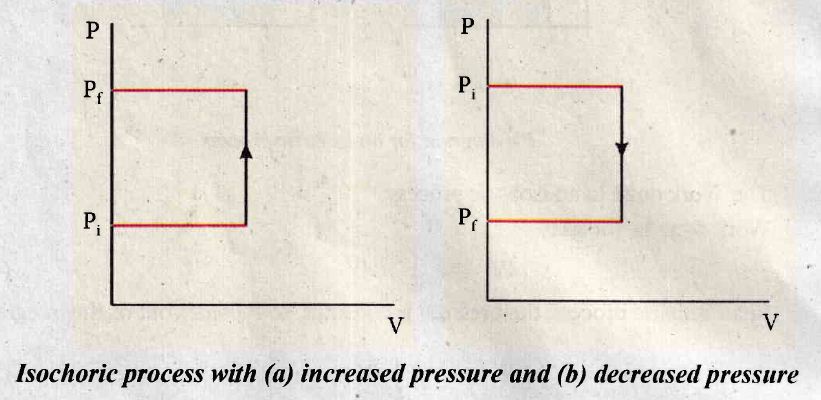
The equation of state for an isochoric process is given by
\(P=\left( \cfrac { \mu R }{ V } \right) T\) ...(1)
Where \(\left( \cfrac { \mu R }{ V } \right) \)= constant
It is that the pressure is directly proportional to temperature. This implies that the P-T graph for an isochoric process is a straight line passing through origin.
If a gas goes from state (Pi,Ti) to (Pf, Tf) at constant volume, then the system satisfies the following equation
\(\cfrac { { P }_{ i } }{ { T }_{ i } } =\cfrac { { P }_{ f } }{ { T }_{ f } } \) ...(2)
For an isochoric processes, \(\triangle \)V = 0 and W = 0. Then the first law becomes
\(\triangle \)U = Q ....(3)
Implying that the heat supplied is used to increase only the internal energy. As a result the temperature increases and pressure also increases.
Suppose a system loses heat to the surroundings through conducting walls by keeping the volume constant, then its internal energy decreases. As a result the temperature decreases; the pressure also decreases.
1. When food is cooked by closing with a lid as shown in figure.
When food is being cooked in this closed position, after a certain time you can observe the lid is being pushed upwards by the water steam. This is because when the lid is closed, the volume is kept constant. As the heat continuously supplied, the pressure increases and water steam tries to push the lid upward's.
.JPG)
2. In automobiles the petrol engine undergoes four processes. First the piston is adiabatically compressed to some volume as shown in the Figure (a). In the second process (Figure (b)), the volume of the air-fuel mixture is kept constant and heat is being added. As a result the temperature and pressure are increased. This is an isochoric process. For a third stroke (Figure (c)) there will be an adiabatic expansion and fourth stroke again isochoric process by keeping the piston immoveable (Figure (d)).
.JPG)
2.
Consider μ moles of an ideal gas enclosed in a cylinder having perfectly non conducting walls and base, A frictionless and insulating piston of cross sectional area A is fitted in the cylinder.
Let W be the work done when the system goes from the initial state (Pi, Vi, Ti ) to the final state (Pf' Vf' Tf) adiabatically.
\(W=\int _{ { V }_{ i } }^{ { V }_{ f } }{ PdV } \) ........(1)
By assuming that the adiabatic process occurs quasi-statically, at every stage the ideal gas law is valid. Under this condition, the adiabatic equation of state is \(PV^\gamma \)= constant (or)
\(P=\cfrac { constant }{ { V }^{ \gamma } } \) can be substituted in the equation (1), we get
\(\therefore \ W_{ adia }=\int _{ { V }_{ i } }^{ { V }_{ f } }{ \cfrac { constant }{ { V }^{ \gamma } } } dV\)
= constant \(\int _{ { { V }_{ i } } }^{ { V }_{ f } }{ { V }^{ -\gamma }dV } \)
= constant \(\left[ \cfrac { { V }^{ -\gamma +1 } }{ -\gamma +1 } \right] _{ { V }_{ i } }^{ { V }_{ f } }\)
\(=\frac{\text { constant }}{1-\gamma}\left[\frac{1}{V_{f}^{\gamma-1}}-\frac{1}{V_{i}^{\gamma-1}}\right]\)
\(=\cfrac { 1 }{ 1-\gamma } \left[ \cfrac { constant }{ { V }_{ f }^{ \gamma -1 } } -\cfrac { constant }{ { V }_{ i }^{ \gamma -1 } } \right] \)
But, \({ P }_{ i }{ V }_{ i }^{ \gamma }={ P }_{ f }{ V }_{ f }^{ \gamma }\) = constant.
\(\therefore { W }_{ adia }=\cfrac { 1 }{ 1-\gamma } \left[ \cfrac { { P }_{ f }{ V }_{ f }^{ \gamma } }{ { V }_{ f }^{ \gamma -1 } } -\cfrac { { P }_{ i }{ V }_{ i }^{ \gamma } }{ { { V }_{ i }^{ \gamma -1 } } } \right] \)
\({ W }_{ adia }=\cfrac { 1 }{ 1-\gamma } \left[ { P }_{ f }{ V }_{ f }-{ { P }_{ i }{ V }_{ i } } \right] \) ......(2)
From ideal gas law,
PfVf = \(\mu \)RT and PiVi = \(\mu \)RTi
Substituting in equation (2), we get
\(\therefore W_{ adia }=\cfrac { \mu R }{ \gamma -1 } \left[ { T }_{ i }-{ T }_{ f } \right] \) ....(3)
In adiabatic expansion, work is done by the gas. i.e., Wadia is positive. As Ti > Tf the gas cools during adiabatic expansion. In adiabatic compression, work is done on the gas. i.e., Wadia is negative. As Ti < Tf the temperature of the gas increases during adiabatic compression.
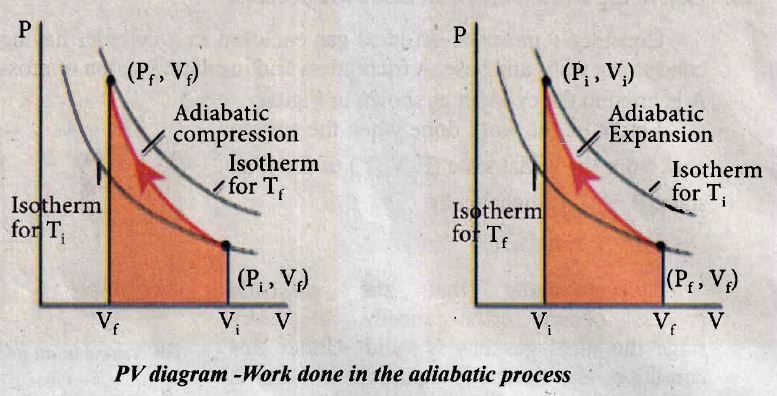
To differentiate between isothermal and adiabatic curves in the adiabatic curve is drawn along with isothermal curve for Tf and Ti. Note that adiabatic curve is steeper
than isothermal curve. This is because \(\gamma\) > 1 always.
3.
Consider an ideal gas which is allowed to expand quasi-statically at constant temperature from initial state (Pi, Vi) to the final state (Pf, Vf). We can calculate the work done by the gas during this process. From equation of the work done by the gas,
\(W=\int _{ { V }_{ i } }^{ { V }_{ f } }{ PdV } \)...(1)
As the process occurs quasi-statically, at every stage the gas is at equilibrium with the surroundings. Since it is in equilibrium at every stage the ideal gas law is valid. Writing pressure in terms of volume and temperature,
\(P=\cfrac { \mu RT }{ V } \) ...(2)
Substituting equation (2) in (1) we get
\(W=\int _{ { V }_{ i } }^{ { V }_{ f } }{ \cfrac { \mu RT }{ V } dV } \)
\(W=\mu RT\int _{ { V }_{ i } }^{ { V }_{ f } }{ \cfrac { dV }{ V } } \) .....(3)
In equation (3), we take J.lRT out of the integral, since it is constant throughout the isothermal process.
By performing' the integration in equation (3), we get.
\(W=mRTln\left( \cfrac { { V }_{ f } }{ { V }_{ i } } \right) \) ....(4)
Since we have an isothermal expansion,\(\cfrac { { V }_{ f } }{ { V }_{ i } } >1\) so In \(\left( \cfrac { { V }_{ f } }{ { V }_{ i } } \right) >0\) . As a result the work done by the gas during an isothermal expansion is positive.
The above result in equation (4) is true for isothermal compression also. But in an\(\cfrac { { V }_{ f } }{ { { V }_{ i } } } <1\), so In \(\left( \cfrac { { V }_{ f } }{ { V }_{ i } } \right) <0\).
As a result the work done on the gas in an isothermal compression is negative.
In the PV diagram the work done during the isothermal expansion is equal to the area under the graph as shown in figure.
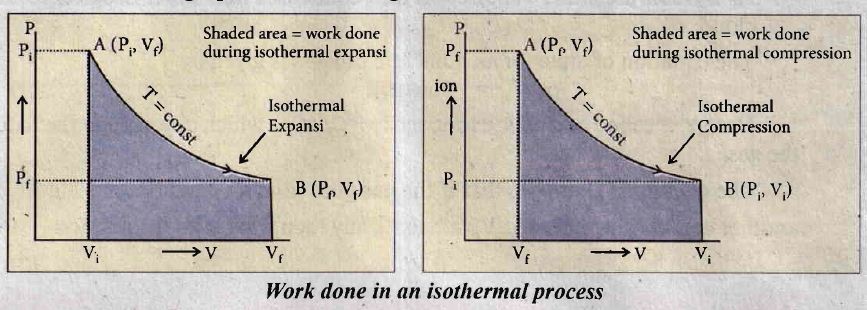
Similarly for an isothermal compression, the area under the PV graph is equal to the work done on the gas which turns out to be the area with a negative sign
4.
Consider μ mole of an ideal gas in a container with volume V, pressure P and temperature T. When the gas is heated at constant volume. the temperature increases by dT. As no work is done by the gas, the heat that flows into the system will increase only the internal energy. Let the change in internal energy be dU.
If Cv is the molar specific heat capacity at constant volume.
\(\mathrm{C}_{\mathrm{v}}=\frac{1}{\mu} \frac{d U}{d T}\)
\(dU=\mu { C }_{ v }dT\) ...(1)
Suppose the gas is heated at constant pressure so that the temperature increases by dT. If 'Q' is the heat supplied in this process and 'dV' the change in volume of the gas
\(Q=\mu { C }_{ p }dT\)......(2)
If W is the workdone by the gas in this process, then
W = PdV .......(3)
But from the first law of thermodynamics,
Q = dU + W ........(4)
Substituting equations (1), (2) and (3) in (4), we get,
\(\mu { C }_{ p }dT=\mu { C }_{ v }dT+PdV\) ...(5)
For mole of ideal gas, the equation of state is given by
PV = \(\mu \)RT ~ PdV+VdP = \(\mu \)RdT ...(6)
Since the pressure is constant, dP = 0
∴ CpdT = CvdT+ RdT
∴ Cp = Cv +R (or) Cp - Cv = R ...(7)
This relation is called Meyer's relation
5.
James Prescott Joule showed that mechanical energy can be converted into internal energy and vice versa. In his experiment, two masses were attached with a rope and a paddle wheel as shown in Figure. When these masses fall through a distance h due to gravity both the masses lose potential energy equal to 2 mgh. When the masses fall, the paddle wheel turns. Due to the turning of wheel inside water, frictional force comes in between the water and the paddle wheel. This causes
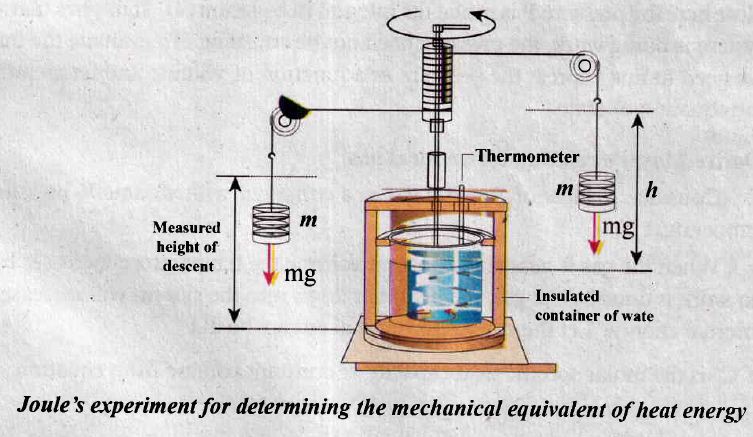
a rise in temperature of the water. This implies that gravitational potential energy is converted to internal energy of water. The temperature of water increases due to the work done by the masses. In fact, Joule was able to show that the mechanical work has the same effect as giving heat. He found that to raise 1 g of an object by 1°C, 4.186 J of energy is required. In earlier days the heat was measured in calorie.
1 cal = 4.186 J
This is called Joule's mechanical equivalent of heat.

11th Standard Syllabus & Materials
11th Standard
TN 11th Tamil பீடு பெற நில் - செய்யுள் - காவடிச்சிந்து Important Questions And Answers Study Material - QB365 Set A
NEW11th Standard
TN 11th Tamil பீடு பெற நில் - உரைநடை - மலை இடப்பெயர்கள் : ஓர் ஆய்வு Important Questions And Answers Study Material - QB365 Set A
NEW11th Standard
TN 11th Tamil மாமழை போற்றுதும் - துணைப்பாடம் - யானை டாக்டர் Important Questions And Answers Study Material - QB365 Set A
NEW11th Standard
TN 11th Tamil மாமழை போற்றுதும் - செய்யுள் - ஐங்குறுநூறு Important Questions And Answers Study Material - QB365 Set A



Tamilnadu Stateboard 11th Standard Subjects

Maths

Commerce

Economics

Biology

Business Maths and Statistics

Accountancy

Computer Science
Physics

Chemistry
Maths
Biology
Economics
Physics
Chemistry

History
Business Maths and Statistics

Computer Science
Accountancy

Computer Applications
History
Computer Technology
Commerce
Computer Applications
Computer Technology

Tamil

English

French
Tamilnadu Stateboard Standards



