
 100% FREE ACCESS
11th Standard Syllabus & Materials
11th Standard
TN 11th Tamil இயற்கை வேளாண்மை,சுற்றுச்சூழல் -செய்யுள் - மனோன்மணீயம் Important Questions And Answers Study Material - QB365 Set A
NEW11th Standard
TN 11th Tamil என்னுயிர் என்பேன் -துணைப்பாடம் - இசைத்தமிழர் இருவர் Important Questions And Answers Study Material - QB365 Set A
NEW11th Standard
TN 11th Tamil மொழி கலை -செய்யுள் - ஒவ்வொரு புல்லையும் Important Questions And Answers Study Material - QB365 Set A
NEW11th Standard
TN 11th Tamil பீடு பெற நில் - இலக்கணம் - பகுபத உறுப்புகள் Important Questions And Answers Study Material - QB365 Set A
NEW11th Standard
TN 11th Tamil பீடு பெற நில் - துணைப்பாடம் - வாடிவாசல் Important Questions And Answers Study Material - QB365 Set A
NEW11th Standard
TN 11th Tamil பீடு பெற நில் - செய்யுள் - குறுந்தொகை Important Questions And Answers Study Material - QB365 Set A

Published on: 24/06/2021
QB365 provides detailed and simple solution for every
Creative Questions in class 11 Physics Subject. It will helps to get more idea about question pattern in every Creative questions with solution.
Download Tamil Nadu 11th Standard Physics question papers, model tests, one-mark questions, important questions, and public exam papers in PDF format. Free study materials and answer keys for TN State Board students.
Questions + Answers key
Take MCQ Physics Test1.
Discuss the pure rolling and find the condition for rolling without slipping and sliding.
2.
Obtain the relation between Torque and angular acceleration.
3.
Define angular momentum and derive the expression of it.
4.
Define Torque and derive its expression.
5.
State in the absence of any external force the velocity of the centre of mass remains constant.
1.
(i) In pure rolling, the point of the rolling object which comes in contact with the surface is at momentary rest.
(ii) This is the case with every point that is on the edge of the rolling object. As the rolling proceeds, all the points on the edge, one by one come in contact with the surface remain at momentary rest at the time of contact and then take the path of the cycloid. Consider the pure rolling in two different ways.
(a) The combination of translational motion and rotational motion about the center of mass.
(or)
(b) The momentary rotational motion about the point of contact.
(iii) As the point of contact is at momentary rest in pure rolling, its resultant velocity v is zero (v = 0). For example, at the point of contact, vTRANS is forward (to right) and vROT is backwards (to the left).
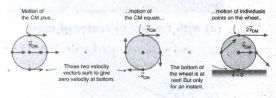
(iv) That implies that, vTRANS and vRoT are equal in magnitude and opposite in direction (v = VTRANS - vROT= 0). Hence, we conclude, that in pure rolling, for all the points on the edge, the magnitudes of vTRANS and vROT are equal (vTRANS= vROT). As vTRANS=vCM and vROT = Rω, in pure rolling we have,
vCM = Rω
(v) For the topmost point, the two velocities vTRANS and vROT are equal in magnitude and in the same direction (to the right). Thus, the resultant velocity v is the sum of these two velocities, v =vTRANS+ vROT In other form, v = 2 vCM
Sliding
(i) Sliding is the case when vCM > Rω (or vTRANS > vROT).The translation is more than the rotation. This kind of motion happens when sudden brake is applied in a moving vehicles or when the vehicle enters into a slippery road. In this case, the point of contact has more of vTRANS than vROT
(ii) Hence, it has a resultant velocity v in the forward direction. The kinetic frictional force (fk) opposes the relative motion. Hence, it acts in the opposite direction of the relative velocity.
(iii) This frictional force reduces the translational velocity and increases the rotational velocity till they become equal and the object sets on pure rolling. Sliding is also referred as forward slipping.
Slipping
(i) Slipping is the case when vCM < Rω (or vTRANS < vROT).The rotation is more than the translation ..This kind of motion happens When we suddenly start the vehicle from rest or the vehicle is stuck in mud.
(ii) In this case, the point of contact has more of vROT than VTRANS. It has a resultant velocity v in the backward direction.
(iii) The kinetic frictional force (fk) opposes the relative motion. Hence it acts in the opposite direction of the relative velocity.
(iv) This frictional force reduces the rotational velocity and increases the translational velocity till they become equal and the object sets pure rolling. Slipping is sometimes emphasised as backward slipping.
2.
(i) Consider a rigid body rotating about a fixed axis. A point mass m in the body will execute a circular motion about a fixed axis.
(ii) A tangential force \(\vec F\) acting on the point mass produces the necessary torque for this rotation. This force \(\vec F\) is perpendicular to the position vector \(\vec r\) of the point mass.
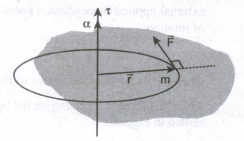
iii) The torque produced by the force on the point mass m about the axis can be written as,
\(\tau =rFsin90=rF\quad \left[ \because sin90=1 \right] \)
\(\tau =rma\ \left[ \because \left( F=ma \right) \right] \)
\(\tau =rmr\alpha =mr^{ 2 }\alpha \ \left[ \because \left( a=r\alpha \right) \right] \)
\(\tau =\left( mr^{ 2 } \right) \alpha \)
(iv) Hence, the torque of the force acting on the point mass produces an angular acceleration (a) in the point mass about the axis of rotation.
In vector notation,
\(\vec \tau =\left( mr^{ 2 } \right) \vec \alpha\)
(v) The directions of \(\tau \) and \(\alpha\) are along the axis of rotation. If the direction of \(\tau\) is in the direction of \(\alpha\), it produces angular acceleration. On the other hand if \(\tau \) is opposite to \(\alpha\) angular deceleration or retardation is produced on the point mass.
(vi) The term mr2 in equations is called moment of inertia (I) of the point mass. A rigid body is made up of many such point masses. Hence, the moment of inertia of a rigid body is the sum of moments of inertia of all such individual point masses that constitute the body \(\left( I=\sum { { m }_{ i }{ r }_{ i }^{ 2 } } \right) \) Hence, torque for the rigid body can be written as,
\(\vec \tau =\left( \sum { m_{ i }{ r }_{ i }^{ 2 } } \right) \vec a\)
\(\vec \tau = I \vec a\)
3.
(i) The angular momentum of a point mass is defined as the moment of its linear momentum. In other words, the angular momentum L of a point mass having a linear momentum p at a position r with respect to a point or axis is mathematically written as,
\(\overset { \rightarrow }{ L } =\overset { \rightarrow }{ r } \overset { \rightarrow }{ p } \)
(ii) The magnitude of angular momentum could be written as, L= rp sin\(\theta\) where, ፀ is the angle between \(\overset { \rightarrow }{ r } \) and \(\overset { \rightarrow }{ p } .\overset { \rightarrow }{ L } \) is perpendicular to the plane containing \(\overset { \rightarrow }{ r } \) and \(\overset { \rightarrow }{ p } \)
(iii) As we have written in the case of torque, here also we can associate sinθ with either \(\overset { \rightarrow }{ r } \) and \(\overset { \rightarrow }{ p } \)
L=r(p sin\(\theta\)) = r(p丄)
L=(r sin\(\theta\)) p = (r丄)p
where, p丄 is the component of linear momentum p perpendicular to r, and r丄 is the component of position r perpendicular to p.
(iv) The angular momentum is zero (L = 0), if the linear momentum is zero (p = 0) or if the particle is at the origin (\(\overset { \rightarrow }{ r } \)=0) or if \(\overset { \rightarrow }{ r } \) and \(\overset { \rightarrow }{ p } \) are parallel or antiparallel to each other\(\theta\) =00 or 1800)
4.
(i) Torque is defined as the moment of the external applied force about a point or axis of rotation.
(ii) \(\overset { \rightarrow }{ \tau } =\overset { \rightarrow }{ r } \times \overset { \rightarrow }{ F } \)
where, \(\overset { \rightarrow }{ r } \) is the position vector of the point where the force \(\overset { \rightarrow }{ F } \) is acting on the body as shown in Figure.
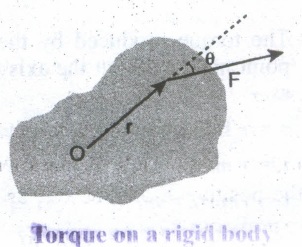
(iii) Here, the product of \(\overset { \rightarrow }{ r } \) and \(\overset { \rightarrow }{ F } \) is called the vector product or cross product. The vector product of two vectors results in another vector that is perpendicular to both the vectors. Hence, torque (\(\overset { \rightarrow }{ \tau } \)) is a vector quantity.
(iv) Torque has a magnitude (r F sin θ) and direction perpendicular to \(\overset { \rightarrow }{ r } \) and \(\overset { \rightarrow }{ F } \). Its unit is N m.
\(\overset { \rightarrow }{ \tau } =(r\ F\sin\theta )\hat { n } \)
(v) Here, \(\theta\) is the angle between \(\overset { \rightarrow }{ r } \) and \(\overset { \rightarrow }{ F } \) and \(\hat { n } \) is the unit vector in the direction of \(\overset { \rightarrow }{ \tau } \).
5.
(i) When a rigid body moves, its center of mass will also move along with the body. For kinematic quantities like velocity (vCM) and acceleration (aCM) of the center of mass, we can differentiate the expression for position of center of mass with respect to time once and twice respectively. For, simplicity, let us take the motion along, X direction only.
\(\overset { \rightarrow }{ v } _{ CM }=\frac { d\overset { \rightarrow }{ x } _{ CM } }{ dt } =\frac { \sum { { m }_{ i }\left( \frac { d\overset { \rightarrow }{ x } _{ i } }{ dt } \right) } }{ \sum { { m }_{ i } } } =\frac { \sum { { m }_{ i }\overset { \rightarrow }{ v } _{ i } } }{ \sum { { m }_{ i } } } \)
\(\overset { \rightarrow }{ v } _{ CM }=\frac { \sum { { m }_{ i }\overset { \rightarrow }{ { v }_{ i } } } }{ \sum { { m }_{ i } } } \)
\(\overset { \rightarrow }{ a } _{ CM }=\frac { d }{ dt } \left( \frac { d\overset { \rightarrow }{ x_{ CM } } }{ dt } \right) =\left( \frac { d\overset { \rightarrow }{ v } _{ CM } }{ dt } \right) =\frac { \sum { { m }_{ i }\left( \frac { d\overset { \rightarrow }{ v_{ i } } }{ dt } \right) } }{ \sum { { m }_{ i } } } \)
=\(\frac { \sum { { m }_{ i }\overset { \rightarrow }{ a_{ i } } } }{ \sum { { m }_{ i } } } \)
(ii) In the absence of external force, i.e. \(\overset { \rightarrow }{ F_{ ext } } \)= 0 the individual rigid bodies of a system can move or shift only due to the internal forces.
(iii) This will not affect the position of the center of mass. This means that the center of mass will be in a state of rest or uniform motion. Hence, \(\overset { \rightarrow }{ { v }_{ CM } } \) will be zero when center of mass is at rest and constant when center of mass has uniform motion (\(\overset { \rightarrow }{ v_{ CM } } =0 \ or \ \overset { \rightarrow }{ v_{ CM } } \)=constant). There will be no acceleration of center of mass, \(\left( \overset { \rightarrow }{ a_{ CM } } =0 \right) \).
From equation
\(0=\frac { \sum { { m }_{ i }\overset { \rightarrow }{ v_{ i } } } }{ \sum { { m }_{ i } } } \)
\(\overset { \rightarrow }{ v_{ CM } } =\frac { \sum { { m }_{ i }\overset { \rightarrow }{ v_{ i } } } }{ \sum { { m }_{ i } } } ;\overset { \rightarrow }{ a_{ CM } } =0\)
(vi) Here, the individual particles may still move with their respective velocities and accelerations due to internal forces

11th Standard Syllabus & Materials
11th Standard
TN 11th Tamil பீடு பெற நில் - செய்யுள் - காவடிச்சிந்து Important Questions And Answers Study Material - QB365 Set A
NEW11th Standard
TN 11th Tamil பீடு பெற நில் - உரைநடை - மலை இடப்பெயர்கள் : ஓர் ஆய்வு Important Questions And Answers Study Material - QB365 Set A
NEW11th Standard
TN 11th Tamil மாமழை போற்றுதும் - துணைப்பாடம் - யானை டாக்டர் Important Questions And Answers Study Material - QB365 Set A
NEW11th Standard
TN 11th Tamil மாமழை போற்றுதும் - செய்யுள் - ஐங்குறுநூறு Important Questions And Answers Study Material - QB365 Set A



Tamilnadu Stateboard 11th Standard Subjects

Maths

Commerce

Economics

Biology

Business Maths and Statistics

Accountancy

Computer Science
Physics

Chemistry
Maths
Biology
Economics
Physics
Chemistry

History
Business Maths and Statistics

Computer Science
Accountancy

Computer Applications
History
Computer Technology
Commerce
Computer Applications
Computer Technology

Tamil

English

French
Tamilnadu Stateboard Standards



