
 100% FREE ACCESS
11th Standard Syllabus & Materials
11th Standard
TN 11th Tamil இயற்கை வேளாண்மை,சுற்றுச்சூழல் -செய்யுள் - மனோன்மணீயம் Important Questions And Answers Study Material - QB365 Set A
NEW11th Standard
TN 11th Tamil என்னுயிர் என்பேன் -துணைப்பாடம் - இசைத்தமிழர் இருவர் Important Questions And Answers Study Material - QB365 Set A
NEW11th Standard
TN 11th Tamil மொழி கலை -செய்யுள் - ஒவ்வொரு புல்லையும் Important Questions And Answers Study Material - QB365 Set A
NEW11th Standard
TN 11th Tamil பீடு பெற நில் - இலக்கணம் - பகுபத உறுப்புகள் Important Questions And Answers Study Material - QB365 Set A
NEW11th Standard
TN 11th Tamil பீடு பெற நில் - துணைப்பாடம் - வாடிவாசல் Important Questions And Answers Study Material - QB365 Set A
NEW11th Standard
TN 11th Tamil பீடு பெற நில் - செய்யுள் - குறுந்தொகை Important Questions And Answers Study Material - QB365 Set A

Published on: 24/06/2021
QB365 provides detailed and simple solution for every
Creative Questions in class 11 Physics Subject. It will helps to get more idea about question pattern in every Creative questions with solution.
Download Tamil Nadu 11th Standard Physics question papers, model tests, one-mark questions, important questions, and public exam papers in PDF format. Free study materials and answer keys for TN State Board students.
Questions + Answers key
Take MCQ Physics Test1.
Explain briefly about the graphical representation of Displacement, velocity and acceleration in SHM.
2.
Explain acceleration is S.H.M, and discuss its special cases.
3.
Explain Displacement, velocity in SHM, and derive special cases.
4.
Show that the projection of uniform circular motion on a diameter is SHM.
5.
Write a short note on Simple Harmonic Motion.
1.
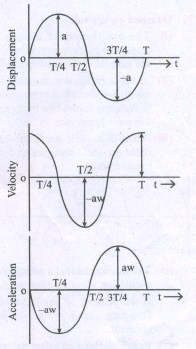
Graphical representation of displacement, velocity and acceleration of a particle vibrating simple harmonically with respect to time t.
(i) Displacement graph is a sine curve. Maximum displacement of the particle is y =+a
(ii) The velocity of the vibrating particle is maximum at the mean position i.e v =+ aw and it is zero at the extreme position.
(iii) The acceleration of the vibrating particle is zero at the mean position and maximum at the extreme position (i.e) ± aw2.
The velocity is ahead of displacement by a phase angle of \(\frac { \pi }{ 2 } \) . The acceleration is ahead of the velocity by a phase angle \(\frac { \pi }{ 2 } \) or by aw2 phase \(\pi\) ahead of displacement. (i.e) When the displacement has its greatest positive value, acceleration has its negative maximum value or vice versa.
2.
Acceleration in SHM:
The rate of change of velocity is the acceleration of the vibrating particle.
\(\frac { d^{ 2 }y }{ dt^{ 2 } } =\frac { d }{ dt } \left( \frac { dy }{ dt } \right) =\frac { d }{ dt } \) (aw(cos wt))
= w2asin wt
Acceleration =\(\frac { { d }^{ 2 }y }{ dt^{ 2 } } \)= -w2y
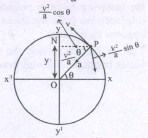
The acceleration of the particle can also be obtained by component method. The centripetal acceleration of the particle pacting along po is \(\frac { { v }^{ 2 } }{ a } \)
Acceleration in SHM:
This acceleration is resolved into two components
\(\frac { { v }^{ 2 } }{ a } \) cosθ along PN perpendicular to oy.
\(\frac { { v }^{ 2 } }{ a } \) sinθ along perpendicular to oy.
Hence acceleration = \(\frac { { v }^{ 2 } }{ a } \) sinθ
= -aw2sinwt
= -w2y
Acceleration = -w2y
The negative sign indicates that the acceleration is always opposite to the direction of displacement and is directed toward the centre.
Special cases:
When particle is at the mean position (i.e), y = 0, the acceleration is zero.
When the particle is at the extreme position (i.e) y = ± a acceleration is ± a W2 which is called as acceleration amplitude.
3.
Displacement in SHM:
The distance travelled by the vibrating particle at any instant of time t from its mean position is known as displacement. When the particle is at p, the displacement of the particle along y axis is y.
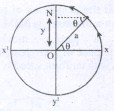
The in ΔOPN, sinθ=\(\frac { ON }{ op } \)
ON = y = op sinθ
y = op sin wt
Since op = a, the radius of the circle, the displacement of the vibrating particle is
y = a sin wt ....(1)
The amplitude of the vibrating particle is defined as its maximum displacement from the mean position.
Velocity in SHM:
The rate of change of displacement is the velocity of the vibrating particle.
Differentiating equation (1), with respect to time t.
\(\frac { dy }{ dt } =\frac { d }{ dt } \) (a sin wt) ....(2)
∴ v = aw cost wt
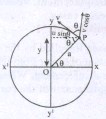
The velocity v of the particle moving along the circle can also be obtained by resolving it into two components.
Velocity in SHM
(i) cos θ in a direction parallel to oy.
(ii) V sin θ in a direction perpendicular to oy.
The component v sin θ has no effect along yoy' since it is perpendicular to oy
Velocity =V cosθ = V cos wt
We know that,
Linear Velocity = radius\(\times\)angular velocity
∴ v = aw
Velocity = aw cost wt
Velocity = \(aw\sqrt { 1-sin^{ 2 }wt } \)
∴ Velocity =\(w=\sqrt { ({ a }^{ 2 }-y^{ 2 }) } \)
Special cases:
When the particle is at mean position,
(i.e.) y = 0. Velocity is aw and is maximum.
v = ± aw is called velocity amplitude.
When the particle is in the extreme position,
(i.e) y = +a, the velocity is zero.
4.
Consider a particle moving along the y circumference of a circle of radius a and NP centre 0, with uniform speed v, in anticlockwise direction.
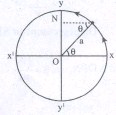
Let xx1 and yy1 be the two perpendicular x diameters. Suppose the particle is at p after a time t. If w is the angular velocity then the angular displacement θ in time t is given by θ = -wt.
From p draw pN perpendicular to yy1. As the particles moves from x to y, foot of the perpendicular N moves from 0 to y. As it moves further from y to x1, then from x1 to y1 and back again to x, the point N moves from y to 0, from 0 to y1 and back again to O. When the particle completers one revolution along the circumference, the point N completes one vibration about the mean position O. The motion of the point N along the diameter yy1 is simple harmonic.
Hence the projection of a uniform circular motion on a diameter of side in simple harmonic motion.
5.
We shall first discuss the general dynamics of an SHM. We know that work has to be done on a system to displace it from its position of equilibrium. The restoring force F obviously depends on the work done to give a displacement x.
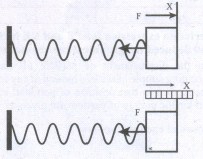
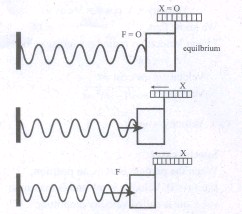
(i) Thus, F is some general function of x. For system oscillating violently (large x) the dependence of F on x is very complex.
(ii) This is called small oscillation approximation. For such system, the restoring force is proportional to the displacement and opposes its increase.
F = -kx ...(1)
(iii) The negative sign indicates that F opposes increase in x. k, the, constant of proportionality, is called the force constant. The Mks unit for k is \(\frac{N}{m}\) . The magnitude of k depends on the elastic properties of the system. In the specific examples, in the system consisting of a mass and a spring, k will depend on the stiffness or strength of the spring.
(iv) The equation (1) is a statement of Hooke's law for elastic forces. The general definition of SHM is the motion in which the restoring force is proportional to the displacement from the mean position and opposes its increase.
(v) That in such a motion the displacement varies harmonically with time.

11th Standard Syllabus & Materials
11th Standard
TN 11th Tamil பீடு பெற நில் - செய்யுள் - காவடிச்சிந்து Important Questions And Answers Study Material - QB365 Set A
NEW11th Standard
TN 11th Tamil பீடு பெற நில் - உரைநடை - மலை இடப்பெயர்கள் : ஓர் ஆய்வு Important Questions And Answers Study Material - QB365 Set A
NEW11th Standard
TN 11th Tamil மாமழை போற்றுதும் - துணைப்பாடம் - யானை டாக்டர் Important Questions And Answers Study Material - QB365 Set A
NEW11th Standard
TN 11th Tamil மாமழை போற்றுதும் - செய்யுள் - ஐங்குறுநூறு Important Questions And Answers Study Material - QB365 Set A



Tamilnadu Stateboard 11th Standard Subjects

Maths

Commerce

Economics

Biology

Business Maths and Statistics

Accountancy

Computer Science
Physics

Chemistry
Maths
Biology
Economics
Physics
Chemistry

History
Business Maths and Statistics

Computer Science
Accountancy

Computer Applications
History
Computer Technology
Commerce
Computer Applications
Computer Technology

Tamil

English

French
Tamilnadu Stateboard Standards



