
 100% FREE ACCESS
11th Standard Syllabus & Materials
11th Standard
TN 11th Tamil இயற்கை வேளாண்மை,சுற்றுச்சூழல் -செய்யுள் - மனோன்மணீயம் Important Questions And Answers Study Material - QB365 Set A
NEW11th Standard
TN 11th Tamil என்னுயிர் என்பேன் -துணைப்பாடம் - இசைத்தமிழர் இருவர் Important Questions And Answers Study Material - QB365 Set A
NEW11th Standard
TN 11th Tamil மொழி கலை -செய்யுள் - ஒவ்வொரு புல்லையும் Important Questions And Answers Study Material - QB365 Set A
NEW11th Standard
TN 11th Tamil பீடு பெற நில் - இலக்கணம் - பகுபத உறுப்புகள் Important Questions And Answers Study Material - QB365 Set A
NEW11th Standard
TN 11th Tamil பீடு பெற நில் - துணைப்பாடம் - வாடிவாசல் Important Questions And Answers Study Material - QB365 Set A
NEW11th Standard
TN 11th Tamil பீடு பெற நில் - செய்யுள் - குறுந்தொகை Important Questions And Answers Study Material - QB365 Set A

Published on: 13/05/2022
QB365 provides detailed and simple solution for every Book back Questions in class 11 Physics Subject. It will helps to get more idea about question pattern in every book back questions with solution.
latest Book back QuestionsDownload Tamil Nadu 11th Standard Physics question papers, model tests, one-mark questions, important questions, and public exam papers in PDF format. Free study materials and answer keys for TN State Board students.
Questions + Answers key
Take MCQ Physics Test1.
Obtain an expression for the excess of pressure inside a
i) liquid drop
ii) liquid bubble
iii) air bubble.
2.
Derive the expression for the terminal velocity of a sphere moving in a high viscous fluid using stokes force.
3.
Derive an expression for the elastic energy stored per unit volume of a wire.
4.
State Hooke’s law and verify it with the help of an experiment?
5.
State and prove Pascal’s law in fluids?
1.
(1) Excess of pressure inside air bubble in a liquid.
Consider an air bubble of radius R inside a liquid having surface tension T as shown in Figure. Let P1 and P2 be the pressures outside and inside the air bubble, respectively. Now, the, excess pressure inside the air bubble is
\(\Delta P=P_{1}-P_{2}.\)
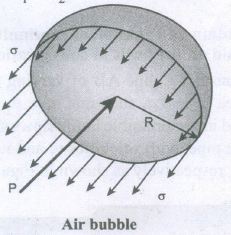
In order to find the excess pressure inside the air bubble, let us consider the forces acting on the air bubble. For the hemispherical portion of the bubble, considering the forces acting on it, we get,
(i) The force due to surface tension acting towards right around the rim of length \(2 \pi \mathrm{R} \ is \ \mathrm{F}_{\mathrm{T}}=2 \pi \mathrm{RT}\)
(ii) The force due to outside pressure P1 is to the right acting across a cross sectional area of \(\pi \mathrm{R}^{2} \ is \ F_{P_{1}}=P_{1} \pi R^{2}\)
(iii) The force due to pressure P2 inside the bubble, acting to the left is \(F_{P_{2}}=P_{2} \pi R^{2}\).
As the air bubble is in equilibrium under the action of these forces, \(F_{P_{2}}=F_{T}+F_{P_{1}}\)
\(\mathrm{P}_{2} \pi \mathrm{R}^{2} =2 \pi \mathrm{RT}+\mathrm{P}_{1} \pi \mathrm{R}^{2}
\)
\(\Rightarrow\left(\mathrm{P}_{2}-\mathrm{P}_{1}\right) \pi \mathrm{R}^{2} =2 \pi \mathrm{RT}\)
Excess pressure is \(\Delta \mathrm{P}=P_{2}-P_{1}=\frac{2 T}{R}\)
(2) Excess pressure inside a soap bubble
Consider a soap bubble of radius R and the surface tension of the soap bubble be T. A soap bubble has two liquid surfaces in contact with air, one inside the bubble and other outside the bubble. Hence, the force on the soap bubble due to surface tension is \(2 \times 2 \pi\) RT. The various forces acting on the soap bubble are,
(i) Force due to surface tension \(F_{T}=4 \pi R T\) towards right
(ii) Force due to outside pressure, \(F_{P_{1}}=P_{1} \pi R^{2}\) towards right
(iii) Force due to inside pressure, \(F_{P_{2}}=P_{2} \pi R^{2}\) towards left
As the bubble is in equilibrium, \(F_{P_{2}}=F_{T}+F_{P_{1}}\)
\(\mathrm{P}_{2} \pi \mathrm{R}^{2} =4 \pi \mathrm{RT}+\mathrm{P}_{1} \pi \mathrm{R}^{2}
\)
\(\Rightarrow\left(\mathrm{P}_{2}-\mathrm{P}_{1}\right) =\pi \mathrm{R}^{2}=4 \pi \mathrm{RT} \pi \mathrm{R}^{2}
\)
\(\text {Excess pressure is } \Delta \mathrm{P} =\mathrm{P}_{2}-\mathrm{P}_{1}=\frac{4 T}{R}\)
(3) Excess pressure inside the liquid drop
Consider a liquid drop of radius R and the surface tension of the liquid is T.
The various forces acting on the liquid drop are,
(i) Force due to surface tension \(F_{T}=2 \pi R T\) towards right
(ii) Force due to outside pressure, \(F_{P_{1}}=P_{1} \pi R^{2}\) towards right
(iii) Force due to inside pressure, \(F_{P_{2}}=P_{2} \pi R^{2}\) towards left
As the bubble is in equilibrium, \(F_{P_{2}}=F_{T}+F_{P_{1}}\)
\(\mathrm{P}_{2} \pi \mathrm{R}^{2} =2 \pi \mathrm{RT}+\mathrm{P}_{1} \pi \mathrm{R}^{2}
\)
\(\Rightarrow\left(\mathrm{P}_{2}-\mathrm{P}_{1}\right) \pi \mathrm{R}^{2}=2 \pi \mathrm{RT}
\)
\(\text {Excess pressure is } \Delta \mathrm{P} =\mathrm{P}_{2}-\mathrm{P}_{1}=\frac{2 T}{R}\)
2.
Consider a sphere of radius r which falls freely through a highly viscous liquid of coefficient of viscosity η. Let the density of the material of the sphere be p and the density of the fluid be σ.
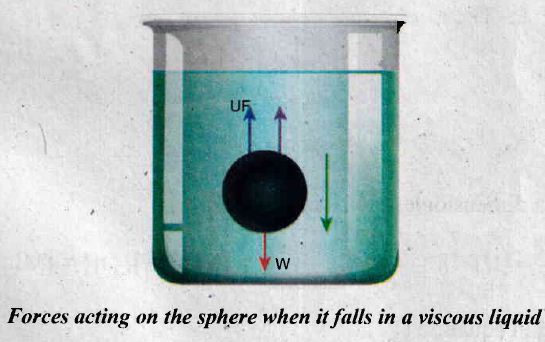
Gravitational force acting on the sphere,
\(F_{G}=mg=\frac{4}{3}\pi r^{3}\rho g \) (downward force)
Up thrust, U = \(\frac{4}{3} \pi r^{3} g\) (upward force)
viscous force F = 6ㅠηrvt
At terminal velocity vt
downward force = upward force
\(F_{G}-U=F \Rightarrow \frac{4}{3}\pi r^{3}\rho g - = \frac{4}{3}\pi r^{3} \sigma g =6\pi \eta r v_{t}\)
\(v_{t}=\frac{2}{9} \times \frac{r^{2} (\rho-\sigma)}{\eta}g \Rightarrow v_{t} \infty r^{2}\)
Here, it should be noted that the terminal speed of the sphere is directly proportional to the square of its radius.
3.
When a body is stretched, work is done against the restoring force (internal force). This work done is stored in the body in the form of elastic energy. Consider a wire whose un-stretch length is L and area of cross section is A. Let a force produce an extension I and further assume that the elastic limit of the wire has not been exceeded and there is no loss in energy. Then, the work done by the force F is equal to the energy gained by the wire.
The work done in stretching the wire by dl, dW = Fdl
The total work done in stretching the wire from 0 to l is
\(W=\int^{l}_{o}F dl\) --- (1)
From Young's modulus of elasticity,
\(\mathrm{Y}=\frac{F}{A} \times \frac{L}{l} \Rightarrow \frac{Y A l}{L}\) ......(2)
Substituting equation (2) in equation (1), we get
\(\mathrm{W}=\int_{0}^{1} \frac{Y A l}{L} d l\)
Since, l is the dummy variable in the integration, we can change l to l' (not in limits), therefore
\(\mathrm{W}=\int_{0}^{l} \frac{Y A l^{\prime}}{L} d l^{\prime} =\frac{Y A}{L}\left(\frac{l^{\prime 2}}{2}\right)_{0}^{i}=\frac{Y A}{I} \frac{l^{2}}{2}=\frac{1}{2}\left(\frac{Y A l}{L}\right) l=\frac{1}{2} F l \)
\(W =\frac{1}{2} F l=\text { Elastic potential energy }\)
Energy per unit volume is called energy density,
\(u =\frac{\text { Elastic potential energy }}{\text { Volume }}=\frac{\frac{1}{2} F l}{A L}
\)
\(\frac{1}{2} \frac{F}{A} \frac{l}{L} =\frac{1}{2}(\text { Stress } \times \text { Strain })\) ......(3)
4.
Hooke's law states that within the elastic limit, the strain produced in a body is directly proportional to the stress applied.
It can be verified in a simple way by stretching a thin straight wire (stretches like spring) of length L and uniform cross-sectional area A suspended from a fixed point O. A pan and a pointer are attached at the free end of the wire as shown in Figure. The extension produced on the wire is measured using a vernier scale arrangement. The experiment shows that for a given load, the corresponding stretching force is F and the elongation produced on the wire is ΔL. It is directly proportional to the original length L and inversely proportional to the area of cross section A. A graph is plotted using F on the X-axis and ΔL on the Y-axis. This graph is a straight line passing through the origin as shown in Figure.
.JPG)
.JPG)
Therefore,
ΔL = (slope)F
Multiplying and dividing by volume,
V = AL,
F (slope) = \(\frac{AL}{AL} \Delta L\)
Rearranging, we get
\(\frac{F}{A}=[\frac{L}{A(Slope)}]\frac{\Delta L}{L}\)
Therefore, \(\frac{F}{A} \alpha [\frac{\Delta L}{L}]\)
Comparing with equations stress and strain \(\sigma=\frac{\text { Force }}{\text { Area }}=\frac{F}{A}, \varepsilon=\frac{\text { Change in size }}{\text { Original size }}=\frac{\Delta l}{l}\),
we get volume strain, \(\varepsilon_{v}=\frac{\Delta V}{V}\) equation as
\(\sigma \propto \varepsilon\)
i.e., the stress is proportional to the strain in the elastic limit.
5.
If the pressure in a liquid is changed at a particular point, the change is transmitted to the entire liquid without being diminished in magnitude.
Application of pascal's law
A practical application of Pascal's law is the hydraulic lift which is used to lift a heavy load with a small force. It is a force multiplier. It consists of two cylinders A and B connected to each other by a horizontal pipe, filled with a liquid.
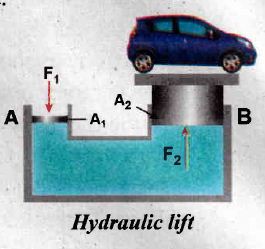
They are fitted with frictionless pistons of cross sectional areas A1 and A2 (A2 > A1). Suppose a downward force F is applied on the smaller piston, the pressure of the liquid under this piston increases to\(\left(\right. where, \left.P=\frac{F_{1}}{A_{1}}\right).\) But according to Pascal's law, this increased pressure P is transmitted undiminished in all directions. So a pressure is exerted on piston B. Upward force on piston B is
\(\mathrm{F}_{2}=\mathrm{P} \times \mathrm{A}_{2}=\frac{F_{1}}{A_{1}} \times A_{2} \Rightarrow \mathrm{F}_{2}=\frac{A_{2}}{A_{1}} \times F_{1}\)
Hence by changing the force on the smaller piston A, the force on the piston B has been increased by the factor \(\frac{A_{2}}{A_{1}}\) and this factor is called the mechanical advantage of the lift.

11th Standard Syllabus & Materials
11th Standard
TN 11th Tamil பீடு பெற நில் - செய்யுள் - காவடிச்சிந்து Important Questions And Answers Study Material - QB365 Set A
NEW11th Standard
TN 11th Tamil பீடு பெற நில் - உரைநடை - மலை இடப்பெயர்கள் : ஓர் ஆய்வு Important Questions And Answers Study Material - QB365 Set A
NEW11th Standard
TN 11th Tamil மாமழை போற்றுதும் - துணைப்பாடம் - யானை டாக்டர் Important Questions And Answers Study Material - QB365 Set A
NEW11th Standard
TN 11th Tamil மாமழை போற்றுதும் - செய்யுள் - ஐங்குறுநூறு Important Questions And Answers Study Material - QB365 Set A



Tamilnadu Stateboard 11th Standard Subjects

Maths

Commerce

Economics

Biology

Business Maths and Statistics

Accountancy

Computer Science
Physics

Chemistry
Maths
Biology
Economics
Physics
Chemistry

History
Business Maths and Statistics

Computer Science
Accountancy

Computer Applications
History
Computer Technology
Commerce
Computer Applications
Computer Technology

Tamil

English

French
Tamilnadu Stateboard Standards



