
 100% FREE ACCESS
12th Standard Syllabus & Materials
12th Standard
TN 12th Computer Applications மின்னணு தரவு பரிமாற்றம் Sample Question Papers Study Material - QB365 Set A
NEW12th Standard
TN 12th Computer Applications மின் - வணிக பாதுகாப்பு அமைப்புகள் Sample Question Papers Study Material - QB365 Set A
NEW12th Standard
TN 12th Computer Applications மின்னணு செலுத்தல் முறைகள் Sample Question Papers Study Material - QB365 Set A
NEW12th Standard
TN 12th Computer Applications மின் - வணிகம் Sample Question Papers Study Material - QB365 Set A
NEW12th Standard
TN 12th Computer Applications திறந்த மூல கருத்துருக்கள் Sample Question Papers Study Material - QB365 Set A
NEW12th Standard
TN 12th Computer Applications வலையமைப்பு வடமிடல் Sample Question Papers Study Material - QB365 Set A

Published on: 30/07/2019
Electromagnetic Induction and Alternating Current
Download Tamil Nadu 12th Standard Physics question papers, model tests, one-mark questions, important questions, and public exam papers in PDF format. Free study materials and answer keys for TN State Board students.
Questions + Answers key
Take MCQ Physics Test1.
What is resonant frequency?
2.
Distinguish between AC and DC.
3.
What is inductive reactance X1? How does it depend on the frequency and give its unit?
4.
What is meant by mutual induction?
5.
What do you mean by self-induction?
6.
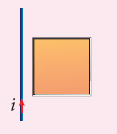
If the current i flowing in the straight conducting wire as shown in the figure decreases, find out the direction of induced current in the metallic square loop placed near it.
7.
A straight conducting wire is dropped horizontally from a certain height with its length along east-west direction. Will an emf be induced in it? Justify your answer.
8.
A cylindrical bar magnet is kept along the axis of a circular solenoid. If the magnet is rotated about its axis, find out whether an electric current is induced in the coil.
9.
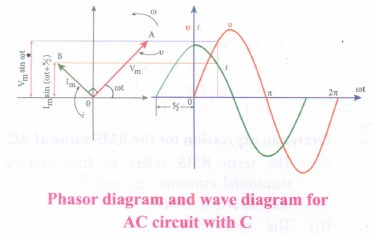
What is the phase relation between current and emf in an AC circuit containing a cpacitor only? Sketch a graph showing the variation the reactance of a capacitor with frequency.
10.
How does the capacitive reactance depend on frequency? & What is the reactance of a capacitor at hertz to the study at?
11.
An inverter is common electrical device which we use in our homes. When there is no power in our house, inverter gives AC power to run a few electronic appliances like fan or light. An inverter has inbuilt step-up transformer which converts 12 V AC to 240 V AC. The primary coil has 100 turns and the inverter delivers 50 mA to the external circuit. Find the number of turns in the secondary and the primary current.
12.
A step-down transformer reduces the supply voltage from 220 V to 11 V and increase the current from 6 A to 100 A. Then its efficiency is
1.2
0.83
0.12
0.9
13.
14.
A circular coil with a cross-sectional area of 4 cm2 has 10 turns. It is placed at the centre of a long solenoid that has 15 turns/cm and a cross-sectional area of 10 cm2. The axis of the coil coincides with the axis of the solenoid. What is their mutual inductance?
7.54 μH
8.54 μH
9.54 μH
10.54 μH
15.
When the current changes from +2A to −2A in 0.05 s, an emf of 8 V is induced in a coil. The co-efficient of self-induction of the coil is
0.2H
0.4H
0.8H
0.1H
16.
The flux linked with a coil at any instant t is given by \(\Phi\)B = 10t2 − 50t + 250. The induced emf at t = 3s is
−190 V
−10 V
10 V
190 V
17.
RLC circuit
18.
Ac circult with capacitor
19.
Ac circuit with inductor
20.
Ac circuit with resistor
21.
Faraday's law
22.
Explain the mutual induction between two long solenoids. Obtain an expression for the mutual inductance.
23.
Obtain an expression for angular frequency of LC oscillations?
1.
When the frequency of the applied alternating source (ωr) is equal to the natural frequency \(\left[ \frac { 1 }{ \sqrt { LC } } \right] \) of the RLC circuit, the current in the circuit reaches its maximum value. Then the circuit is said to be in electrical resonance. The frequency at which resonance takes place is called resonant frequency.
Resonant angular frequency, ωr = \(\frac { 1 }{ \sqrt { LC } } \)
2.
|
AC |
DC |
|---|---|
| It is the current varying to the magnitude continuously and reverses the direction periodically. | The current and voltage in a DC system remain constant over a period of time and flows in the same fixed direction. |
| I = Im sin ωt | i = \(\frac{Q}{t}\) |
| The average value of AC over the complete cycle is zero. | The current is steady with respect to time. |
3.
The resistance offered by the inductor, called inductive reactance (XL). It is measured in ohm.
XL = ωL
XL = 2πfL
where f is the frequency of the alternating current. For a steady current, f = 0. Therefore, XL = 0. Thus an ideal inductor offers no resistance to steady DC current.
4.
When an electric current passing through a coil changes with time, an emf is induced in the neighboring coil. This phenomenon is known as mutual induction.
5.
An electric current flowing through a coil will set up a magnetic field around it. Therefore the magnetic flux of the magnetic field is linked with that coil it self. If this flux is changed by changing the current, an emf is induced in that same coil. This phenomenon is known as self-induction.
6.
From right hand rule, the magnetic field by the straight wire is directed into the plane of the square loop perpendicularly and its magnetic flux is decreasing. The decrease in flux is opposed by the current induced in the loop by producing a magnetic field in the same direction as the magnetic field of the wire. Again from right hand rule, for this inward magnetic field, the direction of the induced current in the loop is clockwise.
7.
Yes! An emf will be induced in the wire because it moves perpendicular to the horizontal component of Earth’s magnetic field and hence it cuts the magnetic lines of Earth's magnetic field.
8.
The magnetic field of a cylindrical magnet is symmetrical about its axis. As the magnet is rotated along the axis of the solenoid, there is no induced current in the solenoid because the flux linked with the solenoid does not change due to the rotation of the magnet.
9.
Current lags behind the applied voltage by \(\frac{\pi}{2}\) in an inductive circuit.
10.
Current leads the applied voltage by \(\frac{\pi}{2}\) in a capacitive circuit.
This is the resistance offered by the capacitor, called capacitive reactance (Xc). It measured in ohm.
\({ X }_{ c }=\frac { 1 }{ \omega C } \)
The capacitive reactance (Xc) varies inversely as the frequency. For a steady current, f = 0
∴\({ X }_{ c }=\frac { 1 }{ \omega C } -\frac { 1 }{ 2\pi fC } =\frac { 1 }{ 0 } =\infty \)
Thus a capacitive circuit offers infinite resistance to the steady current.
11.
Vp = 12 V; Vs = 240 V
Is = 50 mA; Np = 100 turns
\(\frac { { V }_{ s } }{ { V }_{ P } } =\frac { { N }_{ s } }{ { N }_{ p } } =\frac { { I }_{ P } }{ { I }_{ S } } =K\)
Transformation ratio, K = \(\frac{240}{12}=20\)
The number of turns in the secondary
NS = NP x K = 100 x 20 = 2000
Primary current,
IP = K x Is = 20 x 50 mA = 1 A
12.
\(\mathrm{V}_{\mathrm{P}}=220 \mathrm{~V}, \mathrm{~V}_{\mathrm{s}}=11 \mathrm{~V} \)
\(\mathrm{I}_{\mathrm{P}}=6 \mathrm{~A}, \mathrm{I}_{\mathrm{s}}=100 \mathrm{~A} . \)
\(\text {Efficiency }=\frac{\mathrm{V}_{\mathrm{s}} \mathrm{I}_{\mathrm{s}}}{\mathrm{V}_{\mathrm{P}} \mathrm{I}_{\mathrm{P}}} \)
\(=\frac{11 \times 100}{220 \times 6}=\frac{1100}{220 \times 6}=\frac{5}{6}=0.83\)
13.
(a)
14.
\(A_1 =4 \times 10^{-4} \mathrm{~m}^2 \)
\(N_1 =10 \text { turns } \)
\(A_2 =4 \times 10^{-4} \mathrm{~m}^2 \)
\(N_2 =15 \times 10^{-}=1500 \mathrm{turn} / \mathrm{m} \)
\(\phi =B_2 A_2=\left(\mu_0 \mathrm{n}_2 I_2\right) \mathrm{A}_1 \)
\(Where, \mathrm{n}_2=\frac{\mathrm{N}_2}{l}=1500 \mathrm{turn} / \mathrm{m}\)
The mutual Inductance is,
\(M =\frac{N_1 o_{12}}{I_2}=\mu_0 n_2 N_1 A_1 \)
\(=4 \pi \times 10^{-7} \times 1500 \times 10 \times 4 \times 10^{-4} \)
\(=7.54 \times 10^{-6} \mathrm{H}=7.54 \mu \mathrm{H}\)
15.
\(\text {emf } e=8 \mathrm{~V} \)
\(d I=I_1-I_0=2-(-2)=4 \mathrm{~A} \)
\(\text {dt }=0.05 \mathrm{~s} \)
\(L=\frac{-e}{d I / d t}=\frac{-8}{4 / 0.05} \)
\(=\frac{-8 \times 0.05}{4}=\frac{-0.40}{4} \)
=-0.1 H
-ve sign indicates that self-induced emf always opposes the current w.r.t. time.
16.
\(\phi_B =10 t^2-50 t+250 \)
\(e =\frac{-d \phi_B}{d t} \)
\(=\frac{-d}{d t}\left(10 t^2-50 t+250\right) \)
=-(20 t - 50)
=-20 t + 50
When, t = 3 s, e =-20(3) + 50 = -60 + 50
e = -10V
17.
Predominantly Inductive
18.
Current leads voltage
19.
Voltage leads current
20.
Voltage and current are in phase
21.
Electromagnetic Induction
22.
(i) S1 and S2 are two long solenoids each length l. The solenoid S2 is wound closely over the solenoid S1.
(ii) N1 and N2 are the number of turns in the solenoids S1 and S2 respectively. Both the solenoids are considered to have the same area of cross-section A as they are closely wound together.
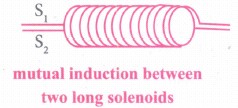
(iii) I1 is the current flowing through the solenoid S1 The magnetic field B1 produced at any point inside the solenoid S1 due to the current I1 is
\({ B }_{ 1 }={ \mu }_{ o }\frac { { N }_{ i } }{ l } { I }_{ 1 }\) ...(1)
(iv) The magnetic flux linked with each turn of S2 is equal to B1A.
Total magnetic flux linked with solenoid S2 having N2 turns is
Φ2 = \(\frac { { \mu }_{ o }{ N }_{ 1 }N_{ 2 }{ AI }_{ 1 } }{ l } \) ...(2)
But Φ2 = MI1 ...(3)
where M is the coefficient of mutual induction between S1 and S2
From equations (2) and (3),
MI1 = \(\frac { { \mu }_{ o }{ N }_{ 1 }N_{ 2 }{ AI }_{ 1 } }{ l } \); M = \(\frac { { \mu }_{ o }{ N }_{ 1 }N_{ 2 }A }{ l } \)
(v) If the core is filled with a magnetic material of permeability μ,
M = \(\frac { { \mu }_{ o }{ N }_{ 1 }N_{ 2 }A }{ l } \)
23.
By differentiating equation twice, we get
q(t) Qm cos(ωt + Φ) ...(1)
\(\frac { { d }^{ 2 }q }{ { dt }^{ 2 } } \) = - Qm ω2 cos (ωt + Φ) ...(2)
Substituting equations (1) and (2) in equation
\(\frac { dU }{ dt } =\frac { 1 }{ 2 } L\left( 2i\frac { di }{ dt } \right) +\frac { 1 }{ 2C } \left( 2q\frac { dq }{ dt } \right) =0\)
(or) \(L\frac { { d }^{ 2 }q }{ { dt }^{ 2 } } +\frac { 1 }{ C } q=0\)
we obtain
L[- Qm ω2 cos (ωt + Φ)] + \(\frac { 1 }{ C } \) Qm cos (ωt + Φ) = 0
Rearranging the terms, the angular frequency of LC oscillations is given by
ω = \(\frac { 1 }{ \sqrt { LC } } \)
This equation is the same as that obtained from qualitative analogy.

12th Standard Syllabus & Materials
12th Standard
TN 12th Computer Applications களப்பெயர் முறைமை (DNS) Sample Question Papers Study Material - QB365 Set A
NEW12th Standard
TN 12th Computer Applications வலையமைப்பு எடுத்துக்காட்டுகள் மற்றும் நெறிமுறைகள் Sample Question Papers Study Material - QB365 Set A
NEW12th Standard
TN 12th Computer Applications கணினி வலையமைப்பு ஓர் அறிமுகம் Sample Question Papers Study Material - QB365 Set A
NEW12th Standard
TN 12th Computer Applications PHP-உடன் MySQL-ஐ இணைத்தல் Sample Question Papers Study Material - QB365 Set A



Tamilnadu Stateboard 12th Standard Subjects

Maths

Chemistry
Physics

Biology

Computer Science

Business Maths and Statistics

Economics

Commerce

Accountancy

History

Computer Applications
Biology
Computer Technology
Computer Applications
Computer Science
Business Maths and Statistics
Commerce
Economics
Maths
Chemistry
Physics
Computer Technology
History
Accountancy

Tamil

English

French
Tamilnadu Stateboard Standards

