
 100% FREE ACCESS
11th Standard Syllabus & Materials
11th Standard
TN 11th Tamil இயற்கை வேளாண்மை,சுற்றுச்சூழல் -செய்யுள் - மனோன்மணீயம் Important Questions And Answers Study Material - QB365 Set A
NEW11th Standard
TN 11th Tamil என்னுயிர் என்பேன் -துணைப்பாடம் - இசைத்தமிழர் இருவர் Important Questions And Answers Study Material - QB365 Set A
NEW11th Standard
TN 11th Tamil மொழி கலை -செய்யுள் - ஒவ்வொரு புல்லையும் Important Questions And Answers Study Material - QB365 Set A
NEW11th Standard
TN 11th Tamil பீடு பெற நில் - இலக்கணம் - பகுபத உறுப்புகள் Important Questions And Answers Study Material - QB365 Set A
NEW11th Standard
TN 11th Tamil பீடு பெற நில் - துணைப்பாடம் - வாடிவாசல் Important Questions And Answers Study Material - QB365 Set A
NEW11th Standard
TN 11th Tamil பீடு பெற நில் - செய்யுள் - குறுந்தொகை Important Questions And Answers Study Material - QB365 Set A

Published on: 30/08/2019
Nature of Physical World and Measurement
Download Tamil Nadu 11th Standard Physics question papers, model tests, one-mark questions, important questions, and public exam papers in PDF format. Free study materials and answer keys for TN State Board students.
Questions + Answers key
Take MCQ Physics Test1.
A length-scale (I) depends on the permittivity (e) of a dielectric material, Boltzmann constant (kB), the absolute temperature (T), the number per unit volume (n) of certain charged particles, and the charge (q) carried by each of the particles. Which of the following expression for I is dimensionally correct?
\(l=\sqrt{{{nq^2}\over{\epsilon {k}_{B}T}}}\)
\(l=\sqrt{{{\epsilon {k}_{B}T}\over{nq^2}}}\)
\(l=\sqrt{{{q^2}\over{e{n}^{{{2}\over{3}}}{k}_{B}}T}}\)
\(l=\sqrt{{{q^2}\over{\epsilon n{k}_{B}T}}}\)
2.
Planck's constant (h), speed of light in vacuum (c) and Newton's gravitational constant (G) are taken as three fundamental constants. Which of the following combinations of these has the dimension of length?
\({{\sqrt{hG}}\over{{c}^{{{3}\over{2}}}}}\)
\({{\sqrt{hG}}\over{{c}^{{{5}\over{2}}}}}\)
\(\sqrt{{{hc}\over{G}}}\)
\(\sqrt{{{Gc}\over{{h}^{{{3}\over{2}}}}}}\)
3.
The dimension of \({\left( {\mu}_{0}{\epsilon}_{0} \right)}^{{{1}\over{2}}}\) is
length
time
velocity
force
4.
If the force is proportional to square of velocity, then the dimension of proportionality constant is
[MLT0]
[MLT-1]
[MLT-2T]
[MLT-1T0]
5.
The density of a material in CGS system of units is 4 g cm-3. In a system of units in which unit of length is 10 cm and unit of mass is 100 g, then the value of density of material will be
0.04
0.4
40
400
6.
Arrive at Einstein's mass-energy relation by dimensional method (E = mc2).
7.
The voltage across a wire is (100 ± 5)V and the current passing through it is (10 ± 0.2) A. Find the resistance of the wire.
8.
The initial and final temperatures of a liquid in a container are observed to be 75.4 ± 0.5°C and 56.8 ± 0.2°C. Find the fall in the temperature of the liquid.
9.
Round off the following numbers as indicated 12.653 up to 3 digits.
10.
Round off the following numbers as indicated 248337 up to digits 3 digits
11.
Round off the following numbers as indicated 101.55 \(\times\) 106 up to 4 digits
12.
Explain the principle of homogeniety of dimensions. What are its uses? Give example
13.
The shadow of a pole standing on a level ground is found to be 45 m longer when the sun's altitude is 30o than when it was 60o. Determine the height of the pole. [Given \(\sqrt { 3 } \)=1.73]
1.
\(\text {Dimension of permittivity } \varepsilon=A^{2} C^{2} N^{-1} m^{-2}\)
\(\text {Dimension of Boltzmann constant } k_{B}=\left[\mathrm{ML}^{2} \mathrm{~T}^{-2} \mathrm{~K}^{-1}\right]\)
\(\text {Dimension of Absolute Temperature }=T\)
No. of charged particles per unit
Volume = No. of dimensions = a
Dimension of charge = AT
Dimension of length = L
\(\text { Dimension of }=\frac{\sqrt{\varepsilon k_{B} T}}{n q^{2}}\)
\(=\frac{\sqrt{\left[\mathrm{A}^{2} \mathrm{C}^{2} \mathrm{~N}^{-1} \mathrm{~m}^{-2}\right]}\left[\mathrm{ML}^{2} \mathrm{~T}^{-2} \mathrm{~K}^{-1}\right][\mathrm{T}]}{[\mathrm{AT}]^{2}}\)
\(=\sqrt{L^{2}}=L\)
\(\therefore \text { Dimension of length }=\mathrm{L}\)
2.
Dimension of Planck's constant is \(\left[\mathrm{ML}^{2} \mathrm{~T}^{-1}\right]\)
Dimension of Gravitational constant is \(\left[\mathrm{M}^{-1} \mathrm{~L}^{+3} \mathrm{~T}^{-1}\right]\)
Dimension of Velocity constant is LT-1
Dimension of Length is L
\(\therefore \text { Dimension of } \frac{\sqrt{h G}}{C^{\frac{3}{2}}}\)
\(=\frac{\sqrt{\left(\mathrm{ML}^{2} \mathrm{~T}^{-1}\right)\left(\mathrm{M}^{-1} \mathrm{~L}^{3} \mathrm{~T}^{-2}\right)}}{\left(\mathrm{LT}^{-1}\right)^{3 / 2}} \)
\(=\frac{\sqrt{\mathrm{L}^{5} \mathrm{~T}^{-3}}}{\mathrm{~L}^{3 / 2} \mathrm{~T}^{-3 / 2}} \)
\(=\frac{\mathrm{L}^{5 / 2} \mathrm{~T}^{-3 / 2}}{\mathrm{~L}^{3 / 2} \mathrm{~T}^{-3 / 2}} \)
\(=\mathrm{L}^{5 / 2-3 / 2} \mathrm{~T}^{3 / 2+3 / 2}=\mathrm{L}^{1} \mathrm{~T}^{0}=\mathrm{L}\)
Dimension of length = L
3.
\(\text { Velocity of light } c=\frac{1}{\sqrt{\mu_{0} \varepsilon_{0}}}\)
\(c=\left(\mu_{0} \varepsilon_{0}\right)^{-\frac{1}{2}}\)
\(\text { Hence dimension }\left(\mu_{0} \varepsilon_{0}\right)^{-\frac{1}{2}} \text { is that of velocity. }\)
4.
F = kv2
Dimensional of k
\(=\frac{\text { Dimension of } \mathrm{F}}{\text { Dimension of }(v)^{2}}\)
\(=\frac{\mathrm{MLT}^{-2}}{\left(\mathrm{LT}^{-1}\right)^{2}}=\frac{\mathrm{MLT}^{-2}}{\mathrm{~L}^{2} \mathrm{~T}^{-2}} \)
\(=\left[\mathrm{ML}^{-1-2} \mathrm{~T}^{-2+2}\right] \)
Dimension of proportionality constant \(=\left[\mathrm{ML}^{-1} \mathrm{~T}^{0}\right]\)
5.
(c)
40
6.
Let us assume that the Energy E depends on mass m and velocity of light c.
\(E\alpha m^ac^b\)
\(E=km^ac^b\) where K a constant
Dimensions of E = [ML2T-2]
Dimensions of m = [M]
Dimensions ofc = [LT-1]
Substituting the values in the above equation
[ML2T-2] = K[M]a [LT-1]b
By equating the dimensions
a = 1
b = 2
-b = -2
E = k.mc2
The value of constant k = 1
E = mc2. This is Einstein's mass energy relation.
7.
Voltage V = (100 ± 5)V
Current I = (10 ± 0.2)A
Resistance R = ?
Then resistance R is given by Ohm's law,
\(R={V\over I}={100\over 10}=10\Omega\)
\({\triangle R\over R}=({\triangle V\over V}+{\triangle I\over I})\)
\({\triangle R\over R}=({\triangle V\over V}+{\triangle I\over I})R=({5\over 100}+{0.2\over 10})10\)
= (0.05 + 0.02)10 = 0.07\(\times\)10 = 0.7
The resistance R = (10 ± 0.7)\(\Omega\)
8.
t1 = (75.4 ± 0.5)0C
t2 = (56.8 ± 0.2)0C
Fall in temperature = (75.4 ± 0.5°C) - (56.8 ± 0.2°C)
t = (18.6 ± 0.7)0C
9.
12.7
10.
248000
11.
101.6\(\times\)106
12.
The principle of homogeneity of dimensions states that the dimensions of all the terms in a physical expression should be the same. For example, in the physical expression v2= u2 + 2as, the dimensions of v2, u2 and 2 as are the same and equal to [L2T-2].
This method is used to
(i) Convert a physical quantity from one system of units to another.
(ii) Check the dimensional correctness of a given physical equation.
(iii) Establish relations among various physical quantities.
(i) To convert a physical quantity from one system of units to another: This is based on the fact that the product of the numerical values (n) and its corresponding unit (u) is a constant. i.e, n1[u1] = constant (or) n, n1[u1 ] = n2[u2].
Consider a physical quantity which has dimension 'a' in mass, 'b' in length and 'c' in time.
If the fundamental units in one system are M1, L1 and T1 and the other system are M2, L2, and T2 respectively, then we can write, n1 [M1a L1b T1c] = n2 [ M 2a L2b T2c]
We have thus converted the numerical value of physical quantity from one system of units into the other system.
Example: Convert 76 cm of mercury pressure into Nm-2 using the method of dimensions.
Solution: In cgs system 76 cm of mercury pressure =76\(\times\)13.6\(\times\)980 dyne cm-2
The dimensional formula of pressure P is [ML-1T-2]
\(P_{1}\left[M_{1}^{a} L_{1}^{b} T_{1}^{c}\right]=P_{2}\left[M_{2}^{a} L_{2}^{b} T_{2}^{c}\right]\)
We have
\(P_{2} =\left[\frac{\mathrm{M}_{1}}{\mathrm{M}_{2}}\right]^{a}\left[\frac{\mathrm{L}_{1}}{\mathrm{~L}_{2}}\right]^{b}\left[\frac{\mathrm{T}_{1}}{\mathrm{~T}_{2}}\right]^{c} \)
\(M_{1} =1 \mathrm{~g}, \mathrm{M}_{2}=1 \mathrm{~kg}\)
\(L_{1}=1 \mathrm{~cm}, \mathrm{~L}_{2}=1 \mathrm{~m}
\)
\(T_{1}=1 \mathrm{~s}, T_{2}=1 \mathrm{~s}\)
So a=1, b=1 and c=-2
Then
\(P_{2} =76 \times 13.6 \times 980\left[\frac{\mathrm{g}}{1 \mathrm{~kg}}\right]^{1}\left[\frac{\mathrm{cm}}{1 \mathrm{~m}}\right]^{-1}\left[\frac{1 \mathrm{~s}}{1 \mathrm{~s}}\right]^{-2} \)
\(=76 \times 13.6 \times 980\left[\frac{10^{-3} \mathrm{~kg}}{1 \mathrm{~kg}}\right]^{1}\left[\frac{10^{-2} \mathrm{~m}}{1 \mathrm{~m}}\right]^{-1}\left[\frac{1 \mathrm{~s}}{1 \mathrm{~s}}\right]^{-2} \)
\(=76 \times 13.6 \times 980 \times\left[10^{-3}\right] \times 10^{2} \)
\(P_{2} =1.01 \times 10^{5} \mathrm{Nm}^{-2}\)
(ii) To check the dimensional correctness of a given physical equation:
Example: The equation \(1\over 2\) mv2 = mgh can be checked by using this method as follows.
Solution: Dimensional formula for
\(\boxed{{1\over 2}mv^2=[M][LT^{-1}]^2=[ML^2T^{-2}]}\)
Dimensional formula for
\(\boxed {mgh=[M][LT^{-2}][L]=[ML^{2}T^{-2}] \\ [ML^{2}T^{2}]=[ML^{2}T^{-2}]}\)
Both sides are dimensionally the same, hence the equations\(1\over 2\) mv2 = mgh is dimensionally correct.
(iii) To establish the relation among various physical quantities:
If the physical quantity Q depends upon the quantities Q1, Q2 and Q3 ie. Q is proportional to Q1, Q2 and Q3.
Then,
\(Q \alpha Q_{1}^{a} Q_{2}^{b} Q_{3}^{c}
\)
\(Q=k Q_{1}^{a} Q_{2}^{b} Q_{3}^{c}\)
where k is a dimensionless constant. When the dimensional formula of Q1, Q2 and Q3 are substituted, then according to the principle of homogeneity, the powers of M, L, T are made equal on both sides of the equation. From this, we get the values of a, b, c.
Example:
Obtain an expression for the time period T of a simple pendulum. The time period T depend upon (i) mass 'm' of the bob (ii) length 'l' of the pendulum and (iii) acceleration due to gravity g at the place where the pendulum is suspended. (Constant k=2π ) i.e
Solution:
\(\boxed{T \alpha m^a l^b g^c \\ T=k.m^al^bg^c}\)
Here k is the dimensionless constant. Rewriting the above equation with dimensions.
\(\boxed{[T^1]=[M^a][L^b][LT^{-2}]^c\\ [M^oL^oT^1]=[M^aL^{b+c}T^{-2c}]}\)
Comparing the powers of M, L and T on both sides, a = 0, b + C = 0, -2c = 1
Solving for a, b and c a = 0, b = 1/2, and c = -1/2
From the above equation
T = k. mo l1/2 g-1/2
T=\(k{1\over g}^{1\over 2}=k\sqrt{1\over g}\)
Experimentally k = 2\(\pi\) , hence \(T=2\pi \sqrt{l\over g}\)
13.
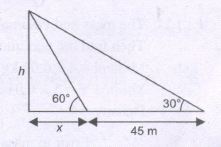
Let the height of the pole be h
Solution \(\frac { x+45 }{ h } \) = cot 30o ⇒ h =\(\frac { x+45 }{ cot\quad { 30 }^{ o } } \)
\(\frac { x }{ h } \) = cot 30o ⇒ x = h cot 60o
Substituting the values of x in the above equation
h = \(\frac { h\quad cot \ { 60 }^{ o }+45 }{ cot \ { 30 }^{ o } } \)
\(h \cot 30^{\circ} =h \cot 60^{\circ}+45
\)
\(h\left(\cot 30^{\circ}-\cot 60^{\circ}\right) =45
\)
\(h =\frac{45}{\cot 30^{\circ}-\cot 60^{\circ}}=\frac{45}{\sqrt{3}-\frac{1}{\sqrt{3}}}=38.97 \mathrm{~m}\)

11th Standard Syllabus & Materials
11th Standard
TN 11th Tamil பீடு பெற நில் - செய்யுள் - காவடிச்சிந்து Important Questions And Answers Study Material - QB365 Set A
NEW11th Standard
TN 11th Tamil பீடு பெற நில் - உரைநடை - மலை இடப்பெயர்கள் : ஓர் ஆய்வு Important Questions And Answers Study Material - QB365 Set A
NEW11th Standard
TN 11th Tamil மாமழை போற்றுதும் - துணைப்பாடம் - யானை டாக்டர் Important Questions And Answers Study Material - QB365 Set A
NEW11th Standard
TN 11th Tamil மாமழை போற்றுதும் - செய்யுள் - ஐங்குறுநூறு Important Questions And Answers Study Material - QB365 Set A



Tamilnadu Stateboard 11th Standard Subjects

Maths

Commerce

Economics

Biology

Business Maths and Statistics

Accountancy

Computer Science
Physics

Chemistry
Maths
Biology
Economics
Physics
Chemistry

History
Business Maths and Statistics

Computer Science
Accountancy

Computer Applications
History
Computer Technology
Commerce
Computer Applications
Computer Technology

Tamil

English

French
Tamilnadu Stateboard Standards

