
 100% FREE ACCESS
11th Standard Syllabus & Materials
11th Standard
TN 11th Tamil இயற்கை வேளாண்மை,சுற்றுச்சூழல் -செய்யுள் - மனோன்மணீயம் Important Questions And Answers Study Material - QB365 Set A
NEW11th Standard
TN 11th Tamil என்னுயிர் என்பேன் -துணைப்பாடம் - இசைத்தமிழர் இருவர் Important Questions And Answers Study Material - QB365 Set A
NEW11th Standard
TN 11th Tamil மொழி கலை -செய்யுள் - ஒவ்வொரு புல்லையும் Important Questions And Answers Study Material - QB365 Set A
NEW11th Standard
TN 11th Tamil பீடு பெற நில் - இலக்கணம் - பகுபத உறுப்புகள் Important Questions And Answers Study Material - QB365 Set A
NEW11th Standard
TN 11th Tamil பீடு பெற நில் - துணைப்பாடம் - வாடிவாசல் Important Questions And Answers Study Material - QB365 Set A
NEW11th Standard
TN 11th Tamil பீடு பெற நில் - செய்யுள் - குறுந்தொகை Important Questions And Answers Study Material - QB365 Set A

Published on: 05/10/2019
Work, Energy and Power
Download Tamil Nadu 11th Standard Physics question papers, model tests, one-mark questions, important questions, and public exam papers in PDF format. Free study materials and answer keys for TN State Board students.
Questions + Answers key
Take MCQ Physics Test1.
Consider an object of mass 2 kg moved by an external force 20 N in a surface having coefficient of kinetic friction 0.9 to a distance 10 m. What is the work done by the external force and kinetic friction? Comment on the result. (Assume g = 10 ms-2)
2.
A weight lifter lifts a mass of 250 kg with a force 5000 N to the height of 5m
(a) What is the work done by the weight lifter?
(b) What is the work done by the gravity?
(c) What is the net work done on the object?
3.
A lighter particle moving with a speed of 10 ms-1 collides with an object of double its mass moving in the same direction with half its speed. Assume that the collision is a one dimensional elastic collision. What will be the speed of both particles after the collision?
4.
An object of mass 2 kg attached to a spring is moved to a distance x = 10 m from its equilibrium position. The spring constant k = 1 N m-1 and assume that the surface is frictionless.
(a) When the mass crosses the equilibrium position, what is the speed of the mass?
(b) What is the force that acts on the object when the mass crosses the equilibrium position and extreme position x = ± 10m?
5.
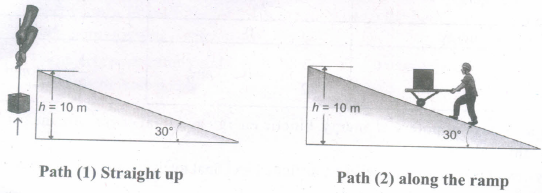
A body of mass 100 kg is lifted to a height 10 m from the ground in two different ways as shown in the figure. What is the work done by the gravity in both the cases? Why is it easier to take the object through a ramp?
6.
A body of mass m is attached to the spring which is elongated to 25 cm by an applied force from its equilibrium position.
(a) Calculate the potential energy stored in the spring-mass system?
(b) What is the work done by the spring force in this elongation?
(c) Suppose the spring is compressed to the same 25 cm, calculate the potential energy stored and also the work done by the spring force during compression. (The spring constant, k= 0.1 N m-1).
7.
Let the two springs A and B be such that kA > kB, On which spring will more work has to be done if they are stretched by the same force?
8.
An object of mass 2 kg is taken to a height 5 m from the ground (g = 10 ms-2).
(a) Calculate the potential energy stored in the object.
(b) Where does this potential energy come from?
(c) What external force must act to bring the mass to that height?
(d) What is the net force that acts on the object while the object is taken to the height 'h'?
9.
Two objects of masses 2 kg and 4 kg are moving with the same momentum of 20 kg m s-1.
(a) Will they have same kinetic energy?
(b) Will they have same speed?
10.
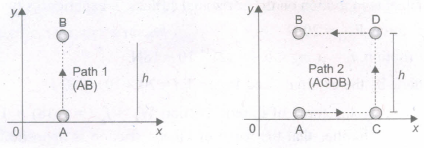
Show that the work done by the conservative force is independent of the path. Consider the following cases
1.
m = 2 kg, d = 10 m, Fext = 20 N, \(\mu\)k = 0.9.
when an object is in motion on he horizontal surface, it experiences two forces.
(a) External force, Fext = 20 N
(b) Kinetic friction,
fk = \(\mu\)k mg = 0.9 \(\times\) (2) \(\times\) 10 = 18N
The work done by the external force Wext = Fd = 20 x 10 = 200J
The work done by the force of kinetic friction Wk = fkd = (-18) \(\times\) 10 = -180 J. Here the negative sign implies that the force of kinetic friction is opposite to the direction of displacement.
The total work done on the object Wtotal = Wext + Wk = 200 J - 180 J = 20 J.
Since the friction is a non-conservative force, out of 200 J given by the external force, the 180 J is lost and it can not be recovered.
2.
a) When the weight lifter lifts the mass, force and displacement are in the same direction, which means that the angle between them θ = 0°. Therefore, the work done by the weight lifter,
Wweight lifter = Fwh cos θ = Fwh (cos 0°)
= 5000\(\times\)5\(\times\)(1) = 25,000 joule= 25 kJ
(b) When the weight lifter lifts the mass, the gravity acts downwards which means that the force and displacement are in opposite direction. Therefore, the angle between them θ = 180°.
Wgravity = Fgh cos θ = mgh( cos 180°)
= 250\(\times\)10\(\times\)5\(\times\)(-1) = -12,500 joule = -12.5 kJ
(c) The net work done (or total work done) on the object
Wnet = Wweight lifter+ Wgravity
= 25 kJ -12.5 kJ = +12.5 kJ
3.
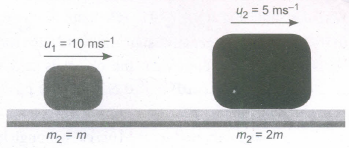
Let the mass of the first body be m which moves with an initial velocity, u1 = 10 m s-1.
Therefore, the mass of second body is 2m and its initial velocity is \({ u }_{ 2 }=\frac { 1 }{ 2 } { u }_{ 1 }=\frac { 1 }{ 2 } (10{ ms }^{ -1 })\)
\({ v }_{ 1 }=\left( \frac { { m }_{ 1 }-{ m }_{ 2 } }{ { m }_{ 1 }+{ m }_{ 2 } } \right) { u }_{ 1 }+\left( \frac { 2m }{ { m }_{ 1 }+{ m }_{ 2 } } \right) { u }_{ 2 }\)
\({ v }_{ 1 }=\left( \frac { { m }_{ 1 }-2m }{ m+2m } \right) +10+\left( \frac { 2\times 2m }{ m+2m } \right) 5\)
\({ v }_{ 1 }=-\left( \frac { 1 }{ 3 } \right) 10+\left( \frac { 4 }{ 3 } \right) 5=\frac { -10+20 }{ 3 } =\frac { 10 }{ 3 } \)
v1 = 3.33 ms-1
\({ v }_{ 2 }=\left( \frac { 2{ m }_{ 1 } }{ { m }_{ 1 }+{ m }_{ 2 } } \right) { u }_{ 1 }+\left( \frac { { m }_{ 2 }-{ m }_{ 1 } }{ { m }_{ 1 }+{ m }_{ 2 } } \right) { u }_{ 2 }\)
\({ v }_{ 2 }=\left( \frac { 2m }{ m+2m } \right) 10+\left( \frac { 2m-m }{ m+2m } \right) 5\)
\({ v }_{ 2 }=\left( \frac { 2 }{ 3 } \right) 10+\left( \frac { 1 }{ 3 } \right) 5=\frac { 20+5 }{ 3 } =\frac { 25 }{ 3 } \)
v2 = 8.33 ms-1
As the two speeds v1 and v2 are positive, they move in the same direction with the velocities 3.33 ms-1 and 8.33 ms-1 respectively.
4.
(a) Since the spring force is a conservative force, the total energy is constant. At x = 10 m, the total energy is purely potential.
\(E=U=\frac { 1 }{ 2 } { kx }^{ 2 }=\frac { 1 }{ 2 } \times (1)\times ({ 10 })^{ 2 }=50\quad J\)
When the mass crosses the equilibrium position (x = 0) the potential energy
\(U=\frac { 1 }{ 2 } \times 1\times (0)=0\quad J\)
The entire energy is purely kinetic energy at this position.
\(E=KE=\frac { 1 }{ 2 } { mv }^{ 2 }=50\quad J\)
The speed \(v=\sqrt { \frac { 2KE }{ m } } =\sqrt { \frac { 2\times 50 }{ 2 } } =\sqrt { 50 } { ms }^{ -1 }=7.07 \ { ms }^{ -1 }\)
(b) Since the restoring spring force is F = -kx, when the object crosses the equilibrium position, it experiences no force. Note that at equilibrium position, the object moves very fast. When the object is at x = +10m (elongation), the force F = -kx.
F = -(1)(10) =-10 N. Here the negative sign implies that the force is towards equilibrium
i.e., towards negative x-axis and when the object is at x = -10 (compression), it experiences a forces F = -(1) (-10) = +10 N. Here the positive sign implies that the force points towards positive x-axis.
The object comes to momentary rest at x = ±10 m even though it experiences a maximum force at both these points.
5.
m = 100 kg, h = 10 m
Along path (1):
The minimum force F1 required to move the object to the height of 10 m should be equal to the gravitational force, F1 = mg = 100 \(\times\) 10 = 1000 N.
The distance moved along path (1) is, h = 10 m.
The work done on the object along path (1) is
W = Fh = 1000 \(\times\) 10 = 10,000 J
Along path (2):
In the case of the ramp, the minimum force F2 that we apply on the object to take it up is not equal to mg, it is rather equal to mg sin \(\theta\). (mg sin \(\theta\) < mg).
Here, angle \(\theta\) = 30°
Therefore, F2 = mg sin \(\theta\) = 100 \(\times\)10 \(\times\) sin30° = 100 \(\times\) 10 \(\times\) 0.5 = 500 N.
Hence, (mg sin \(\theta\) < mg)
The path covered along the ramp is, \(l=\frac { h }{ sin \ 30^o } =\frac { 10 }{ 0.5 } =20 \ m\)
The work done on the object along path (2) is, W = F2 l = 500 \(\times\) 20 = 10,000 J.
Since the gravitational force is a conservative force, the work done by gravity on the object is independent of the path taken.
In both the paths the work done by the gravitational force is 10,000 J.
Along path (1): more force needs to be applied against gravity to cover lesser distance.
Along path (2): lesser force needs to be applied against the gravity to cover more distance,
As the force needs to be applied along the ramp is less, it is easier to move the object along the ramp.
6.
The spring constant, k = 0.1 N m-1
The displacement, x = 25 cm = 0.25 m
(a) The potential energy stored in the spring is given by
\(U=\frac { 1 }{ 2 } { kx }^{ 2 }=\frac { 1 }{ 2 } \times 0.1\times { (0.25) }^{ 2 }=0.0031J\)
(b) The work done Ws by the spring force \(\bar { F } \) is given by,
\({ W }_{ s }=\int _{ 0 }^{ x }{ \overrightarrow { { F }_{ s } } .\overrightarrow { dr } } =\int _{ 0 }^{ x }{ (-k\ x\hat { i } ).(dx\hat { i } ) } \)
The spring force \(\overrightarrow { { F }_{ s } } \) acts in the negative x direction while elongation acts in the positive x direction.
\({ W }_{ s }=\int _{ 0 }^{ x }{ (-kx)dx=-\frac { 1 }{ 2 } { kx }^{ 2 } } \)
\({ W }_{ s }=-\frac { 1 }{ 2 } \times 0.1\times { (0.25) }^{ 2 }=-0.0031\ J\)
Note that the potential energy is defined through the work done by the external agency. The positive sign in the potential energy implies that the energy is transferred from the agency to the object. But the work done by the restoring force in this case is negative since restoring force is in the opposite direction to the displacement direction.
(c) During compression also the potential energy stored in the object is the same.
\(U=\frac { 1 }{ 2 } { kx }^{ 2 }=0.0031\ J\)
Work done by the restoring spring force during compression is given by
\({ W }_{ s }=\int _{ 0 }^{ x }{ { \overrightarrow { F } }_{ s } } \overrightarrow { dr } =\int _{ 0 }^{ x }{ (kx\hat { i } ).(-dx\hat { i } ) } \)
In the case of compression, the restoring spring force acts towards positive x-axis and displacement is along negative x direction.
\({ W }_{ s }=\int _{ 0 }^{ x }{ (-kx)dx=-\frac { 1 }{ 2 } { kx }^{ 2 } } =-0.0031J\)
7.
F = kAxA = kBxB
\({ x }_{ A }=\frac { F }{ { k }_{ A } } ,{ x }_{ B }=\frac { F }{ { k }_{ B } } \)
The work done on the springs are stored as potential energy in the springs.
\({ U }_{ A }=\frac { 1 }{ 2 } { k }_{ A }{ x }_{ A }^{ 2 };\quad { U }_{ B }=\frac { 1 }{ 2 } { k }_{ B }{ x }_{ B }^{ 2 }\)
\(\frac { { U }_{ A } }{ { U }_{ B } } =\frac { { k }_{ A }{ x }_{ A }^{ 2 } }{ { k }_{ B }{ x }_{ B }^{ 2 } } =\frac { { { k }_{ A }\left( \frac { F }{ { k }_{ A } } \right) }^{ 2 } }{ { { k }_{ B }\left( \frac { F }{ { k }_{ B } } \right) }^{ 2 } } =\frac { \frac { 1 }{ { k }_{ A } } }{ \frac { 1 }{ { k }_{ B } } } \)
\(\frac { { U }_{ A } }{ { U }_{ B } } =\frac { { k }_{ B } }{ { k }_{ A } } \)
kA > kB implies that UB > UA.Thus, more work is done on B than A.
8.
(a) The potential energy U = mgh = 2 \(\times\) 10 \(\times\) 5 = 100 J
Here the positive sign implies that the energy is stored on the mass.
(b) This potential energy is transferred from external agency which applies the force on the mass.
(c) The external applied force \(\overrightarrow { { F }_{ a } } \) which takes the object to the height 5 m is \(\overrightarrow { { F }_{ a } } =-\overrightarrow { { F }_{ g } } \)
\(\overrightarrow { { F }_{ a } } =-(-mg\hat { j } )=mg\hat { j } \)
where, \(\hat { j } \) represents unit vector vertical upward direction.
(d) From the definition of potential energy, the object must be moved at constant velocity. So the net force acting on the object is zero.
\(\overrightarrow { { F }_{ g } } +\overrightarrow { { F }_{ a } } =0\)
9.
(a) The kinetic energy of the mass is given by \(KE=\frac { { p }^{ 2 } }{ 2m } \)
For the object of mass 2 kg, kinetic energy is KE1 = \(\frac { ({ 20 })^{ 2 } }{ 2\times 2 } =\frac { 400 }{ 4 } =100 \ J\)
For the object of mass 4 kg, kinetic energy is KE2 = \(\frac { { (20) }^{ 2 } }{ 2\times 4 } =\frac { 400 }{ 8 } =50 \ J\)
Note that KE1 \(\neq \) KE2 i.e., even though both are having the same momentum, the kinetic energy of both masses is not the same. The kinetic energy of the heavier object has lesser kinetic energy than smaller mass. It is because the kinetic energy is inversely proportional to the mass (KE \(\infty \frac { 1 }{ m } \) ) for a given momentum.
(b) As the momentum, p = mv, the two objects will not have same speed.
10.
Force \(\overrightarrow { F } =mg\left( -\hat { j } \right) =-mg\hat { j } \)
Displacement vector \(d\vec{r}\) = dx\(\hat { i } \) + dy \(\hat { j } \)
(As the displacement is in two dimension; unit vectors \(\hat { j } \) and \(\hat { i } \) are used)
(a) Since the motion is only vertical, horizontal displacement component dx s zero. Hence, work done by the force along path 1 (of distance h).
\({ W }_{ push\ \ 1 }=\int _{ A }^{ B }{ \overrightarrow { F } .d\overrightarrow { r } =\int _{ A }^{ B }{ (-mg\hat { j } ).(dy\hat{j})=-mg\int _{ 0 }^{ h }{ dy=-mgh } } } \)
Total work done for path 2 is
\({ W }_{ push\ \ 2 }=\int _{ A }^{ B }{ \overrightarrow { F } .d\overrightarrow { r } =\int _{ A }^{ C }{ \overrightarrow { F } .d\overrightarrow { r } +\int _{ C }^{ D }{ \overrightarrow { F } .d\overrightarrow { r } +\int _{ D }^{ B }{ \overrightarrow { F } .d\overrightarrow { r } } } } } \)
But \(\int _{ A }^{ C }{ \overrightarrow { F } .d\overrightarrow { r } =\int _{ A }^{ B }{ (-mg\hat { j } ).(dx\hat { i } )=0 } } \)
\(\int _{ A }^{ D }{ \overrightarrow { F } .d\overrightarrow { r } =\int _{ C }^{ D }{ (-mg\hat { j } ).(dy\hat { j } )=-mg\int _{ 0 }^{ h }{ dy } =-mgh } } \)
\(\int _{ D }^{ B }{ \overrightarrow { F } .d\overrightarrow { r } =\int _{ A }^{ B }{ (-mg\hat { j } ).(dx\hat { i } )=0 } } \)
Therefore, the total work done by the force along the path 2 is
\({ W }_{ push\ \ 2 }=\int _{ A }^{ B }{ \vec { F } } .d\overrightarrow { r } =-mgh\)
Note that the work done by the conservative force is independent of the path.

11th Standard Syllabus & Materials
11th Standard
TN 11th Tamil பீடு பெற நில் - செய்யுள் - காவடிச்சிந்து Important Questions And Answers Study Material - QB365 Set A
NEW11th Standard
TN 11th Tamil பீடு பெற நில் - உரைநடை - மலை இடப்பெயர்கள் : ஓர் ஆய்வு Important Questions And Answers Study Material - QB365 Set A
NEW11th Standard
TN 11th Tamil மாமழை போற்றுதும் - துணைப்பாடம் - யானை டாக்டர் Important Questions And Answers Study Material - QB365 Set A
NEW11th Standard
TN 11th Tamil மாமழை போற்றுதும் - செய்யுள் - ஐங்குறுநூறு Important Questions And Answers Study Material - QB365 Set A



Tamilnadu Stateboard 11th Standard Subjects

Maths

Commerce

Economics

Biology

Business Maths and Statistics

Accountancy

Computer Science
Physics

Chemistry
Maths
Biology
Economics
Physics
Chemistry

History
Business Maths and Statistics

Computer Science
Accountancy

Computer Applications
History
Computer Technology
Commerce
Computer Applications
Computer Technology

Tamil

English

French
Tamilnadu Stateboard Standards

