
 100% FREE ACCESS
11th Standard Syllabus & Materials
11th Standard
TN 11th Tamil இயற்கை வேளாண்மை,சுற்றுச்சூழல் -செய்யுள் - மனோன்மணீயம் Important Questions And Answers Study Material - QB365 Set A
NEW11th Standard
TN 11th Tamil என்னுயிர் என்பேன் -துணைப்பாடம் - இசைத்தமிழர் இருவர் Important Questions And Answers Study Material - QB365 Set A
NEW11th Standard
TN 11th Tamil மொழி கலை -செய்யுள் - ஒவ்வொரு புல்லையும் Important Questions And Answers Study Material - QB365 Set A
NEW11th Standard
TN 11th Tamil பீடு பெற நில் - இலக்கணம் - பகுபத உறுப்புகள் Important Questions And Answers Study Material - QB365 Set A
NEW11th Standard
TN 11th Tamil பீடு பெற நில் - துணைப்பாடம் - வாடிவாசல் Important Questions And Answers Study Material - QB365 Set A
NEW11th Standard
TN 11th Tamil பீடு பெற நில் - செய்யுள் - குறுந்தொகை Important Questions And Answers Study Material - QB365 Set A

Published on: 22/08/2018
objective type
Download Tamil Nadu 11th Standard Maths question papers, model tests, one-mark questions, important questions, and public exam papers in PDF format. Free study materials and answer keys for TN State Board students.
Questions + Answers key
Take MCQ Maths Test1.
Find the range of the function.
f = {1, x), (1, y), (2, x), (2, y), (3, z)}
2.
3.
If f:R \(\rightarrow\) R is defined by f(x) = 3x - 5, prove that f is a bijection and find its inverse.
4.
Consider the function \(f:[0,{\pi\over 2}]⟶R\) given by f(x) = sin x and \(g:[0,{\pi\over 2}]⟶R\)given by g(x) = cos x. Show that f and g are one-one but (f + g) is not one-one.
5.
Let A = R - [2] and B = R - [1]. If f : A ⟶ B is a mapping defined by \(f(x)={x-1\over x-2}\) Show that f is one-one and onto.
6.
On the set of natural numbers let R be the relation defined by aRb if 2a + 3b = 30. Write down the relation by listing all the pairs. Check whether it is transitive
7.
Let f and g be real functions defined by \(f(x)=\sqrt{x+2}\) and \(g(x)=\sqrt{4-x^2}\) Find f/g
8.
Let f and g be real functions defined by \(f(x)=\sqrt{x+2}\)and \(g(x)=\sqrt{4-x^2}\). Find f-g
9.
Let f and g be real functions defined by \(f(x)=\sqrt{x+2}\)and \(g(x)=\sqrt{4-x^2}\). Find f + g
10.
Show that the relation R defined on the set A of all polygons as R = {(P1 P2) : P1 and P2 have same number of sides} is an equivalence relation.
11.
Show that the relation R on the set A = {x ∈ Z : 0 < x < 12} given by R = {(a, b) : |a - b| is a multiple of 4} is an equivalence relation
12.
For A = {0,1,2,3, 4}, B = {1, -2, 3, 4, 5, 6} and C = {2, 4, 6, 7} verify A\(B ∩ C) = (A\B) U(A\C) Using venn diagram.
13.
Let A = {a, b, c, d}, B = {a, c, e}, C = {a, e}.
Verify using Venn diagram.
14.
Let A = {a, b, c, d}, B = {a, c, e}, C = {a, e}.
Show that A ∩ (B ∩ C) = (A ∩ B) ∩ C
15.
From the curve y = sin x, graph the functions.
(i) y = sin(-x)
(ii) y = -sin(-x)
(iii) \(y=sin\left( {\pi\over 2}+x\right)\) which is cos x
(iv) \(y=sin\left({\pi\over 2}-x \right)\) which is also cos x (refer trigonometry)
16.
The function for exchanging American dollars for Singapore Dollar on a given day is f(x) = 1.23x, where x represents the number of American dollars. On the same day function for exchanging Singapore dollar to Indian Rupee is g(y) = 50.50y, Where y represents the number of Singapore dollars. Write a function which will give the exchange rate of American dollars in terms of Indian rupee
17.
If A and B are any two finite sets having m and n elements respectively then the cardinality of the power set of A \(\times\) B is ___________
2m
2n
mn
2mn
18.
n[P[P[p(Ø)]]] =
2
1
4
8
19.
If A = {1, 2}, B = {1, 3} then n(A x B) = ___________
2
4
8
0
20.
If \(f(x)={1-x\over 1+x},(x\neq0)\) then f-1(x) =
f(x)
\(1\over f(x)\)
-f(x)
-\(1\over f(x)\)
21.
The domain of the function \(f(x)=\sqrt{4-\sqrt{4-\sqrt{4-x^2}}}\)
(-∞, 4)
(-4, ∞)
(- 2,2)
[- 2,2]
22.
The domain of the function \(f(x)=\sqrt{ x - 5 }+ \sqrt{6 - x}\) is
[5, ∞)
(- ∞, 6)
[5, 6]
(-5, ≠6)
23.
Which of the following functions is an even function?
\(f(x)={2^x+2^{-n}\over 2^x-2^{-x}}\)
\(f(x)={3^x+1\over 3^x-1}\)
\(f(x)={x.3^x-1\over 3^x+1}\)
\(f(x) = log (x +\sqrt{x^2 + 1})\)
24.
Which one of the following statements is false? The graph of the function \(f(x)={1\over x}\)
exist is the first and third quadrant only
is a reciprocal function
is defined at x = 0
it is symmetric about y = x and y = - x.
25.
Let S = (1, 2, 3), R be (1, 1) (1, 2) (2, 2) (1, 3) (3, 1), what are the elements to-be included to make R reflexive ___________
(3, 3)
(2, 3)
(3, 2)
none of these
26.
The number of reflective relations one set containing n elements is __________
212
24
216
28
27.
The range of the function \(f(x) = \left| \left\lfloor x \right\rfloor - x \right| ,x \in R\) is
[0, 1]
[0, ∞)
[0, 1)
(0, 1)
28.
Let X = {1, 2, 3, 4} and R = {(1, 1), (1, 2), (1, 3), (2, 2), (3, 3), (2, 1), (3, 1), (1, 4),(4, 1)}. Then R is
reflexive
symmetric
transitive
equivalence
29.
Let R be the universal relation on a set X with more than one element. Then R is
not reflexive
not symmetric
transitive
none of the above
30.
If f(x) = |x - 2| + |x + 2|, x ∈ R, then
\(f(x)=\left\{\begin{array}{lll} -2 x & \text { if } & x \in(-\infty,-2] \\ 4 & \text { if } & x \in(-2,2] \\ 2 x & \text { if } & x \in(2, \infty) \end{array}\right.\)
\(f(x)=\begin{cases}2x\ if\ x∈(-∞,-2] \\4x\ if \ x∈(-2,2]\\ - 2x\ if\ x∈(2,∞)\end{cases}\)
\(f(x)=\begin{cases}-2x\ if\ x∈(-∞,-2] \\-4x\ if \ x∈(-2,2]\\ 2x\ if\ x∈(2,∞)\end{cases}\)
\(f(x)=\begin{cases}-2x\ if\ x∈(-∞,-2] \\2x\ if \ x∈(-2,2]\\ 2x\ if\ x∈(2,∞)\end{cases}\)
31.
The relation R defined on a set A= {0,-1, 1, 2} by xRy if |x2+y2| ≤ 2, then which one of the following is true?
R = {(0,0), (0,-1), (0, 1), (-1, 0), (-1, 1), (1, 2), (1, 0)}
R-1 = {(0,0), (0,-1), (0, 1), (-1, 0), (1, 0)}
Domain of R is {0,-1, 1, 2}
Range of R is {0,-1, 1}
32.
If A = {(x,y) : y = sin x, x ∈ R} and B = {(x,y) : y = cos x, x ∈ R} then A∩B contains
no element
infinitely many elements
only one element
cannot be determined
33.
Which of the following is not an equivalence relation on z?
aRb ⇔ a+b is an even integer
aRb ⇔ a-b is an even integer
aRb ⇔ a
aRb ⇔ a=b
34.
Let R be a relation on the set N given by R = {(a,b) : a = b - 2, b > 6}. Then ____________
(2,4)∈R
(3,8)∈R
(6,8)∈R
(8,7)∈R
35.
Let f:R➝R be defined by f(x) = 1 - |x|. Then the range of f is
R
(1,∞)
(-1,∞)
(-∞,1]
36.
Let X = {1, 2, 3, 4}, Y = {a, b, c, d} and f = {(1, a), (4, b), (2, c), (3, d), (2, d)}. Then f is
an one-to-one function
an onto function
a function which is not one-to-one
not a function
37.
Let us now draw the graph of y = 2 sin ( x - 1 ) + 3.
38.
Consider the functions:
i) \(f(x)=x^2,\)
ii) \(f(x)={1\over 2}x^2,\)
iii) \(f(x)=2x^2\)
39.
Consider the positive branches y2 = x and y2 = -x.
40.
Find the range of the following functions given by \( f(x) = \frac { 1 }{ 2-sin\ 3x } .\)
41.
Let f = {(1, 4), (2, 5), (3, 5)} and g = {(4, 1), (5, 2), (6, 4)}. Find g o f. Can you find f o g?
42.
Let f = {(1, 2), (3, 4), (2, 2)} and g = {(2, 1), (3, 1), (4, 2)}. Find g o f and f o g.
43.
Find the largest possible domain for the real valued function given by \(f(x)={\sqrt{9-x^2}\over{x^2-1}}.\)
44.
The weight of the muscles of a man is a function of his body weight x and can be expressed as W(x) = 0.35x. Determine the domain of this function.
45.
If f, g, h are real valued functions defined on R, then prove that (f + g) o h = f o h + g o h. What can you say about f o(g + h)? Justify your answer.
46.
Show that the relation is congruent to on the set of all triangles in a plane is an equivalence relation.
47.
If R is the set of all real numbers, what do the cartesian products R \(\times\) R and R \(\times\)R \(\times\)R represent?
48.
Draw venn diagram of three sets A, B and C which illustrates the following:
A ∩ B ∩ C
49.
Write a description of each shaded area. Use symbols U, A, B, C, U, ∩, and as necessary.
.png)
50.
Write a description of each shaded area. Use symbols U, A, B, C, U, ∩, ' and \ as necessary.
.png)
51.
Let A and B be two sets. Using properties of sets prove that A ∩ B' = Φ ⇒ A ⊂ B.
52.
Which of the following sets are finite and which are infinite?
{x ∈ R: 0 < x < 1}
53.
Which of the following sets are finite and which are infinite?
Set of concentric circles in a plane.
54.
Find the pairs of equal sets from the following sets. A = {0}, B = {x : x > 15 and x < 5}, C = {x : x - 5 = 0}, D = {x : x2 = 25}, E = {x : x is an integral positive root of the equation x2 - 2x - 15 = 0}.
55.
Find the range of the function \(\frac { 1 }{ 2cosx-1 } \)
56.
Let A={1,2,3,4} and B = {a,b,c,d}. Give a function from A\(\rightarrow\)B for each of the following:
neither one-to-one and nor onto.
57.
Let P be the set of all triangles in a plane and R be the relation defined on P as aRb if a is similar to b. Prove that R is an equivalence relation.
58.
Show that the function f : R ⟶ R given by f(x) = cos x for all x ∈ R is neither one-one nor onto.
59.
Find the quotient of the identity function by the modulus function
60.
If n (p(A)) = 1024, n(A\(\cup\)B) = 15 and n(p(B)) = 32, then find n(A\(\cap\)B).
61.
By taking suitable sets A, B, C, verify the following results:
(B - A) \(\cup\) C = (B\(\cup\)C) - (A-C)
62.
If A = { 0, 1, 2, 3, 4, 5, 6, 7 } is a set. Then,
63.
Find the domain and range of the function f(x) = \(\frac { { x }^{ 2 }-9 }{ x-3 } \).
64.
Write the following sets in roster form, {x \(\in \) N; x3<1000}
65.
Check the following functions for one-to-oneness and ontoness.
(i) \(f:N\rightarrow N\) defined by f(n) = n2.
(ii) \(f: \mathbb{R} \rightarrow \mathbb{R}\) defined by f(n) = n2.
66.
Check whether the following functions are one-to-one and onto.
(i) \(f:N\rightarrow N\) defined by f(n) = n + 2.
(ii) \(f: \mathbb{N} \cup\{-1,0\} \rightarrow \mathbb{N}\) defined by \(f(n)=n+2\)
67.
Let S = {1, 2, 3} and \(\rho\) = {(1, 1), (1, 2), (2, 2), (1, 3), (3, 1)}.
(i) Is \(\rho\) reflexive? If not, state the reason and write the minimum set of ordered pairs to be included to p so as to make it reflexive.
(ii) Is \(\rho\) symmetric? If not, state the reason, write minimum number of ordered pairs to be included to \(\rho\) so as to make it symmetric and write minimum number of ordered pairs to be deleted from p so as to make it symmetric,
(iii) Is \(\rho\) transitive? If not, state the reason, write minimum number of ordered pairs to be included to \(\rho\) so as to make it transitive and write minimum number of ordered pairs to be deleted from \(\rho\) so as to make it transitive.
(iv) Is \(\rho\) an equivalence relation? If not, write the minimum ordered pairs to be included to \(\rho\) so as to make it an equivalence relation.
68.
State whether the following relations are functions or not. If it is a function check for one-to-oneness and onto-ness. If it is not a function state why?
If A = {a, b, c} and f = {(a, c) (b, c) (c, b)} : (f : A \(\rightarrow\)A).
69.
Consider f : {1, 2, 3} ⟶ {a, b, c} given by f(1) = a, f(2) = b and f(3) = c. Show that (f-1)-1 = f
70.
Show that the function f : R➝R given by f(x) = x2 is neither one-one nor onto.
71.
If H = {x : 3 ≤ x ≤ 5}, can 4.7∈H
72.
Using Venn diagram verify (AUB)'=A'⋂B'
73.
If A⊂B then find A⋂B and A\B (using venn diagram)
74.
Check whether the following sets are disjoint where p = {x : x is a prime < 15} and Q = {x : x is a multiple of 2 and x < 16}
75.
If A = {x : x is a multiple of 5, x ≤ 30 and x ∈ N}
B = {1, 3, 7, 10, 12, 15, 18, 25} then find AUB
1.
The range of the function is {x, y, z}.
2.
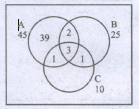
3.
Let y = 3x -5.
\(\Rightarrow y+5=3x\Rightarrow \frac { y+5 }{ 3 } =x\)
Let g(y) = \(\frac { y+5 }{ 3 } \)
\(gof(x)=g(f(x))=g(3x-5)=\frac { 3x-5+5 }{ 3 } =\frac { 3x }{ 3 } =y\)
Also f o g(y) = f(g(y)) = \(f\left( \frac { y+5 }{ 3 } \right) =3\left( \frac { y+5 }{ 3 } \right) -5=y+5-5=y\)
Thus g o f = Ix and fog = Iy.
This implies that f and g are bijections and inverses to each other.
Hence f is a bijection and f-1(y) = \(\frac { y+5 }{ 3 } \)
Replacing y by x we get, f-1(x) = \(\frac { x+5 }{ 3 } \)
4.
For any two distinct elements x1, x2 in \([0,{\pi\over 2}]\)
in x1 = sin x2 ⇒ x1 = x2
∴ f is one - one...(1)
Also cos x1 = cos x2 ⇒ x1 = x2
∴ g is also one-one...(2)
Now, (f + g) (x) = f(x) + g(x) = sin x + cos x
⇒ (f+g)(0) = sin0 + cos0 = 0+1=1
and \(f+g\left(\pi\over 2\right)=sin\frac{\pi}{2}+cos{\pi}{2}=1+0=1\)
(f+g)(0) = (f+g)\((\frac{\pi}{2})\) ⇒ 0 ≠ \(\frac{\pi}{2}\)
∴ (f + g) is not one-one...(3)
From (1), (2) and (3), we get f and g are one-one but (f +g) is not one-one.
5.
Let x, y be any two elements of A.Then f(x) = f(y)
\(⇒\ \ {x-1\over x-2}={y-1\over y-2}\)
(x-1)(y-2) = (y-1)(x-2)

-2x - y + 2y + x = 0
-x + y = 0
x = y
∴ f(x) = f(y) ⇒ x = y for all x,y ∈ A
∴ f is one-one.
Let y be an arbitrary element of B.
Then f(x) = \(y⇒{x-1\over x-2}=y\)
⇒ (x - 1) = y (x - 2) ⇒ x-1 = xy - 2y
⇒ x - xy = 1 - 2y
⇒ x (1-y) = 1- 2y
\(⇒\ x={1-2y\over 1-y}\)
Clearly \(x={1-2y\over 1-y}\) is a real number for all y≠1. Also \({1-2y\over 1-y}≠2\)
Thus, every element y in B has is pre-image in A ∴ f is onto.
Hence,f is one-one and onto.
6.
Given relation is 2a + 3b = 30 for all a, b \(\in \) N.
2a + 3b = 30 \(\Rightarrow\) 2a =30 - 3b
\(\Rightarrow a=\frac { 30-3b }{ 2 } \)
| a | 12 | 9 | 6 | 3 |
| b | 2 | 4 | 6 | 8 |
\(\therefore\) The list of ordered pairs are (12, 2) (9, 4) (6, 6) (3, 8)
Transitivity: Clearly R is not transitive.
7.
Given \(f(x)=\sqrt{x+2}\)and \(g(x)=\sqrt{4-x^2}\) Clearly, f(x) is defined for all x, satisfying x + 2 > 0 ⇒x > -2 ⇒ x ∈[-2, ∞]
∴ Domain of f = [-2, ∞]
Also, g(x) is defined for all x satisfying 4 - x2 ≥ 0 ⇒ x2 - 4 < 0 ⇒ (x - 2) (x + 2) < 0
⇒ x ∈ [-2, 2]
∴ Domain of g = [-2, 2]
Given \(g(x)=\sqrt{4-x^2},\ x)=0⇒4-x^2=0⇒x=±2\)
So, domain of \(\left(f\over g\right)=[-2, 2] ⇒ -[-2, 2] = (-2, 2)\)
\(∴\left(f\over g\right):(-2, 2)⟶R\) is given by
\(\left(f\over g\right)(x)={f(x)\over g(X)}={\sqrt{x+2}\over\sqrt{4-x^2}}={1\over \sqrt{2-x}}\)
8.
Given \(f(x)=\sqrt{x+2}\)and \(g(x)=\sqrt{4-x^2}\) Clearly, f(x) is defined for all x, satisfying x + 2>0 ⇒x > -2 ⇒ x ∈[-2, ∞)
∴ Domain of f = [-2, ∞)
Also, g(x) is defined for all x satisfying 4 - x2 ≥ 0 ⇒ x2 - 4 < 0 ⇒ (x - 2) (x + 2) < 0
⇒ x ∈ [-2, 2]
∴ Domain of g = [-2, 2]
(f - g) : [-2, 2] ⟶ R is given by \((f- g)(x) =f(x) - g(x) =\sqrt{x+2}+\sqrt{4-x^2}\)
9.
Given \(f(x)=\sqrt{x+2}\)and \(g(x)=\sqrt{4-x^2}\) Clearly, f(x) is defined for all x, satisfying x + 2 > 0 ⇒x > -2 ⇒ x ∈[-2, ∞)
∴ Domain of f = [-2, ∞)
Also, g(x) is defined for all x satisfying 4 - x2 ≥ 0 ⇒ x2 - 4 < 0 ⇒ (x - 2) (x + 2) < 0
⇒ x ∈ [-2, 2]
∴ Domain of g = [-2, 2]
(f + g) : [-2, 2] ⟶ R is given by \((f+ g)(x) =f(x) + g(x) =\sqrt{x+2}+\sqrt{4-x^2}\)
10.
The relation R on the set of all polygons is defined as R = {(P1, P2): P1 and P2 have same number of sides}
Reflexivity : Let P be any polygon in A. Then P and P have same number of sides.
⇒ (P, P) ∈ R
⇒ R is reflexive on A.
Symmetry : Let P1 and P2 be two polygons in A such that (P1, P2) ∈ R
(P1, P2) ∈ R ⇒ P1 and P2 have same number of sides.
⇒ P2 and P1 have same number of sides.
⇒ (P2, P1)∈ R
∴ R is symmetric on A
Transitivity : Let P1, P2, P3 be three polygons in A such that (P1, P2) ∈ R and (P2, P3) ∈ R.
⇒ P1 and P2 have same number of sides and P2 and P3 have same number of sides.
⇒ P1 and P3 have same number of sides.
⇒ (P1, P3) ∈ R
∴ R is transitive.
Hence, R is an equivalence relation.
11.
Given R = {(a, b) : |a - b| is a multiple of 4}
Reflexivity: Where a, b ∈ A = {0, 1, 2, ... 12}. For any a ∈ A, we have |a - a| = 0 which is a multiple of 4.
⇒ (a, a) ∈ A for all a ∈ A
∴ R is reflexive
Symmetry: Let (a, b) ∈ R. Then
(a, b) ∈ R
⇒ |a - b| is a multiple of 4.
⇒ |a - b| = 4⋋- for some ⋋∈N.
⇒ |b - a| = 4⋋- for some ⋋∈N.
⇒ (b, a) ∈N
∴ R is symmetric Transitivity: Let (a, b) ∈ R and (b, c) ∈ R
Then (a, b) ∈ R and (b, c) ∈ R
⇒ |a - b| is a multiple of 4 and |b - c| is a multiple of 4.
⇒ |a - b| = 4⋋ and |b - c| = 4μ for some ⋋ μ∈ N
⇒ a-b = ±4 -and b-c = ±4μ for some ⋋, μ ∈ N
⇒ a-c = ±4⋋ ±4μ for some ⋋, μ ∈ N
⇒ |a - c| is a multiple of 4.
⇒ (a-c)∈R
∴ R is transitive.
Hence, R is an equivalence relation.
12.
B ⋂ C = {4, 6}
A\(B ⋂ C) = {0, 1, 2, 3}
A\B = {0,2}
A\B = {0, 1, 3}
(A\B) U (A\C)= {a, 1,2, 3}
From (1) and (2), A\(B ∩ C) = (A\B) U (A\C)
Venn diagram:
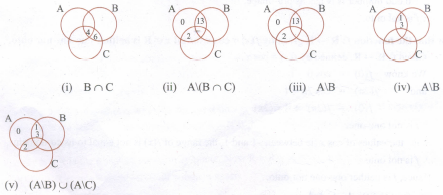
From (ii) and (v), we get
A\(B ∩ C) = (A\B) U (A\C)
13.
Venn diagram
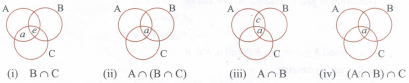
From (ii) and (iv), it is clear that A ∩ (B ∩ C) = (A ∩ B) ∩ C.
14.
Given A = {a, b, c, d}, B = {a, c, e}, C = {a, e}
B∩C = {a, c}
A∩(B∩C) = {a}
A ∩ B = {a, e}
(A ∩ B) ∩ C = {a}
From (1) and (2), it is clear that A ∩ (B ∩ C) = (A ∩ B) ∩ C.
15.
(i) y = sin (-x)
.png)
Let y = sin x.
Then sin(-x) is the reflection of the graph of sin x, about y-axis.
(ii) y = -sin(-x)
.png)
-sin(-x) is the reflection of the graph of sin(-x) about the x-axis.
(iii) \(y=sin\left( {\pi\over 2}+x\right)\)
.png) Let y = sinx.
Let y = sinx.
Then \(sin\left( {\pi\over 2}+n\right)\)causes the shift to the left for \(\pi\over 2\) unit to the sin x curve.
(iv) \(y=sin\left({\pi\over 2}-x \right)\)
.png)
Let y = sin x. Then \(sin\left( {\pi\over 2}-n\right)\) causes the shift to the left for \(\pi\over 2\) unit to the sin (-x) curve.
16.
Given f(x) = 1.23x where x represents the number of American dollars.
and g(y) = 50.50y where y represents the number of Singapore dollars.
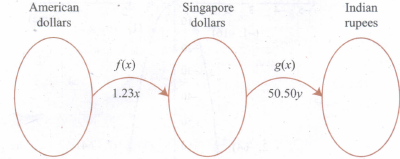
To convert American dollars to Indian rupees, we have to find out go f(x)
∴ go f(x) = g(f(x))
= g(1.23x)
= 50.50[1.23x]
= 62.115x
∴ The function for exchange rate of American dollars in terms of Indian rupee is g o f (x) = 62.115x.
17.
(d)
2mn
18.
(c)
4
19.
(b)
4
20.
(a)
f(x)
21.
(d)
[- 2,2]
22.
(c)
[5, 6]
23.
(c)
\(f(x)={x.3^x-1\over 3^x+1}\)
24.
(c)
is defined at x = 0
25.
(a)
(3, 3)
26.
(a)
212
27.
\(\mathrm{f}(x)=\left\lfloor\begin{array}{lll} x & -x \mid, \mathrm{f}(x) \end{array}=\left\lfloor\begin{array}{ll} x & -x \end{array}\right.\right.\)
\(f(0) =0-0=0 \)
\(f(6.5) =6-6.5=|-0.5|=0.5 \)
\(f(-7.2) =8-7.2=0.8 \)
\(\therefore \text { Range is }[0,1)\)
28.
\(\text { If } 4 \in X \text { then }(4,4) \notin \mathrm{R}\)
R is not reflexive
symmetric can be easily checked
29.
Let X = (a, b, c)
Then R = Universal relation
= {(a, a), (a, b), (a, c), (b, a), (b, b), (b, c), (c, a), (c, b), (c, c)}.
It is transitive
30.
\(\text { If } x \in(-\infty,-2), \text { Let } x=-3\)
\(\text { then } f(x)=|-5|+|1|=6=-2 x\)
\(\text { If } x \in(-2,-2), \text { Let } x=0 \text { then }\)
\(f(x)=|0-2|+|0+2|=4\)
\(\text { If } x \in(2, \infty), \text { Let } x=4\)
\(\text { then } f^{}(x)=|2|+|6|=8=2 x\)
\(\therefore \mathrm{f}(x)=\left\{\begin{array}{rl} -2 x & x \in(-\infty,-2] \\ 4 & x \in(-2,2] \\ 2 x & x \in(2, \infty) \end{array}\right.\)
31.
\(\text { Since }\left|x^{2}+y^{2}\right|<2, x, y \text { must be } 0,1,-1 \text {. }\)
32.
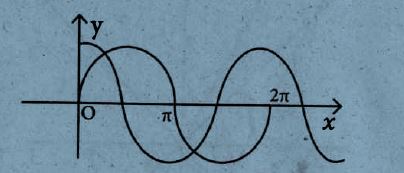
33.
(c)
aRb ⇔ a
34.
(c)
(6,8)∈R
35.
\(\mathrm{f}: \mathbb{R} \rightarrow \mathbb{R} \text { is defined by }\)
\(\mathrm{f}(x)=1-|x|\)
\(\text { The range is }(-\infty, 1] \text { as } f(-\infty)=-\infty\)
\(f(0)=1\)
\(f(\infty) =-\infty\)
36.
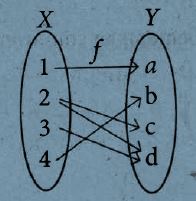
It is not a function since it has two images
37.
It is clear that the curve can be obtained from that of y = sin x using translation and dilation. So first we draw y = sin x. From that it is easy to draw the curve y = sin (x - 1), then draw y = 2 sin (x - 1) and finally y = 2 sin (x - 1) + 3.
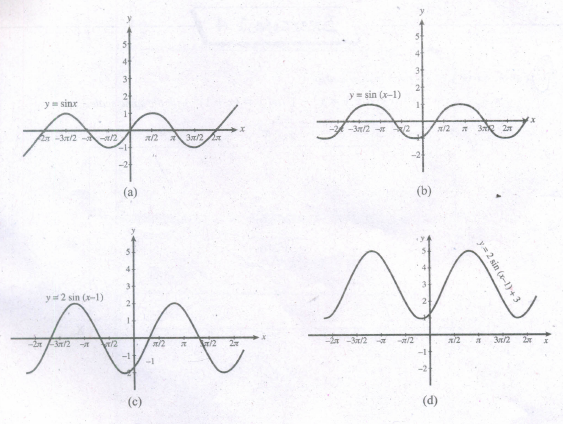
38.
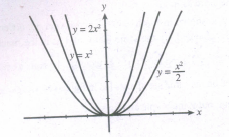
\(f(x)={1\over 2}x^2\) causes the graph of the function \(f(x)=x^2\) stretches towards x-axis since the multiplying factor is \({1\over 2}\) which is less than one. \(f(x)=2x^2\)causes the graph of the function \(f(x)=x^2\) compresses towards the y-axis that is, moves away from the x-axis since the multiplying factor is 2 which is greater than one.
39.
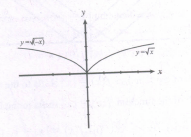
For the curve \(f(x)=\sqrt{x},\) we have \(f(-x)=\sqrt{-x}\) and hence \(f(-x)=\sqrt{-x}\) where x < 0, is the reflection of \(f(x)=\sqrt{x}\) about y-axis.
40.
We have \(f(x) =\frac { 1 }{ 2-sin\ 3x } \)
-1 ≤ sin 3x ≤ 1 for all x \(\in\) R
⇒ -1 ≤ - sin 3x ≤ 1 for all x \(\in\) R
⇒ 1 ≤ 2 - sin 3x ≤ 3 for all x \(\in\) R
⇒ 2 - sin 3x ≠ 0 for all x \(\in\) R
⇒ f(x) = \(\frac { 1 }{ 2-sin\ 3x } \) is defined for all x \(\in\) R
Hence, domain (f) =R
Range of f: As discused above
1 ≤ 2 - sin 3x ≤ 3 for all x \(\in\) R
⇒ \(\frac { 1 }{ 3 } \le \frac { 1 }{ 2-sin\ 3x } \)-sin3x ≠ 0 for all x \(\in\) R
⇒ \(\frac { 1 }{ 3 } \)≤ f(x) ≤1 for all x \(\in\) R.
⇒ f(x) \(\in\) R [1/3, 1]
Hence, range (f) = [1/3, 1]
41.
Clearly, g o f = {(1, 1), (2, 2), (3, 2)}. But f o g is not defined because the range of g = {1, 2, 4} is not contained in the domain of f = {1, 2, 3}.
42.
To check whether compositions can be defined, let us find the domain and range of these functions.
Domain of f = {1, 2, 3}, Range of f = {2, 4}, Domain of g = {2, 3, 4} and Range of g = {1, 2}. Since the range of f is contained in the domain of g we can define g o f, so as to find the image of 1 under g o f, we first find the image of 1 under f and then its image under g. The image of 1 under f is 2 and its image under g is 1. So (g o f) (1) = g(f(1)) = g(2) = 1.
Similarly we find that (g o f) (2) = 1 and (g o f) (3) = 2. So g o f = {(1, 1), (2, 1), (3, 2)}.
Similarly f o g = {(2, 2), (3, 2), (4, 2)}.
43.
If x < -3 or x > 3, then x2 will be greater than 9 and hence 9 - x2 will become negative which has no square root in R.
So x must lie on the interval [- 3, 3].
Also if \(x\ge-1\) or \(x\le 1,\) then x2-1 will become negative or zero. If it is negative, x2 - 1 has no square root in R. If it is zero, f is not defined. So, x must lie outside [- 1, 1].
That is x must lie on \(( -\infty,-1 ]\cup[1,\infty),\) Combining these two conditions, the largest possible domain for f is \([-3,3]\cap((-\infty, -1)\cup(1,\infty)).\) That is \([-3,-1)\cup(1, 3].\)
44.
Given w(x) = 0.35x
Since x represents the number of men, it will take only positive integers.
\(\therefore\) W : W \(\rightarrow\) R+
Hence the domain is the set of whole numbers.
45.
(i) Since f, g, h are functions from R \(\rightarrow\) R,
(f + g)o h: R \(\rightarrow\) R and f o h + g o h: R\(\rightarrow\) R. For any x \(\in \) R,
[(f + g)oh](x) = (f + g)(h(x) - f(h(x)) + g(h(x)) = f o h(x) + g o h(x)
(f + g)o h = f o h + g o h
(ii) Also fo(g + h) = f[(g + h)(x)] for any x \(\in \)R
= f[g(x) + h(x)] = f(g(x) + f(h(x)) = f o g(x) + f o h(x)
\(\therefore\) fo(g + h) = fog(x) + f o h(x).
46.
Let S be the set of all triangles in a plane and let R be the relation on S defined by (Δ1, Δ2) ∈ R⇔ triangle Δ1 is congruent to triangle Δ2.
Reflexivity : For each triangle Δ ∈ S, we have Δ = Δ ⇒ (Δ, Δ) ∈ R for all Δ ∈ S.
⇒ R is reflexive on S.
Symmetry : Let Δ1 Δ2 ∈ S such that (Δ1, Δ2) ∈ R. Then (Δ1 Δ2) ∈ R ⇒ (Δ1, Δ2) ∈ R
∴ R is symmetric on S
Transitivity : Let Δ1, Δ2, Δ3, ∈ S such that (Δ1, Δ2) ∈ R and (Δ2, Δ3) ∈ R
Then (Δ1, Δ2) ∈ R and (Δ2, Δ3) ∈ R ⇒ (Δ1, Δ3) ∈ R.
∴ R is transitive on S.
Since R is reflexive, symmetric and transitive, R is an equivalence relation.
47.
Given R is the set of all real numbers. Then R x R is the set of all ordered pairs (x, y) where x, y ∈ R.
R \(\times\)R = {(x,y): x, y ∈ R}
Clearly R \(\times\)R is the set of all points in xy-plane. Now R \(\times\)R \(\times\)R = {(x, y, z) : x,y, x ∈ R}.
∴ R \(\times\)R \(\times\)R represents the set of all points in space.
48.
The Venn diagram of A∩B∩C is as follows.
.png)
49.
The shaded region is A' U (A ∩ B) or (A\B)'
50.
The shaded region is (A ∩ B) U (A ∩ B)
51.
We have A = A ⋂ U
A = A ⋂ (B ⋂ B)' [∵ B U B' =U]
A = (A ⋂ B) U (A ⋂ B') [⋂ is distribute over union]
A = (A ⋂ B) U Φ [given A ⋂ B' = Φ]
A = A ⋂ B
A ⊂ B. Hence proved
52.
{x ∈ R: 0 < x < 1} is an infinite set since any interval has got infinite number of elements
53.
Set of concentric circles in a plane is an infinite set since number of concentric circles in a plane is infinite
54.
Given A = {0} ...(1)
B = {x : x > 15 and x < 5} ⇒ B = Ф ...(2)
C = {x : x-5 = 0} ⇒ B = {5} ...(3)
D = { x : x2 = 25} ⇒ D = {-5, 5} ...(4)
E = {x : x is an integral positive root of x2 - 2x - 15 = 0}
⇒ E = {5} ...(5)
From (3) and (5), clearly C = E.
Hence C and E are equal sets
55.
Range of cosine function is -1 \(\le \)cos x \(\le \) 1
\(\Rightarrow\) -2 \(\le \) 2 cos x \(\le \) 2 (Multiplied by 2)
\(\Rightarrow\) -2 -1 \(\le \) 2 cos x -1 \(\le \) 2-1
\(\Rightarrow\) -3 \(\le \) 2 cos x-1 \(\le \) 1
\(\Rightarrow \frac { -1 }{ 3 } >\frac { 1 }{ 2cosx-1 } >\frac { 1 }{ 1 } \)
\(\Rightarrow \frac { -1 }{ 3 } f(x)>1\)
\(\therefore \ Range \) \(=\left(-\infty,-\frac{1}{3}\right] \cup[1, \infty)\)
56.
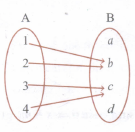
Let f = {(1, b) (2, b) (3, c) (4, d)}
Different elements in A does not have different images in B
∴ f is not one-one
Now, Co-domain = {a, b, c, d}, Range = {b, c}
Co-domain ≠ range
∴ f is not onto. Hence f is neither one-one and nor onto.
57.
Let P be the set of all triangles in a plane R is defined as aRb if a is similar to b.
Let a, b, c ∊ P.
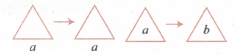
Reflexivity: aRa ⇒ a is similar to a for all a ∊ P.
∴ R is reflexive
Symmetricity: aRb ⇒ bRa
a is similar to b ⇒ b is similar to a for all a, b ∊ p.
Transitivity: aRb, and bRC ⇒ aRC.
a is similar to b and b is similar to C
⇒ a is similar to C.
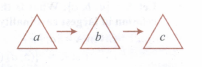
Hence R is an equivalence relation.
58.
Given f : R ⇾ R, defined by f(x) = cos x
We know f(0) = cos 0 = 1
and f(2π) = cos 2π = 1
∴ f(0) = f(2π) ⇒ 0 ≠ (2π)
∴ f is not one-one.
Since the values of cos x tie between -1 and 1, the range of f(x) is not equal to its co-domains.
∴ f is not onto.
Hence, f is neither one-one nor onto.
59.
Let f and g denote the identity function and the modulus function.
Then f : R ⟶ R is defined as f(x) = x and g : R ⟶ R is defined as g(x) = |x|
g(x) = 0 ⇒ |x| = 0 ⇒ x =0
∴ The quotient of f by g is \({f\over g}:R-\{0\}⟶R\) and is defined as
\(\left(f\over g \right)(x )={f(x)\over g(x)}={x\over |x|}=\begin{cases} {x\over x}=1\ if\ xx>0 \\{x\over -x}=-1\ if\ x<0 \end{cases}\)
60.
Given n(p(A)) = 1024 = 210
\(\Rightarrow\) n(A) = 10 [\(\therefore\) if n(A) = n, then n(p(A)) = 2n]
n(p(B)) = 32 = 25
\(\Rightarrow\) n(B) = 5.
We know that,
n(A\(\cup\) B) = n(A) + n(B) - n(A\(\cap\)B)
\(\Rightarrow\) 15 = 10+5 - (A\(\cap\)B)
\(\Rightarrow\) n(A\(\cap\)B) = 0.
61.
B-A = {4,5,6,7}
(B-A)\(\cup\)C = {3,4,5,6,7,9}....(1)
B\(\cup\)C = {3, 4, 5, 6, 7,9}
A-C = {1, 2}
(B\(\cup\)C) - (A-C) = {3,4,5,6,7,9} ....(2)
From (1) and (2), (B-A) \(\cup\) C = (B\(\cup\)C) - (A-C)
Hence verified
62.
A = { x | x is a whole number less than or equal to 7 } is the set-bilder form of A.
63.
We have f(x) = \(\frac { { x }^{ 2 }-9 }{ x-3 } \)
Domain of f : Clearly f(x) is not defined for x - 3 = 0 i.e. x = 3. Therefore, Domain (f) = R- {3}
Range of f: Let f(x) = y. Then,
f(x) = y ⇒ \(\frac { { x }^{ 2 }-9 }{ x-3 } \)=y ⇒ x+3 = y
it follows from the above relation that y takes all real values except 6 when x takes values in the ser R - {3}. Therefore, Range (f) = R {6}.
64.
A = {1, 2, 3, 4, 5,6, 7, 8, 9}
65.
(i) f( m) = f( n) \(\Rightarrow\) m2 = n2 \(\Rightarrow\) m = n since \(m,\ n\in N.\) Thus f is one-to-one. But, non-perfect square elements in the co-domain do not have pre-images and hence not onto.
(ii) Two different elements in the domain have same images and hence f is not one-to-one. Clearly the range of f is a proper subset of R. Thus it is not onto.
66.
(i) If f(n) = f(m), then n + 2 = m + 2 and hence m = n. Thus f is one-to-one. As 1 has no pre-image, this function is not onto.
(ii) As above, this function is one-to-one. If m is in the co-domain, then m − 2 is in the domain and f(m − 2) = (m − 2) + 2 = m; thus m has a pre-image and hence this function is onto.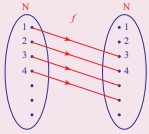
67.
(i) \(\rho\) is not reflexive because (3, 3) is not in \(\rho\). As (1, 1) and (2, 2) are in \(\rho,\) it is enough to include the pair (3, 3) to \(\rho\) so as to make it reflexive.
(ii) \(\rho\) is not symmetric because (1, 2) is in p, but (2, 1) is not in \(\rho.\) It is enough to include the pair (2, 1) to \(\rho\) so as to make it symmetric. It is enough to remove the pair (1, 2) from p so as to make it symmetric.
(iii) \(\rho\) is not transitive because (3, 1) and (1,3) are in,\(\rho\) but (3, 3) is not in \(\rho.\) To make it transitive we have to include (3, 3) in \(\rho\) . Even after including (3, 3), the relation is not transitive because (3, 1) and (I, 2) are in \(\rho\) , but (3, 2) is not in \(\rho\). To make it transitive we have to include (3, 2) also in \(\rho\) , Now it becomes transitive. So (3, 3) and (3, 2) are to be included into so as to make \(\rho\) transitive. But if we remove (3, 1) from \(\rho\), then it becomes transitive.
(iv) We have seen that
i) to make \(\rho\) reflexive, we have to include (3, 3);
ii) to make \(\rho\) symmetric, we have to include (2, 1);
iii) and to make \(\rho\) transitive, we have to include (3, 3) and (3, 2).
To make \(\rho\) as an equivalence relation we have to include all these pairs. So after including the pairs the relation becomes {(1, 1), (2, 2), (3, 3), (1, 2), (2, 1), (1, 3), (3, 1), (3, 2)}.
But this relation is not symmetric because (3,2) is in the relation and (2,3) is not in the relation. So we have to include (2,3) also. Now the new relation becomes {(1, 1); (2, 2), (3, 3), (1, 2), (2, 1), (1, 3), (3, 1), (3, 2), (2, 3)}.
It can be seen that this relation is reflexive, symmetric and transitive and hence it is an equivalence relation. Thus we have to include (3, 3), (2, 1), (3, 2) and (2, 3) to \(\rho\) so as to make it an equivalence relation.
68.
If A = {a, b, c} and f = {(a, c) (b, c) (c, b)} : (f : A \(\rightarrow\)A).
Given f : A ⇾ A
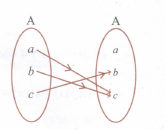
This is a function. Since different elements of A do not have different images in A.
∴ f is not one-one.
Here
Co-domain = {a, b, c}
But Range = {b, c}
f is not onto since co-domain ≠ Range.
69.
Given f(1) = a, f(2) = b, f(3) = c
∴ f = {(1, a) (2, b) (3, c)}...(1)
Clearly f is a bijection and invertible
∴ f-1 = {(a, 1) (b, 2) (c, 3)}
⇒ (f-1)-1 = {(1, a) (2, b) (3, c)}...(2)
From (1) and (2), it is clear that f = (f-1)-1
70.
f(-1) = (-1)2 and f(1) = 12
f(-1) = f(1) but -1 ≠ 1
ஃ f is one-one
Also -1 in the co-domain R is not having any image in the domain R.
ஃ f is not onto.
71.
Yes, since 4.7 is a point in between 3 and 5
72.

From (ii) and (v), (AUB)' = A' ∩ B'
73.
Given A⊂B

(i) From the diagram A ∩ B =A
(ii) A\B = Ø
74.
Given P = {1, 2, 3, 5, 7, 11, 13}
and Q = {2, 4, 6, 8, 10, 12, 14}
Now P⋂Q = {2}
Since P⋂Q ≠ Ø, the given sets are not disjoint.
75.
Given A = {5, 10, 15, 20, 25, 30}
B = {1, 3, 7, 10, 12, 15, 18, 25}
Now AUB = {1, 3, 5, 7, 10, 12, 15, 18, 20, 25, 30}

11th Standard Syllabus & Materials
11th Standard
TN 11th Tamil பீடு பெற நில் - செய்யுள் - காவடிச்சிந்து Important Questions And Answers Study Material - QB365 Set A
NEW11th Standard
TN 11th Tamil பீடு பெற நில் - உரைநடை - மலை இடப்பெயர்கள் : ஓர் ஆய்வு Important Questions And Answers Study Material - QB365 Set A
NEW11th Standard
TN 11th Tamil மாமழை போற்றுதும் - துணைப்பாடம் - யானை டாக்டர் Important Questions And Answers Study Material - QB365 Set A
NEW11th Standard
TN 11th Tamil மாமழை போற்றுதும் - செய்யுள் - ஐங்குறுநூறு Important Questions And Answers Study Material - QB365 Set A



Tamilnadu Stateboard 11th Standard Subjects
Maths

Commerce

Economics

Biology

Business Maths and Statistics

Accountancy

Computer Science

Physics

Chemistry
Maths
Biology
Economics
Physics
Chemistry

History
Business Maths and Statistics

Computer Science
Accountancy

Computer Applications
History
Computer Technology
Commerce
Computer Applications
Computer Technology

Tamil

English

French
Tamilnadu Stateboard Standards

