
 100% FREE ACCESS
12th Standard Syllabus & Materials
12th Standard
TN 12th Computer Applications மின்னணு தரவு பரிமாற்றம் Sample Question Papers Study Material - QB365 Set A
NEW12th Standard
TN 12th Computer Applications மின் - வணிக பாதுகாப்பு அமைப்புகள் Sample Question Papers Study Material - QB365 Set A
NEW12th Standard
TN 12th Computer Applications மின்னணு செலுத்தல் முறைகள் Sample Question Papers Study Material - QB365 Set A
NEW12th Standard
TN 12th Computer Applications மின் - வணிகம் Sample Question Papers Study Material - QB365 Set A
NEW12th Standard
TN 12th Computer Applications திறந்த மூல கருத்துருக்கள் Sample Question Papers Study Material - QB365 Set A
NEW12th Standard
TN 12th Computer Applications வலையமைப்பு வடமிடல் Sample Question Papers Study Material - QB365 Set A

Published on: 07/03/2020
12 Standard Chemistry English Medium All Chapter Book Back and Creative Five Mark Question 2020
Download Tamil Nadu 12th Standard Chemistry question papers, model tests, one-mark questions, important questions, and public exam papers in PDF format. Free study materials and answer keys for TN State Board students.
Questions + Answers key
Take MCQ Chemistry Test
1.
Compound (A) with Molecular formula C7H6O does not reduce Fehling's solution. Compound (A) reacts with acetone in the presence of NaOH to give a compound (B) which is an α, β-unsaturated compound. Further (A) reacts with dimethyl aniline in the presence of cone, H2SO4 to give compound (C) which is a dye. Identify (A) (B) and (C). Explain the reactions.
2.
An organic compound (A) C2H3OCI on treatment with Pd and BaSO4 gives (B) C2H4O which answers iodoform test. (B) when treated with cone.H2SO4 undergoes polymerisation to give (C) a cyclic compound. Identify (A), (B) and (C) and explain the reactions.
3.
Write a note on
(i) Carbylamine reaction
(ii) Mustard oil reaction
(iii) Acetylation of benzylamine
(iv) Formation of Schiff's base
(v) Diazotisation reaction
4.
List the importance of proteins in biological processes.
5.
Elucidate the structure of glucose.
6.
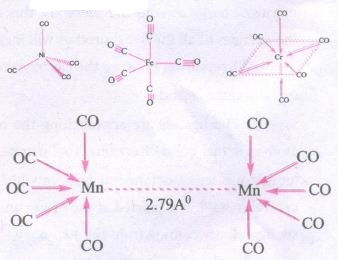
Explain the classification of polymers based on their structure and mode of synthesis.
7.
Write a note on drug target interaction.
8.
An organic compound (A) of molecular formula C6H6O gives violet colour with neutral FeCI3. (A) gives maximum of two isomers (B) and (C) when an alkaline solution of (A) is refluxed with CCI4 (A) also reacts with C6H5N2CI to give the compound (D) which is red orange dye. Identify (A), (B), (C) and (D). Explain with suitable chemical reactions.
9.
How can the following coversion be effected?
i) Nitrobenzene ⇾ Nitrosobenzene
ii) Nitrobenzene ⇾ Azoxybenzene
iii) Nitrobenzene ⇾ Hydrazobenzene
10.
Distinguish between (a) Ethanol and phenol (b) Phenol and acetic acid (c) Phenol and aniline (d) Phenol and anisole.
11.
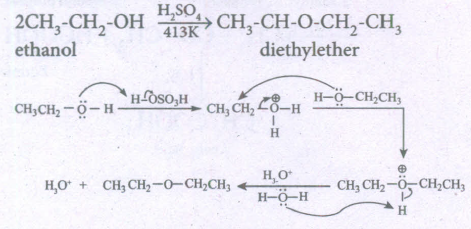
Explain the mechanism involved in the intermolecular dehydration of alcohols to give ethers.
12.
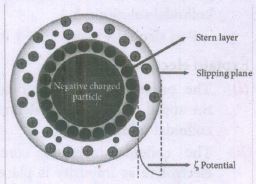
Explain the electrical property of colloids with a neat diagram. (or) Write a note on Helmholta electrical double layer.
13.
Write a note on phase transfer catalysis.
14.
The emf of the half cell Cu2+(aq)/ Cu(s). containing 0.01 M Cu2+solution is + 0.301V. Calculate the standard emf of the half cell
15.
The equivalent conductances at infinite dilution of HCl, CH3COONa and NaCl are 42616, 91.0 and 126.45 ohm-1 cm2 gm equuivalent-1 respectively. Calculate the equivalent conductance (λ∞) of acetic acid.
16.
Derive the hydrolysis constant for the hydrolysis of salt of strong base and weak acid. Deduce its pH.
17.
18.
Explain intermediate compound formation theory of catalysis with an example.
19.
A dibromo derivative (A) on treatment with KCN followed by acid hydrolysis and heating gives a monobasic acid (B) along with liberation of CO2 . (B) on heating with liquid ammonia followed by treating with Br2 /KOH gives (c) which on treating with NaNO2 and HCl at low temperature followed by oxidation gives a monobasic acid (D) having molecular mass 74. Identify A to D.
20.
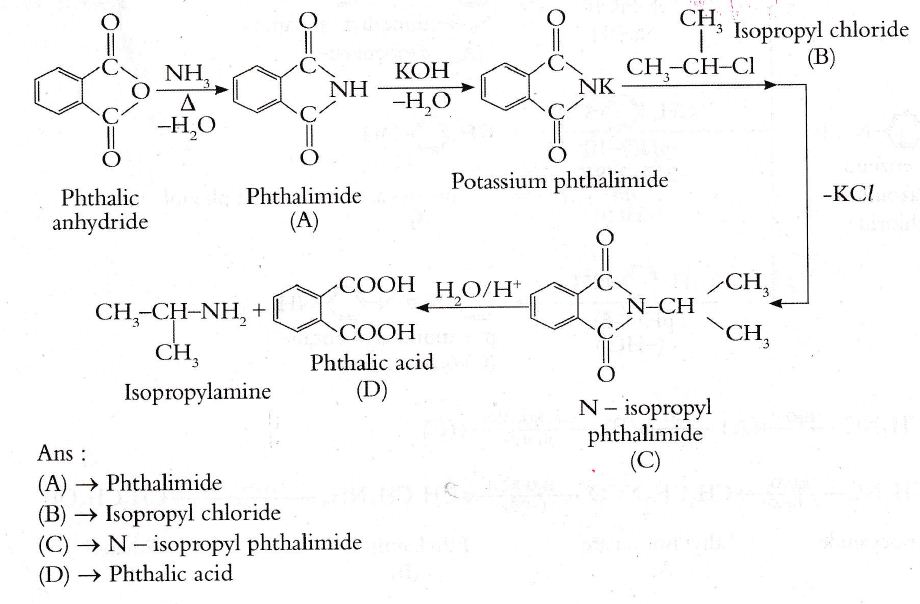
Predict A,B,C and D for the following reaction
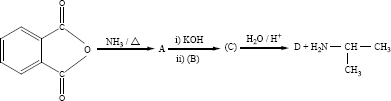
21.
Differentiate thermoplastic and thermosetting.
22.
What are bio degradable polymers? Give examples.
23.
For the reaction R - P, the concentration of a reactant changes from 0.03 M to 0.02 M in 25 minutes. Calculate the average rate of reaction using units of time both in minutes and second.
24.
Write a short note on the oxidation states of 3d series elements.
25.
Justify the following statement.
"Elements of the first transition series possess many properties different from those of heavier transition elements".
26.
In a pseudo first order hydrolysis of ester in water, the following results were obtained.
| 1 | 0 | 30 | 60 | 90 |
|---|---|---|---|---|
| [Ester]mol L-1 | 0.55 | 0.31 | 0.17 | 0.085 |
(i) Calculate the average rate of reaction between the time interval 30 to 60 seconds.
(i) Calculate the pseudo first order rate constant for the hydrolysis of ester.
27.
Explain the oxidising property of sulphuric acid.
28.
An amorphous solid (A) burns in air to form a gas (B) which turns lime water milky. The gas is also produced as a byproduct during roasting of sulphide ore. This gas decolourises acidified aqueous KMnO4 solution and reduces Fe3+ to Fe2+. Identify the solid 'A' and the gas 'B' and write the reactions involved.
29.
Explain the following: Similarities and differences between metallic and ionic crystals.
30.
Ionic solids, which have anionic vacancies due to metal excess defect, develop colour. Explain with the help of a suitable example.
31.
Distinguish between diamond and graphite.
32.
What are the various methods by which carbon-di-oxide is prepared?
33.
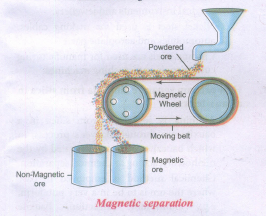
Explain concentration by magnetic separation with diagram.
34.
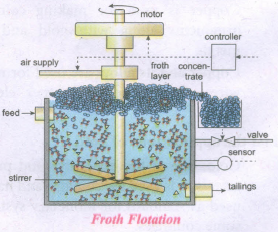
Explain froth flotation, with diagram.
35.
How are metal carbonyls classified based on the structure?
36.
Mention the type of hybridisation and magnetic property of the following complexes using VB theory a) [FeF6]4- b) [Fe(CN)6]4-
37.
Predict which of the following will be coloured in aqueous solution Ti2+, V3+, Sc4+, Cu+, Sc3+, Fe3+, Ni2+ and Co3+
38.
On the basis of VB theory explain the nature of bonding in [Co(C2O4)3]3-
39.
Explain the principle of electrolytic refining with an example.
40.
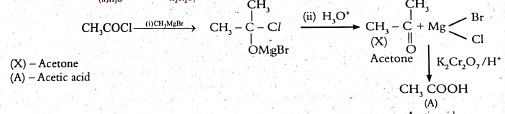
What will be the product (X and A) for the following reaction acetylchloride \(\frac{\text { i) } \mathrm{CH}_{3} \mathrm{MgBr}}{\text { ii) } \mathrm{H}_{3} \mathrm{O}^{+}}{\longrightarrow} \mathrm{X} \stackrel{\text { acid } \mathrm{K}_{2} \mathrm{Cr}_{2} \mathrm{O}_{7}}{\longrightarrow}\) A
41.
Explain any one method for coagulation.
42.
Write a note on formation of α-helix .
43.
Write the structure of all possible dipeptides which can be obtained form glycine and alanine
44.
What is crystal field stabilization energy (CFSE)?
45.
Complete the following reactions.
\(1. \mathrm{NaCl}+\mathrm{MnO}_{2}+\mathrm{4H}_{2} \mathrm{SO}_{4} \longrightarrow \)
\(2. \mathrm{NaNO}_{2}+\mathrm{HCl} \longrightarrow \)
\(3.\mathrm{P}_{4}+\mathrm{3NaOH}+\mathrm{3H}_{2} \mathrm{O} \longrightarrow \)
\(4. \mathrm{AgNO}_{3}+\mathrm{PH}_{3} \longrightarrow \)
\(5. \mathrm{Mg}+\mathrm{10HNO}_{3} \longrightarrow \)
\(6. \mathrm{KClO}_{3} \stackrel{\Delta}{\longrightarrow} \)
\(7. \mathrm{Cu}+Con. \ Hot \ \mathrm{H}_{2} \mathrm{SO}_{4} \longrightarrow\)
\(8. \mathrm{Sb}+\mathrm{Cl}_2 \longrightarrow \)
\(9. \mathrm{HBr}+\mathrm{H}_2 \mathrm{SO}_4 \longrightarrow \)
\(10. \mathrm{XeF}_6+\mathrm{H}_2 \mathrm{O} \longrightarrow \)
\(11. \mathrm{XeO}_6{ }^{4-}+\mathrm{Mn}^{2+}+\mathrm{H}^{+} \longrightarrow \)
\(12. \mathrm{XeOF}_4+\mathrm{SiO}_2 \longrightarrow \)
\(13. \mathrm{Xe}+\mathrm{F}_2 \frac{\mathrm{Ni} / 200 \mathrm{~atm}}{400^{\circ} \mathrm{C}}\).
46.
Suggest a reason why HF is a weak acid, whereas binary acids of the all other halogens are strong acids.
47.
An atom crystallizes in fcc crystal lattice and has a density of 10 gcm−3 with unit cell edge length of 100pm. Calculate the number of atoms present in 1 g of crystal.
48.
Write a note on zeolites.
49.
The selection of reducing agent depends on the thermodynamic factor: Explain with an example.
50.
Complete the following reaction
\({ CH }_{ 3 }-{ CH }_{ 2 }-{ CH }_{ 2 }-\underset { \overset { || }{ O } }{ C } -{ CH }_{ 3 }\overset { HO-{ CH }_{ 2 }-{ CH }_{ 2 }-OH }{ \underset { { dry }{ HCl} }{ \longrightarrow } } ?\)
51.
Write the structure of the major product of the aldol condensation of benzaldehyde with acetone.
52.
Establish a relationship between the solubility product and molar solubility for the following
a) BaSO4
b) Ag2(CrO4)
53.
Ionic conductance at infinite dilution of Al3+ and SO4 2- are 189 and 160 mho cm2 equiv-1. Calculate the equivalent and molar conductance of the electrolyte Al2(SO4)3 at infinite dilution.
54.
For the cell Mg (s) Mg2+(aq)||Ag+(aq)|Ag(s), calculate the equilibrium constant at 250C and maximum work that can be obtained during operation of cell. Given: \(E^{0}_{Mg^{2+}|Mg}\)=-237V and \(E^{0}_{Ag^{2+}|Ag}\) = 0.80V.
55.
Will a precipitate be formed when 0.150 L of 0.1M Pb(NO3)2 and 0.100L of 0.2 M NaCl are mixed? \(K_{sp}\ (PbCl_{2})=1.2\times10^{-5}\).
56.
The rate constant of a reaction at 400 and 200K are 0.04 and 0.02 s-1 respectively. Calculate the value of activation energy.
57.
Benzene diazonium chloride in aqueous solution decomposes according to the equation \({ C }_{ 6 }{ H }_{ 5 }{ N }_{ 2 }Cl\longrightarrow { C }_{ 6 }{ H }_{ 5 }Cl+{ N }_{ 2 }\)Starting with an initial concentration of 10g L-1, the volume of N2 gas obtained at 50 °C at different intervals of time was found to be as under:
| t(min) | 6 | 12 | 18 | 24 | 30 | \(\infty \) |
| Vol of N2 (ml) | 19.3 | 32.6 | 41.3 | 46.5 | 50.4 | 58.3 |
Show that the above reaction follows the first order kinetics. What is the value of the rate constant?
58.
Why europium (II) is more stable than Cerium (II)?
59.
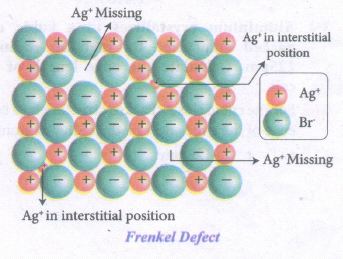
Write a note on Frenkel defect.
60.
A double salt which contains fourth period alkali metal (A) on heating at 500K gives (B). Aqueous solution of (B) gives white precipitate with BaCl2 and gives a red colour compound with alizarin. Identify A and B.
1.
(i) Compound (A) does not reduce Fehling's solution, so it is benzaldehyde.
(ii) Benzaldehyde (A) reacts with acetone in the presence of NaOH to give on a, p unsaturated compound (B).
\(\\ \\ \\ \underset { (A) }{ { C }_{ 6 }{ H }_{ 5 }CHO } +{ CH }_{ 3 }-{ COCH }_{ 3 }\overset { NaoH }{ \longrightarrow } \underset { (B) }{ { C }_{ 6 }{ H }_{ 5 } } -\underset { Acetone }{ CH=CH-{ COCH }_{ 3 } } \)
(iii) (A) reacts with dimethyl aniline in the presence of conc. H2SO4 to give compound (C).
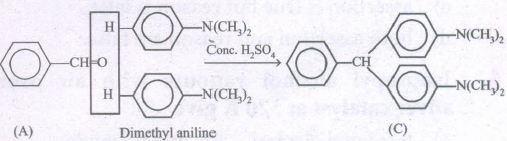
| Compound | Compound Name | Formula |
| A | Benzaldehyde | C6H5CHO |
| B | Benzal acetone | C6H5CH = CH-COCH3 |
| C | Triphenyl methane dye | 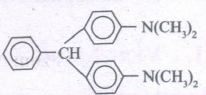 |
2.
(i) Compound (A) must be acetyl chloride which undergoes Rosenmund's reduction giving acetaldehyde.
\(\underset { (A) }{ { CH }_{ 3 }COCl } \overset { Pd/BaS{ O }_{ 4 } }{ \longrightarrow } \underset { (B) }{ { CH }_{ 3 }CHO } \)
(B) undergoes iodoform reaction
\(\underset { (B) }{ { CH }_{ 3 }COH } \overset { { I }_{ 2 }/NaOH }{ \longrightarrow } \underset { Iodoform }{ { CHI }_{ 3 } } +HCOONa\)
(ii) Acetaldehyde (B) undergoes polymerisation giving a cyclic compound.
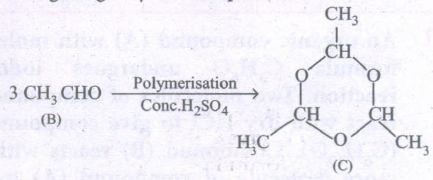
| Compound | Compound name | Formula |
| A | Acetyl chloride | CH3COCI |
| B | Acetaldehyde | CH3CHO |
| C | Paraldehyde | 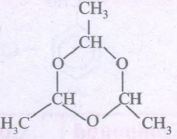 |
3.
(i) Carbylamine reaction: Primary amines
on heating with chloroform and alcoholic potash forms a foul smelling substance called carbylamine or alkyl isocyanide
\(\underset { Chloroform }{ CH_{ 3 }{ NH }_{ 2 }+{ CHCl }_{ 3 } } +3KOH\rightarrow \underset { Methyl \ isocyanide }{ { CH }_{ 3 }NC } +3KCl+{ 3H }_{ 2 }O\)
This reaction is characteristic of primary amines. Secondary and tertiary amines do not undergo this reaction.
(ii) Mustard oil reaction: This is also a reaction characteristic of primary amine. When primary amines are warmed with carbon disulphide and mercuric chloride, alkyl isothiocyanate, having a pungent Mustard like odour is obtained
\(CH_{ 3 }{ NH }_{ 2 }+\underset { Carbondisulphide }{ S=C=S } \rightarrow \underset { Methyl \ isothicyanate }{ { CH }_{ 3 }-N=C=S } +{ H }_{ 2 }S\)
(iii) Aniline reacts with acetyl chloride and acetic anhydride to form corresponding amides called anilide.
\({ C }_{ 6 }H_{ 5 }{ NH }_{ 2 }+\underset { Acetyl \ chloride }{ ClCO{ CH }_{ 3 } } \rightarrow \underset { N-phenyl \ acetamide }{ { C }_{ 6 }{ H }_{ 5 }NHCO{ CH }_{ 3 } } +HCl\)
\({ C }_{ 6 }H_{ 5 }{ NH }_{ 2 }+\underset { Acetic \ anhydride }{ { CH }_{ 3 }COOCO{ CH }_{ 3 } } \rightarrow \underset { Acetanilide }{ { C }_{ 6 }{ H }_{ 5 }NHCO{ CH }_{ 3 } } +{ CH }_{ 3 }COOH\)
(iv) Formation of Schiff's base: Primary amines condense with aromatic aldehydes forming Schiff's base
\({ C }_{ 6 }H_{ 5 }CHO+{ H }_{ 2 }{ NCH }_{ 3 }\rightarrow \underset { Schiff's \ base\\ (benzal-N-methyl \ amine) }{ { C }_{ 6 }{ H }_{ 5 }CH=NC{ H }_{ 3 } } \)
(v) Reaction with nitrous acid: A cold solution of sodium nitrite reacts with aniline dissolved in hydrochloric acid, a clear solution is obtained. This solution contains 'benzene diazonium chloride'. This reaction is known as 'diazotisation'.
\({ C }_{ 6 }{ H }_{ 5 }N\boxed { { H }_{ 2 }+O } =N-OH\underrightarrow { HCl } \underset { Bensene\quad diazonium\quad chloride }{ { C }_{ 6 }{ H }_{ 5 }-N=N-Cl } \)
4.
Importance of proteins:
Proteins are the functional units of living things : play vital role in all biological processes
(i) All biochemical reactions occur in the living systems are catalysed by the catalytic proteins called enzymes.
(ii) Proteins such as keratin, collagen acts as structural back bones.
(iii) Proteins are used for transporting molecules (Haemoglobin), organelles (Kinesins) in the cell and control the movement of molecules in and out of the cells (Transporters).
(iv) Antibodies help the body to fight various diseases
(v) Proteins are used as messengers to coordinate many functions. Insulin & glucagon controls the glucose level in the blood.
(vi) Proteins act as receptors that detect presence of certain signal molecules and activate the proper response.
(vii) Proteins are also used to store metals such as iron (Ferritin) etc.
5.
Structure of glucose: Glucose is an aldohexose. It is optically active with four asymmetric carbons. Its solution is dextrorotatory and hence it is also called as dextrose. The proposed structure of glucose is shown in the figure which was derived based on the following evidences
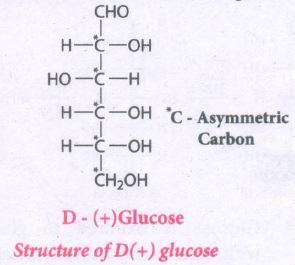
(i) Elemental analysis and molecular weight determination show that the molecular formula of glucose is C6H120 6'
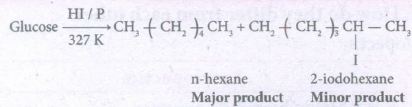
(ii) On reduction with concentrated HI and red phosphorus at 373K, glucose gives a mixture of n hexane and 2, iodohexane indicating that the six carbon atoms are bonded linearly.
(iii) Glucose reacts with hydroxylamine to form oxime and with HCN to form: cyanohydrin. These reactions indicate the I presence of carbonyl group in glucose
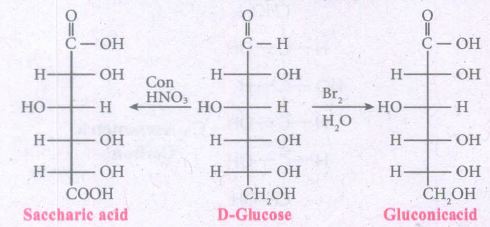
(v) Glucose is oxidised to gluconic acid with ammonical silver nitrate (Tollen's reagent) and alkaline copper sulphate (Fehling's solution). Tollens reagent is I reduced to metallic silver and Fehlings I solution to cuprous oxide which appears as red precipitate. These reactions further: confirm the presence of an aldehyde group
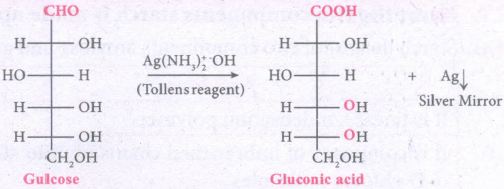
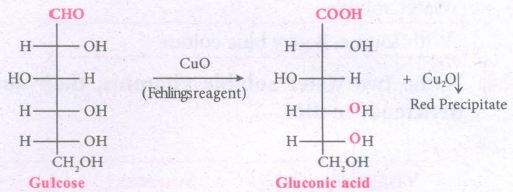
(vi) Glucose forms penta acetate with acetic anhydride suggesting the presence of five alcohol groups.
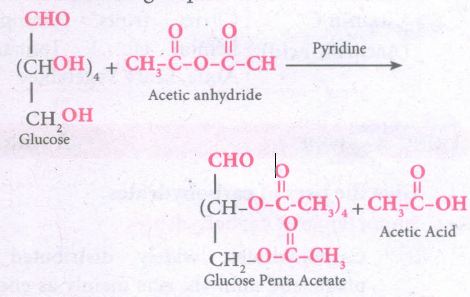
(vii) Glucoseis a stable compound and does not undergo dehydration easily. It indicates that not more than orie hydroxyl group is bonded to a single carbon atom. Thus the five hydroxyl groups are attached to five different carbon atoms and the sixth carbon is an aldehyde group.
6.
(i) Structure:
(a) Linear polymers (long continuous chain) E.g. HDPE, PVC
(b) Branched polymers (one main chain with small chains as branches) E.g. polypropylene, LDPE.
(c) Cross linked polymers (linking of chain polymers) E.g. bakelite, melamine, formaldehyde
(ii) Mode of synthesis:
(a) Addition polymers. Formed by polymerisation of monomers without the elimination of byproduct. E.g. polyethylene, PVC, teflon.
(b) Condensation Polymer formed by the condensation of two or more monomers with the elimination of simple molecules like H2O, NH3, etc., E.g. Nylon:6-6, polyester.
7.
(i) The biochemical processes such as metabolism, cell-signaling etc... are essential for the normal functioning of our body.
(ii) These routine processes may be disturbed by any external factors such as microorganism, chemicals etc ..
(iii) Under such conditions medicines restore the normal functioning of the body.
(iv) These drug molecules interact with biomolecules such as proteins, lipids, etc .. that are responsible for different functions of the body.
(v) The drug interacts with these molecules and modify the normal biochemical reactions either by modifying the enzyme activity or by stimulating/suppressing certain receptors.
8.
(i) Compound A giving violet colour with neutral ferric chloride is phenol (C6H5OH).
(ii) (B) and (C) isomers are formed when alkaline solution of (A) is refluxed with CCI4.

(iii) (A) when treated with C6H5N2CI, forms a red orange dye (D).

| Compound | Compound Name | Formula |
| A | Phenol | C6H5OH |
| B | o-Hydroxy benzoic acid | 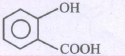 |
| C | p-Hydroxy benzoic acid | 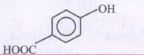 |
| D | p-Hydroxy azo benzene | 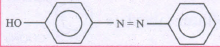 |
9.
i) Nitrobenzene ⇾ Nitrosobenzene
When nitrobenzene is treated with glucose and NaOH (alkaline medium) Nitrosobenzene is formed.
\({ C }_{ 6 }{ H }_{ 5 }N{ O }_{ 2 }\rightarrow \underset { Nitrosobenzene }{ { C }_{ 6 }{ H }_{ 5 }NO+{ H }_{ 2 }O } \)
ii) Nitrobenzene ⇾ Azoxybenzene
When nitrobenzene is subjected to reduction with glucose and NaOH forms the intermediate products nitrosobenzene and phenyl hydroxyl amine. These undergo bimolecular condensation reaction to give azoxy benzene.
\({ C }_{ 6 }{ H }_{ 5 }N{ O }_{ 2 }\underrightarrow { Glucose+NaOH } \underset { Nitrosobenzene }{ { C }_{ 6 }{ H }_{ 5 }NO+{ H }_{ 2 }O } \xrightarrow [ { H }_{ 2 }O ]{ \triangle } \underset { Azoxy\quad benzene }{ { C }_{ 6 }{ H }_{ 5 }-N=N{ C }_{ 6 }{ H }_{ 5 } } \)
iii) Nitrobenzene ⇾ Hydrazobenzene
When nitrobenzene is subjected to alkaline reduction in the presence of Zn+NaOH, hydrozo benzene is formed.
\({ C }_{ 6 }{ H }_{ 5 }N{ O }_{ 2 }\underrightarrow { Zn/NaOH } \underset { Nitrosobenzene }{ { C }_{ 6 }{ H }_{ 5 }NH+{ NHC }_{ 6 }{ H }_{ 5 }} \)
10.
| a. | Ethanol | Phenol |
| i. | It does not give violet colour with neutral FeCI3 | It gives violet colour with netural FeCI3 |
| ii. | It does not declourise bromine water (no electroplilic substitution). |
It declourises Br/H2O and the product formed is 2, 4, 6-tribromo (electrtophilic substitution). |
| a. | Phenol | Acetic acid |
| i. | It gives violet colour with neutral FeCI3. | It does not give violet colour with netural FeCI3. |
| ii. | It undergoes electrophilic substitution reaction at ortho & para position. |
It does not undergo electrophilic substitution |
| a. | Phenol | Aniline |
| i. | It does not undergo diazotisation reaction at all temperature |
It undergo diazotisation reaction at 0 C0. |
| ii. | It undergoes condensation polymerisation with HCHO to produce bakelite |
It does not undergo condensation polymerisation reaction with HCHO. |
| a. | Phenol | Anisole |
| i. | It gives violet colour with neutral FeCI3. | It does not give violet colour with neutral FeCI3. |
| ii. | It undergoes coupling reaction with ben- zene diazonium chlo ride to give 'red dye'. |
It does not undergo coupling reaction with benzene diazonium chloride. |
11.
Inter molecular dehydration of alcohol: We have already learnt that when ethanol is treated with con.HSO2 4 at 443K, elimination takes place to form ethene. If the same reaction is carried out at 413K, substitution competes over elimination to form ethers.
12.
Helmholtz double layer:
(i) The surface of colloidal particle adsorbs one type of ion due to preferential adsorption.
(ii) This layer attracts the oppositely charged < ions in the medium and hence at the boundary separating the two electrical double layers are setup.
(iii) This is called as Helmholtz electrical double layer.
(iv) As the particies nearby are having similar: charges, they cannot come close and condense.
13.
(i) Suppose the reactant of a reaction is present in one solvent and the other reactant is present in an another solvent.
(ii) The reaction between them is very slow, if the solvents are immisible.
(iii) As the solvents from separate phases the reactants have to migrate across the boundary to react.
(iv) But migration of reactants across the boundary is not easy. For such situations a third solvent is added which is miscible with both.
(v) So, the phase boundary is eliminated reactants freely mix and react fast.
(vi) But for large scale production of any product, use of a third solvent is not convenient as it may be expensive.
(vii) For such problems phase transfer catalysis provides a simple solution, which avoides the use of solvents.
(viii) It directs the use a phase transfer catalyst (a phase transfer reagent) to facilitate transport of a reactant in one solvent to the other solvent where the second reactant is present.
(ix) As the reactants are now brought together they rapidly react and form the product.
14.
Given: E = 0.301 V; [Cu2+] = 0.01M
Formula:
\({ E }_{ { Cu }^{ 2+ }/Cu }^{ o }={ E }_{ { Cu }^{ 2+ }/Cu }^{ }+\frac { 2.303Rt }{ nF } \log\frac { [{ Cu }^{ 2+ }] }{ [Cu] } \)
Solution:
\(=+0.301+\frac { 0.0591 }{ 2 } \log\frac { 0.01 }{ 1 } \)
\({ E }^{ o }=0.301+\frac { 0.059 }{ 2 } \times 2=0.3591V\)
Eo = 0.36 V
15.
Given:
λ∞CH3COONa = 91.0 ohm-1 cm2g eq-1
Formula:
λ∞CH3COONa = λ∞CH3COONa + λ∞HCl - λ∞NaCl
λ∞HCl = 426.16 ohm-1 cm2g eq-1
λ∞NaCl = 126.45 ohm-1 cm2g eq-1
Solution: ∴ λ∞CH3COOH
= 91.0 + 426.16 - (126.45)
= 517.16 - 126.45
λ∞CH3COOH = 390.71 ohm-1cm2 g eq-1
16.
Let us find a relation between the equilibrium constant for the hydrolysis reaction (hydrolysis constant) and the dissociation constant of the acid.
\({ K }_{ h }=\frac { [{ CH }_{ 3 }COOH][{ OH }^{ - }] }{ [{ CH }_{ 3 }{ COO }^{ - }][{ H }_{ 2 }O] } \)
\({ K }_{ h }=\frac { [{ CH }_{ 3 }COOH][{ OH }^{ - }] }{ [{ CH }_{ 3 }{ COO }^{ - }] } \) ...(1)
\({ CH }_{ 3 }{ COONH }_{ (aq) }\rightleftharpoons { C }{ H }_{ 3 }COO_{ (aq) }^{ - }+{ H }_{ (aq) }^{ + }\)
\({ K }_{ h }=\frac { [{ CH }_{ 3 }CO{ O }^{ - }][{ H }^{ + }] }{ [{ CH }_{ 3 }{ COO }H] } \) ...(2)
(1) x (2)
⇒ Kb . Ka = [H+][OH-]
we know that [H+] [OH-] = Kw
Kh· Ka = Kw
Kh value in terms of degree of hydrolysis (h) and the concentration of salt (C) for the equilibrium can be obtained as in the case of Ostwald's dilution law. Kh = h2C. and i.e [OH-] = \(\sqrt { { K }_{ h }.C } \)
pH of salt solution in terms of Ka and the concentration of the electrolyte
pH + pOH = 14
pH = 14 - pOH = 14 - {-log [OH-]}
= 14 + log [OH-]
∴ pH = 14 + log (KhC)\(\frac12\)
pH =14 + log \({ \left( \frac { { K }_{ w }C }{ { K }_{ a } } \right) }^{ \frac { 1 }{ 2 } }\)
pH = 14 + (\(\frac12\) log Kw + \(\frac12\) log C - \(\frac12\) log Ka)
[∴ Kw = 10-14]
\(pH=14-7+\frac { 1 }{ 2 } \log \ C+\frac { 1 }{ 2 } p{ K }_{ a }\frac { 1 }{ 2 } \log{ K }_{ w }=\frac { 1 }{ 2 } \times { \log10 }^{ -14 }=\frac { -14 }{ 2 } (1)=-7\)
\(pH=7+\frac { 1 }{ 2 } { pK }_{ a }+\frac { 1 }{ 2 } \log \ C\) [-log Ka = pKa]
17.
18.
The intermediate compound formation theory :
A catalyst acts by providing a new path with low energy of activation. In homogeneous catalysed reactions a catalyst may combine with one or more reactant to form an intermediate which reacts with other reactant or decompose to give products and the catalyst is regenerated.
Consider the reactions :
A+B➝AB; C is the catalyst .............(1)
A + C ➝ AC (intermediate) ..........(2)
AC + B ⟶ AB + C ...............(3)
Example 1:
The mechanism of Fridel crafts reaction is given below
\({ C }_{ 6 }{ H }_{ 6 }+{ { CH }_{ 3 }Cl\overset { anhydrous\\ { AlCl }_{ 3 } }{ \longrightarrow } }{ C }_{ 6 }{ H }_{ 5 }{ CH }_{ 3 }+HCl\)
The action of catalyst is explained as follows
CH3Cl + AlCl3 ⟶ [CH3]+ [AlCl4]-
It is an intermediate.
\({ C }_{ 6 }{ H }_{ 6 }+\left[ { CH }_{ 3 }^{ + } \right] \left[ { AlCl }_{ 4 } \right] ^{ - }\longrightarrow { C }_{ 6 }{ H }_{ 5 }{ CH }_{ 3 }+{ AlCl }_{ 3 }+Hcl\)
Example 2:
\({ { 2KClO }_{ 3 }\overset {\\ { MnO }_{ 3 } }{ \longrightarrow } }{ 2KCl }+{ 3O }_{ 2 }\)
Thermal decomposition of KCIO3 in the presence of MnO2 proceeds as follows. Steps in the reaction
2KCIO3 ⟶ 2KCI + 3O2 Can be given as
2KClO3 + 6MnO2 → 6MnO3 + 2KCl
It is an intermediate
6MnO3 → 6MnO2 + 3O2
Example 3:
Formation of water due to the reaction of H2 and O2 in the presence of Cu can be given as
H2 + 1/2O2 → H2O
2Cu + \(\frac{1}{2}\)O2 → Cu2O
It is an intermediate.
Cu2O + H2 → H2O + 2Cu
Advantages:
This theory describes
(a) The specificity of a catalyst and
(b) The increase in the rate of the reaction with increasc inthe concentration of a catalyst
Limitations:
(a) The intermediate compound theory fails to explain the action of catalytic poison and activators (promoters).
(b) This theory is unable to explain the mechanism of heterogeneous catalysed reactions.
19.
Compound A,B,C and D
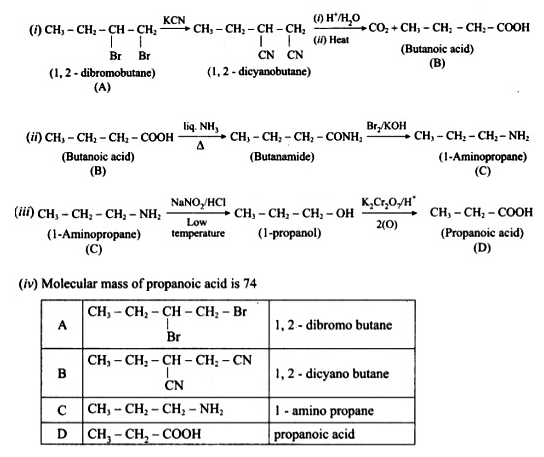
20.
21.
(i) Thermoplastic: They become soft on heating and hard on cooling. They can be remolded
E.g. polythene, PVC, polystrene
(ii) Thermo setting : Do not be come soft on heating set to an infusible mass upon heating.
E.g. bakelite, melamine, formaldehyde
22.
1. The materials that are readily decomposed by microorganisms in the environment are called biodegradable.
2. Natural polymers degrade on their own after certain period of time but the synthetic polymers do not.
3. It leads to serious environmental pollution. One of the solution to this problem is to produce biodegradable polymers which can be broken down by soil micro organism.
Examples:
(i) Polyhydroxy butyrate (PHB)
(ii) Polyhydroxy butyrate-co-A- hydroxyl valerate (PHBV)
(iii) Polyglycolic acid (PGA), Polylactic acid (PLA)
(iv) Poly ( E caprolactone) (PCL)
(v) Biodegradable polymers are used in medical field such as surgical sutures, plasma substitute etc...
4. these polymers are decomposed by enzyme action and are either metabolized or excreted from the body.
23.
Average rate = \(-\frac { \triangle \left( R \right) }{ \triangle t } =-\frac { { \left[ R \right] }_{ 2 }-{ \left[ R \right] }_{ 1 } }{ { t }_{ 2 }-{ t }_{ 1 } } \)
\(=-\frac { 0.02M-0.03M }{ 25min } =\frac { -0.01M }{ 25min } \)
= 4 x 10⁻⁴ M min-1 and
= \(-\frac { -0.01m }{ 25\times 60 } \) = 6.66 x 10⁻⁶ Ms-1
24.
(i) The first transition metal Scandium exhibits only +3 oxidation state, but all other transition elements exhibit variable oxidation states by loosing electrons from (n-1)d orbital and ns orbital as the energy difference between them is very small.
(ii) At the beginning of the series, +3 oxidation state is stable but towards the end +2 oxidation state becomes stable.
(iii) The number of oxidation states increases with the number of electrons available, and it decreases as the number of paired electrons increases.
(iv) Hence, the first and last elements show less number of oxidation states and the middle elements with more number of oxidation states.
(v) For example, the first element Sc has only one oxidation state +3; the middle element Mn has six different oxidation states from +2 to +7. The last element Cu shows +1 and +2 oxidation states only.
(vi) The relative stability of different oxidation - states of 3d metals is correlated with the extra stability of half filled and fully filled electronic configurations. Example: Mn2+(3d5) is more stable than Mn4+(3d3).
25.
The heavier transition elements belong to fourth (4d), fifth (Sd) and sixth (6d) transition series. Their properties are expected to be different form the elements belonging to the first (3d) series due to the following reasons.
(i) Atomic radii: Size of the transition elements 94d and Sd series are larger than those of the corresponding elements of the first transition series though those of 4d and Sd series are very close to each other.
(ii) Ionisation enthalpy of Sd series are higher than the corresponding elements of 3d and 4d series.
(iii) Atomisation enthalpy of 4d and Sd series are higher than the corresponding elements of the first series.
(iv) Melting and boiling points of heavier transition elements are greater than those of the first transition series due to stronger intermetallic bonding.
(v) The elements of the first transition series generally form low or high spin complexes, depending upon the higher of ligand field. However, the heavier transition elements form low spin complexes irrespective of the strength of the ligand filed.
26.
(i) Average rate of reaction between the time interval, 30 to 60 seconds
\(=\frac { d\left[ Ester \right] }{ dt } \)
\(=\frac { 0.31-0.17 }{ 60-30 } =\frac { 0.14 }{ 30 } \)
= 4.67 x 10⁻³ mol L-1 s-1.
(ii) For a pseudo first order reaction,
\(k=\frac { 2.303 }{ t } \log { \frac { { \left[ R \right] }_{ 0 } }{ \left[ R \right] } } \)
For, t = 303
\({ k }_{ 1 }=\frac { 2.303 }{ t } \log { \frac { 0.55 }{ 0.31 } } \)
For, t = 60 s
\({ k }_{ 2 }=\frac { 2.303 }{ 60 } \log { \frac { 0.55 }{ 0.17 } } \)
For, t = 90 s
\({ k }_{ 3 }=\frac { 2.303 }{ 90 } \log { \frac { 0.55 }{ 0.085 } } \)
= 2.075 x 10⁻² s-1
The average rate constant,
\(k=\frac { { k }_{ 1 }+{ k }_{ 2 }+{ k }_{ 3 } }{ 3 } \)
\(=\frac { \left( 1.911\times { 10 }^{ -2 } \right) +\left( 1.957\times { 10 }^{ -2 } \right) +\left( 2.075\times { 10 }^{ -2 } \right) }{ 3 } \)
= 1.98 x 10⁻² s-1.
27.
Oxidising property of H2SO4:
Sulphuric acid is an oxidising agent as it produces nascent oxygen as shown below.
\({ H }_{ 2 }{ SO }_{ 4 }\longrightarrow { H }_{ 2 }O+\underset { nascentoxygen }{ { SO }_{ 2 } } +\left( O \right) \)
Sulphuric acid oxidises elements such as carbon, sulphur and phosphorus. It also oxides bromide and iodide to bromine and iodine respectively.
C + 2H2SO4 \(\longrightarrow \) 2SO2 + 2H2O + CO2
S + 2H2SO4 \(\longrightarrow \) 3SO2 + 2H2O
P4 + 10H2SO4 \(\longrightarrow \) 4H3PO4 + 10SO2 + 4H2O
H2S + H2SO4 \(\longrightarrow \) SO2 + 2H2O + S
H2SO4 + 2HI \(\longrightarrow \) SO2 + H2O + I2
H2SO4 + 2HBr \(\longrightarrow \) 2SO2 + 2H2O + Br2
28.
(I) Since the byproduct of roasting to sulphide ore is SO2 It turns lime water milky.
Therefore, gas 'B' must be SO2
(ii) As the gas 'B' is obtained when amorphous solid 'A' burns in air therefore, amorphous solid 'A' must be sulphur S8
\(\underset { (A) }{ { S }_{ g } } +{ 8O }_{ 2 }\overset { \Delta }{ \longrightarrow } \underset { (B) }{ { 8SO }_{ 2 } } \)
(iii) Gas (B) reduces acidified aqueous KMnO4 solution and reduces Fe3+ to Fe2+ salts as shown below:
\(\underset { (yellow) }{ { 2MnO }_{ 4 } } ^{ - }+\underset { (b) }{ { SO }_{ 2 } } +2{ H }_{ 2 }O\longrightarrow { 2Fe }^{ 2+ }+\underset { (Green) }{ { SO }_{ 4 }^{ 2- } } +{ 4H }^{ + }\)
(iv) Thus, solid 'A' is S8 and gas 'B' is SO2
29.
(i) Similarities between ionic and metallic crystals:
(a) Ionic and metallic crystals have electrostatic forces of attraction.
(b) Both the crystals exhibit high melting point.
(c) The bonds in metallic and ionic crystals are non-directional.
(ii) Differences between ionic and metallic crystals:
| Property | Ionic Crystals | Metallic Crystals |
| Electrical conductivity | They conduct electricity in the molten state or in aqueous solution but not in solid state. | They conduct electricity in solid state as well as in molten state. |
| Binding forces | It is strong due to electrostatic forces of attraction. | It may be weak or strong depending upon the number of valence electrons. |
| Physical nature | Ionic crystals are hard but brittle | Metallic crystals are usually hard and malleable. |
30.
(i) The colour develops because of the presence of electrons in the 8 anionic sites.
(ii) These electron absorb energy from the visible region of radiation and get excited.
(iii) For example when crystals of NaCl are heated in an atmosphere of sodium vapours, the sodium atoms get deposited on the surface of the crystal and the deposited Na atoms.
(iv) During this process, the Na atoms on the surface lose electrons to form Na+ ions
(v) These electrons get excited by absorbing energy from the visible light and impart yellow colour to the crystals.
31.
| DIAMOND | GRAPHITE |
| C is sp3 hybridised. | C is sp2 hybridised. |
| Three dimensional, tetrahedral structure. | Two dimensional, sheet like structure. |
| Crystalline, transparent with extra brilliance. | Crystalline, opaque and shiny substance. |
| It is hard with high density and high melting point. | It is soft with low density and high melting point. |
| Bad conductor of and electricity. | Good conductor of heat and electricity. |
32.
(i) Carbon monoxide can be prepared by the reaction of carbon with limited amount of oxygen.
2C + O2 ⟶ 2CO
(ii) (a) On industrial scale carbon monoxide is produced by the reaction of carbon with air.
(b) The carbon monoxide formed will contain nitrogen gas also and the mixture of nitrogen and carbon monoxide is called producer gas.
(c) \(2C+{ O }_{ 2 }/{ N }_{ 2 }(air)\longrightarrow \underset { Producers \ Gas }{ 2CO } +{ N }_{ 2 }\)
(d) The producer gas is then passed through a solution of copper(I) chloride under pressure which results in the formation of CuCI(CO).2H2O.
(e) At reduced pressures this solution releases the pure carbon monoxide.
(iii) Pure carbon monoxide is prepared by warming methanoic acid with concentrated sulphuric acid which acts as a dehydrating agent.
HCOOH + H2SO4 ⟶ CO + H2O + H2SO4
33.
(i) Magnetic separation is applicable to ferromagnetic ores and it is based on the difference in the magnetic properties of the ore and the impurities.
(ii) For example tin stone can be separated from the wolframite impurities which is magnetic.
(iii) Similarly, ores such as chromite, pyrolusite having magnetic property can be removed from the non magnetic siliceous impurities.
(iv) The crushed ore is poured on to an electromagnetic separator consisting of a belt moving over two rollers of which one is magnetic.
(v) The magnetic part of the ore is attracted towards the magnet and falls as a heap close to the magnetic region while the nonmagnetic part falls away from it as shown in the figure.
34.
(i) Froth flotation method is commonly used to concentrate sulphide ores such as galena (PbS), zinc blende (ZnS) etc.
(ii) In this method, the metallic ore particles which are preferentially wetted by oil can be separated from gangue.
(iii) In this method, the crushed ore is suspended in water and mixed with frothing agent such as pine oil, eucalyptus oil etc.
(iv) A small quantity of sodium ethyl xanthate which acts as a collector is also added.
(v) A froth is generated by blowing air through this mixture.
(vi) The collector molecules attach to the ore particle and make them water repellent.
(vii) As a result, ore particles, wetted by the oil, rise to the surface along with the froth.
(viii) The froth is skimmed off and dried to recover the concentrated ore.
(ix) The gangue particles that are preferentially wetted by water settle at the bottom.
35.
The structures of the binuclear metal carbonyls involve either metal-metal bonds or bridging CO groups, or both. The carbonyl ligands that are attached to only one metal atom are referred to as terminal carbonyl groups, whereas those attached to two metal atoms simultaneously are called bridging carbonyls. Depending upon the structures, metal carbonyls are classified as follows.
Non-bridged metal carbonyls:
These metal carbonyls do not contain any bridging carbonyl ligands. They may be of two types.
(i) Non- bridged metal carbonyls which contain only terminal carbonyls. Examples: [Ni (CO)4], [Fe (CO)5] and [Cr (CO)6]
(ii) Non- bridged metal carbonyls which contain terminal carbonyls as well as Metal- Metal bonds. For examples, The structure of Mn2(CO)10 actually involve only a metal-metal bond, so the formula is more correctly represented as (CO)5Mn-Mn(CO)5
Other examples of this type are, Tc2(CO) 10, and Re2(CO)10.
36.
a) [FeF6]4-: Fe atom - outer electronic configuration 3d6 4s2
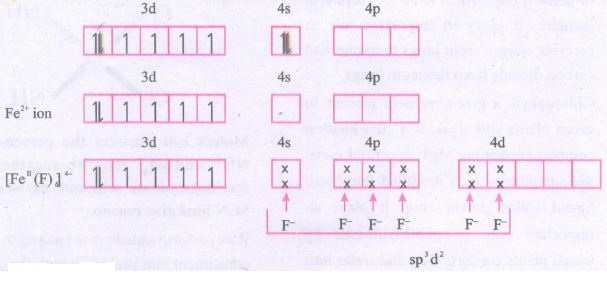
F- is weak field ligand
In [FeF6]4-the hybridisation takes place is sp3d2
The number of unpaired electrons = 4.
\(\therefore \mu =\sqrt { 4(4+2) } =\sqrt { 24 } \)
The molecule is paramagnetic due to the presence of unpaired electrons.
The geometry of the molecule is octahedral.
b) [Fe(CN)6]4-
.JPG)
In [Fe(CN)6]4- complex, the CN- ligand is a powerful ligand, it forces the unpaired electrons in the 3d level to pair up inside.
Hence the species has no unpaired electron after hybridisation So the molecule is diamagnetic.
.JPG)
The geometry of the molecule is octahedral.
37.
(i) Only the ions that have unpaired electrons in d- orbital and in which d - d transition is possible will be coloured.
(ii) The ions in which d - orbitals are empty or completely filled will be colourless as no d -d transition is possible in those configurations.
(iii) From the above ions, it can be easily observed that only Sc3+ has an empty d - orbital and Cu+ has completely filled d-orbitals.
(vi) All other ions, except Sc3+ and Cu+, will be coloured in aqueous solution because of d - d transition.
38.
In \(\left[\mathrm{Co}\left(\mathrm{C}_{2} \mathrm{O}_{4}\right)_{3}\right]^{3-}\) Cobalt is in +3 oxidation state
\(\mathrm{Co}=[\mathrm{Ar}] 3 \mathrm{~d}^{7} 4 \mathrm{~s}^{2} \)
\(\mathrm{Co}^{3+}=3 \mathrm{~d}^{6} 4 \mathrm{~s}^{\circ}\)
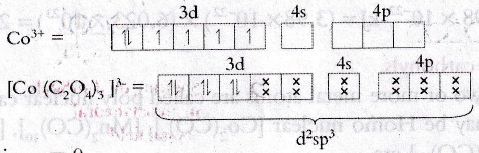
It is diamagnetic; n = 0
d2sp3 hybridisation; μs = 0
39.
1. The crude metal is refined by electrolysis. It is carried out in an electrolytic cell
Anode : Impure metal to be refined with dilute acid.
Cathode : Thin strips of pure metal
Electrolyte : Aqueous solution of the salts of the metal with dilute acid.
2. The metal dissolves from the anode, pass into the solution.
3. At the same amount of metal ions from the solution will be deposited at the cathode.
4. During electrolysis, the less electropositive impurities in the anode, settle down at the bottom and are removed as anode mud.
Example: Electrolytic refining of silver.
Cathode: Pure silver
Anode: lmpure silver rods
Electrolyte: Acidified aqueous solution of silver nitrate
5. When a current is passed through the electrodes the following reactions will take place
(a) Reaction at anode: \({ Ag }_{ (s) }\longrightarrow { Ag }^{ + }_{ (aq) }+{ 1e }^{ - }\)
(b) Reaction at cathode: \({ Ag }^{ + }_{ (aq) }+{ 1e }^{ - }\longrightarrow { Ag }_{ (s) }\)
6. During electrolysis, at anode silver loses electrons and form silver ions and the silver ions migrate towards the cathode and get discharged and deposited on the cathode.
7. Copper, Zinc etc can also be refined by this process.
40.
41.
Addition of electrolytes:
A negative ion causes the precipitation of positively charged sol and vice versa. When the valency of ion is high, the precipitation power is increased.
For example, the precipitation power of some cations and anions varies in the following order
\(\mathrm{Al}^{3+}>\mathrm{Ba}^{2+}>\mathrm{Na}^{+} \text {, Similarly }\left[\mathrm{Fe}\left(\mathrm{CN}_{6}\right)\right]^{3-}>\mathrm{SO}_{4}{ }^{2-}>\mathrm{Cl}^{-}\)
The precipitation power of electrolyte is determined by finding the minimum concentration (millimoles/lit) required to cause precipitation of a sol in 2 hours. This value is called flocculation value. The smaller the flocculation value greater will be precipitation.
42.
α - Helix:
In the a-helix sub-structure, the amino acids are arranged in a right handed helical (spiral) structure and are stabilised by the hydrogen bond between the carbonyl oxygen one amino acid (nth residue) with amino hydrogen of the fifth residue (n + 4th residue).The side chains of the residues protrude, outside of the helix. Each turn of an a-helix contains about 3.6 residues and is about 5.4 Å long.The amino acid proline produces a kink in the helical structure and often called as a helix breaker due to its rigid cyclic structure.
43.
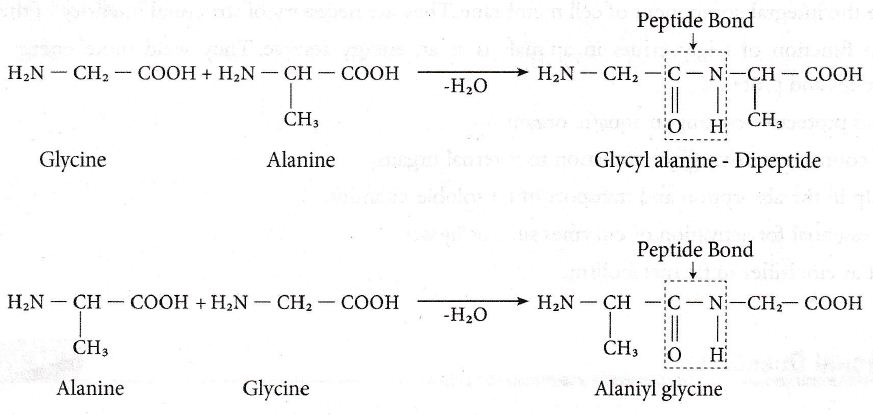
∴ Two dipeptides structures are possible from glycine and alanine. They are glycyl alanine and Alanyl glycine.
44.
The CFSE is defined as the energy of the electronic configuration in the ligand field minus the energy of the electronic configuration in the isotropic field.
CFSE (\(\Delta\)Eo) = {ELf}-{Eiso}
={[nt2g(-0.4) + neg(0.6)]\(\Delta\)o + npP} - {n'pP}
Here, nt2g is the number of electrons in t2g orbitals;
neg is number of electrons in eg orbitals;
np is number of electron pairs in the ligand field; &
n'p is the number of electron pairs in the isotropic field (barycenter).
P - pairing energy
45.
\((i) \quad 4 \mathrm{NaCl}+\mathrm{MnO}_{2}+4 \mathrm{H}_{2} \mathrm{SO}_{4} \rightarrow \mathrm{Cl}_{2}+\mathrm{MnCl}_{2}+4 \mathrm{NaHSO}_{4}+2 \mathrm{H}_{2} \mathrm{O} \)
\((ii) \quad \mathrm{NaNO}_{2}+\mathrm{HCl} \rightarrow \mathrm{NaCl}+\mathrm{HNO}_{2} \)
\((iii) \quad \mathrm{P}_{4}+3 \mathrm{NaOH}+3 \mathrm{H}_{2} \mathrm{O} \rightarrow 3 \mathrm{NaH}_{2} \mathrm{PO}_{2}+\mathrm{PH}_{3} \uparrow \)
\((iv) \quad 3 \mathrm{AgNO}_{3}+\mathrm{PH}_{3} \rightarrow \mathrm{Ag}_{3} \mathrm{P}+3 \mathrm{HNO}_{3} \)
\((v) \quad 4 \mathrm{Mg}+10 \mathrm{HNO}_{3} \rightarrow 4 \mathrm{Mg}\left(\mathrm{NO}_{3}\right)_{2}+\mathrm{N}_{2} \mathrm{O}+6 \mathrm{H}_{2} \mathrm{O} \)
\((vi) \quad 2 \mathrm{KClO}_{3} \stackrel{\Delta}{\longrightarrow} 2 \mathrm{KCl}+3 \mathrm{O}_{2} \uparrow \)
\((vii) \quad \mathrm{Cu}+Con. Hot \mathrm{H}_{2} \mathrm{SO}_{4} \rightarrow \mathrm{CuSO}_{4}+2 \mathrm{H}_{2} \mathrm{O}+\mathrm{SO}_{2} \uparrow \)
\((viii) \quad 2 \mathrm{Sb}+3 \mathrm{Cl}_{2} \rightarrow 2 \mathrm{SbCl}_{3} \)
\((ix) \quad 2 \mathrm{HBr}+\mathrm{H}_{2} \mathrm{SO}_{4} \rightarrow 2 \mathrm{SO}_{2}+2 \mathrm{H}_{2} \mathrm{O}+\mathrm{Br}_{2} \)
\((x) \quad \mathrm{XeF}_{6}+3 \mathrm{H}_{2} \mathrm{O} \rightarrow \mathrm{XeO}_{3}+6 \mathrm{HF} \)
\((xi) \quad 5 \mathrm{XeO}_{6}^{4-}+2 \mathrm{Mn}^{2+}+14 \mathrm{H}^{+} \rightarrow 2 \mathrm{MnO}_{4}^{-}+5 \mathrm{XeO}_{5}+7 \mathrm{H}_{2} \mathrm{O} \)
\((xii) \quad 2 \mathrm{XeOF}_{4}+\mathrm{SiO}_{2} \rightarrow 2 \mathrm{XeO}_{2} \mathrm{~F}_{2}+\mathrm{SiF}_{4} \)
\((xiii) \quad Xe+{ 3F }_{ 2 }\overset { Ni/200atm }{ \underset { 400^{ 0 }C }{ \longrightarrow } }XeF_6\)
46.
HF is a weak acid i.e. 0.1 M solution is only 10% ionised, but in 5M & 15M solution, HF is stronger acid due to chemical equilibrium.
\(\mathrm{HF}+\mathrm{H}_{2} \mathrm{O} \rightleftharpoons \mathrm{H}_{3} \mathrm{O}^{+}+\mathrm{F}^{-} \)
\(\mathrm{HF}+\mathrm{F}^{-} \rightleftharpoons \mathrm{HF}_{2}^{-}\)
47.
\(\operatorname{Density}(\rho)=\frac{\mathrm{nM}}{\mathrm{a}^{3} \mathrm{~N}_{\mathrm{A}}} \)
\(\rho=10 \mathrm{~g} \mathrm{~cm}^{-3} ; \mathrm{a}=100 \mathrm{pm}=1 \times 10^{-8} \mathrm{~cm} ; \mathrm{N}_{\mathrm{A}}=6.023 \times 10^{23} ; \mathrm{n}=4 ; \mathrm{M}=? \)
\(M=\frac{\rho \mathrm{a}^{3} \mathrm{N_{A}}}{n} \)
\(=\frac{10 \times\left(1 \times 10^{-8}\right)^{3} \times 6.023 \times 10^{23}}{4} \)
\(=\frac{6.023}{4} \)
= 1.505 g /mol
No. of moles \(=\frac{\text { Mass }}{\text { Molar mass }}=\frac{1}{1.505}\)
= 0.664 moles
Hence number of atoms = 0.664 x 6.023 x 1023 = 3.99 x 10²³ atoms
48.
(i) Zeolites are three-dimensional crystalline solids containing Al, Si and O in their regular three dimensional framework.
(ii) They are hydrated sodium alumino silicates with general formula Na2O(AI2O3).·x(SiO2)·yH2O
(x = 2 to 10; y = 2 to 6).
(iii) Zeolites have porous structure in which the monovalent sodium ions and water molecules are loosely held.
(iv) The Si and Al atoms are tetrahedrally coordinated with each other through shared oxygen atoms.
(v) Zeolites are similar to clay minerals but they differ in their crystalline structure.
(vi) Zeolites have a three dimensional crystalline structure looks like a honeycomb consisting of a network of interconnected tunnels and cages.
(vii) Water molecules moves freely in and out of these pores but the zeolite framework remains rigid
(viii) Another special aspect of this structure is that the pore/channel sizes are nearly uniform, allowing the crystal to act as a molecular sieve.
49.
(i) The extraction of metals from their oxides can be carried out by using different reducing agents.
(ii) Consider the following reaction
\(\frac{2}{\mathrm{y}} \mathrm{M}_{\mathrm{x}} \mathrm{O}_{\mathrm{y}(\mathrm{s})} \rightarrow \frac{2 \mathrm{x}}{\mathrm{y}} \mathrm{M}_{(s)}+\mathrm{O}_{ 2(\mathrm{~g})}\) (1)
(iii) The above reduction may be carried out with carbon. In this case the reducing agent carbon may be oxidized to either CO or CO2
\(\mathrm{C}+\mathrm{O}_{2} \rightarrow \mathrm{CO}_{2(\mathrm{~g})} \) (2)
\(2 \mathrm{C}+\mathrm{O}_{2} \rightarrow 2 \mathrm{CO}_{(\mathrm{g})} \) (3)
(iv) If CO is used as a reducing agent
\(2 \mathrm{CO}+\mathrm{O}_{2} \rightarrow 2 \mathrm{CO}_{2(\mathrm{~g})}\) (4)
(v) A suitable reducing agent is selected based on the thermodynamics considerations.
(vi) We know that for a spontaneous reaction, the change in free energy (\(\triangle\)G) should be negative.
(vii) Therefore, thermodynamically, the reduction of metal oxide with a given reducing agent can occur if the free energy change for the coupled reaction is negative.
(viii) Hence, the reducing agent is selected in such a way that it provides a large negative \(\triangle\)G value for the coupled reaction.
50.

2- Pentanone.
51.
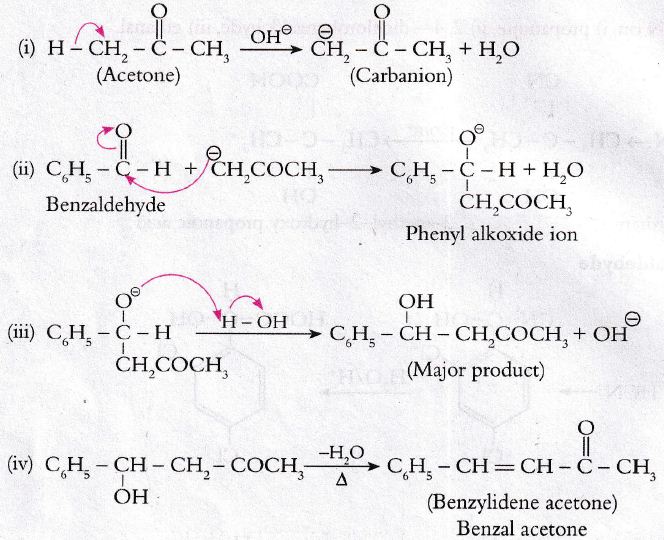
52.
a) \(BaSO_{4}(s)\overset{H_{2}O}{\rightleftharpoons }Ba^{2+}(aq)+SO^{2+}_{4}(aq)\)
\(K_{sp}=[Ba^{2+}][SO^{2-}_{4}]\) = (s) (s)
Ksp = s2
b) \(Ag_{2}CrO_{4}(s)\overset{H_{2}O}{\rightleftarrows }2Ag^{+}(aq)+CrO_{4}^{2-}(aq)\)
\(K_{sp}=[Ag^{+}]^{2}[CrO)^{2-}_{4}]\)
= (2s)2 (s)
Ksp = 4S3
53.
a) Equivalent conductance
\(\lambda_{\infty} \mathrm{Al}_{2}\left(\mathrm{SO}_{4}\right)_{3} =\frac{1}{3} \lambda_{\infty} \mathrm{Al}^{3+}+\frac{1}{2} \lambda_{\infty} \mathrm{SO}_{4}^{2-} \)
\(=\left(\frac{1}{3} \times 189\right)+\frac{1}{2}(160) \)
\(=63+80=143 \mathrm{~S} \mathrm{~cm}^{2} \mathrm{~g} \mathrm{eq}^{-1} \)
b) Molar conduçtance
\(\mu_{\infty} \mathrm{Al}_{2}\left(\mathrm{SO}_{4}\right)_{3} =2 \mu_{\infty} \mathrm{Al}^{3+}+3 \mu_{\infty} \mathrm{SO}_{4}^{2-} \)
=2(189) + 3(160)
=378 + 480
= \(858 \mathrm{~S} \mathrm{~cm}{ }^{2} \mathrm{~mol}^{-1}\)
54.
a) Oxidation at anode :
\(\mathrm{Mg} \rightarrow \mathrm{Mg}^{2+}+2 \mathrm{e}^{-} ; \mathrm{E}_{\mathrm{Ox}}^{0}=2.37 \mathrm{~V}\) ...(1)
Reduction at cathode:
\(A \mathrm{~g}^{+} +\mathrm{e}^{-} \rightarrow \mathrm{Ag} ; \mathrm{E}_{\text {red }}^{0}=+0.80 \mathrm{~V} \) ...(2)
\(E_{\text {Cell }}^{0} =\left(\mathrm{E}_{\text {ox }}^{0}\right)_{\text {anode }}+\left(\mathrm{E}_{\text {red }}^{0}\right)_{\text {cathode }} \)
= 2.37 + 0.80 = 3.17V
Overall reaction : (1) + 2 x (2)
\(\mathrm{Mg} \rightarrow M g^{2+}+2 e^{-} \)
\(2 \mathrm{Ag}^{+}+2 \mathrm{e}^{-} \rightarrow 2 A g \)
__________________
\(M g+2 A g^{+} \rightarrow M g^{2+}+2 A g\)
b) \( \therefore \Delta G^{0}=-n F E^{0} \)
\(=-2 \times 96500 \times 3.17 \)
\(=-611810=-6.12 \times 10^{5} \mathrm{~J} \)
\(W=6.12 \times 10^{5} \mathrm{~J}\)
c) \(\Delta \mathrm{G}^{0}=-2.303 \mathrm{RT} \log \mathrm{K}_{c} \)
\(\log \mathrm{K}_{\mathrm{c}}=-\frac{\Delta G^{0}}{2.303 R T} \)
\(\log \mathrm{K}_{c}=-\frac{\left(-6.12 \times 10^{5}\right)}{2.303 \times 8.314 \times 298}=107.2 \)
\(K_{c}=A . \log 107.2 \)
\(\mathrm{K}_{c}=\text { Antilog of (107.2) }\)
= 1.58 x 10107
55.
When two are more solution are mixed, the resulting concentrations are different from the original.
\(\text { Molarity }=\frac{n}{\mathrm{~V}} \text { (or) } \mathrm{n}=\text { Molarity } \times \mathrm{v} \)
Total Volume of the mixture = 0.15 + 0.1
= 0.25 L
\(\underset{0.1M}{Pb(NO_{3})_{2}}\rightleftharpoons \underset{0.1M}{Pb^{2+}}+2\underset{0.2M}{2NO^{-}_{3}}\)
nPb2+ \(=0.1\times0.15=0.015 \ mol\)
\([Pb^{2+}]_{mix}= \frac{n}{v} = \frac{0.1\times0.15}{0.25}=0.06M\)
\(\underset{0.2M}{NaCl}\rightleftharpoons \underset{0.2M}{Na^{+}}+\underset{0.2M}{Cl^{-}}\)
\(\mathrm{n}_{\mathrm{Cl^-}}=0.2 \times 0.1=0.02 \mathrm{~mol} \)
\(\left[\mathrm{Cl}^{-}\right]_{\text {mix }}=\frac{0.02}{0.25}=0.08 \mathrm{M} \)
\(\therefore Ionic \ Product =\left[\mathrm{Pb}^{2+}\right]\left[\mathrm{Cl}^{-}\right]^{2} \)
\(=0.06 \times(0.08)^{2} \)
\(IP =3.84 \times 10^{-4}\)
\(\therefore 3.84 \times 10^{-4}>1.2 \times 10^{-5}\)
(or) \(\mathrm{IP}>\mathrm{K}_{\mathrm{sp}}\)
\(\therefore\) PbCl2 will be precipitated.
56.
According to Arrhenius equation
\(\log\left( \frac { { k }_{ 2 } }{ { k }_{ 1 } } \right) =\frac { { E }_{ a } }{ 2.303R } \left( \frac { { T }_{ 2 }-{ T }_{ 1 } }{ { T }_{ 1 }{ T }_{ 2 } } \right) \)
T2 = 400K ; k2 = 0.04 s-1
T1 = 200K ; k1 = 0.02 s-1
\(\log\left( \frac { 0.04}{ 0.02} \right) =\frac { { E }_{ a } }{ 2.303\times 8.314} =\left( \frac { 400-200 }{ 200\times 400 } \right) \)
\(\log(2)=\frac { { E }_{ a } }{ 2.303\times 8.314} =\left( \frac { 1 }{ 400 } \right) \)
Ea = log(2) \(\times\) 2.303 \(\times\) 8.314 \(\times\) 400
= 0.3010 \(\times\) 2.303 \(\times\) 8.314 \(\times\) 400
Ea = 2305 J mol-1 = 2.305 kJ mol-1
57.
For a first order reaction
\(k=\frac { 2.303 }{ t } \log\frac { \left[ { A }_{ 0 } \right] }{ \left[ A \right] } \)
\(k=\frac { 2.303 }{ t } \log\frac { { V }_{ \infty } }{ { V }_{ \infty }-{ V }_{ 1 } } \)
V∞= 58.3 ml.
| t(min) | Vt | V∞=Vt | \(k=\frac { 2.303 }{ t } \log\frac { { V }_{ \infty } }{ { V }_{ \infty }-{ V }_{ t } } \) |
| 6 | 19.3 | 58.3-19.3=39.0 | \(k=\frac { 2.303 }{ 6 } \log\left( \frac { 58.3 }{ 39 } \right) =0.0670\) min-1 |
| 12 | 32.6 | 58.3-32.6=25.7 | \(k=\frac { 2.303 }{ 12 } \log\left( \frac { 58.3 }{ 25.7 } \right) =0.06838\) min-1 |
| 18 | 41.3 | 58.3-41.3=17.0 | \(k=\frac { 2.303 }{ 18 } \log\left( \frac { 58.3 }{ 17 } \right) =0.06838\) min-1 |
| 24 | 46.5 | 58.3-46.5=11.8 | \(k=\frac { 2.303 }{ 24 } \log\left( \frac { 58.3 }{ 11.8 } \right) =0.0666\) min-1 |
| 30 | 50.4 | 58.3 - 50.4 = 7.9 | \(k=\frac{2.303}{30} \log \left(\frac{58.3}{7.9}\right)=0.067\) min-1 |
| Mean value of k = 0.0674 min-1 |
As the rate constants are constant through out it is a first order reaction.
58.
\(Eu (63)-[\mathrm{Xe}] 4 \mathrm{f}^{7} 5 \mathrm{~d}^{0} 6 \mathrm{~s}^{2}, \mathrm{Eu}^{2+}-[\mathrm{Xe}] 4 \mathrm{f}^{7} \)
\(\mathrm{Ce}(58)-[\mathrm{Xe}] 4 \mathrm{f}^{1} 5 \mathrm{~d}^{1} 6 \mathrm{~s}^{2}, \mathrm{Ce}^{2+}-[\mathrm{Xe}] 4 \mathrm{f}^{1} 5 \mathrm{~d}^{1} \)
Eu2+ has exactly half filled stable electronic configuration. Hence Europium (II) is more stable than Cerium (II).
59.
(i) Frenkel defect arises due to the dislocation of ions from its crystal lattice.
(ii) The ion which is missing from the lattice point occupies an interstitial position.
(iii) This defect is shown by ionic solids in which cation and anion differ in size.
(iv) Unlike Schottky defect, this defect does not affect the density of the crystal.
For example AgBr, in this case, small Ag+ ion leaves its normal site and occupies an interstitial position.
60.
1. A double salt which contains fourth-period alkali metal (A) is potash alum
K2SO4 Al2(SO4)3 - 24 H₂O
2. On heating potash alum (A) 500 k give anhydrous potash alum (or) burnt alum (B).
\(\mathrm{K}_{2} \mathrm{SO}_{4} \cdot \mathrm{Al}_{2}\left(\mathrm{SO}_{4}\right)_{3} \cdot 24 \mathrm{H}_{2} \mathrm{O} \stackrel{500 \mathrm{~K}}{\longrightarrow} \mathrm{K}_{2} \mathrm{SO}_{4} \cdot \mathrm{Al}_{2}\left(\mathrm{SO}_{4}\right)_{3}+24 \mathrm{H}_{2} \mathrm{O}\)
[Potash alum (A)] [Burnt alum (B)]
3. Aqueous solution of burnt alum, has sulphates ion, potassium ion and aluminium ion. Sulphate ion reacts with BaCl₂ to form a white precipitate of Barium Sulphate
(SO4)2 + BaCl2 → BaSO4 + 2 Cl¯
Aluminium ion reacts with alizarin solution to give a red colour compound.

12th Standard Syllabus & Materials
12th Standard
TN 12th Computer Applications களப்பெயர் முறைமை (DNS) Sample Question Papers Study Material - QB365 Set A
NEW12th Standard
TN 12th Computer Applications வலையமைப்பு எடுத்துக்காட்டுகள் மற்றும் நெறிமுறைகள் Sample Question Papers Study Material - QB365 Set A
NEW12th Standard
TN 12th Computer Applications கணினி வலையமைப்பு ஓர் அறிமுகம் Sample Question Papers Study Material - QB365 Set A
NEW12th Standard
TN 12th Computer Applications PHP-உடன் MySQL-ஐ இணைத்தல் Sample Question Papers Study Material - QB365 Set A



Tamilnadu Stateboard 12th Standard Subjects

Maths
Chemistry

Physics

Biology

Computer Science

Business Maths and Statistics

Economics

Commerce

Accountancy

History

Computer Applications
Biology
Computer Technology
Computer Applications
Computer Science
Business Maths and Statistics
Commerce
Economics
Maths
Chemistry
Physics
Computer Technology
History
Accountancy

Tamil

English

French
Tamilnadu Stateboard Standards
