
 100% FREE ACCESS
12th Standard Syllabus & Materials
12th Standard
TN 12th Computer Applications மின்னணு தரவு பரிமாற்றம் Sample Question Papers Study Material - QB365 Set A
NEW12th Standard
TN 12th Computer Applications மின் - வணிக பாதுகாப்பு அமைப்புகள் Sample Question Papers Study Material - QB365 Set A
NEW12th Standard
TN 12th Computer Applications மின்னணு செலுத்தல் முறைகள் Sample Question Papers Study Material - QB365 Set A
NEW12th Standard
TN 12th Computer Applications மின் - வணிகம் Sample Question Papers Study Material - QB365 Set A
NEW12th Standard
TN 12th Computer Applications திறந்த மூல கருத்துருக்கள் Sample Question Papers Study Material - QB365 Set A
NEW12th Standard
TN 12th Computer Applications வலையமைப்பு வடமிடல் Sample Question Papers Study Material - QB365 Set A

Published on: 07/03/2020
12 Standard Chemistry English Medium All Chapter Book Back and Creative Three Mark Question 2020
Download Tamil Nadu 12th Standard Chemistry question papers, model tests, one-mark questions, important questions, and public exam papers in PDF format. Free study materials and answer keys for TN State Board students.
Questions + Answers key
Take MCQ Chemistry Test
1.
How are the following compounds obtained from benzene diazonium chloride?
(i) phenol
(ii) ester
(iii) p-hydroxy azo benzene
2.
An Organic compound (A) with molecular formula C6H7N gives (B) with HNO2 / HCI at 273 K. The aqueous solution of (B) on heating gives compound (C) which gives violet colour with netural FeCI3. Identify the compounds (A), (B) and (C) and write the equations.
3.
How is carboxylic acid prepared from alcohols?
4.
Explain Stephen's reaction.
5.
The monomer is capro lactam 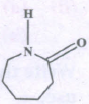 Identify the polymer when the monomer is heated at 533K.
6.
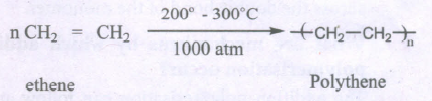
How is Low density polyethene prepared?
7.
Distinguish between fat soluble and water soluble vitamins.
8.
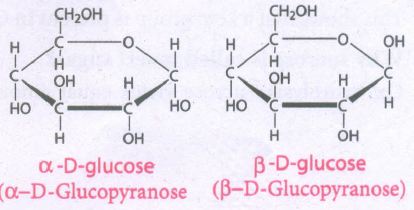
Give the structure of α - D - glucose and β- D - glucose
9.
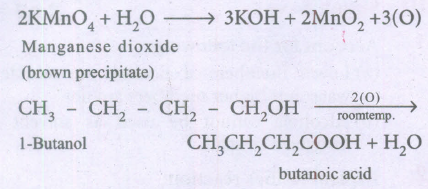
When tertiary butyl alcohol and 1-butanol are separately treated with a few drops of KMnO4, in one case only the purple colour disappears and a brown precipitate is formed. Which of the two alcohols gives the above reaction and what is that brown precipitate?
10.
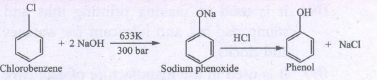
How will you prepare phenol (i) From chloro benzene (ii) From benzene sulphonic acid?
11.
Explain the meaning of the statement. 'Adsorption is a surface phenomenon'.
12.
Why does physisorption decrease with increase of temperature?
13.
Why does the emf of Leclanche cell decrease?
14.
Write the cell representation of the galvanic cell in which the following reaction take place
\({ Zn }_{ (s) }+Cu{ SO }_{ 4 }\rightarrow { ZnSO }_{ 4 }+{ Cu }_{ (s) }\)
For the above cell. Identify the anode and cathode half cell.
15.
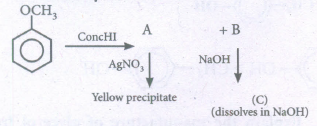
Complete the following sequence of reaction and Identify A, B and C.
16.
Define buffer Index
17.
What do you mean by auto ionisation of water?
18.
Addition of Alum purifies water. Why?
19.
Why are lyophillic colloidal sols are more stable than lyophobic colloidal sol.
20.
What happens when 1-phenyl ethanol is treated with acidified KMnO4.
21.
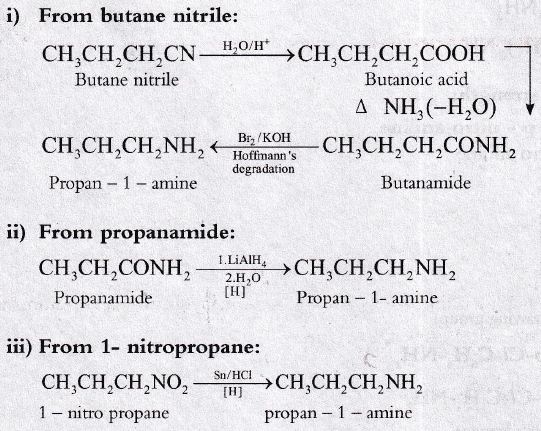
How will you prepare propan – 1- amine from
i) butane nitrile
ii) propanamide
ii) 1- nitropropane
22.
Why is AC current used instead of DC in measuring the electrolytic conductance?
23.
What are reducing and non – reducing sugars?
24.
Calculate the pH of 1.5\(\times\)10-3 M solution of Ba(OH)2
25.
A first order reaction takes 8 hours for 90% completion. Calculate the time required for 80% completion. (log 5 = 0.6989 ; log10 = 1)
26.
Why Hcl and HNO3 cannot be used for making the KMnO4 medium acidic?
27.
Give the ionic reaction of electrolytic of aqueous solution of KMnO4
28.
Give examples for first order reaction.
29.
A reaction is of second order in A and first order in B.
(i) Write the differential rate equation.
(ii) How is the rate affected on increasing the concentration of A three times?
(iii) How is the rate affected when the concentration of both A and B is doubled?
30.
Why do noble gases form compounds with fluorine and oxygen only?
31.
Name a reaction for the estimation of Ozone.
32.
If NaCI is doped with 10-3 mol % of SrCl2 What is the concentration of cation valencies?
33.
Silver crystallizes in fcc lattice. If edge length of the cell is 4.07 x 10⁻⁸ em and density is 10.5 g cm-3. Calculate the atomic mass of silver
34.
Describe the structure of carbon nanotubes.
35.
What are the uses of diborane?
36.
Support the statement given below with relevant examples.
37.
What is meant by aluminothermic process?
38.
Mohr's salt answers the presence of Fe2+, NH4+and SO42- ions, whereas the potassium ferrithiocyanate will not answer Fe3+ and SCN ions give reason.
39.
What is the significance of stability constants?
40.
Explain why Cr2+ is strongly reducing while Mn3+ is strongly oxidizing.
41.
Write briefly about the applications of coordination compounds in volumetric analysis
42.
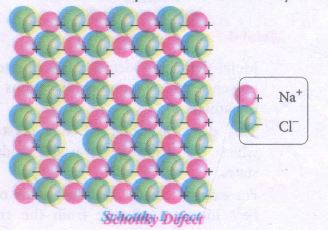
Explain Schottky defect.
43.
Write the reason for the anomalous behaviour of Nitrogen.
44.
Write a note on metallic nature of p-block elements.
45.
Explain the following terms with suitable examples.
(i) Gangue
(ii) slag
46.
A carbonyl compound A having molecular formula C5H10O forms crystalline precipitate with sodium bisulphate and gives positive iodoform test. A does not reduce Fehling solution. Identify A.
47.
Is it possible to store copper sulphate in an iron vessel for a long time?
Given : \(E^{0}_{Cu^{2+}|Cu} = 0.34\) V and \(E^{0}_{Fe^{2+}|Fe} = -0.44\)V.
48.
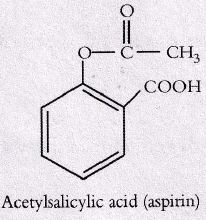
Write the structural formula of aspirin.
49.
Why carbohydrates are generally optically active.
50.
Define pH.
51.
A gas phase reaction has energy of activation 200 kJ mol-1. If the frequency factor of the reaction is 1.6 x 10¹³s-1. Calculate the rate constant at 600 K.(e-40.09 = 3.8 x 10-48)
52.
Write the electronic configuration of Ce4+ and Co2+.
53.
Why tetrahedral complexes do not exhibit geometrical isomerism.
54.
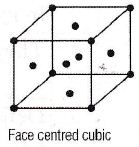
Calculate the number of atoms in a fcc unit cell.
55.
How will you prepare chlorine in the laboratory?
56.
Give one example for each of the following
(i) icosogens
(ii) Tetragens
(iii) pnictogens
(iv) chalcogens
57.
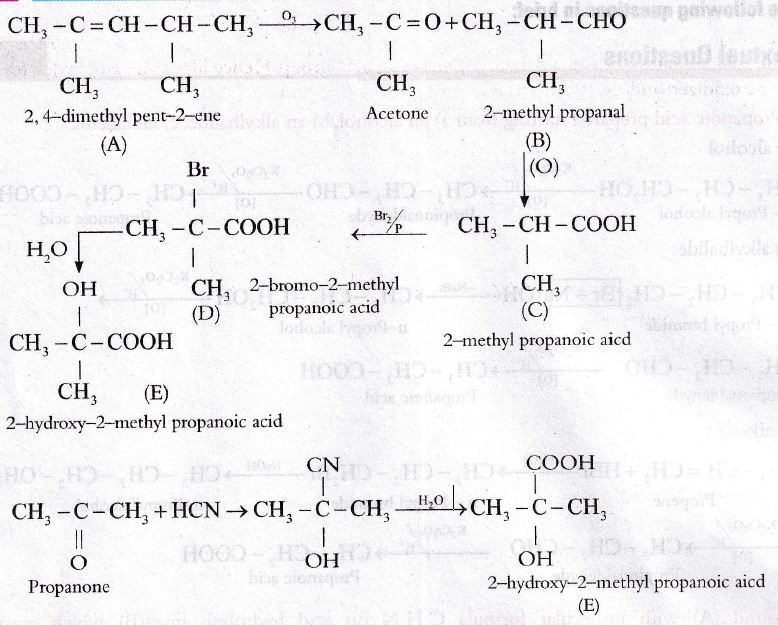
An alkene (A) on ozonolysis gives propanone and aldehyde (B). When (B) is oxidised (C) is obtained. (C) is treated with Br2/P gives (D) which on hydrolysis gives (E). When propanone is treated with HCN followed by hydrolysis gives (E). Identify A, B, C, D and E.
58.
Arrange the following
i. In increasing order of solubility in water, C6H5 NH2, (C2H5)2NH, C2H5NH2
ii. In increasing order of basic strength
a) aniline, p- toludine and p – nitroaniline
b) C6H5 NH2, C6H5 NHCH3, C6H5NH2, p-Cl-C6- H4-NH2
iii. In decreasing order of basic strength in gas phase
(C2H5)NH2, (C2H5)NH, (C2H5)5N and NH3
iv. In increasing order of boiling point
C6H5OH, (CH3)2NH, C2H5NH2
v. In decreasing order of the pKb values
C2H5NH2, C6H5NHCH3.(C2H5)2 NH and CH3NH2
vi. Increasing order of basic strength
C2H5NH2,C6H5N(CH3)2, (C2H5)2 NH and CH3NH2
vii. In decreasing order of basic strength

59.
What are drugs? How are they classified.
1.
(i) Repl cementby-OH: When the aqueous solution is boiled, phenol is obtained

This is an example of SN1 reaction in which C6H5N2CI initially gives C6H5+ and water is the nudeophile.
(ii) Replacement of RO- (or) RCOO- groups Similarly -N2CI can be replaced acyloxy group by boiling with carboxylic acids.
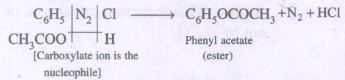
(iii) Diazonlum coupling reaction: Diazonium salt reacts with aromatic amine and phenols to give azo compounds of the general formula.
Ar - N = N - Ar'
This reaction is known as Coupling reaction since all these compounds are intensely coloured and used as dyes, thousands of azodyes have been synthesised by this procedure.

2.
(i) An organic compound (A) with molecular formula C6H7N is identified as Aniline C6H5NH2
(ii) Aniline on treatment with HNO2 / HCl at 273 K gives a clear solution of Benzene diazonium chloride C6H5N2CI the compound (B).
\({ C }_{ 6 }{ H }_{ 5 }{ NH }_{ 2 }+{ HNO }_{ 2 }\xrightarrow [ 273K ]{ NCl } \underset { Benzene \ diazonium \ chloride }{ { C }_{ 6 }{ H }_{ 5 }{ N }_{ 2 }Cl } \)
(iii) An aqueous solution of benzene diazonium chloride on heating gives phenol C6H5OH and it is compound (C).
\({ C }_{ 6 }{ H }_{ 5 }{ N }_{ 2 }Cl+{ HOH }\underrightarrow { \triangle } { C }_{ 6 }{ H }_{ 5 }OH-{ N }_{ 2 }+HCl\)
| A | C6H5NH2 | Aniline |
| B | C6H5N2Cl | Benzene diazonium chloride |
| C | C6H5OH | Phenol |
3.
Primary alcohols and aldehydes can easily be oxidised to the corresponding carboxylic acids with oxidising agents such as potassium permanganate (in acidic or alkaline medium), potassium dichromate (in acidic medium)
Example:
\(\underset{Ethyl \ alcohol}{ { CH }_{ 3 }{ CH }_{ 2 }OH}\overset { { H }^{ + }/{ K }_{ 2 }{ Cr }_{ 2 }{ O }_{ 7 } }{ \underset { (O) }{ \longrightarrow } } \underset{Acetaldehyde}{{ CH }_{ 3 }CHO}\underset { (O) }{ \longrightarrow }
\underset{Acetic \ acid}{{ CH }_{ 3 }COOH}\)
4.
When alkylcyanides are reduced using SnCl2 HCl, imines are formed, which on hydrolysis gives corresponding aldehyde.
\({ CH }_{ 3 }-C\equiv N\overset { { SnCl }_{ 2 }/HCl }{ \longrightarrow } { CH }_{ 3 }-CH={ NH }\overset { { H }_{ 3 }{ O }^{ + } }{ \longrightarrow } { CH }_{ 3 }-CHO\)
5.
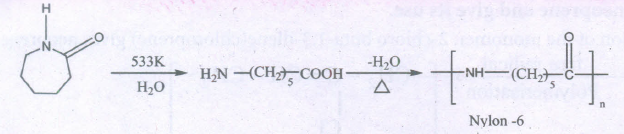
Capro lactam (monomer) on heating at 533K in an inert atmosphere with traces of water gives \(\in \) amino carproic acid which polymerises to give nylon - 6
6.
LDPE is formed by heating ethene at 200° to 300°C under oxygen as a catalyst. The reaction follows free radical mechanism. The peroxides formed from oxygen acts as a free radical initiator.
7.
| Fat Soluble Fat Soluble | Water Soluble Vitamins |
|---|---|
| Do not dissolve in water | Readily soluble in water |
| They are stored in fatty tissues and liver | These can't be stored |
| Eg: Vitamin A, D, E and K | Eg: Vitamin Band |
8.
9.
1-Butanol, being primary alcohol gets oxidised by dilute KMnO4. The brown precipitate is due to the formation of manganese dioxide.
10.
(i) From halo arenes(Dows process):
When Chlorobenzene is hydrolysed with 6-8% NaOH at 300 bar and 633K in a closed vessel, sodium phenoxide is formed which on treatment with dilute HCI gives phenol.
(ii) From benzene sulphonic acid:
Benzene is sulphonated with oleum and the benzene sulphonic acid so formed is heated with molten NaOH at 623K gives sodium phenoxide which on acidification gives phenol.
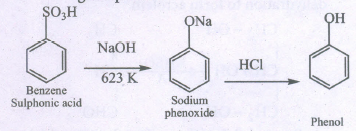
11.
When a solid adsorbent is placed in a closed vessel containing some gas or a solution. The molecules of the gas or the solute are adsorbed on the surface so that their concentration or higher on the surface. Hence, it is called a surface phenomenon.
12.
Physisorption is an exothermic process
\(\underset { (Adsorbent) }{ Solid } +\underset { (Adsorbate) }{ Gas } \rightleftharpoons \underset { (Gas\ adsorbed \ on\ solid) }{ Gas/solid } +Heat\)
According to Le chatelier's principle, if we increase the temperature, equilibrium will shift in the backward direction, i.e., gas is released from the surface on which it is adsorbed.
13.
The overall redox reaction in Leclanche cell is
\( \mathrm{Zn}_{(\mathrm{s})}+2 \mathrm{NH}_{4 \text { (aq) }}^{+}+2 \mathrm{MnO}_{2(\mathrm{~s})} \longrightarrow \mathrm{Zn}_{(\mathrm{aq})}^{2+}+\mathrm{MnO}_{2} \mathrm{O}_{3(\mathrm{~s})}+\mathrm{H}_{2} \mathrm{O}(l)+2 \mathrm{NH}_{3} \)
The ammonia produced at the cathode combines with Zn2+ to form a complex ion [Zn (NH3)4]2+(aq). As the reaction proceeds the concentration of NH3 will decrease and the aqueous NH3 will increase which lead to the decrease in the emf of cell.
14.
The galvanic cell is represented as
\({ Zn }_{ (s) }|{ Zn }_{ (aq) }^{ 2+ }||{ Cu }_{ (aq) }^{ 2+ }|{ Cu }_{ (s) }\)
The anode half cell is \({ Zn }_{ (s) }|{ Zn }_{ (aq) }^{ 2+ }\)
The cathode half cell is \({ C }u_{ (Aq) }^{ 2+ }|{ Cu }_{ (s) }\)
15.
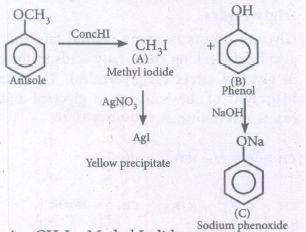
A - CH3I- Methyl Iodide
B - C6H5OH - Phenol
C - C6H5ONa - Sodium Phenoxide
16.
Buffer index β, as a quantitative measure of the buffer capacity. It is defined as the number of gram equivalents of acid or base added to 1litre of the buffer solution to change its pH by unity.
\(\beta =\frac { dB }{ d(pH) } \)
Here,
dB = number of gram equivalents of acid / base added to one litre of buffer solution
d(pH) = The change in the pH after the addition of acid / base.
17.
Pure water itself has a little tendency to dissociate. i.e, one water molecule donates a proton to an another water molecule. This is known as auto ionisation of water and it is represented as below.
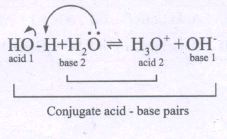
18.
(i) Purification of drinking water is activated by coagulation of suspended impurities in water by using alums containing \(\mathrm{Al}^{3+}\left(\mathrm{K}_{2} \mathrm{SO}_{4} \mathrm{Al}_{2}\left(\mathrm{SO}_{4}\right)_{3} \cdot 24 \mathrm{H}_{2} \mathrm{O}\right)\) Alum has a negative charge and tends to disperse in water very fast.
(ii) The increased size as well as the lack of repelling charges cause the alum particles to settle down at the bottom or rise up and float in water. After the particles are neutralized, they clump together because of the London dispersive force which are part of vander Waal's forces. The weak inter molecular force arising from quantum induced instantaneous polarisation multi poles in molecules causes even non polar particles to attract each other due to the corelated movements of the electrons in interacting molecules. Then they settle down.
19.
(i) In lyophillic colloids or sols definite attractive force or affinity exists between dispersion medium and dispersed phase. Examples: sols of protein and starch. They are more stable and will not get precipitated easily.
(ii) In a lyophobic colloids, no attractive force exists between the dispersed phase and dispersion medium. They are less stable and precipitated readily, but cannot be produced again by just adding the dispersion medium.
Examples: sols of gold, silver, platinum and copper.
20.
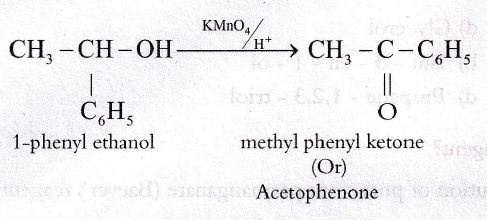
21.
 + 2H2O
22.
(a) If we apply DC current through the conductivity cell, it will lead to the electrolysis of the solution taken in the cell.
(b) So, AC current is used for this measurement to prevent electrolysis.
23.
i) Reducing sugars:
1. Sugars which reduce Tollen's reagent or Fehling's solution or Benedict's solution are called reducing sugars.
2. These contain either α - hydroxyl ketone or cyclical hemi acetal or hemi ketal or structures in equilibrium with open chain forms having a free- CHO or C=O group.
3. E.g. a) All monosaccharide's like D - glucose, D - fructose (aldoses and ketoses)
b) Sugars like Lactose and maltose except sucrose.
ii) Non - reducing sugars:
1. Sugars which do not reduce either Tollen's reagent, Fehling's solution or Benedict's solution are called non-reducing sugars.
2. They contain a stable acetal or ketal structures which cannot be opened into a free carbonyl group.
E.g. Sucrose, starch, cellulose, glycogen, dextrin etc.
24.
Considering Ba(OH)2 to be a strong base:
\(\text { Normality } =\text { Molarity } \times \text { Acidity } \)
\(=1.5 \times 10^{-3} \times 2\)
\({\left[\mathrm{OH}^{-}\right] } =3 \times 10^{-3} \)
\(\mathrm{pOH} =-\log _{10}[\mathrm{OH}^-] \)
\(=-\log _{10}\left(3 \times 10^{-3}\right) \)
\(=-\left[\log _{10} 3+3 \log 10\right] \)
= 3-log 3
= 3-0.4771
= 2.5229
\(\mathrm{pH} =14-\mathrm{pOH} \)
= 14-2.5229
pH = 11.4771 = 11.48
25.
For a first order reaction
\(\\ \\ k=\frac { 2.303 }{ t } log\left( \frac { [{ A }_{ 0 }] }{ [A] } \right) \\ \) ..(1)
Let[A0] =100M
When
t = t90%; [A] = 10M (given that t90% = 8hours)
t = t80%; [A ] = 20M
\(k=\frac { 2.303 }{ { t }_{ 80\% } } \log\left( \frac { 100 }{ 20 } \right) \)
\({ t }_{ 80\% }=\frac { 2.303 }{ K } \log(5)\) ....(2)
Find the value of k using the given data
\(k=\frac { 2.303 }{ { t }_{ 90\% } } \log\left( \frac { 100 }{ 10 } \right) \)
\(k=\frac { 2.303 }{ 8 } \log10\)
\(k=\frac { 2.303 }{ 8 } ...(3)\)
Substitute the value of k in equation (2)
\({ t }_{ 80\% }\frac { 2.303 }{ 2.303/8hours } \log(5)\)
t80%= 8 hours x 0.6989
t80%= 5.59 hours
26.
(i) HCl cannot be used for making the medium acidic since it reacts with KMnO4 as follows.
2MnO4- + 10 Cl- + 16H+ ⟶ 2Mn2+ + 5Cl2+ 8H2O
(ii) HNO3 also cannot be used since it is good oxidising agent and reacts with reducing agents in the reaction.
(iii) However, H2SO4 is found to be most suitable since it does not react with potassium permanganate.
27.
In this method aqueous solution of potassium manganate is electrolyzed in the presence of little alkali.
K2MnO4 ⇌ 2K+ + MO42-
H2O ⇌ H+ + OH-
Manganate ions are converted into permanganate ions at anode.
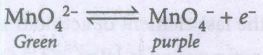
H2 is liberated at the cathode.
2H+ + 2e- ⟶ H2 ↑
The purple coloured solution is concentrated by evaporation and forms crystals of potassium permanganate on cooling.
28.
(i) All radioactive transformations follow first order kinetics. For example,
92U238 ⟶ 90U234 +2He4
(ii) Decomposition of sulphuryl chloride in the gas phase proceeds by first order kinetics.
SO2Cl2(g) ⟶ SO2(g) + Cl2(g)
(iii) Inversion of sucrose in acidic aqueous medium follows first order reaction.
C12H22O11 +H2O \(\overset { H+ }{ \longrightarrow } \) C6H12O6 +C6H12O6
29.
A reaction is second order in A and first order in B
(i) Differential rate equation,
Rate = \(\frac { -d\left[ R \right] }{ dt } =k{ \left[ A \right] }^{ 2 }\left[ B \right] \)
(ii) When the concentration of A is increased three times, (i.e) 3A, then
Rate = k[3A]2 [B]
= 9k [A]2[B] = 9 (initial rate)
This shows the rate will increase 9 times to the initial time.
(iii) When concentration of both A and B is doubled then,
Rate = k [2A]2 [2B] = 8k [A]2 [B] = 8 (initial rate)
This shows that rate will increase 8 times to the initial rate.
30.
(i) Both fluorine and oxygen have very high electron affinities and can easily cause the excitation of the electrons from 5p orbital to 5d orbital of xenon.
(ii) The unpaired electrons thus formed can take up electrons from oxygen or fluorine to form compounds.
(iii) Thus xenon has low ionisation energy and it can form compounds with strong oxidising agents (high E.A) like F2 and O2·
31.
O3 oxidises potassium iodide to iodine. This reaction is quantitative and can be used for estimation of ozone
\({ O }_{ 3 }+2KI+{ H }_{ 2 }O\longrightarrow 2KOH+{ O }_{ 2 }+{ I }_{ 2 }\)
32.
Doping of NaCI with 10-3 mol% SrCl2 means that 100 moles of NaCl are doped with 10-3 mol SrCl2.
∴ 1mole of NaCl is doped with SrCl2
\(=\frac { { 10 }^{ -3 } }{ 100 } \times 6.02\times { 10 }^{ 23 }=6.02\times 10^{ 18 }\)
33.
\(M=\frac { d\times { a }^{ 3 }\times NA }{ g } \)
d = Density of the material
a = Length of the edge of the cell.
NA = Avogadro number
Z = No. of atoms
\(M=\frac { 10.5{ gcm }^{ -3 }{ (4.07\times { 10 }^{ -6 }cm) }^{ 3 }\times \left( 6.023\times { 10 }^{ 23 }{ mol }^{ -1 } \right) }{ 4 } \)
Atomic mass of silver M = 107.08 g mol-1.
34.
(i) Carbon nanotubes, have graphite like tubes with fullerene ends.
(ii) Along the axis, these nanotubes are stronger than steel and conduct electricity.
(iii) These have many applications in nanoscale electronics, catalysis, polymers and medicine.
35.
(i) Diborane is used as a high energy fuel for propellant.
(ii) It is used as a reducing agent in organic chemistry.
(iii) It is used in welding torches.
36.
"The choice of a reducing agent in a particular case depends on the thermodynamic factor". The statement is correct. We consider both relations,
\(\Delta G-\Delta H-T\Delta S\) or \(\Delta { G }^{ 0 }=-RT \text { lnk}\)
For a particular reducing agent to work with a metallic oxide
(i) the value of \(\Delta \)G should be negative
(ii) \(\Delta \)S should be positive
37.
(i) Metallic oxides such as Cr2O3 can be reduced by an aluminothermic process.
(ii) In this process, the metal oxide is mixed with aluminum powder and placed in a fire clay crucible.
(iii)To initiate the reduction process, an ignition mixture (usually magnesium and barium peroxide is used
\({ BaO }_{ 2 }+Mg\longrightarrow Bao+MgO\)
(iv) During the above reaction a large amount of heat is evolved (temperature up to 2400°C, is generated and the reaction enthalpy is: 852 kJ mol-1 which facilitates the reduction of Cr2O3 by aluminium power.
\({ Cr }_{ 2 }{ O }_{ 3 }+2Al\overset { \Delta }{ \longrightarrow } 2Cr+{ Al }_{ 2 }{ O }_{ 3 }\)
38.
If we perform a qualitative analysis to identify the constituent ions present in both the compounds, Mohr's salt answers the presence of Fe2+, NH4+, and SO42- ions, whereas the potassium ferrithiocyanate will not answer Fe3+ and SCN ions. We can infer that the double salts loose their identity and dissociate into their constituent simple ions in solutions, whereas the complex ion in coordination compound, does not loose its identity and never dissociate to give simple ions.
39.
The stability of coordination complex is measured in terms of its stability constant (β). Higher the value of stability constant for a complex ion, greater is the stability of the complex ion.
40.
Mn3+ has large and negative standard electrode potential E0 (-1.18 V) than that of Cr2+ which has only -0.91 V. If the standard electrode potential of a metal is large and negative, the metal is a powerful reducing agent because it loses electrons easily. Hence Mn3+ is strongly oxidizing while Cr2+ is strongly reducing.
41.
(i) EDTA is used in the volumetric determination of a wide variety of metal ions in solution.
Eg. Zn2+, Pb2+, Ca2+, CO2+, Ni2+,Cu2+, etc.
(ii) By careful adjustment of the pH and using suitable indication, mixtures of metals can v be analyzed.
Eg. Bi3+in the presence of Pb2+
(iii) Hardness of water due to the presence of Ca2+ and Mg2+ ions is estimated by complexometric titrations using EDTA.
42.
(i) Schottky defect arises due to the missing of equal number of cations and anions from the crystal lattice. This effect does not change the stoichiometry of the crystal.
(ii) Ionic solids in which the cation and anion are of almost of similar size show schottky defect.
Example: NaCl.
(iii) Presence of large number of schottky defects in a crystal, lowers its density.
(iv) Presence of Schottky defect in the crystal provides a simple way by which atoms or ions can move within the crystal lattice.
43.
(i) Its small size
(ii) Its high electronegativity
(iii) Its high ionisation energy
(iv) Non-availability of d-orbital in the valence shell.
(v) Rather inert
(vi) High bond energy
44.
Generally on descending a group the ionisation energy decreases and hence the metallic character increases.
45.
(i) Gangue: The ores are associated with nonmetallic impurities, rocky materials and siliceous matter which are collectively known as gangue.
Eg: SiO2 is the gangue present in the iron ore (Fe2O3)
(ii) Slag: In the smelting process, a flux combines with Silica gangue forming slag.
CaO(s) + SiO2(s) → CaSiO3(s)
Flux + gangue → Slag
46.
An carbonyl compound having molecular formula C5H10O giving positive iodoform test. It does not reduce Fehling solution.So it is 2- pentanone.
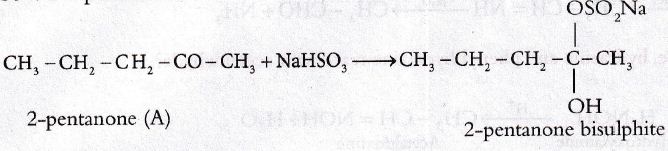
∴ (A) is 2-pentanone.
47.
\((E^{0}_{ox})_{Fe^{2+}|Fe} = -0.44\) and
\((E^{0}_{red})_{Cu^{2+}|Cu} = 0.34\)
These +ve emf values shows that iron will oxidise and copper will get reduced i.e., the vessel will dissolve. Hence it is not possible to store copper sulphate in an iron vessel.
48.
Aspirin is o-acetyl salicylic acid
49.
(i) Almost all carbohydrates are optically active as they contain one or more chiral carbons.
(ii) The number of optical isomers depends upon the number of chiral carbons (ie) 2n isomers, where n = total number of chiral carbons.
(iii) Glucose has \(4{ }^{\star} \)C; ∴ It has 24 =16 isomers.
50.
(i) pH = -log10 [H3O+]
(ii) The pH of a solution is defined as the negative logarithm of base 10 of the molar concentration of the hydronium ions present in the solution.
51.
Ea = 200 kJ mol-1=200 \(\times\) 103J mol-1
A = 1.6 \(\times\) 1013s-1; T = 600 K; R = 8.314 JK mol-1
\(k=A{ e }^{ -\left( \frac { Ea }{ RT } \right) }\)
\(k=1.6\times { 10 }^{ 13 }{ s }^{ -1 }{ e }^{ -\left( \frac { 200\times 10^3}{ 8.314 \times 600 } \right) }\)
\(k=1.6\times { 10 }^{ 13 }{ s }^{ -1 }{ e }^{ -\left( 40.09 \right) }\)
\(k=1.6\times { 10 }^{ 13 }\times 3.8\times { 10 }^{ -18 }{ s }^{ -1 }\)
\(k=6.08\times { 10 }^{ -5 }{ s }^{ -1 }\)
52.
Electronic configuration of Ce4+ = [Xe] 4f05d06s0
Electronic configuration of Co2+ = [Ar]3d7
53.
Tetrahedral complexes do not exhibit geometrical isomerism. Because the relative position of donor atoms of ligand the unidentate Iigands (donor atom) attached to the central atom are same with respect to each other.
54.
Number of atoms in a fcc unit cell = \(\frac{N_{c}}{8}+\frac{N_{f}}{2}=\frac{8}{8}+\frac{6}{2}=1+3=4\)
55.
Chlorine is prepared by the action of conc. sulphuric acid on chlorides in presence of manganese dioxide
4NaCl + MnO2 + 4H2SO4 \(\longrightarrow \)Cl2+ MnCl2 +4NaHSO4 + 2H2O
56.
(i) Icosogens → B, Al, Ga, In, Tl
(ii) Tetragens → C, Si, Ge, Sn, Pb
(iii) Pnictogens → N, P, As, Sb, Bi
(iv) Chalcogens → O, S, Se, Te, Po
57.
58.
i) In increasing order of solubility in water:
\(\mathrm{C}_{6} \mathrm{H}_{5} \mathrm{NH}_{2},\left(\mathrm{C}_{2} \mathrm{H}_{5}\right)_{2} \mathrm{NH}, \mathrm{C}_{2} \mathrm{H}_{5} \mathrm{NH}_{2} \)
\(\mathrm{C}_{2} \mathrm{H}_{5} \mathrm{NH}_{2}>\mathrm{C}_{6} \mathrm{H}_{5} \mathrm{NH}_{2}>\left(\mathrm{C}_{2} \mathrm{H}_{5}\right)_{2} \mathrm{NH}\)
ii) In increasing order of basic strength:
a. Aniline, p - toluidine and p - nitro aniline
p - toluidine > aniline >p - nitro aniline
.JPG)
b. \(\mathrm{C}_{6} \mathrm{H}_{5} \mathrm{NH}_{2}, \mathrm{C}_{6} \mathrm{H}_{5} \mathrm{NHCH}_{3}, \mathrm{p}-\mathrm{Cl}-\mathrm{C}_{6} \mathrm{H}_{4}-\mathrm{NH}_{2} \)
\(\mathrm{C}_{6} \mathrm{H}_{5} \mathrm{NHCH}_{3}>\mathrm{C}_{6} \mathrm{H}_{5} \mathrm{NH}_{2}>\mathrm{p}-\mathrm{Cl}-\mathrm{C}_{6} \mathrm{H}_{4}-\mathrm{NH}_{2}\\ 2^{o} \text { amine } \quad \quad \quad \quad e^{\ominus} \text { with drawing (group) }\)
(iii) In decreasing order of basic strength in gas phase:
\(\mathrm{C}_{2} \mathrm{H}_{5} \mathrm{NH}_{2},\left(\mathrm{C}_{2} \mathrm{H}_{5}\right) \mathrm{NH},\left(\mathrm{C}_{2} \mathrm{H}_{5}\right)_{3} \mathrm{~N} \text { and } \mathrm{NH}_{3} \)
\(\mathrm{NH}_{3}<\mathrm{C}_{2} \mathrm{H}_{5} \mathrm{NH}_{2}<\left(\mathrm{C}_{2} \mathrm{H}_{5}\right)_{2} \mathrm{~N}<\left(\mathrm{C}_{2} \mathrm{H}_{5}\right)_{3} \mathrm{NH}\\ \quad \quad \quad 1^{0} \text { amine } \quad 2^{0} \text { amine } \quad \quad \quad 3^{0} \text { amine }\)
(iv) In increasing order of boiling point:
\(\mathrm{C}_{6} \mathrm{H}_{5} \mathrm{OH},\left(\mathrm{CH}_{3}\right)_{2} \mathrm{NH}, \mathrm{C}_{2} \mathrm{H}_{5} \mathrm{NH}_{2} \)
\(\left(\mathrm{CH}_{3}\right)_{2} \mathrm{NH}>\mathrm{C}_{2} \mathrm{H}_{5} \mathrm{NH}_{2}>\mathrm{C}_{6} \mathrm{H}_{5} \mathrm{OH} \\ 2^{0} \text { amine } \quad \quad1^{0} \text { amine }\)
Generally amines have lower boiling point than alcohol. Due to comparable molecular mass and weaker H-bonds in Amines.
(v) In decreasing order of the pKb values:
\( \mathrm{C}_{2} \mathrm{H}_{5} \mathrm{NH}_{2}, \mathrm{C}_{6} \mathrm{H}_{5} \mathrm{NHCH}_{3},\left(\mathrm{C}_{2} \mathrm{H}_{5}\right)_{2} \mathrm{NH} \text { and } \mathrm{CH}_{3} \mathrm{NH}_{2} \)
\(\left(\mathrm{C}_{2} \mathrm{H}_{5}\right)_{2} \mathrm{NH}<\mathrm{C}_{2} \mathrm{H}_{5} \mathrm{NH}_{2}<\mathrm{CH}_{3} \mathrm{NH}_{2}<\mathrm{C}_{6} \mathrm{H}_{5} \mathrm{NHCH}_{3} \)
\(\quad \quad \quad 2^{0} \text { amine } \quad 1^{0} \text { amine } 1^{0} \text { amine } \quad 2^{0} \text { amine } \)
\(\mathrm{PK}_{b}: \quad 3.00\quad < \quad 3.29 \quad < \quad 3.38 \quad<\quad 9.30\)
pKb ,Due to + 1 effect of C2H5 group. Higher the value of pKb lower is the basicity
(vi) Increasing Order of basic strength:
\(\mathrm{C}_{6} \mathrm{H}_{5} \mathrm{NH}_{2}, \mathrm{C}_{6} \mathrm{H}_{5} \mathrm{~N}\left(\mathrm{CH}_{3}\right)_{2},\left(\mathrm{C}_{2} \mathrm{H}_{5}\right)_{2} \mathrm{NH} \text { and } \mathrm{CH}_{3} \mathrm{NH}_{2} \)
\(\mathrm{C}_{6} \mathrm{H}_{5} \mathrm{NH}_{2}>\mathrm{C}_{6} \mathrm{H}_{5} \mathrm{~N}\left(\mathrm{CH}_{3}\right)_{2}>\mathrm{CH}_{3} \mathrm{NH}_{2}>\left(\mathrm{C}_{2} \mathrm{H}_{5}\right)_{2} \mathrm{NH} \\ \left(\mathrm{pK}_{6}: 9.38 \quad > \quad \quad 8.92 \quad \quad > \quad 3.38 \quad > \quad \quad 3.00\right)\)
Due to + 1 effect of C2H5 group.
In decreasing order of basic strength:
.JPG)
59.
A drug is a substance that is used to modify or explore physiological systems or pathological states for the benefit of the recipient. It is used for the purpose of diagnosis, prevention, cure/relief of a disease.
a) Classification of drugs:
Drugs are classified based on their properties such as chemical structure, pharmacological effect, target system, site of action etc.
b) Classification based on the chemical structure:
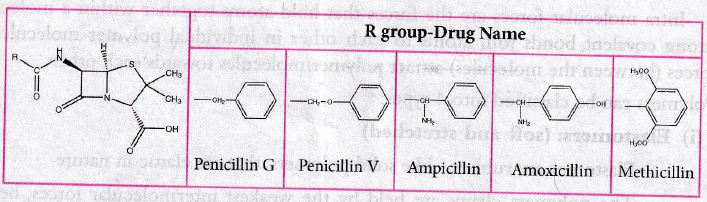
In this classification, drugs with a common chemical skeleton are classified into a single group. For example, ampicillin, amoxicillin, methicillin etc.. all have similar structure and are classified into a single group called penicillin. Similarly, we have other group of drugs such as opiates, steroids, catecholamines etc. Compounds having similar chemical structure are expected to have similar chemical properties. However, their biological actions are not always similar. For example, all drugs belonging to penicillin group have same biological action, while groups such as barbiturates, steroids etc.. have different biological action.
Penicillins
Classification based on Pharmacological effect:
In this classification, the drugs are grouped based on their biological effect that they produce on the recipient. For example, the medicines that have the ability to kill the pathogenic bacteria are grouped as antibiotics. This kind of grouping will provide the full range of drugs that can be used for a particular condition (disease). The physician has to carefully choose a suitable medicine from the available drugs based on the clinical condition of the recipient.
Examples:
Antibiotic drugs: amoxicillin, ampicillin, cefixime, cefpodoxime, erythromycin, tetracycline etc.. Antihypertensive drugs: propranolol, atenolol, metoprolol succinate, amlodipine etc...
Classification based on the target system (drug action):
In this classification, the drugs are grouped based on the biological system/process, that they target in the recipient. This classification is more specific than the pharmacological classification. For example, the antibiotics streptomycin and erythromycin inhibit the protein synthesis (target process) in bacteria and are classified in a same group. However, their mode of action is different. Streptomycin inhibits the initiation of protein synthesis, while erythromycin prevents the incorporation of new amino acids to the protein.
Classification based on the site of action (molecular target):
The drug molecule interacts with biomolecules such as enzymes, receptors etc, which are referred as drug targets. We can classify the drug based on the drug target with which it binds. This classification is highly specific compared to the others. These compounds often have a common mechanism of action, as the target is the same.

12th Standard Syllabus & Materials
12th Standard
TN 12th Computer Applications களப்பெயர் முறைமை (DNS) Sample Question Papers Study Material - QB365 Set A
NEW12th Standard
TN 12th Computer Applications வலையமைப்பு எடுத்துக்காட்டுகள் மற்றும் நெறிமுறைகள் Sample Question Papers Study Material - QB365 Set A
NEW12th Standard
TN 12th Computer Applications கணினி வலையமைப்பு ஓர் அறிமுகம் Sample Question Papers Study Material - QB365 Set A
NEW12th Standard
TN 12th Computer Applications PHP-உடன் MySQL-ஐ இணைத்தல் Sample Question Papers Study Material - QB365 Set A



Tamilnadu Stateboard 12th Standard Subjects

Maths
Chemistry

Physics

Biology

Computer Science

Business Maths and Statistics

Economics

Commerce

Accountancy

History

Computer Applications
Biology
Computer Technology
Computer Applications
Computer Science
Business Maths and Statistics
Commerce
Economics
Maths
Chemistry
Physics
Computer Technology
History
Accountancy

Tamil

English

French
Tamilnadu Stateboard Standards
