
 100% FREE ACCESS
12th Standard Syllabus & Materials
12th Standard
TN 12th Computer Applications மின்னணு தரவு பரிமாற்றம் Sample Question Papers Study Material - QB365 Set A
NEW12th Standard
TN 12th Computer Applications மின் - வணிக பாதுகாப்பு அமைப்புகள் Sample Question Papers Study Material - QB365 Set A
NEW12th Standard
TN 12th Computer Applications மின்னணு செலுத்தல் முறைகள் Sample Question Papers Study Material - QB365 Set A
NEW12th Standard
TN 12th Computer Applications மின் - வணிகம் Sample Question Papers Study Material - QB365 Set A
NEW12th Standard
TN 12th Computer Applications திறந்த மூல கருத்துருக்கள் Sample Question Papers Study Material - QB365 Set A
NEW12th Standard
TN 12th Computer Applications வலையமைப்பு வடமிடல் Sample Question Papers Study Material - QB365 Set A

Published on: 07/03/2020
12 Standard Chemistry English Medium All Chapter Book Back and Creative Two Mark Question 2020
Download Tamil Nadu 12th Standard Chemistry question papers, model tests, one-mark questions, important questions, and public exam papers in PDF format. Free study materials and answer keys for TN State Board students.
Questions + Answers key
Take MCQ Chemistry Test
1.
Identify A and B in the following sequence of reactions.\({ CH }_{ 3 }-Br\xrightarrow [ 675k\\ Red\ hot\ si\ tube ]{ { HNO }_{ 3 } } A\xrightarrow [ NaOH ]{ { Cl }_{ 2 } } B\)
2.
Write any two uses benzoic acid.
3.
Mention the inductive effect in monochloro acetic acid.
4.
Give the structural formula of
i) 2-amino-2-methyl propane
ii) 2-(N, N- dimethyl) amino butane
5.
Ethene \(\overset { Polymerises }{ \longrightarrow } \) Polyethene.
(i) What in the mechanism involved in the above process?
(ii) What are the two types of polyethene?
6.
Give the classification of polymers on the basis of their source.
7.
Why cellulose is not used as food by humans?
8.
What is meant by blood sugar?
9.
Which will adsorb more gas, a lump of charcoal or its powder and why?
10.
Define adsorption isotherm.
11.
What is an electrochemical series?
12.
What are the two types of batteries?
13.
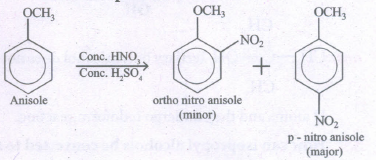
What happens when anisole is nitrated?
14.
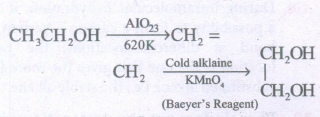
How is the following conversion effected? Ethyl alcohol ⟶ Ethylene glycol
15.
What are the limitations of Ostwald's dilution law?
16.
Define Buffer solution.
17.
Calculate the molar conductance of 0.025M aqueous solution of calcium chloride at 25°C. The specific conductance of calcium chloride is 12.04 x 10⁻² Sm-1.
18.
Calculate the concentration of OH- in a fruit juice which contains \(2\times10^{-3}\) M, H3O+ ion. Identify the nature of the solution.
19.
Give two important characteristics of physisorption.
20.
There are two isomers with the formula CH3NO2. How will you distinguish between them?
21.
Write down the possible isomers of the C4H9NO2 give their IUPAC names.
22.
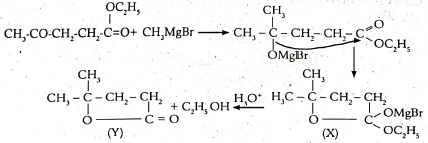
Identify X and Y.
\({ CH }_{ 3 }CO{ CH }_{ 2 }{ CH }_{ 2 }COO{ C }_{ 2 }{ H }_{ 5 }\overset { { CH }_{ 3 }MgBr }{ \longrightarrow } X\overset { { H }_{ 3 }{ O }^{ + } }{ \longrightarrow } Y\)
23.
How is propanoic acid is prepared starting from
(a) an alcohol
(b) an alkylhalide
(c) an alkene
24.
What are antibiotics?
25.
Account for the acidic nature of HClO4 in terms of Bronsted – Lowry theory, identify its conjugate base.
26.
What is an alloy? Give an example.
27.
Complete the following equations.
(i) 2 CrO42- + 2H+ ⟶
(ii) KMnO4 ⟶
28.
If the rate of a reaction gets doubled as the temperature is increased from 27oC to 37oC. Find the activation energy of reaction?
29.
For a reaction A + B ⟶ C, the rate of the reaction is denoted \(\frac { -dA }{ dt } \) or \(\frac { -dB }{ dt } \) or \(\frac { +dC }{ dt } \). State the significance of plus and minus sign.
30.
There is a huge difference between the melting and boiling points of oxygen and sulphur. Why?
31.
Give two uses of nitric acid.
32.
Name the seven primitive crystal systems.
33.
Why do solids have a definite volume?
34.
Give the formula of chlorosilazanes. Explain its preparation from SiCI4.
35.
What are alums?
36.
List out the commercial uses of iron.
37.
Identify the ligand and the central metal in the Co-ordination compound. [Co(NH3)4Cl6]CI
38.
Calculate the Oxidation number of
(i) Iron in [Fe(CN)6]4-.
(ii) Cobalt in [Co(NH3)5CI)]2+.
39.
Write the rate law for the following reactions.
(a) A reaction that is 3/2 order in x and zero order in y.
(b) A reaction that is second order in NO and first order in Br2.
40.
41.
Ni2+ is identified using alcoholic solution of dimethyl glyoxime. Write the structural formula for the rosy red precipitate of a complex formed in the reaction.
42.
Write the formula for the co-ordination compounds.
43.
What are point defects?
44.
Why fluorine is more reactive than other halogens?
45.
What is the role of quick lime in the extraction of Iron from its oxide Fe2O3?
46.
What are the various steps involved in the extraction of pure metals from their ores?
47.
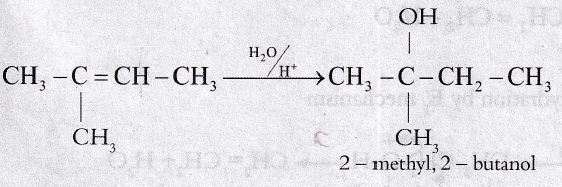
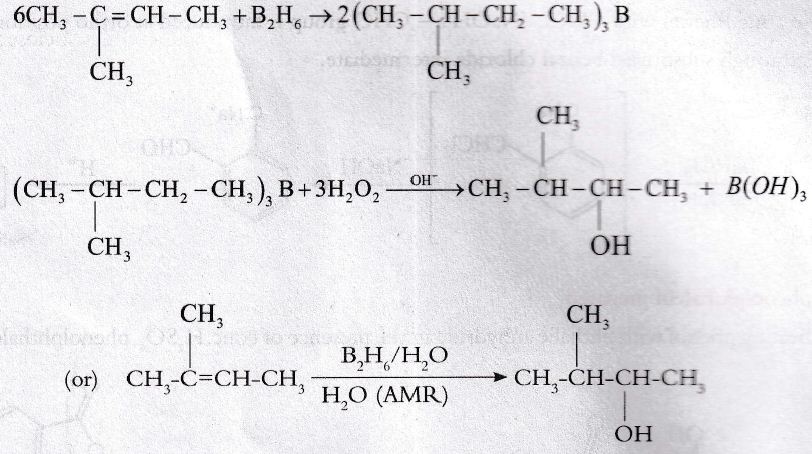
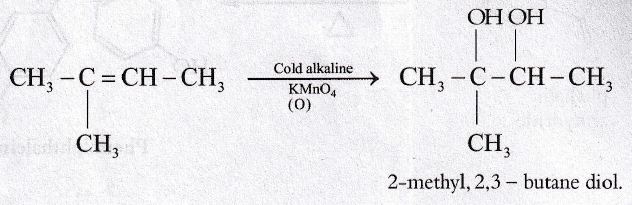
Predict the major product, when 2-methyl but -2-ene is converted into an alcohol in each of the following methods.
(i) Acid catalysed hydration
(ii) Hydroboration
(iii) Hydroxylation using Baeyer's reagent
48.
Identify the product (s) is / are formed when 1 – methoxy propane is heated with excess HI. Name the mechanism involved in the reaction.
49.
What are food preservatives?
50.
Define average rate and instantaneous rate.
51.
What are transition metals? Give four examples.
52.
Give any three characteristics of ionic crystals.
53.
What are interhalogen compounds? Give examples.
54.
55.
Differentiate physisorption and chemisorption.
56.
Describe the construction of Daniel cell. Write the cell reaction.
57.
Give the differences between primary and secondary structure of proteins.
58.
What type of linkages hold together monomers of DNA?
1.
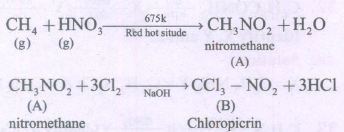
A - Nitromethane - CH3NO2.
B - Chloropicrin - CCl3 - NO2.
2.
Benzoic acid uses :
(i) as food preservative either in the pure form or in the form of sodium benzoate
(ii) in medicine as an urinary antiseptic
(iii) for manufacture of dyes
3.
(i) In monochloro acetic acid, the -I effect of chlorine (electron withdrawing group) increases its strength.
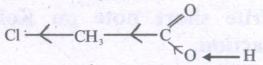
(ii) This effect weakens the -O-H bond. There by facilitating the removal of H from -OH group. This acid (ClCH2COOH) becomes stronger than formic acid.
4.
(i) 2-amino-2-methyl propane
\(\quad { CH }_{ 3 }-\overset { \underset { | }{ { CH }_{ 3 } } }{ \underset { \overset { | }{ { NH }_{ 3 } } }{ C } } -{ CH }_{ 3 }\)
(ii) 2-(N, N- dimethyl) amino butane
\({ CH }_{ 3 }-{ CH }_{ 2 }-\overset { \underset { | }{ { CH }_{ 3 } } }{ CH } -\overset { \underset { | }{ { CH }_{ 3 } } }{ N } -{ CH }_{ 3 }\)
5.
(i) Addition polymerisation
(ii) (a) HDPE (High Density Polyethylene):
(b) LDPE (Low Density polyethylene).
6.
On the basic of their source polymers are classified as
(i) Natural polymers (obtained from plants/ animals). E.g. Cellulose, Silk
(ii) Synthetic polymers (man made from chemicals) E.g. polythene, PVC, etc.,
Semisynthetic polymers (natural polymersmodified by chemical treatment)
E.g. viscose rayon, cellulose diacetate.
7.
Humans cannot use cellulose as food because our digestive systems do not contain the necessary enzymes (glycosidases or cellulases) that can hydrolyse the cellulose.
8.
Human blood contains about 100 mg/dL of glucose, hence it is also known as blood sugar.
9.
Powdered charcoal will adsorb more gas because of its larger surface area than a lump of charcoal.
10.
A plot between the amount of adsorbate adsorbed and pressure or concentration of adsorbate at constant temperature is called adsorption isotherms.
11.
The standard aqueous electrode potential at 298K for various metal - metal ion electrodes are arranged in the decreasing order of their standard reduction potential values as shown in the figure. This series is called electrochemical series.
12.
The two types of batteries are primary batteries (non - rechargeable) and secondary batteries (rechargeable).
13.
When anisole is treated with a mixture of cone. HNO3 and cone. H2SO4, it gives a mixture of ortho and para nitro anisole.
14.
15.
Ostwald's dilution law is applicable only for weak electrolyte and does not hold good for concentrated solution.
16.
Buffer is a solution which consists of a mixture of a weak acid and its conjugate base (or) a weak base and its conjugate acid.
17.
Molar conductance = Λm = \( \frac{k\ (Sm^{-1})\times10^{-3}}{M} mol^{-1}m^{3} \)
\(= \frac{(12.04 \times 10^{-2} Sm^{-1}) \times 10^{-3} (mol^{-1}m^{3})} {0.025}\)
= 481.6 x 10⁻⁵ Sm2mol-1
18.
Given that H3O+ = \(2\times10^{-3}M\)
\(K_{w}=[H_{3}O^{+}][OH^{-}]\)
\(\therefore [OH^{-}]=\frac{K_{w}}{[H_{3}O^{+}]}=\frac{1\times10^{-14}}{2\times10^{-3}}=0.5\times10^{-11}M\)
\(2\times10^{-3} >>0.5\times10^{-11}\)
i.e., [H3O+]>>[OH-], hence the juice is acidic in nature
19.
(i) It is instantaneous.
(ii) It is non-specific.
(iii) No transfer of electrons.
(iv) Multilayer of adsorbate is formula.
20.
a) Primary and secondary nitroalkanes, having α-H, also show an equilibrium mixture of two tautomers namely nitro - and aci - form
.JPG)
b) Difference:
| S.No | Nitro form | Aci - form |
| 1. | Less acidic in nature. | More acidic |
| 2. | Dissolves in NaOH slowly | Dissolves in NaOH instantly |
| 3. | Decolourises FeCl3 solution | With FeCl3 gives reddish brown colour |
| 4. | Electrical conductivity is low | Electrical conductivity is high |
21.
| Isomerism | Structural formula of isomers |
| Chain isomerism: They differ in the length of carbon chain. |
.JPG) |
| Position isomerism: They differ in the position of nitro group. |
.JPG) |
| Functional isomerism: Nitroalkanes exhibit functional isomerism with alkylnitrites |
\( \mathrm{CH}_{3} \mathrm{CH}_{2} \mathrm{CH}_{2} \mathrm{CH}_{2}-\mathrm{NO}_{2} \text { and } \mathrm{CH}_{3} \mathrm{CH}_{2} \mathrm{CH}_{2} \mathrm{CH}_{2}-\mathrm{O}-\mathrm{N}=\mathrm{O}\\ \quad 1 - nitrobutane \quad \quad \quad \quad \quad \quad \quad butyl \ nitrite\) |
22.
23.
An alcohol:
.JPG)
An alkylhalide:
.JPG)
An alkene:
.JPG)
24.
(i) Many micro organisms (bacteria, fungi and moulds) produce certain chemicals which inhibit the growth or metabolism of some other micro organism. Such chemicals are called antibiotics.
(ii) Eg: Penicillin from the mould penicillium notatum
25.
\(\mathrm{HClO}_{4} \rightleftharpoons \mathrm{H}^{+}+\mathrm{ClO}_{4}^{-}\)
Bronsted Acid Proton Conjugate Base
HClO4 can donate a proton. Therefore HClO4 is an acid. Its conjugate base is ClO4-
26.
(i) An alloy is formed by blending a metal with one or more other elements. The elements may be metals or non-metals or both.
(ii) The bulk metal is named as solvent, and the other elements in smaller portions are called solute.
(iii) The alloys so formed are hard and often have high melting points.
(iv) Example: Ferrous alloys, gold - copper alloy, chrome alloys etc.
27.
(i) 2 CrO42- + 2H+ ⟶ Cr2O72- + H2O
(ii) 2KMnO4 \(\overset { \triangle }{ \underset { 513 k }{ \longrightarrow } } \) K2Mn4O4 + MnO2 + O2
28.
In \(\frac { { k }_{ 2 } }{ { k }_{ 1 } } =\frac { { E }_{ a } }{ R } \left[ \frac { { T }_{ 2 }-{ T }_{ 1 } }{ { T }_{ 1 }{ T }_{ 2 } } \right] \)
In 2 = \(\frac { { E }_{ a } }{ R } \) \(\left[ \frac { 10 }{ 300\times 310 } \right] \)
Ea = 9300 R In 2
= 53.4 kJ mol-1
29.
Minus sign i.e. \(\frac { -dA }{ dt } \) or \(\frac { -dB }{ dt } \) indicates decreases in the concentration of reactants whereas + sign indicates in the concentration of products with time i.e. \(\frac { +dC }{ dt } \)
30.
(i) Sulphur has great catenation property and forms large molecule having high weight, which results higher melting point.
(ii) While oxygen exists as diatomic molecule of less molecular weight, hence has very low melting point.
31.
(i) Nitric acid is used as a oxidising agent and in the preparation of aqua regia.
(ii) Salts of nitric acid are used in photography (AgNO3) and gun powder for fire arms (NaNO3)·
32.
There are seven primitive crystal systems; cubic, tetragonal, orthorhombic, hexagonal, monoclinic, triclinic and rhombohedral.
33.
(i) The intermolecular forces of attraction that are present in solids are very strong.
(ii) The constituent particles of solids have fixed position.
(iii) Hence, solids have a definite volume.
34.
Chlorosilazanes is Cl3Si - NH - SiCl3.Silicon tetrachloride undergoes ammonolysis to form chlorosilazanes.
\(2Si{ Cl }_{ 4 }+{ NH }_{ 3 }\overset { 330K }{ \underset { Ether }{ \longrightarrow } } { Cl }_{ 3 }Si-NH-Si{ Cl }_{ 3 }\).
35.
The name alum is given to the double salt of potassium aluminium sulphate.
[K2SO4.Al2(SO4)3.24H2O]
36.
(i) Iron is used in the manufacture of wrought iron and steel.
(ii) Cast iron is used for casting stoves, railway sleepers, toys, etc.
(iii) Stainless steel is used for cycles, automobiles, utensils, pens, etc.
(iv) Chrome steel is used for cutting tools and crushing machines
37.
Ligands NH3 AND Cl-
Central metal Co (in cationic complex).
38.
(i) In [Fe(CN)6]4-, Let the oxidation number of iron is x:
The net charge: -4 = x + 6 (-1) => x = +2
(ii) In [Co(NH3)5]2+, let the oxidation number of cobalt is x:
The net charge: +2 = x + 5(0) + 1 (-1) => x = +3
39.
(a) Rate = \(k{ \left[ x \right] }^{ 3/2 }{ \left[ y \right] }^{ 0 }=k[x]^{3/2}\)
(b) 2NO + Br2 ⟶ 2NOBr
Rate = k[NO]2[Br2]
40.

.JPG)
41.
Addition of an alcoholic solution of dimethylglyoxime to an ammoniacal solution of Ni(II) gives rose - red precipitate Ni[ONCC N OH]2 Nickel Cis (dimethylglyoximate)
42.
a) potassiumhexacyanidoferrate(II) - Potassiumhexacyanidoferrate(II) - K4[Fe(CN)6]
b) Pentacarbonyliron(0) - [Fe(CO)5]
c) Pentaamminenitrito −kNcobalt(III)ion - [Co(NH3)5(NO2)]2+
d) Hexaamminecobalt(III) Sulphate - [CO(NH3)6](SO4)3
e) Sodiumtetrafluoridodihydroxidochromate(III) - Na2[CrF4(OH)2]
43.
The imperfection occurs due to missing atoms, displaced atoms or extra atoms, is named as a point defect. Such defects arise due to imperfect packing during the original crystallisation or they may arise from thermal vibrations of atoms at elevated temperatures.
44.
(i) Fluorine is more electro negative than other halogens.
(ii) Because except fluorine all the other halogens have positive oxidation state.
(iii) It has high electron affinity character
Example:
\(\mathrm{Cl}_{2}\mathrm{O} \Rightarrow+1 \text { oxidation state }(\mathrm{Cl}) \)
\(\mathrm{OF}_{2} \Rightarrow-1 \text { oxidation state }(\mathrm{F})\)
45.
In this extraction, a basic flux, quick lime (CaO) is used, since the silica gangue present in the ore is acidic in nature. The quick lime combines with it to form calcium silicate (slag).
CaO(s) + Sio2(s) ⟶ CaSio3(s)
Flux Gangue Slag
46.
(i) Concentration of the ore
(ii) Extraction of crude metal
(iii) Refining of crude metal
47.
(i) Acid catalysed hydration
(ii) Hydroboration
(iii) Hydroxylation using Baeyer's reagent
48.
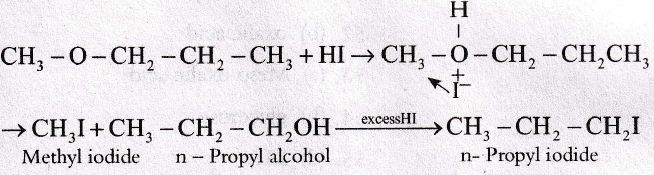
Since 1 - methoxy propane has primary alkyl group, it under goes SN2 reaction.
49.
(i) Preservatives are chemicals added to food which are capable of inhibiting, retarding or arresting the process of fermentation, acidification or other decomposition of food by the growth of micro organisms (or)
(ii) Chemical substances which are added to food that prevents the spoilage of food materials by destroying the food - spoiling micro-organisms are called food preservatives.
(iii) Eg: sodium benzoate, NaCl, Acetic acid Sodium metabisulphite, potassium meta bisulphite etc.
50.
Average rate of reaction:
The average rate is defined as the ratio of change in the final concentration of reactants and the initial concentration of reactants over the entire time period of reaction.
Average rate=\(\frac{-[Final \space concentration \space of \space reactants - Initial \space concentration \space of \space reactants}{(Change \space in \space time)}\)
R \(=\frac{-\left(\left[A_{2}\right]-\left[A_{1}\right]\right)}{\left(t_{2}-t_{1}\right)}=-\left(\frac{\Delta[A]}{\Delta t}\right)\)
[A]1 = Concentration of reactant A1 at time t1
[A]2 = Concentration of reactant A2 at time t2
Instantaneous rate of reaction:
The rate of reaction at any particular instant during the course of reaction is called as instantaneous rate.
Instantaneous rate \(=(\text { Average rate })_{\Delta t \rightarrow 0}\)
Rate of the reaction \(=\left(\frac{-\Delta \mathrm{A}}{\Delta \mathrm{t}}\right)\)
51.
IUPAC defines transition metal as an element whose atom has an incomplete d-sub shell or which can give rise to cations with an incomplete d-sub shell. They occupy the central position of the periodic table, between s and p-block elements.
Examples: Fe, Cu, Ag, Au
52.
(i) Ionic solids have high melting points.
(ii) These solids do not conduct electricity, because the ions are fixed in their lattice positions.
(iii) They are hard so strong external force can change the relative positions of ions.
53.
Each halogen combines with other halogens to form a series of compounds are called interhalogen compounds.
Example: AB type: BrF
AB3 type: ICI3
54.
55.
| S.No | Physical adsorption or vander waals adsorption or Physisorption | Chemical adsorption or Chemisorption or Activated adsorption |
|---|---|---|
| 1. | It is instantaneous | It is very slow |
| 2. | It is non-specific | It is very specific depends on nature of adsorbent and adsorbate |
| 3. | In Physisorption, when pressure increases the amount of adsorption increases | Chemical adsorption is fast with increase pressure, it can not alter the amount. |
| 4. | Physisorption decreases with increase in temerature | When temperature is raised chemisorption first increases and then decreases |
| 5. | No transfer of electrons | Chemisorption involves transfer of electrons between the adsorbent and adsorbate |
| 6. | Heat of adsorption is low in the order of 40kJ/ mole. | Heat of adsorption is high i.e., from 40- 400kJ/mole. |
| 7. | Multilayer of the adsorbate is formed on the adsorbent. | Monolayer of the adsorbate is formed |
| 8. | It occurs on all sides | Adsorption occurs at fixed sites called active centres. It depends on surface area |
| 9 | Activation energy is insignificant. | Chemisorption involves the formation of activated complex with appreciable activation energy. |
56.
1. Daniel cell is a galvanic cell. This is a voltaic cell also.
(a) The separation of half reaction is the basis for the construction of Daniel cell. It consists of two half cells.
(i) Oxidation half cell: A metallic zinc strip that dips into an aqueous solution of zinc sulphate taken in a beaker, as shown in Figure
(ii) Reduction half cell: A copper strip that dips into an aqueous solution of copper sulphate taken in a beaker, as shown in Figure
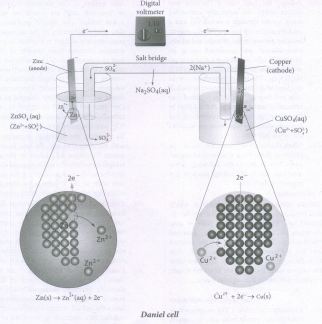
(iii) Joining the half cells:
(a) The zinc and copper strips are externally connected using a wire through a switch (k) and a load (example: volt meter). The electrolytic solution present in the cathodic and anodic compartment are connected using an inverted U tube containing a agar-agar gel mixed with an inert electrolyte such as KCI, Na2SO4 etc.,
(b) The ions of inert electrolyte do not react with other ions present in the half I cells and they are not either oxidised (or) reduced at the electrodes. The solution in the salt bridge cannot get poured out, but through which the ions can move into (or) out of the half cells.
(c) When the switch (k) closes the circuit, the electrons flows from zinc strip to copper strip. This is due to the following redox reactions which are taking place at the respective electrodes.
(iv) Anodic oxidation:
(i) zinc strip acts as the anode.
(ii) Here,oxidation occurs.
The electrode at which the oxidation occur is called the anode. In Daniel cell, the oxidation take place at zinc electrode, i.e., zinc is oxidised to Zn2+ ions and the electrons.
The Zn2+ ions enters the solution and the electrons enter the zinc metal, then flow through the external wire and then enter the copper strip.
Electrons are liberated at zinc electrode and hence it is negative (-ve).
\(Zn_{ (s) }\longrightarrow { { Zn }^{ 2+ }_{ (aq) }+{ 2e }^{ - } } \) (loss of electron-oxidation)
(v) Cathodic reduction:
As discussed earlier. the electrons flow through the circuit from zinc to copper, where the Cu2+ ions in the solution accept the electrons, get reduced to copper and the same get deposited on the electrode Here, the electrons are consumed and hence it is positive (+ve).
\({ Cu }_{ (aq) }^{ 2+ }+{ 2e }^{ - }\longrightarrow { { Cu }_{ (s) } } \)(gain of electron - reduction)
b) When a Zinc metal strip is placed in a copper sulphate solution, the blue colour of the solution fades and the copper is deposited on the zinc strip as red - brown crust due to the following spontaneous chemical reaction.
\(\mathrm{Zn}_{(\mathrm{s})}+\mathrm{CuSO}_{4(\mathrm{aq})} \rightarrow \mathrm{ZnSO}_{4(\mathrm{aq})}+\mathrm{Cu}_{(\mathrm{s})}\)
The energy produced in the above reaction is lost to the surroundings as heat.
In the above redox reaction, Zinc is oxidised to Zn2+ ions and the Cu2+ ions are reduced to metallic copper. The half reactions are represented as below.
\(\mathrm{Zn}_{(\mathrm{s})} \rightarrow \mathrm{Zn}^{2+}{ }_{(\mathrm{aq})}+2 \mathrm{e}^{-} \text {(oxidation) } \)
\(\mathrm{Cu}^{2+}{ }_{(\mathrm{aq})}+2 \mathrm{e}^{-} \rightarrow \mathrm{Cu}_{(\mathrm{s})} \text { (reduction) }\)
If we perform the above two half reactions separately in an apparatus as shown in figure, some of the energy produced in the reaction will be converted into electrical energy.
57.
Primary structure of Proteins:
Proteins are polypeptide chains, made up of amino acids are connected through peptide bonds. The relative arrangement of the amino acids in the polypeptide chain is called the primary structure of the protein. Knowledge of this is essential as even small changes have potential to alter the overall structure and function of a protein.
\(\mathrm{H}_{2} \mathrm{~N}-\mathrm{Gly}-\mathrm{Met}-\mathrm{Phe}-\mathrm{Cys}-\mathrm{Arg}-\mathrm{Asp}-\mathrm{COOH}\)
α - Helix:
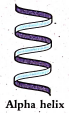
In the α-helix sub-structure, the amino acids are arranged in a right handed helical (spiral) structure and are stabilised by the hydrogen bond between the carbonyl oxygen of one amino acid (n residue) with amino hydrogen of the fifth residue (n + 4th residue). The side chains of the residues protrude outside of the helix. Each turn of an α-helix contains about 3.6 residues and is about 5.4 Å long. The amino acid proline produces a kink in the helical structure and often called as a helix breaker due to its rigid cyclic structure.
1. Linear sequence of aminoacids
2. Linear
3. Composed of peptide bonds formed between amino acids.
Secondary structure of Proteins:
The amino acids in the polypeptide chain forms highly regular shapes (sub-structures) through the hydrogen bond between the carbonyl oxygen (-C=O) and the neighbouring amine hydrogen (-NH) of the main chain. α-Helix and β-strands or sheets are two most common substructures formed by proteins.
β-Strand:
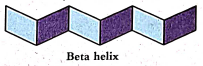
β-Strands are extended peptide chain rather than coiled. The hydrogen bonds occur between main chain carbonyl group one such strand and the amino group of the adjacent strand resulting in the formation of a sheet like structure. This arrangement is called β-sheets.
58.
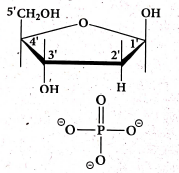
Watson & Crick proposed a 3-dimensional secondary structure of DNA. In this DNA molecule, Monomners of DNA are held together by Phosphodiester linkage. This linkages are occured in 5' & 3' carbon atoms of Pentose sugar.

12th Standard Syllabus & Materials
12th Standard
TN 12th Computer Applications களப்பெயர் முறைமை (DNS) Sample Question Papers Study Material - QB365 Set A
NEW12th Standard
TN 12th Computer Applications வலையமைப்பு எடுத்துக்காட்டுகள் மற்றும் நெறிமுறைகள் Sample Question Papers Study Material - QB365 Set A
NEW12th Standard
TN 12th Computer Applications கணினி வலையமைப்பு ஓர் அறிமுகம் Sample Question Papers Study Material - QB365 Set A
NEW12th Standard
TN 12th Computer Applications PHP-உடன் MySQL-ஐ இணைத்தல் Sample Question Papers Study Material - QB365 Set A



Tamilnadu Stateboard 12th Standard Subjects

Maths
Chemistry

Physics

Biology

Computer Science

Business Maths and Statistics

Economics

Commerce

Accountancy

History

Computer Applications
Biology
Computer Technology
Computer Applications
Computer Science
Business Maths and Statistics
Commerce
Economics
Maths
Chemistry
Physics
Computer Technology
History
Accountancy

Tamil

English

French
Tamilnadu Stateboard Standards
