
 100% FREE ACCESS
12th Standard Syllabus & Materials
12th Standard
TN 12th Computer Applications மின்னணு தரவு பரிமாற்றம் Sample Question Papers Study Material - QB365 Set A
NEW12th Standard
TN 12th Computer Applications மின் - வணிக பாதுகாப்பு அமைப்புகள் Sample Question Papers Study Material - QB365 Set A
NEW12th Standard
TN 12th Computer Applications மின்னணு செலுத்தல் முறைகள் Sample Question Papers Study Material - QB365 Set A
NEW12th Standard
TN 12th Computer Applications மின் - வணிகம் Sample Question Papers Study Material - QB365 Set A
NEW12th Standard
TN 12th Computer Applications திறந்த மூல கருத்துருக்கள் Sample Question Papers Study Material - QB365 Set A
NEW12th Standard
TN 12th Computer Applications வலையமைப்பு வடமிடல் Sample Question Papers Study Material - QB365 Set A

Published on: 20/01/2020
Download Tamil Nadu 12th Standard Accountancy question papers, model tests, one-mark questions, important questions, and public exam papers in PDF format. Free study materials and answer keys for TN State Board students.
Questions + Answers key
Take MCQ Accountancy Test
1.
From the following trading activities of Jamal Ltd. calculate
(i) Gross profit ratio
(ii) Net profit ratio
(iii) Operating cost ratio
(iv) Operating profit ratio
| Particulars | Rs. |
|---|---|
| I. Revenue from operations | 10,000 |
| II. Other Income | |
| Income from investments | 100 |
| III. Total revenue (I +II) | 10,100 |
| IV. Expenses: | |
| Purchases of Stock-in -trade | 8,500 |
| Changes in inventories | -500 |
| Finance costs | 150 |
| Other expenses (Administration and selling) | 1,200 |
| Total expenses | 7,850 |
| V. Profit before tax (III - IV) | 800 |
2.
From the following particulars of Vijay Ltd, prepare common size income statement for the year ended 31st March 2017 and 31st March 2018
3.
Shankar, Saleem and Pandian are partners, sharing profits in the ratio of 3:2:1. Their balance sheet as an 31st December 2018 is as under
4.
Sheela and Neela were sharing profits in the ratio of 4:3. Kamala was admitted with 1/5th share in profits of business. Calculated the New profit Ratio and the sacrificing ratio.
5.
Compute the amount of total purchases and total sales of Mr. Amit from the following information for the year ending on March 31, 2018.
| Rs. | |
|---|---|
| Total debtors as on April 01, 2017 | 40,000 |
| Total creditors as on April 01,2017 | 50,000 |
| Bills receivable as on April 01, 2017 | 30,000 |
| Bills payable as on April 01, 2017 | 45,000 |
| Discount received | 5,000 |
| Bad debts | 2,000 |
| Return inwards | 4,000 |
| Discount allowed | 3,000 |
| Cash sales | 10,000 |
| Cash purchases | 8,000 |
| Total debtors as on March 31, 2018 | 80,000 |
| Cash received from debtors | 1,00,000 |
| Cash paid to creditors | 80,000 |
| Cash received against bills receivable | 25,000 |
| Payment made against bills receivable | 40,000 |
| Total creditors as on March 31, 2018 | 40,000 |
| Bills payable as on March 31, 2018 | 50,000 |
| Bills receivable as on March 31,2018 | 35,000 |
6.
A partnership firm has decided to value its goodwill for the purpose of setting a retiring Partner. The profit of that firm for the last four years were as follows:
2015 : Rs.20,000; 2016 : Rs.25,000; 2017; Rs.24,000 and 2018: Rs.23,000
The business was looked after by a partner. No remuneration was paid to him. The fair remuneration of the partner valued at comes to Rs. 3,000 per annum.
Find out the value of goodwill, if it is valued on the basis of three years purchase of the average profit of the last four years.
7.
How will the following appear in the final account of a club for the year 2017-2018?
| Particulars | Rs |
|---|---|
| Prize fund on 1.4.2017 | 50,000 |
| Prize fund investment on 1.4.2017 | 50,000 |
| Interest received on prize fund investment | 5,000 |
| Prizes distributed | 6,000 |
| Donation received for prize fund | 10,000 |
8.
Following is the receipts and payments accounts of Literacy club for the year ended 31st March 2016
| Receipts | Rs. | Rs. | Payments | Rs. |
|---|---|---|---|---|
| To Balance c/d | 19,550 | By Salary | 3,000 | |
| By News papers | 2,050 | |||
| To Subscribtions | By Electricity bill | 1,000 | ||
| 2014·2015 | 1,200 | By Fixed deposit | 20,000 | |
| 2015·2016 | 26,500 | (on 1st July, 2015 @ | ||
| 500 | 9% per annum | |||
| 28,200 | By Books | 10,600 | ||
| By Rent | 6,800 | |||
| To slae old news paper | 1,250 | By Furniture | 10,500 | |
| To Government grants | 10,000 | By Balance dd | 11,200 | |
| To sale of old furniture | 5,700 | |||
| (book value Rs.7,000) | ||||
| To interest on fixed deposits | 450 | |||
| 65,150 | 65,150 |
Additional information:
(i) Subscription outstanding as on 31st March, 2015 were Rs. 2000 and on 31st March, 2016 Rs. 2,500.
(ii) On 31st March, 2016 Salary outstanding was Rs. 600 and rent outstanding was Rs. 1,200.
(iii) The club owned furniture Rs. 15,000 and books Rs. 7,000 on 1st April, 2015. Prepare income and expenditure account of the dub for the year ended 31st March 2016 and as certain capital fund on 31st March, 2015. Also prepare a balance sheet as on 31st March, 2016.
9.
Kasthuri Ltd. had allotted 20,000 equity shares of Rs.10 each at a premium of Rs.2 each to applicants of 30,000 shares on a pro rata basis. The amount payable was Rs.3 on application, Rs.5 on allotment (including premium of Rs.2 each) and Rs.2 on first call and Rs.2 on final call. Subin, a shareholder failed to pay the first call and final call on his 500 shares. All the shares were forfeited and out of them 400 shares were reissued @ Rs.8 per share. Pass necessary journal entries.
10.
11.
Keerthiga Company issued shares of Rs.10 each at 10% premium, payable Rs.2 on application, Rs.3 on allotment (including premium), Rs.3 on first call and Rs.3 on second and final call. Journalise the transactions relating to forfeiture of shares for the following situations:
(i) Mohan who holds 50 shares failed to pay the second and final call and his shares were forfeited.
(ii) Mohan who holds 50 shares failed to pay the allotment money, first call and second and final call money and his shares were forfeited.
(iii) Mohan who holds 50 shares failed to pay the allotment money and first call and his shares were forfeited after the first call.
12.
Record the following transactions in Tally.
1. Robert commenced a transport business with a capital of Rs.1,00,000
2. An account was opened with State Bank of India and deposited Rs. 30,000
3. Purchased furniture by paying cash Rs. 10,000
4. Goods purchased on credit from Mohaideen for Rs. 20,000
5. Cash sales made for Rs. 8,000
6. Goods purchased from Rathinam for Rs. 5,000 and money deposited in CDM
7. Goods sold to Rony on credit for Rs. 60,000
8. Money withdrawn from bank for office use Rs. 9,000
9. Part payment of Rs.10,000 made to Mohaideen by cheque
10. Rony made part payment of Rs. 5,000 by cash
11. Salaries paid to staff through ECS Rs. 6,000
12. Wages of Rs. 3,000 paid by cash
13. Purchased stationery from Pandian Ltd. on credit Rs. 4,000
13.
14.
Arjun carries on grocery business and does not keep his books on double entry basis. The following particulars have been extracted from his books:
| Particulars | 1-4-2018 Rs. |
31-3-2019 Rs. |
|---|---|---|
| Plant and machinery | 20,000 | 20,000 |
| Stock | 9,000 | 16,000 |
| Sundry debtors | 2,000 | 5,300 |
| Sundry creditors | 5,000 | 4,000 |
| Cash at bank | 4,000 | 6,000 |
Other information for the year ending 31-3-2019 showed the following
| Rs. | |
|---|---|
| Advertising | 4,700 |
| Carriage inwards | 8,000 |
| Cash paid to creditors | 64,000 |
| Drawings | 2,000 |
Total sales during the year were Rs. 85,000. Purchases returns during the year were Rs. 2,000 and sales returns were Rs.1,000. Depreciate plant and machinery by 5%. Provide Rs. 300 for doubtful debts. Prepare trading and profit and loss account for the year ending 31st March, 2019 and a balance sheet as on the date.
15.
From the following details you are required to calculate credit sales and credit purchases by preparing total debtors account, total creditors account, bills receivable account and bills payable account.
| Particulars | Opening Rs. |
Closing Rs. |
|---|---|---|
| Debtors | 60,000 | 55,000 |
| Bills receivable | 5,000 | 1,000 |
| Creditors | 25,000 | 28,000 |
| Bills payable | 2,000 | 3,000 |
| Other information | ||
| Cash received from debtors | 1,30,000 | |
| Discount allowed to customers | 5,500 | |
| Cash paid to creditors | 70,000 | |
| Discount allowed by suppliers | 3,500 | |
| Payments against bill payable | 7,000 | |
| Cash received for bills receivable | 14,000 | |
| Bills receivable dishonoured | 1,200 | |
| Bad debts | 3,500 |
16.
From the following particulars, calculate the Trend percentages of Kavitha Ltd.
| Particulars | Rs.in thousands | ||
|---|---|---|---|
| 2015-16 | 2016-17 | 2017-18 | |
| Revenue from operations | 100 | 125 | 150 |
| Other income | 20 | 25 | 30 |
| Expenses | 100 | 120 | 80 |
| Income tax | 30% | 30% | 30% |
17.
Following is the statement of profit and loss of Maria Ltd. for the year ended 31st March, 2018. Calculate the operating cost ratio.
| Particulars | Note No. | Amount Rs. |
|---|---|---|
| I. Revenue from operations | 8,00,000 | |
| II. Other Income | 20,000 | |
| III. Total revenue (I +II) | 8,20,000 | |
| IV. Expenses: | ||
| Purchases of stock-in-trade | 4,50,000 | |
| Changes in inventories | -40,000 | |
| Employee benefits expenses | 1 | 22,000 |
| Other expenses | 2 | 68,000 |
| Total expenses | 5,00,000 | |
| V. Profit before tax (III-IV) | 3,20,000 |
| Particulars | Amount Rs. |
|---|---|
| 1. Employee benefits expenses | |
| Wages (direct) | 10,000 |
| Salaries | 12,000 |
| Total | 22,000 |
| 2. Other expenses | 20,000 |
| Selling and distribution expenses | 28,000 |
| Loss on sale of fixed asset | 20,000 |
| Total | 68,000 |
18.
Calculate gross profit ratio from the following:
Revenue from operations Rs.1,00,000, Cost of revenue from operations Rs.80,000 and purchases Rs. 62,500
19.
Calculate gross profit ratio from the following:
Revenue from operations Rs. 2,50,000, Cost of revenue from operations Rs. 2,10,000 and Purchases Rs. 1,80,000.
20.
From the following particulars, prepare comparative income statement of Daniel Ltd.
| Particulars |
2015-16 |
2016-17 Rs. |
|---|---|---|
| Revenue from operations | 40,000 | 50,000 |
| Operating expenses | 25,000 | 27,500 |
| Income tax (% of the profit before tax) | 30 | 30 |
1.
(i) Gross profit ratio =\(\frac { Gross\quad profit }{ Revenue\quad from\quad operations } \) \(\times\) 100
Cost of revenue from operations = Purchases of stock-in-trade + Change in inventory + Direct expenses
= 8,500 - 500 + 0 = Rs.8,000
Gross profit = Revenue from operations - Cost of revenue from operations
= 10,000 - 8,000 = Rs.2,000
∴ Gross profit ratio =\(\frac { 2,000 }{ 8,000 } \) \(\times\) 100 = 25%
(ii) Net profit ratio =\(\frac { Net\quad profit\quad after\quad tax }{ Revenue\quad from\quad operations } \) \(\times\) 100
=\(\frac { 800 }{ 10,000 } \) \(\times\) 100 = 8%
(iii) Operating cost ratio =\(\\ \frac { Operating\quad cost }{ Revenue\quad from\quad operations } \) \(\times\) 100
Operating cost = Cost of revenue from operations + Operating expenses
Operating expenses Other expenses = Rs.1,200
Operating cost = 8,000 + 1,200 = Rs.9,200
∴ Operating cost ratio =\(\frac { 9,200 }{ 10,000 } \) \(\times\) 100 = 92%
(iv) Operating profit ratio = \(\frac { Operating\quad profit }{ Revenue\quad from\quad operations } \) \(\times\) 100
Operating profit = Revenue from operations - Operating Cost
= 10,000 - 9,200 = Rs.800
∴ Operating profit ratio = \(\frac { 800 }{ 10,000 } \) \(\times\) 100 = 8%
2.
Common-size income statement of Vijay Ltd for the year ended 3st March 2017 and 31st March 2018
| Particulars | Absolute amount 2016-17 |
Percentage of revenue from operations for 2016-17 |
Absolute amount 2017-18 |
Percentage of revenue from operations for 2017-18 |
|---|---|---|---|---|
| Rs. | Rs. | Rs. | ||
| Revenue from operations | 4,00,000 | 100 | 6,00,000 | 100 |
| Add: other income | 50,000 | 12.50 | 1,50,000 | 25 |
| Total revenue | 4,50,000 | 112.50 | 7,50,000 | 125 |
| Less: Expenses | 5,00,000 | 125 | 3,00,000 | 50 |
| Profit / Loss before tax | - 50,000 | - 12.50 | 10,50,000 | 125 |
| Less: Income Tax (40 %) | - | - | 4,20,000 | 70 |
| Profit before tax | - 50,000 | - 12.50 | 6,30,000 | 55 |
3.
| Liabilities | Rs | Rs | Assets | Rs |
|---|---|---|---|---|
| Capital accounts: | Land | 80,000 | ||
| Sankar | 50,000 | Stock | 20,500 | |
| Saleem | 40,000 | Debtors | 30,000 | |
| Pandiyan | 10,000 | 1,00,000 | Cash at bank | 14,000 |
| General reserve | 36,000 | Profit and loss Ale (loss) | 6,000 | |
| Sundry creditors | 14,000 | |||
| 1,50,000 | 1,50,000 | |||
4.
(i) New partner sharing ratio:
Let the total profit be 1
New partner Kamala's share \(=\frac{1}{5}\)
Remaining share of Sheela and Neela \(=1-\frac{1}{5}=\frac{5-1}{5}=\frac{4}{5}\)
New share of Sheela = Remaining share x Sheela's old share
Sheela \(=\frac{4}{5}\times\frac{4}{7}=\frac{16}{35}\)
Neela \(=\frac{4}{5}\times\frac{3}{7}=\frac{12}{35}\)
Share of new partner:
Kamala \(=\frac{1}{5}\)
In order to equalize the denominator, multiply and divide Kamala's share by 7.
Kamala's share \(=\frac{1}{5}\times\frac{1}{7}=\frac{7}{35}\)
New profit sharing ratio of Sheela, Neela and Kamala \(=\frac{16}{35}:\frac{12}{32}=\frac{7}{35}\) that 16:12:7
ii. Sacrificing ratio:
Sacrifice = Old share - New share
Sheela's sacrifice \(=\frac { 4 }{ 7 } -\frac { 16 }{ 35 } =\frac { 15-12 }{ 35 } =\frac { 4 }{ 35 } \)
Neela's sacrifice \(=\frac { 3 }{ 7 } -\frac { 12 }{ 35 } =\frac { 15-12 }{ 35 } =\frac { 3 }{ 35 } \)
Sacrificing ratio \(=\frac { 4 }{ 35 } :\frac { 3 }{ 35 } =4:3\)
5.
| Particulars | Rs. | Particulars | Rs. |
|---|---|---|---|
| To Balance b/d | 30,000 | By Cash | 25,000 |
| To Total Debtors | 30,000 | By Balance c/d | 35,000 |
| (Balancing figure) | 60,000 | 60,000 |
| Particulars | Rs. | Particulars | Rs. |
|---|---|---|---|
| To Cash | 40,000 | By Balance b/d | 45,000 |
| To Balance c/d | 50,000 | By Total creditors | 45,000 |
| (Balancing figure) | |||
| 90,000 | 90,000 |
| Particulars | Rs. | Particulars | Rs. |
|---|---|---|---|
| To Balance b/d | 40,000 | By Bad debts | 2,000 |
| To Sales | 1,79,000 | By Return inwards | 4,000 |
| (balancing figure) | By Discount allowed | 3,000 | |
| By Cash | 1,00,000 | ||
| By Bills receivable | 30,000 | ||
| (Transfer from bills receivable account) | |||
| By Balance c/d | 80,000 | ||
| 2,19,000 | 2,19,000 |
| Particulars | Rs. | Particulars | Rs. |
|---|---|---|---|
| To Discount received | 5,000 | By Balance b/d | 50,000 |
| To Cash | 80,000 | By Purchases | 1,20,000 |
| To Bills payable | 45,000 | (credit) | |
| (transfer from bills | (Balancing figure) | ||
| payable account) | |||
| To Balance c/d | 40,000 | ||
| 1,70,000 | 1,70,000 |
6.
Average profit \(=\frac{Total\ profit}{Number\ of\ years}\)
\(=\frac{20,000+25,000+24,000+23,000}{4}\)
\(\frac{92,000}{4}\)
Average profit =Rs.23,000
Average profit before adjusting fair remuneration of the partner = Rs.23,000
Less:
Fair remuneration of partners =3,000
_____
Average profit =20,000
_____
Goodwill = Average profit x Number of years of purchase
=20,000x3= Rs. 60,000
7.
| Liabilities | Rs | Rs | Assets | Rs | Rs |
|---|---|---|---|---|---|
| Prize find | 50,000 | Prize fund investment | 50,000 | ||
| Add : | |||||
| interest received on prize | |||||
| fund investment | 5,000 | ||||
| Add: | |||||
| Donation for prize fund | 10,000 | ||||
| 65,000 | |||||
| Less: | |||||
| Prizes distributed | |||||
| 6,000 | |||||
| 59,000 |
8.
| Liabilities | Rs | Assets | Rs |
|---|---|---|---|
| (balancing figure) | 43,550 | Cash in hand | 19,550 |
| (balancing figure) | Subscription outstanding | 2,000 | |
| Furniture | 15,000 | ||
| Books | 7,000 | ||
| 43,550 | 43,550 |
| Expenditure | Rs. | Rs. | Income | Rs. | Rs. |
|---|---|---|---|---|---|
| To Salary | 3,000 | By Subscriptions | 26,500 | ||
| Add: Outstanding | 600 | 3,600 | Add: Outstanding for 2015-16 | 1,700 | 28,200 |
| To Newspapers | 2,050 | By Sale of old newspaper | 1,250 | ||
| To Rent | 6,800 | By Interest on fixed deposit | 450 | ||
| Add: Outstanding | 1,200 | 8,000 | Add: Accrued interest | 900 | 1,350 |
| To Loss on sale of | |||||
| furniture (7000 - 5700) | 1,300 | ||||
| To Surplus | 24,850 | ||||
| (Excess of income over | |||||
| expenditure) | |||||
| 40,800 | 40,800 |
| Liabilities | Rs. | Rs. | Assets | Rs. | Rs. |
|---|---|---|---|---|---|
| Salary outstanding | 600 | Cash in hand | 11,200 | ||
| Rent outstanding | 1,200 | Subscription outstanding | |||
| Subscription | for 2014 - 15 | 800 | |||
| received in advance | 500 | (2000 - 1200) | |||
| Capital fund | 43,550 | for 2015 - 16 | 1,700 | 2,500 | |
| Add: Surplus | 24850 | 68,400 | Fixed depo | 20,000 | |
| Accrued interest on fixed | |||||
| deposit | 900 | ||||
| Furniture (15000-7000 + 10,500 | 18,500 | ||||
| Books (7,000 + 10,600 | 17,600 | ||||
| 70,700 | 70,700 |
9.
| Date | Particulars | L.F. | Debit Rs. | Credit Rs. | |
|---|---|---|---|---|---|
| Bank A/c | Dr | 30,000 | |||
| To Share application A/c | 30,000 | ||||
| (Application money for shares received) | |||||
| Share application A/c | Dr | 20,000 | |||
| To Share capital A/c | 20,000 | ||||
| (Application money transferred to share capital) | |||||
| Share application A/c | Dr | 10,000 | |||
| To Share allotment A/c | 10,000 | ||||
| (Excess application money adjusted towards allotment) | |||||
| Share allotment A/c | Dr | 1,00,000 | |||
| To Share capital A/c | 60,000 | ||||
| To Securities premium A/c | 40,000 | ||||
| (Allotment money due) | |||||
| Bank A/c | Dr | 90,000 | |||
| To Share allotment A/c | 90,000 | ||||
| (Allotment money received) | |||||
| Share first call A/c | Dr | 40,000 | |||
| To Share capital A/c | 40,000 | ||||
| (First call amount due) | |||||
| Bank A/c | Dr | 39,000 | |||
| To Share first call A/c | 39,000 | ||||
| (First call money received for shares) | |||||
| Share second and final call A/c | Dr | 40,000 | |||
| To Share capital A/c | 40,000 | ||||
| (Second and final call amount due) | |||||
| Bank A/c | Dr | 39,000 | |||
| To Share second and final call A/c | 39,000 | ||||
| (Second and final call money received for @ 19,500 shares) | |||||
| Share capital | Dr | 5,000 | |||
| To Share first call A/c | 1,000 | ||||
| To Share second and final call A/c | 1,000 | ||||
| To Shares forfeited A/c | 3,000 | ||||
| (Forfeiture of 500 shares for non-payment first and second calls) |
|||||
| Bank A/c | Dr | 3,200 | |||
| Shares forfeited A/c | Dr | 800 | |||
| To Share capital A/c | 4,000 | ||||
| (Reissue of forfeited shares) | |||||
| Shares forfeited A/c | Dr | 1,600 | |||
| To Capital reserve A/c | 1,600 | ||||
| (Profit on reissue of forfeited shares transferred to capital reserve account) |
Amount forfeited for 500 shares = Rs. 3,000
Amount forfeited for 400 shares = \(\frac{3000}{500}\) \(\times\) 400
= 2,400
Less :
Loss on reissue = 400
Net gain transferred to capital reserve = 2,000
10.
11.
(i) When final call money is not paid
| Date | Particulars | L.F. | Debit Rs. |
Credit Rs. |
|
|---|---|---|---|---|---|
| Equity share capital A/c (50 × 10) | Dr. | 500 | |||
| To Equity share second and final call A/c (50 × 3) | 150 | ||||
| To Forfeited shares A/c (50 × 7) | 350 | ||||
| (50 shares forfeited) |
Note: Since the premium amount is received by the company, premium should not be cancelled
(ii) When allotment, first call money and second and final call money is not paid
| Date | Particulars | L.F. | Debit Rs. |
Credit Rs. |
|
|---|---|---|---|---|---|
| Share capital A/c (50 × 10) | Dr. | 500 | |||
| Share premium A/c (50 × 1) | Dr. | 50 | |||
| To Share allotment A/c (50 × 3) | 150 | ||||
| To Share first call A/c (50 × 3) | 150 | ||||
| To Share second and final call A/c (50 × 3) | 150 | ||||
| To Shares forfeited A/c (50 × 2) | 100 | ||||
| (50 shares forfeited) |
(iii) When allotment and first call money is not paid
| Date | Particulars | L.F | Debit Rs. |
Credit Rs. |
|
|---|---|---|---|---|---|
| Share capital A/c (50 × 7) | Dr. | 350 | |||
| Share premium A/c (50 × 1) | Dr. | 50 | |||
| To Share allotment A/c (50 × 3) | 150 | ||||
| To Share first call A/c (50 × 3) | 150 | ||||
| To Shares forfeited A/c (50 × 2) | 100 | ||||
| (50 shares forfeited) |
12.
| S.NO. | Particulars | Debit Rs. | Credit Rs. | Voucher type | Group | |
|---|---|---|---|---|---|---|
| (1) | Cash A/c | Dr. | 1,00,000 | Receipt | Cash -in -Hand | |
| To Robert’s Capital A/c | 1,00,000 | Voucher | Capital Account | |||
| (2) | State Bank of India A/c | Dr. | 30,000 | Contra | Bank Accounts | |
| To Cash A/c | 30,000 | Voucher | Cash-in-Hand | |||
| (3) | Furniture A/c | Dr. | 10,000 | Payment | Fixed Assets | |
| To Cash A/c | 10,000 | Voucher | Cash-in-Hand | |||
| (4) | Purchases A/c | Dr. | 20,000 | Purchase | Purchase Accounts | |
| To Mohaideen A/c | 20,000 | Voucher | Sundry Creditors | |||
| (5) | Cash A/c | Dr. | 8,000 | Sales | Cash-in-Hand | |
| To Sales A/c | 8,000 | Voucher | Sales Accounts | |||
| (6) | Purchases A/c | Dr. | 5,000 | Purchase | Purchase Accounts | |
| To Cash A/c | 5,000 | Voucher | Cash-in-Hand | |||
| (7) | Rony A/c | Dr. | 60,000 | Sales | Sundry Debtors | |
| To Sales A/c | 60,000 | Voucher | Sales Accounts | |||
| (8) | Cash A/c | Dr. | 9,000 | Contra | Cash-in-Hand | |
| To Bank A/c | 9,000 | Voucher | Bank Accounts | |||
| (9) | Mohaideen A/c | Dr. | 10,000 | Payment | Sundry Creditors | |
| To Bank A/c | 10,000 | Voucher | Bank Accounts | |||
| (10) | Cash A/c | Dr. | 5,000 | Receipt | Cash -in -Hand | |
| To Arun A/c | 5,000 | Voucher | Sundry Debtors | |||
| (11) | Salaries A/c | Dr. | 6,000 | Payment | Indirect Expenses | |
| To Bank A/c | 6,000 | Voucher | Bank Accounts | |||
| (12) | Wages A/c | Dr. | 3,000 | Payment | Direct Expenses | |
| To Cash A/c | 3,000 | Voucher | Cash-in-Hand | |||
| (13) | Stationery A/c | Dr. | 4,000 | Journal | Indirect Expenses | |
| To Pandian Ltd. A/c | 4,000 | Voucher | Sundry Creditors |
Following steps are to be followed to enter the transaction in Tally ERP 9
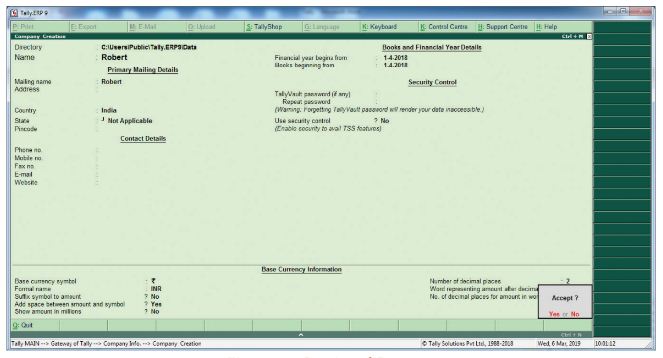
1. To create company
Company Info > Create Company
Type the Name as Robert and keep all other fields as they are and choose ‘Yes’ to accept.
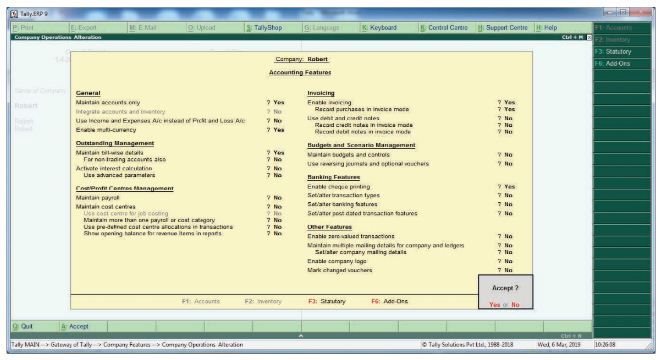
2. To maintain accounts only
Gateway of Tally > F11 Accounting Features > General > Maintain accounts only: Yes > Accept> Yes
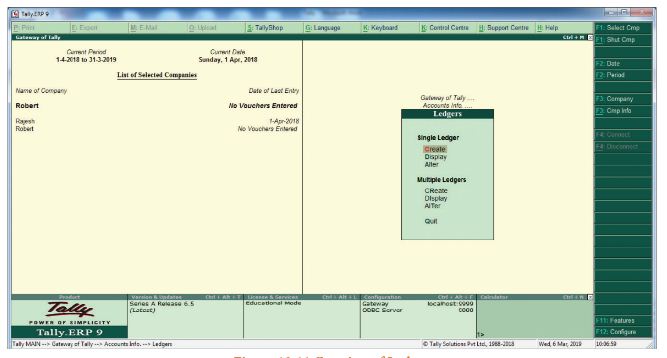
3. To Create ledger accounts
Gateway of Tally > Masters > Accounts Info > Ledgers > Single Ledger > Create
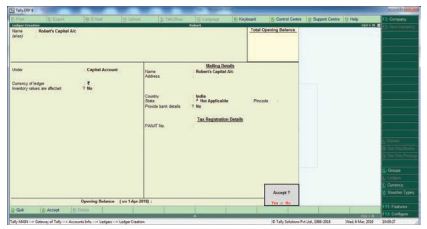
(i) To Create Devi's Capital A/c
Name: Devi's Capital A/c
Under Capital Account
Accept: Yes
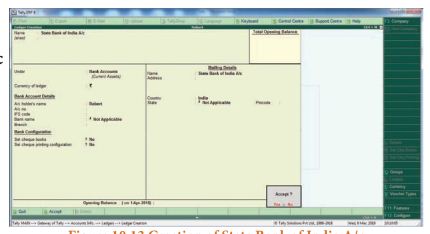
(ii) To Create Indian Bank A/c
Name: Indian Bank A/c
Under: Bank Accounts
Accept: Yes
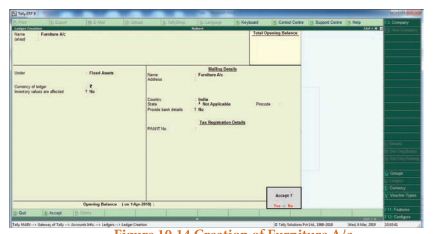
(iii) To Create Furniture A/c
Name: Furniture A/c
Under: Fixed Assets
Accept: Yes
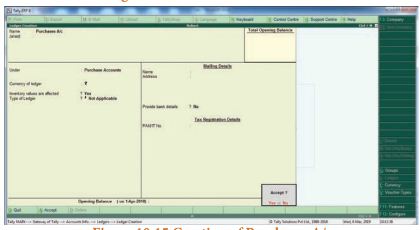
(iv) To Create Purchases A/c
Name: Purchases A/c
Under: Purchase
Accept: Yes
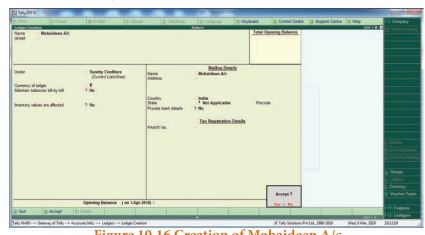
(v) To Create Mohaideen A/c
Name: Mohaideen A/c
Under: Sundry Creditors
Accept: Yes
(vi) To Create Sales A/c
Name: Sales A/c
Under: Sales Account
Accept: Yes
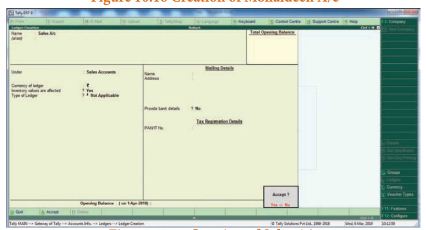
(vii) To create Rony A/c
Name: Rony A/c
Under: Sundry Debtors
Accept: Yes
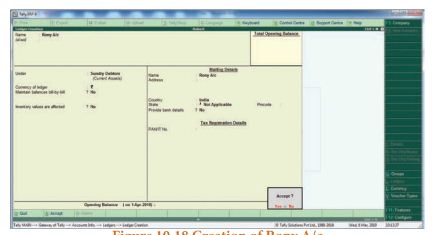
(viii) To create Salaries A/c
Name: Salaries A/c
Under: Indirect Expenses
Accept: Yes
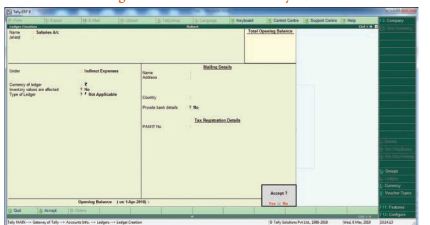
(ix) To create Wages A/c
Name: Wages A/c
Under: Direct Expenses
Accept: Yes
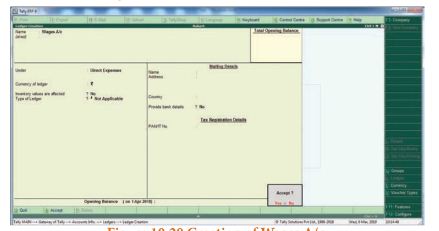
(x) To create Stationery A/c
Name: Stationery A/c
Under: Indirect Expenses
Accept: Yes
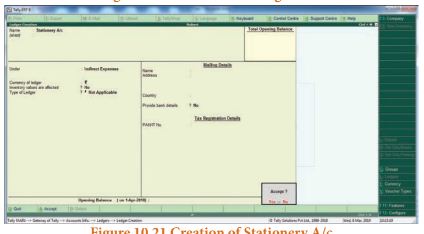
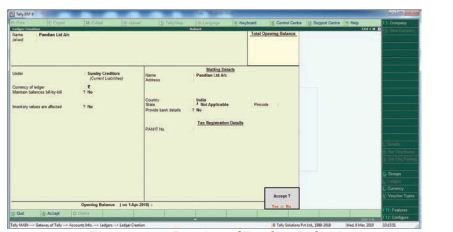
(xi) To create Pandian Ltd. A/c
Name: Pandian Ltd. A/c
Under:Sundry Creditors
Accept: Yes
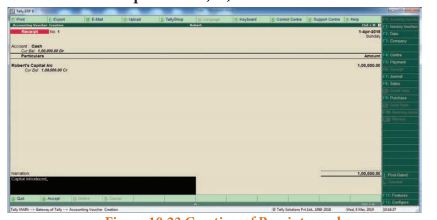
4. To enter transactions through vouchers
Gateway of Tally > Transactions > Accounting Vouchers
(i) Robert commenced a transport business with a capital of Rs. 1,00,000
F6: Receipt Voucher: Accounts: Cash
Particulars: Robert Capital A/c (Choose from List of Ledgers Accounts)
Enter the amount of Capital Rs. 1,00,000
Narration: Capital Introduced
Accept: Yes
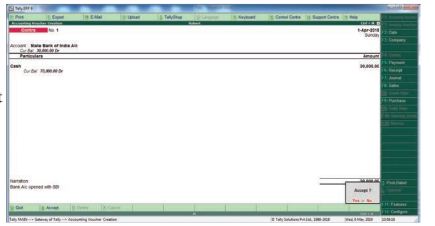
(ii) An account was opened with State Bank of India and deposited Rs. 30,000
F4: Contra Voucher
Accounts: State Bank of India
Particulars: Cash
Amount: Rs. 30,000
Narration: Opened bank account in SBI
Accept: Yes
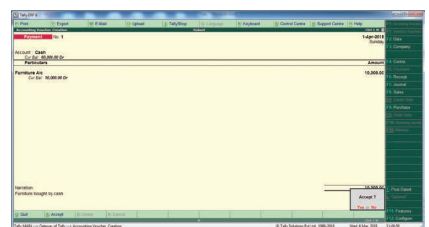
(iii) Purchased Furniture by paying cash Rs. 10,000
F5: Payment Vouchers
Account: Cash
Particulars: Furniture A/c
Amount: Rs. 15,000
Narration: Furniture bought by Cash
Accept: Yes
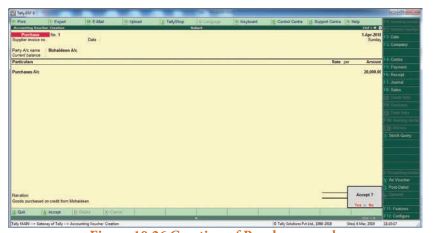
4 Goods purchased on credit from Mohaideen for Rs. 20,000
F9: Purchase voucher
Party A/c name: Mohaideen A/c
Particulars: Purchases A/c
Amount: Rs. 20,000
Narration: Goods purchased on
credit from Mohaideen
Accept Yes
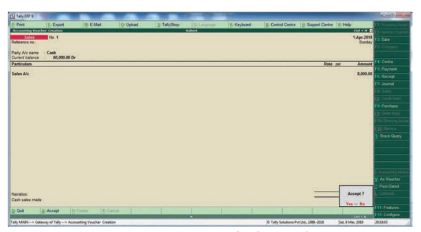
(5) Cash sales made for Rs. 8,000
F8: Sales Voucher,
Account: Cash
Particulars: Sales A/c
Amount: Rs. 8,000
Narration: Cash Sales Mode
Accept: Yes
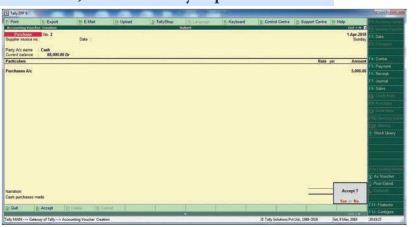
(6) Goods purchased from Rathinam for Rs. 5,000 and money deposited in CDM
F9: Purchase Voucher
Account: Bank
Particulars: Purchase A/c
Amount: Rs. 5,000
Narration: Goods Purchased
(vii) Goods sold to Rony on credit for Rs. 60,000
F8: Sales Voucher
Party: A/c Name: Rony A/c
Particulars: Sales A/c
Amount: Rs. 70,000
Narration: Goods sold on credit to Rony
Accept: Yes
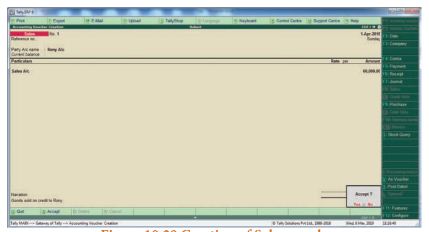
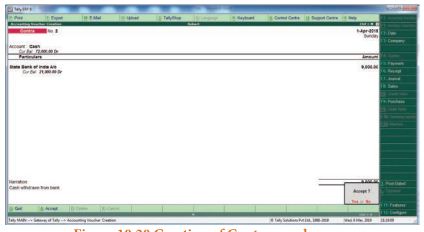
(viii) Money withdrawn from bank for office use Rs. 9,000
F4: Contra Voucher
Account: Cash
Particulars: State Bank of India A/c
Amount: Rs. 9,000
Narration: Cash withdrawn from bank
Accept: Yes
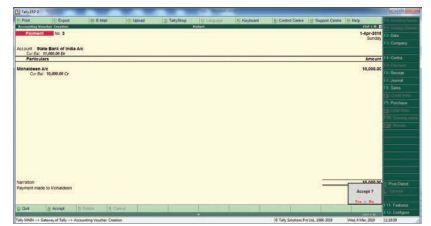
(ix) Part payment of Rs 10,000 to Mohaideen by cheque
F5: Payment Vouchers
Account: State Bank of India
Particulars: Mohaideen A/c
Amount: Rs.10,000
Narration: Payment made to
Mohaideen by cheque
Accept Yes
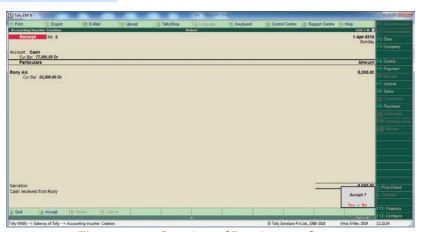
(x) Rony made part payment of Rs. 5,000 by cash
F6: Receipt voucher
Account: Cash
Particulars: Rony A/c
Amount: Rs. 5,000
Narration: Cash received from Rony
Accept Yes.
(xi) Salaries Paid to Staff through ECS Rs. 6,000
F5: Payment Vouchers
Account: Indian Bank
Particulars: Salaries A/c
Amount: Rs 6,000
Narration: Salaries paid through ECS,
Accept: Yes
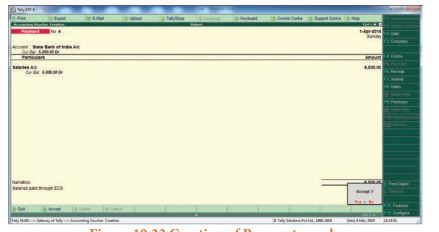
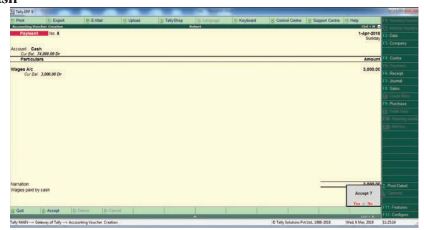
(xii) Wages of Rs. 3,000 paid by cash
F5: Payment voucher
Account: Cash
Particulars: Wages A/c
Amount: Rs. 3,000
Narration: Wages paid by cash
Accept Yes
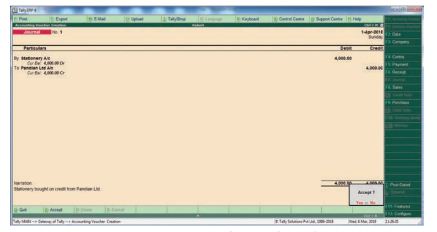
(xiii) Purchased stationery from Pandian Ltd. on credit Rs.4,000
F7: Journal Voucher
Particulars: Computer A/c
Account: Muthu Ltd.
Amount: Rs. 4,000
Narration: Stationery bought on credit from Pandian Ltd.
Accept: Yes
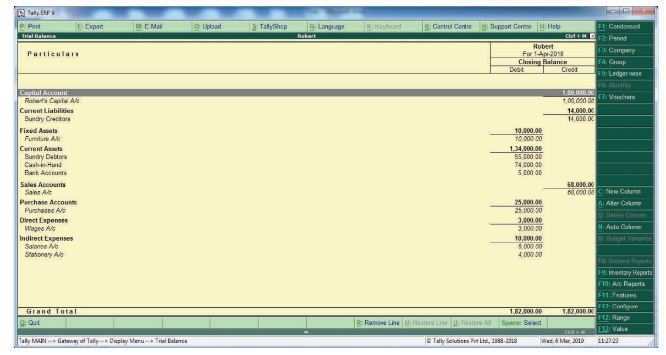
To view reports
(i) To view Trial Balance
Gateway of Tally > Reports > Display > Trial Balance > Alt + F1 (detailed)
(ii) To view profit and loss Account
F10: A/c Reports > Profit & Loss A/c > Alt + F1 (detailed) or
Gateway of Tally > Reports > Profit & Loss A/c Alt + F1 (detailed)
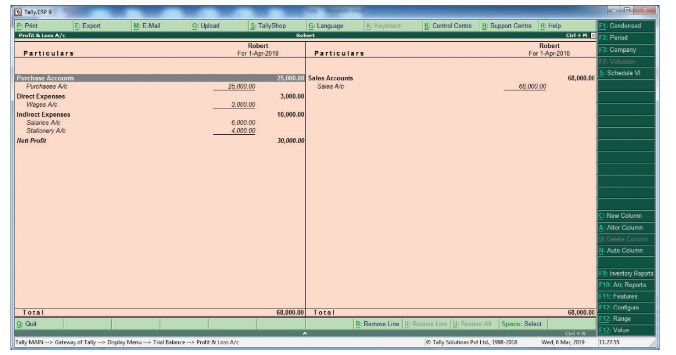
(iii) To view Balance sheet
F10: A/c Reports > Balance sheet > Alt + F1 (detailed)
Gate of Tally > Reports > Balance Sheet > Alt + F1 (detailed)
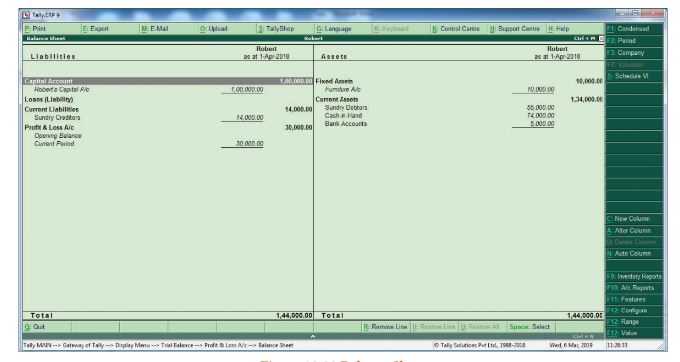
(iv) To view Ratio Analysis
F10: A/c Reports > Ratio Analysis (or)
Gateway of Tally > Reports > Ratio Analysis
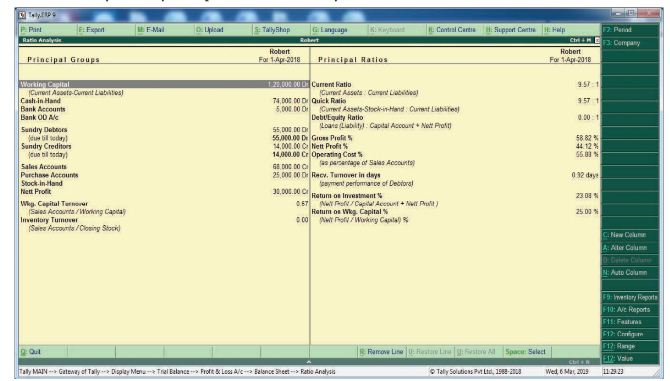
(v) To view Day book
F10: A/c Reports > Day Book > Alt + F1 (detailed (or)
Gateway of Tally > Reports > Display > Day Books > Alt + F1 (detailed)
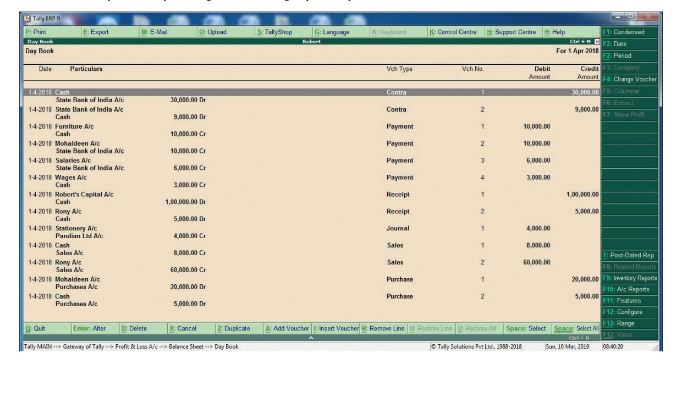
13.
14.
| Liabilities | Rs. | Assets | Rs. |
|---|---|---|---|
| Creditors | 5,000 | Cash at bank | 4,000 |
| Opening capital | 30,000 | Stock | 9,000 |
| (balancing figure) | Sundry debtors | 2,000 | |
| Plant and machinery | 20,000 | ||
| 35,000 | 35,000 |
| Particulars | Rs. | Particulars | Rs. |
|---|---|---|---|
| To Cash A/c (paid) | 64,000 | By Balance b/d | 5,000 |
| To Purchases returns | 2,000 | By Purchases A/c (credit) | 65,000 |
| To Balance c/d | 4,000 | (balancing figure) | |
| 70,000 | 70,000 |
| Particulars | Rs. | Particulars | Rs. | ||
|---|---|---|---|---|---|
| To Opening stock | 9,000 | By Sales | 85,000 | ||
| To Purchases | Less Returns | 1,000 | 84,000 | ||
| Credit | 65,000 | By Closing stock | 16,000 | ||
| Less Returns | 2,000 | 63,000 | |||
| To Carriage inwards | 8,000 | ||||
| To Gross profit c/d | 20,000 | ||||
| 1,00,000 | 1,00,000 | ||||
| To Advertising | 4,700 | By Gross Profit b/d | 20,000 | ||
| To Depreciation on machinery | 1,000 | ||||
| To Provision for doubtful debts | 300 | ||||
| To Net profit transferred to capital a/c | 14,000 | ||||
| 20,000 | 20,000 | ||||
| Liabilities | Rs. | Rs. | Assets | Rs. | Rs. |
|---|---|---|---|---|---|
| Capital | 30,000 | Cash at bank | 6,000 | ||
| Add: Net profit | 14,000 | Stock | 16,000 | ||
| 44,000 | Sundry debtors | 5,300 | |||
| Less: Drawings | 2,000 | 42,000 | Less: Provision | 300 | 5,000 |
| Sundry creditors | 4,000 | Plant and Machinery | 20,000 | ||
| Less: Depreciation | 1,000 | 19,000 | |||
| 46,000 | 46,000 |
15.
| Particulars | Rs | Particulars | Rs |
|---|---|---|---|
| To Balance b/d | 5,000 | By Cash A/c | 14,000 |
| To Debtors A/c | 11,200 | By Debtors A/c | 1,200 |
| (Bills received - balancing figure ) |
(bills receivable dishonoured) By Balance c/d |
1,000 | |
| 16,200 | 16,200 |
| Particulars | Rs | Particulars | Rs |
|---|---|---|---|
| To Balance b/d | 60,000 | By Cash A/c (received) | 1,30,000 |
| To Bills receivable A/c (dishonoured) | 1,200 | By Discount allowed A/c | 5,500 |
| To Sales A/c (credit) | 1,44,000 | By Bad debts A/c | 3,500 |
| (balancing figure) | By Bills receivable A/c | 11,200 | |
| (bills received) By Balance c/d |
55,000 | ||
| 2,05,200 | 2,05,200 |
| Particulars | Rs | Particulars | Rs |
| To Cash A/c (bills paid) | 7,000 | By Balance b/d | 2,000 |
| To Balance c/d | 3,000 | By Sundry creditors A/c (bills accepted – balancing figure) |
|
| 8,000 | |||
| 10,000 | 10,000 |
| Particulars | Rs | Particulars | Rs |
|---|---|---|---|
| To Cash A/c (paid ) | 70,000 | By Balance b/d | 25,000 |
| To Discount received A/c | 3,500 | By Purchases A/c (credit) | 84,500 |
| To Bills payable A/c (bills accepted) | 8,000 | (balancing figure) | |
| To balance c/d | 28,000 | ||
| 1,09,500 | 1,09,500 |
16.
| Particular | Rs. in thousands | Trends percentage | ||||
|---|---|---|---|---|---|---|
| 2015-16 | 2016-17 | 2017-18 | 2015-16 | 2016-17 | 2017-18 | |
| Revenue from operations | 100 | 125 | 150 | 100 | 125 | 150 |
| Add: Other income | 20 | 25 | 30 | 100 | 125 | 150 |
| Total revenue | 120 | 150 | 180 | 100 | 125 | 150 |
| Less: Expenses | 100 | 120 | 80 | 100 | 120 | 80 |
| Project before tax | 20 | 30 | 100 | 100 | 150 | 500 |
| Less Income tax (30%) | 6 | 9 | 30 | 100 | 150 | 500 |
| Profit after tax | 14 | 21 | 70 | 100 | 150 | 500 |
Note: 2016 -17
Percentage for Revenue from operations = \(\frac{125}{100}\) x 100 = 125%
Percentage of other income = \(\frac{25}{20}\) x 100 = 125%
Percentage of total revenue = \(\frac{150}{120}\) x 100 = 125%
Percentage for expenses = \(\frac{120}{100}\) x 100 = 120%
Percentage for before tax = \(\frac{30}{20}\) x 100 = 150%
Percentage for profit before tax = \(\frac{21}{14}\) x 100 = 150%
In 2017 - 18
Percentage for revenue from operations = \(\frac{150}{100}\) x 100 = 150%
Percentage for other income = \(\frac{25}{20}\) x 100 = 125%
Percentage of total revenue \(\frac{180}{120}\) x 100 = 150%
Percentage for expenses = \(\frac{80}{100}\) x 100 = 80%
Percentage for profit before tax = \(\frac{100}{20}\) x 100 = 500%
Percentage for profit after tax = \(\frac{70}{14}\) x 100 = 500%
17.
Operating cost ratio = \(\cfrac { Operating\ cost }{ Revenue\ from\ operations } \times 100=\cfrac { 4,80,000 }{ 8,00,000 } \times 100=60\)%
Cost of revenue from operations = Purchases of stock-in-trade + Change in inventories of stock in trade + Direct expenses (wages)
= 4,50,000 + (40,000) + 10,000 = Rs.4,20,000
Operating expenses = Administrative expenses + Selling and distribution expenses+ Employee benefits expenses (salaries)
= 20,000 + 28,000 + 12,000 = Rs.60,000
Operating cost = Cost of revenue from operations + Operating expenses
= 4,20,000 + 60,000 = Rs.4,80,000
Tutorial Note
Loss on sale of fixed assets is a non-operating item, hence it is ignored.
(iii) Operating profit ratio
Operating profit ratio gives the proportion of operating profit to revenue from operations.
Operating profit ratio is an indicator of operational efficiency of an organisation. It may be computed as follows
Operating profit ratio = \(\cfrac { Operating\ profit }{ Revenue\ from\ operations } \times 100\)
Alternatively, it is calculated as under.
Operating profit ratio = 100 – Operating cost ratio
Operating profit = Revenue from operations – Operating cost
A higher ratio indicates better profitability. Greater the operating ratio, higher is the margin available for paying non-operating expenses
Tutorial note
Operating cost ratio + Operating profit ratio = 100%
18.
\(Gross\ profit\ ratio=\cfrac { Gross\ profit }{ Revenue\ from\ operators } \times 100\)
= \(\cfrac { 20,000 }{ 1,00,000 } \times 100=20\)%
Gross profit = Revenue from operations – Cost of revenue from operations
= 1,00,000 – 80,000 = Rs.20,000
(ii) Operating cost ratio
Operating cost ratio is the proportion of operating cost to revenue from operations.
This ratio is a test of the operational efficiency of the business. It is calculated as under.
\(Operating\ cost\ ratio=\cfrac { Operating\ cost }{ Revenue\ from\ operations } \times 100\)
Operating cost is the cost which is associated with the operating activities of the business.
Operating cost = Cost of revenue from operations + Operating expenses
Operating expenses = Employee benefit expenses + Depreciation + Other expenses related to office and administration, selling and distribution
A lower operating ratio indicates better profitability. Lesser the operating cost ratio, higher is
the margin available for payment of non operating expenses such as interest on loans, loss on sale of fixed assets, etc
19.
Gross profit ratio = \(\frac { Gross\ profit }{ Revenue\ from\ operations } \) \(\times\) 100
Gross profit = Revenue from operations - Cost of revenue from operations
= Rs.2,50,000 - Rs.2,10,000
= Rs.40,000
∴ Gross profit ratio = \(\frac { 40,000 }{ 2,50,000 } \) \(\times\) 100 = 16%
20.
| Particulars | 2015-16 Rs. | 2016-17 Rs. | Absolute amount of increase (+) or decrease (-) Rs. |
Percentage increase (+) or decrease (-) |
|---|---|---|---|---|
| Revenue from Operations | 40,000 | 50,000 | + 10,000 | + 25 |
| Less: Operating expenses | 25,000 | 27,500 | + 2,500 | + 10 |
| Profit before tax | 15,000 | 22,500 | + 7,500 | + 50 |
| Less: Income tax | 4,500 | 6750 | + 2,250 | + 50 |
| Profit after tax | 10,500 | 15,750 | + 5,250 | + 50 |
Note:
Percentage increase for revenue from operations = \(\frac{10,000}{40,000}\) x 100 = 25%
Percentage increase for operating expenses = \(\frac{2,500}{25,000}\) x 100 = 10%
Percentage increase for profit before tax = \(\frac{7,500}{15,000}\) x 100 = 50%
Percentage increase for income for Income tax = \(\frac{2250}{4500}\) x 100 = 50%
Percentage increase for profit after tax = \(\frac{5250}{10,500}\) x 100 = 50%

12th Standard Syllabus & Materials
12th Standard
TN 12th Computer Applications களப்பெயர் முறைமை (DNS) Sample Question Papers Study Material - QB365 Set A
NEW12th Standard
TN 12th Computer Applications வலையமைப்பு எடுத்துக்காட்டுகள் மற்றும் நெறிமுறைகள் Sample Question Papers Study Material - QB365 Set A
NEW12th Standard
TN 12th Computer Applications கணினி வலையமைப்பு ஓர் அறிமுகம் Sample Question Papers Study Material - QB365 Set A
NEW12th Standard
TN 12th Computer Applications PHP-உடன் MySQL-ஐ இணைத்தல் Sample Question Papers Study Material - QB365 Set A



Tamilnadu Stateboard 12th Standard Subjects

Maths

Chemistry

Physics

Biology

Computer Science

Business Maths and Statistics

Economics

Commerce
Accountancy

History

Computer Applications
Biology
Computer Technology
Computer Applications
Computer Science
Business Maths and Statistics
Commerce
Economics
Maths
Chemistry
Physics
Computer Technology
History
Accountancy

Tamil

English

French
Tamilnadu Stateboard Standards
