
 100% FREE ACCESS
12th Standard Syllabus & Materials
12th Standard
TN 12th Maths Applications of Matrices and Determinants Sample Question Papers Study Material - QB365 Set A
NEW12th Standard
TN 12th Computer Applications மின்னணு தரவு பரிமாற்றம் Sample Question Papers Study Material - QB365 Set A
NEW12th Standard
TN 12th Computer Applications மின் - வணிக பாதுகாப்பு அமைப்புகள் Sample Question Papers Study Material - QB365 Set A
NEW12th Standard
TN 12th Computer Applications மின்னணு செலுத்தல் முறைகள் Sample Question Papers Study Material - QB365 Set A
NEW12th Standard
TN 12th Computer Applications மின் - வணிகம் Sample Question Papers Study Material - QB365 Set A
NEW12th Standard
TN 12th Computer Applications திறந்த மூல கருத்துருக்கள் Sample Question Papers Study Material - QB365 Set A

Published on: 12/11/2019
Download Tamil Nadu 12th Standard Accountancy question papers, model tests, one-mark questions, important questions, and public exam papers in PDF format. Free study materials and answer keys for TN State Board students.
Questions + Answers key
Take MCQ Accountancy Test
1.
Prepare common-size statement of financial position of Raheem Ltd as on 31st March 2016 and 31st March 2018.
| Particulars | 31st March 2016 | 31st March 2017 |
|---|---|---|
| Rs. | Rs. | |
| I. Equity and liabilities | ||
| l. Shareholders fund | ||
| a. Share capital | 5,00,000 | 6,00,000 |
| b. Reserve and surplus | 4,00,000 | 3,60,000 |
| 2. Non-current liabilities | ||
| Long-term borrowings | 8,00,000 | 2,40,000 |
| 3. Current liabilities | ||
| Trade payables | 30,000 | - |
| Total | 20,00,000 | 12,00,000 |
| II. Assets | ||
| l. Non-current assets | ||
| a. Fixed assets | 10,00,000 | 6,00,000 |
| b. Non-current investments | 5,00,000 | 2,40,000 |
| 2. Current assets | ||
| Inventories | 3,00,000 | 1,20,000 |
| Cash and cash equipments | 2,00,000 | 2,40,000 |
| Total | 20,00,000 | 12,00,000 |
2.
Sun, Moon and Jupiter are partners sharing profits and losses in the ratio of 5:3:2. Jupiter retires and the share is taken by Sun and Moon in the ratio of 3:2. Find out the new profit sharing ratio and gaining ratio
3.
Kavitha and Radha are partners of a firm sharing profits and losses in the ratio of 4:3. They admit Deepa on 1.1.2019. On that date, their balance sheet showed debit balance of profit and loss account being accumulate loss
Rs. 1,40,000 on the asset side of the balance sheet. Give the journal entry to transfer the accumulated loss on admission.
4.
Mrs. Geetha started business with Rs. 1,20,000 as capital on 1.4.2018. During the year she has withdrawn at the rate of Rs. 1,000 per month. She introduced Rs. 20,000 as additional capital. Her position on 31.3.2019 was as follows.
| Particulars | Rs. |
|---|---|
| Bank balance | 8,000 |
| Stock | 80,000 |
| Sundry debtors | 50,000 |
| Furniture | 2,500 |
| Cash in hand | 2,000 |
| Sundry creditors | 25,000 |
| Expenses outstanding | 1,000 |
She keeps her books under single entry system, determine for profit or loss for the year 2003-04.
5.
The profit and losses of a firm for the last four years were as follows:
2015: Rs.20,000; 2016; Rs. 25,000;
2017; Rs.3,000(loss) 2018; Rs.18,000
You are required to calculate the amount of goodwill on the basis of 5 years purchase of average profit of the last 4 years.
6.
From the following Receipts and Payments Account of Trichy, Rotary club, prepare Income and Expenditure Account for the year ended 31.03.2019
| Receipts | Rs | Paymenta | Rs |
|---|---|---|---|
| To Opening Balance | By Furniture Purchased | 10,000 | |
| Cash in hand | 11,000 | By Rent | 2,800 |
| To Sale of old newspaper | 3,600 | By Postage | 1,700 |
| To Member's Subscription | 31,000 | By General expenses | 4,350 |
| To Locker rent | 8,000 | By Printing and stationery | 45,000 |
| To Interest on investments | 1,250 | By Audit fees | 5,000 |
| To Sale of furniture | 5,000 | By Closing balance | |
| Cash in hand | 3,000 |
7.
Amal and Vimal are partners in a firm sharing profits and losses in the ratio of 7:5. Their balance sheet as on 31st March, 2019, is as follows:
| Liabilities | Rs. | Rs. | Assets | Rs. |
|---|---|---|---|---|
| Capital accounts: | Land | 80,000 | ||
| Amal | 70,000 | Furniture | 20,000 | |
| Vimal | 50,000 | 1,20,000 | Stock | 25,000 |
| Sundry creditors | 30,000 | Debtors | 30,000 | |
| Profit and loss A/c | 24,000 | Bank | 19,000 | |
| 1,74,000 | 1,74,000 |
Nirmal is admitted as a new partner on 1.4.2018 by introducing a capital of Rs.30,000 for 1/3 share in the future profit subject to the following adjustments.
(a) Stock to be depreciated by Rs. 5,000
(b) Provision for doubtful debts to be created for Rs. 3,000
(c) Land to be appreciated by Rs. 20,000
Prepare revaluation account and capital account of partners after admission.
8.
9.
Ramya, Sara and Thara are partners sharing profits and losses in the ratio of 5:3:2. On 1st April 2018, Thara retires and on retirement, the following adjustments are agreed upon:
(i) Increase the value of premises by Rs. 40,000.
(ii) Depreciate stock by Rs. 3,000 and machinery by Rs. 6,500.
(iii) Provide an outstanding liability of Rs. 500
Pass journal entries and prepare revaluation account.
10.
Khan Ltd. issued 50,000 shares of Rs.10 each to the public payable Rs.4 on application, Rs.4 on allotment and Rs.2 on first and final call. Applications were received for 65,000 shares. The directors decided to allot 50,000 shares on pro rata basis and surplus application money was utilised for allotment. Pass journal entries assuming that the amounts due were received.
11.
The following balance sheet has been prepared from the books of Pearl on 1-4-2018.
| Liabilities | Rs. | Assets | Rs. |
|---|---|---|---|
| Capital | 2,26,000 | Buildings | 1,00,000 |
| Sundry creditors: | Furniture | 10,000 | |
| Maya A/c | 24,000 | Stock | 20,000 |
| Sundry debtors | |||
| Peter | 50,000 | ||
| Cash in hand | 15,000 | ||
| Cash at bank | 55,000 | ||
| 2,50,000 | 2,50,000 |
During the year the following transactions took place.
(a) Wages paid by cash Rs. 2,000
(b) Salaries paid by cheque Rs. 5,000
(c) Cash purchases made for Rs. 3,000
(d) Good purchased on credit from Yazhini Rs. 15,000
(e) Goods sold on credit to Jothi Rs. 25,000
(f) Payment made to Yazhini through NEFT Rs. 5,000
(g) Cash received from Peter Rs. 30,000
(h) Cash sales made for Rs. 6,000
(i) Depreciate buildings at 10%
(j) Closing stock on 31.03.2019 Rs. 15,000
You are required to prepare trading and profit and loss account for the year ended 31-03-2019 and a balance sheet as on that date using Tally.
12.
From the following information, compute the value of goodwill by capitalising super profit:
(a) Capital employed is Rs. 4,00,000
(b) Normal rate of return is 10%
(c) Profit for 2016: Rs. 62,000; 2017: Rs. 61,000 and 2018: Rs. 63,000
13.
Calculate the value of goodwill at 5 years purchase of super profit from the following information:
(a) Capital employed: Rs. 1,20,000
(b) Normal rate of profit: 20%
(c) Net profit for 5 years:
2014: Rs. 30,000; 2015: Rs. 32,000; 2016: Rs. 35,000; 2017: Rs. 37,000 and 2018: Rs. 40,000
(d) Fair remuneration to the partners Rs. 2,800 per annum.
14.
Durai and Velan entered into a partnership agreement on 1st April 2018, Durai contributing Rs. 25,000 and Velan Rs. 30,000 as capital. The agreement provided that:
(a) Profits and losses to be shared in the ratio 2:3 as between Durai and Velan.
(b) Partners to be entitled to interest on capital @ 5% p.a.
(c) Interest on drawings to be charged Durai: Rs. 300 Velan: Rs. 450
(d) Durai to receive a salary of Rs. 5,000 for the year, and
(e) Velan to receive a commission of Rs. 2,000
During the year, the firm made a profit of Rs. 20,000 before adjustment of interest, salary and commission. Prepare the Profit and loss appropriation account.
15.
From the following receipts and payment account, prepare income and expenditure account of Kumbakonam Basket Ball Association for the year ended 31st March, 2018
| Receipts | Rs. | Rs. | Payments | Rs. | Rs. |
|---|---|---|---|---|---|
| To Balance b/d | By Rent of ground paid | 12,000 | |||
| Cash in hand | 23,000 | By Printing charges | 5,000 | ||
| Cash at bank | 12,000 | 35,000 | By Bank charges | 1,000 | |
| To Rent of hall received | 6,000 | By Insurance for building | 2,000 | ||
| To Subscription received | 9,000 | By Tournament expenses | 16,000 | ||
| To Life membership fees | 7,000 | By Audit fees | 3,000 | ||
| To Locker rent received | 2,000 | By Sports materials purchased | 4,000 | ||
| By Balance c/d | |||||
| Cash in hand | 2,000 | ||||
| Cash at bank | 14,000 | 16,000 | |||
| 59,000 | 59,000 |
16.
From the following Receipts and Payment Account of Trichy Recreation Club, prepare Income and Expenditure Account for the year ended 31.03.2018.d
| Receipts | Rs. | Payments | Rs. |
|---|---|---|---|
| To Opening balance | By Furniture purchased | 10,000 | |
| Cash in hand | 11,000 | By Rent | 2,800 |
| To Dividend received | 27,600 | By Secretary's honorarium | 15,000 |
| To Sale of old newspaper | 3,000 | By Postage | 1,700 |
| To Members’ subscription | 31,000 | By General expenses | 4,350 |
| To Locker rent | 8,000 | By Printing and Stationery | 45,000 |
| To Interest on investments | 1,250 | By Audit fees | 5,000 |
| To Sale of furniture | 5,000 | By Closing balance | |
| (Book value Rs. 4,400) | Cash in hand | 3,000 | |
| 86,850 | 86,850 |
17.
Pandian does not keep his books under double entry system. From the following information prepare trading and profit and loss account
| 1-1-2018 Rs. |
31-12-2018 Rs. |
|
|---|---|---|
| Furniture | 30,000 | 30,000 |
| Cash in hand | 10,000 | 17,000 |
| Debtors | 40,000 | 60,000 |
| Stock | 28,000 | 11,000 |
| Bills receivable | 12,000 | 35,100 |
| Bank loan | 25,000 | 25,000 |
| Creditors | 15,000 | 16,000 |
| Rs. | Rs. | ||
|---|---|---|---|
| Cash sales | 11,200 | Credit sales | 88,800 |
| Cash purchases | 4,250 | Credit purchases | 35,750 |
| Carriage on purchases | 3,000 | Carriage on sales | 700 |
| Commission received | 600 | Interest on bank loan | 2,500 |
| Drawings | 8,000 | Additional capital | 14,000 |
| Salaries | 8,900 | Office rent | 2,400 |
Adjustments:
Write off depreciation of 5% on furniture. Create a provision of 1% on debtors for doubtful debts.
18.
When a partner dies, firm will receive the __________
1/2 amount of policy
1/4 amount of policy
3/4 amount of policy
Full amount of policy
19.
In single entry system profit is calculated as follows:
Opening capital + Drawings + Fresh Capital + Ending capital
Capital at the end - Drawings - Fresh capital - Opening capital
Capital at the end + Drawings - Fresh capital - Opening capital
None of the above
20.
At what purpose of admission of a new partner may be to raise additional capital. Give reason(s) ________
For expansion of business
For managerial skill of the new partner
Both (a) & (b)
None of these
21.
In case of private placement of shares to raise the amount of capital, a company:
Invites the public through prospectus
Does not invite the public
Invite the public through advertisement
None of these
22.
_______ ratio is an indicator of the overall profitability of the business.
Gross profit
Net profit
Operating cost
Operating profit
23.
_______________ refers to the system of maintaining accounts using computers.
Computer software system
Computer accounting system
Computer hardware system
None of the above
24.
Profit and loss appropriation account is _____________ account in nature.
real
nominal
personal
none of these
25.
The revaluation profits and losses are recorded in the _________ account
Capital
Revaluation
Profit and loss
None of these
26.
Goodwill is paid for obtaining ____________
future profit
present benefit
past benefit
none of the above
27.
Profits and losses of previous years which are not distributed to the partners are known as ___________
Accumulated profit and losses
general reserve
Reserve fund
workmen compensation fund
28.
_______is prepared to find out the surplus or deficit pertaining to a particular year.
Income and Expenditure account
Receipts and Payment account
Trading and Profit and loss account
Balance sheet
29.
30.
The term ‘fund’ refers to
Current liabilities
Working capital
Fixed assets
Non-current assets
31.
A preference share is one
(i) which carries preferential right with respect to payment of dividend at fixed rate
(ii) which carries preferential right with respect to repayment of capital on winding up
Only (i) is correct
Only (ii) is correct
Both (i) and (ii) are correct
Both (i) and (ii) are incorrect
32.
Current assets excluding inventory and prepaid expenses is called
Reserves
Tangible assets
Funds
Quick assets
33.
Which of the following statements is true?
Goodwill is an intangible asset
Goodwill is a current asset
Goodwill is a fictitious asset
Goodwill cannot be acquired
34.
When fixed capital method is adopted by a partnership firm, which of the following items will appear in capital account?
Additional capital introduced
Interest on capital
Interest on drawings
Share of profit
35.
36.
Receipts and payments account is a
Nominal A/c
Real A/c
Personal A/c
Representative personal account
37.
Which one of the following statements is not true in relation to incomplete records?
It is an unscientific method of recording transactions
Records are maintained only for cash and personal accounts
It is suitable for all types of organisations
Tax authorities do not accept
38.
Suresh and Ramesh are partners in a firm with capitals of Rs. 3,00,000 and Rs. 4,00,000 respectively. The do not have a partnership deed. Ramesh wants to share the profits in the ratio of capitals. State with reason whether the claim is valid
39.
The amount of bills payable appearing in the balance sheet is understated by. Rs.10,000 State whether the revaluation account will be debited or credited to restore the amount of bills payable to its actual value. Also give reason for your answer.
40.
Who is an outgoing partner?
41.
Why is goodwill considered as an intangible asset but not a fictitious assets?
42.
Write a note on Donations
43.
Selvam and Senthil are partners sharing profit in the ratio of 2:3. Siva is admitted into the firm with 1/5 share of profit. Siva acquires equally from Selvam and Senthil. Calculate the new profit sharing ratio and sacrificing ratio.
44.
From the following information of Ashika Ltd., calculate fixed assets turnover ratio:
(i) Revenue from operations during the year were Rs.60,00,000.
(ii) Fixed assets at the end of the year was Rs.6,00,000.
45.
From the following details of a business concern calculate net profit ratio.
| Particulars | Rs. |
|---|---|
| Revenue from operations | 3,50,000 |
| Cost of revenue from operations | 1,50,000 |
| Administration expenses | 50,000 |
| Selling expenses | 10,000 |
46.
Muthu was holding 20 equity shares of Rs.10 each on which he paid Rs.2 on application but could not pay Rs.3 on allotment and Rs.1 on first call. Directors forfeited the shares after the first call. Give journal entry for recording the forfeiture of shares.
47.
State any two limitations of ratio analysis.
48.
What is a group in Tally ERP 9?
49.
From the following particulars ascertain profit or loss
| Particulars | Rs. |
|---|---|
| Capital as on 1st January 2018 | 2,20,000 |
| Capital as on 31st December 2018 | 1,80,000 |
| Additional capital introduced during the year | 40,000 |
| Drawings made during the year | 50,000 |
50.
What are the characteristics of a company?
51.
What are the objectives of financial statement analysis?
52.
Radhika started a small bakery for providing healthy and good quality bakery product at reasonable prices on 1st January, 2019 with a capital of Rs. 1,80,000. She appointed a ten year old boy as a sweeper. She withdrew Rs. 60,000 for household expenses. She introduced Rs. 20,000as fresh capital. Her position of assets and liabilities as at 31st December, 2019 stood as follows.
| Rs. | |
|---|---|
| Cash in hand | 70,000 |
| Stock | 80,000 |
| Bills receivable | 1,00,000 |
| Debtors | 1,50,000 |
| Creditors | 60,000 |
| Bills payable | 10,000 |
53.
Sam and Jose are partners in a firm sharing profits and losses in the ratio of 3:2. On 1st April 2018, they admitted Joel as a partner. On the date of Joel’s admission, goodwill appeared in the books of the firm at Rs. 30,000. By assuming fluctuating capital method, pass the necessary journal entry if the partners decide to
(a) write off the entire amount of existing goodwill
(b) write off Rs. 20,000 of the existing goodwill.
54.
1.
| Particulars | Absolute amount on 31st March 2016 |
Percentage of total assets on 31st March 2016 |
Absolute amount on 31st March 2017 |
Percentage of total assets on 31st March 2017 |
|---|---|---|---|---|
| Rs. | Rs. | |||
| I. Equity and liabilities | ||||
| l. Shareholders fund | ||||
| a. Share capital | 5,00,000 | 25 | 6,00,000 | 50 |
| b. Reserve and surplus | 4,00,000 | 20 | 3,60,000 | 30 |
| 2. Non-current liabilities | ||||
| Long-term borrowings | 8,00,000 | 40 | 2,40,000 | 20 |
| 3. Current liabilities | ||||
| Trade payables | 30,000 | 15 | - | - |
| Total | 20,00,000 | 100 | 12,00,000 | 100 |
| II. Assets | ||||
| l. Non-current assets | ||||
| a. Fixed assets | 10,00,000 | 50 | 6,00,000 | 50 |
| b. Non-current investments | 5,00,000 | 25 | 2,40,000 | 20 |
| 2. Current assets | ||||
| Inventories | 3,00,000 | 15 | 1,20,000 | 10 |
| Cash and cash equipments | 2,00,000 | 10 | 2,40,000 | 20 |
| Total | 20,00,000 | 100 | 12,00,000 | 100 |
2.
Jupiter's share \(\cfrac { 2 }{ 10 } \)
Share gained = Retiring partner's share x Proportion of share gained
Sun = \(\cfrac { 2 }{ 10 } \times \cfrac { 3 }{ 5 } =\cfrac { 6 }{ 50 } \)
Moon = \(\cfrac { 2 }{ 10 } \times \cfrac { 2 }{ 5 } =\cfrac { 4 }{ 50 } \)
Gaining ration = \(\cfrac { 6 }{ 50 } :\cfrac { 4 }{ 50 } \) that is,3:2
New share of continuing partner = Old share + share gained
Sun = \(\cfrac { 5 }{ 10 } +\cfrac { 6 }{ 50 } =\cfrac { 25+6 }{ 50 } =\cfrac { 31 }{ 50 } \)
Moon = \(\cfrac { 3 }{ 10 } +\cfrac { 4 }{ 50 } =\cfrac { 15+4 }{ 50 } =\cfrac { 19 }{ 50 } \)
The new of Sun and Moon is \(\cfrac { 31 }{ 50 } :\cfrac { 19 }{ 50 } \)
that is 31: 19
3.
| Date | Particulars | L.F | Debit Rs. |
Credit Rs. |
|
|---|---|---|---|---|---|
| 2019 January 1 |
Kavutha's capital A/c | Dr | 80,000 | ||
| Radha's capital A/c | Dr | 60,000 | |||
| To Profit and loss A/c | 1,40,000 | ||||
| (Accumulated loss transferred to old partner's capital account in the old profit sharing ratio) |
|||||
4.
| Liabilities | Rs. | Assets | Rs. |
|---|---|---|---|
| Sundry creditors | 25,000 | Bank balance | 8,000 |
| Expenses outstanding | 1,000 | Stock | 80,000 |
| Closing capital (B/F) | 1,16,500 | Sundry debtors | 50,000 |
| Furniture | 2,500 | ||
| Cash in hand | 2,000 | ||
| 1,42,500 | 1,42,500 |
| Particulars | Rs. |
|---|---|
| Closing capital | 1,16,500 |
| Add: Drawings (1000 x 12) | 12,000 |
| 1,28,500 | |
| Less: Additional capital | 20,000 |
| Adjusted closing capital | 1,08,500 |
| Less: Opening capital | 1,20,000 |
| Loss for the year | 11,500 |
5.
Goodwill = Average profit x Number of years purchase
Average profit =\(\frac{Total\ profit}{Number\ of\ years}\)
\(=\frac{20,000+25,000-3,000+18,000}{4}\)
\(=\frac{60,000}{4}\)
Rs. 15000
Goodwill =Average profit x Number of years of purchase
=15,000x5=75,000
Goodwill=Rs.75,000
6.
| Expenditure | Rs | Income | Rs |
|---|---|---|---|
| To Rent | 2,800 | By Dividend received | 27,600 |
| To Secretary's honorarium | 15,000 | By Sale of old newspaper | 3,000 |
| To Postage | 1,700 | By Member's subscription | 31,000 |
| To General Expenses | 4,350 | By Locker rent | 8,000 |
| To Printing and stationery | 45,000 | By Interest on investment | |
| To Audit fees | 5,000 | By Profit on sale of | |
| furniture (5000-4000) | |||
| By Deficit (excess of | |||
| expenditure over income) | |||
| 73,850 | 73,850 |
7.
| Particulars | Rs. | Rs. | Particulars | Rs. |
|---|---|---|---|---|
| To Stock A/c | 5,000 | By Land A/c | 20,000 | |
| To Provision for doubtful debts A/c | 3,000 | |||
| To Profit on revaluation transferred to | ||||
| Amal's capital A/c | 7,000 | |||
| Vimal's capital A/c | 5,000 | 12,000 | ||
| 20,000 | 20,000 |
| Particulars | Amal Rs. |
Vimal Rs. |
Nirmal Rs. |
Particulars | Amal Rs. |
Vimal Rs. |
Nirmal Rs. |
|---|---|---|---|---|---|---|---|
| To Balance c/d | 91,000 | 65,000 | 30,000 | By Balance b/d | 70,000 | 50,000 | - |
| By Bank A/c | - | - | 30,000 | ||||
| By Revaluation A/c | 7,000 | 5,000 | - | ||||
| 91,000 | 65,000 | 30,000 | 91,000 | 65,000 | 30,000 | ||
| By Balance b/d | 91,000 | 65,000 | 30,000 |
8.
9.
| Date | Particulars | L.F | Debit Rs. |
Credit Rs. |
|
|---|---|---|---|---|---|
| 2018 April 1 |
Premises A/c | Dr. | 40,000 | ||
| To Revaluation A/c | 40,000 | ||||
| (Value of premises increased) | |||||
| " | Revaluation A/c | Dr. | 10,000 | ||
| To Stock A/c | 3,000 | ||||
| To Machinery A/c | 6,500 | ||||
| To Outstanding liability A/c | 500 | ||||
| (Decrease in value of assets and outstanding liability recorded) | |||||
| " | Revaluation A/c | Dr. | 30,000 | ||
| To Ramya's capital A/c | 15,000 | ||||
| To Sara's capital A/c | 9,000 | ||||
| To Thara's capital A/c | 6,000 | ||||
| (Profit on revaluation distributed) |
| Particulars | Rs. | Rs. | Particulars | Rs. |
|---|---|---|---|---|
| To Stock A/c | 3,000 | By Premises A/c | 40,000 | |
| To Machinery A/c | 6,500 | |||
| To Outstanding liability A/c | 500 | |||
| To Profit on revaluation transferred to | ||||
| Ramya's capital A/c (5/10) | 15,000 | |||
| Sara's capital A/c (3/10) | 9,000 | |||
| Thara's capital A/c (2/10) | 6,000 | 30,000 | ||
| 40,000 | 40,000 |
10.
| Date | Particulars | L.F. | Debit Rs. |
Credit Rs. |
|
|---|---|---|---|---|---|
| Bank A/c (65,000 × 4) | Dr. | 2,60,000 | |||
| To Equity share application A/c | 2,60,000 | ||||
| (Application money received) | |||||
| Equity share application A/c (50,000 × 4) | Dr. | 2,00,000 | |||
| To Equity share capital A/c | 2,00,000 | ||||
| (Transfer of share application money to share capital) | |||||
| Equity share application A/c (15,000 × 4) | Dr. | 60,000 | |||
| To Equity share allotment A/c | 60,000 | ||||
| (Excess share application money utilised for allotment) | |||||
| Equity share allotment A/c | Dr. | 2,00,000 | |||
| To Equity share capital A/c | 2,00,000 | ||||
| (Share allotment money due) | |||||
| Bank A/c (2,00,000 – 60,000) | Dr. | 1,40,000 | |||
| To Equity share allotment A/c | 1,40,000 | ||||
| (Allotment money received) | |||||
| Equity share first and final call A/c (50,000 × 2) | Dr. | 1,00,000 | |||
| To Equity share capital A/c | 1,00,000 | ||||
| (Share first and final call money due) | |||||
| Bank A/c | Dr. | 1,00,000 | |||
| To Equity share first and final call A/c | 1,00,000 | ||||
| (Share first and final call money received) |
11.
Following steps are to be followed to enter the transactions in Tally ERP 9
1. To create company:
Company Info > Create Company
Type the Name as Peral and keep all other fields as they are and choose 'Yes' to accept.
2. To maintain accounts only:
Gateway of Tally > F11 Accounting Features > General > Maintain accounts only: Yes > Accept Yes
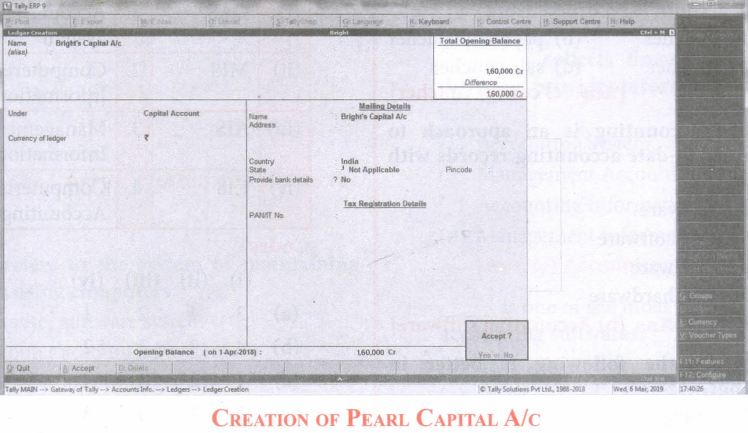
3. To create ledger accounts with opening balances:
Gateway of Tally > Masters > Accounts Info> Ledgers> Single Ledger> Create
| Creation of | Name | Under | Opening balance | Accept |
|---|---|---|---|---|
| Bright’s Capital A/c | Bright’s Capital A/c | Capital Account | 2,26,000 | Yes |
| Ramesh A/c (Sundry creditors) | Ramesh A/c | Sundry Creditors | 24,000 | Yes |
| Machinery A/c | Machinery A/c | Fixed Assets | 1,00,000 | Yes |
| Furnitures A/c | Furnitures A/c | Fixed Assets | 10,000 | Yes |
| Opening stock | Opening stock | Stock-in -Hand | 20,000 | Yes |
| Shankar A/c (Sundry debtors) | Shankar A/c | Sundry Debtors | 50,000 | Yes |
| Cash in hand | Cash | Cash-in-Hand | 15,000 | Yes |
| Cast at bank | Bank | Bank Accounts | 55,000 | Yes |
Note:
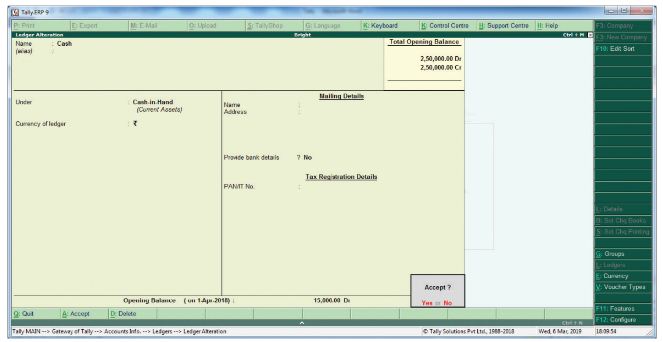
Cash account need not be created as it is a default ledger. Only the opening balance has to be recorded by altering the cash account.
To record the opening balance of Cash
Gateway of Tally > Masters > Accounts Info > Ledgers > Single Ledger > Alter
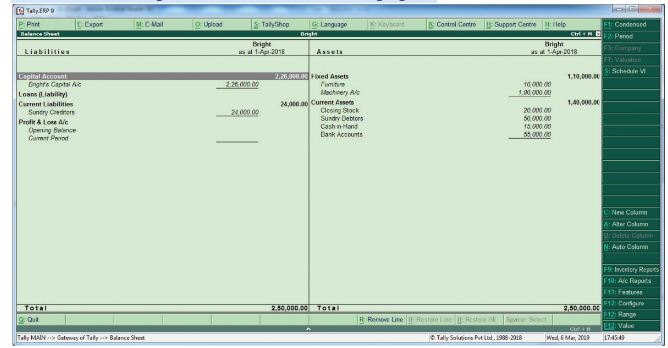
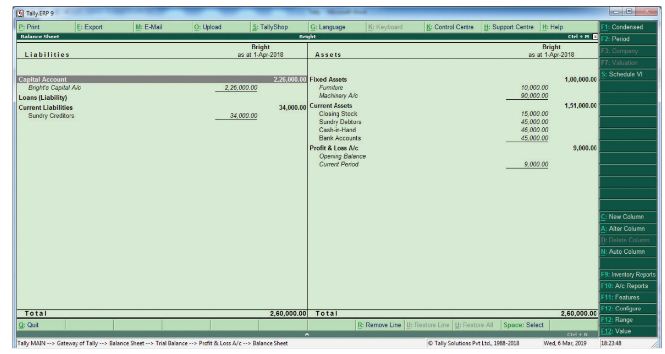
After creating the ledgers and recording the opening balances of ledger accounts the balance sheet of Bright is shown as in the following figure:
4. To create ledger accounts for transactions
| Creation of | Name | Under | Accept |
| Wages A/c | Wages A/c | Direct Expenses | Yes |
| Salaries A/c | Rent A/c | Indirect Expenses | Yes |
| Purchases A/c | Purchases A/c | Purchases Account | Yes |
| Senthamarai A/c | Senthamarai A/c | Sundry Creditors A/c | Yes |
| Sales A/c | Sales A/c | Sales Account | Yes |
| Pushparaj A/c | Pushparaj A/c | Sundry Debtors A/c | Yes |
| Depreciation A/c | Depreciation A/c | Indirect Expenses | Yes |
5. To enter transactions through vouchers
Gateway of Tally > Transactions > Accounting Vouchers
Example: Wages of Rs. 2,000 paid by Cash
F5: Payment Voucher
Account: Cash
Particulars: Wages A/c
Amount: Rs. 2,000
Narration: Wages paid by cash
Accept: Yes
In the similar way, record the other transactions. Use Payment Voucher for Salaries paid and payment to Senthamarai.
Use Purchase Voucher for credit purchases from Senthamarai and cash purchases.
Use Sales Voucher for credit sales to Pushparaj and cash sales.
Use Receipt Voucher for cash received from Shankar.
Use Journal Voucher for depreciation.
To record closing stock:
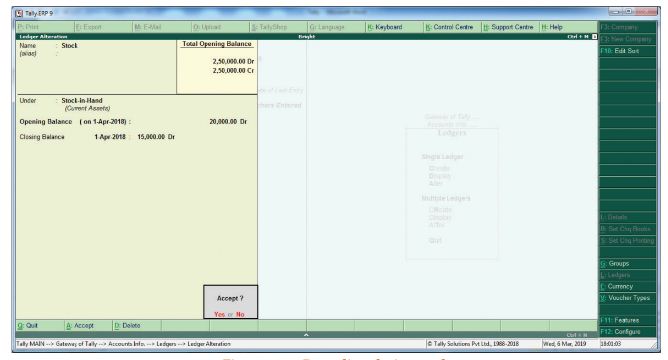
Since maintain accounts only is set to 'Yes' and integrate accounts and inventory is set to "No" under accounting features. Stock has to be recorded manually. Hence the closing stock has to be recorded by altering the stock account and while entering the data of closing stock, the date of opening stock has to be entered. The following procedure is to be followed:
Gateway of Tally > Masters > Accounts Info > Ledgers > Single Ledger > Alter > Stock > Closing balance > Date (opening date) > Amount > Accept Yes
6. To view reports:
(i) To view Profit and Loss Account:
F10: A/c Reports > Profit & Loss A/c > Alt + F1 (detailed) (or)
Gateway of Tally > Report > Profit & Loss A/c > Alt + F1 (detailed)
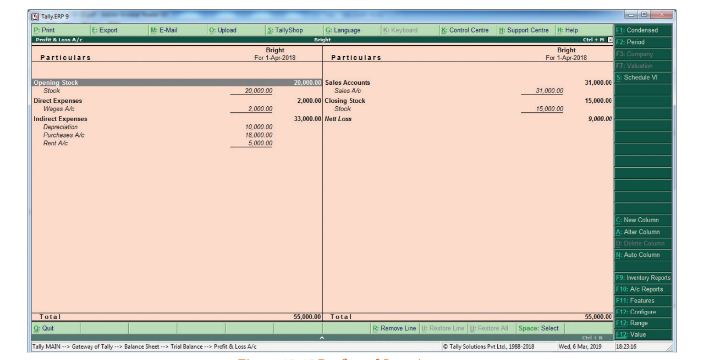
(ii) To view Balance sheet:
F10: A/c Reports > Balance sheet > Alt + F1 (detailed) (or)
Gateway of Tally > Reports > Balance Sheet > Alt + F1 (detailed)
12.
Average profit = \(\frac { Total\ profit }{ Number\ of\ year } \)
=\(\frac { 62,000+61,000+63,000 }{ 3 } \)
= \(\frac { 1,86,000 }{ 3 } \)
= Rs. 62,000
Normal profit = Capital employed \(\times\) Normal rate of return
= 4,00,000 \(\times\) 10%
= Rs. 40,000
Super profit = Average profit - Normal profit
= 62,000 – 40,000
= Rs. 22,000
Goodwill = \(\frac { Super\ profit }{ Normal\ rate\ of\ return } \) \(\times\)100
= \(\frac { 22,000 }{ 10 } \) \(\times\) 100
= Rs. 2,20,000
13.
Average profit = \(\frac { Total\ profit }{ Number\ of\ year } \)
Average profit = \(\frac { 30,000+32,000+35,000+37,000+40,000 }{ 5 } \)
Average profit = \(\frac { 1,74,000 }{ 5 } \)
| Particulars | Rs. |
|---|---|
| Average profit before fair remuneration to the partners | 34,800 |
| Less: Fair remuneration to the partners | 2,800 |
| Average profit | 32,000 |
Normal profit = Capital employed \(\times\) Normal rate of return
= 1,20,000 × 20%
= Rs. 24,000
Super profit = Average profit - Normal profit
= 32,000 – 24,000
= Rs. 8,000
Goodwill = Super profit \(\times\) Number of years of purchase
= 8,000 \(\times\) 5
= Rs. 40,000
14.
| Particulars | Rs. | Rs. | Particulars | Rs. |
|---|---|---|---|---|
| To Interest on capital A/c: | By Profit and loss A/c | 20,000 | ||
| Durai (25,000 \(\times\) 5%) | 1,250 | By Interest on drawings A/c | ||
| Velan (30,000 \(\times\) 5%) | 1,500 | Durai | 300 | |
| To Salary to Durai A/c | 5,000 | Velan | 450 | |
| To Commission to Velan A/c | 2,000 | |||
| To Partners’ capital A/c (profit transferred) | ||||
| Durai (11,000 \(\times\) 2/5) | 4,400 | |||
| Velan (11,000 \(\times\) 3/5) | 6,600 | 11,000 | ||
| 20,750 | 20,750 |
15.
| Expenditure | Rs | Income | Rs |
|---|---|---|---|
| To Rent of ground | 12,000 | By Rent of hall received | 6,000 |
| To Printing Charges | 5,000 | By Subscription received | 9,000 |
| To Bank charges | 1,000 | By Locker rent received | 2,000 |
| To Tournament expenses | 16,000 | By Deficit | 26,000 |
| To Audit fees | 3,000 | (Excess of expenditure over income) | |
| To Sports materials purchased | 4,000 | ||
| To Insurance for building | 2,000 | ||
| 43,000 | 43,000 |
16.
In the books of Trichy Recreation Club
| Expenditure | Rs. | Income | Rs. |
|---|---|---|---|
| To Rent | 2,800 | By Dividend received | 27,600 |
| To Secretary's honorarium | 15,000 | By Sale of old newspaper | 3,000 |
| To Postage | 1,700 | By Members’ subscription | 31,000 |
| To General expenses | 4,350 | By Locker rent | 8,000 |
| To Printing and stationery | 45,000 | By Interest on Investments | 1,250 |
| To Audit fees | 5,000 | By Profit on sale of furniture | 600 |
| (5,000 - 4,400) | |||
| By Deficit | 2,400 | ||
| (Excess of expenditure over income) | |||
| 73,850 | 73,850 |
17.
| Liabilities | Rs. | Assets | Rs. |
|---|---|---|---|
| Creditors | 15,000 | Cash in hand | 10,000 |
| Bank loan | 25,000 | Stock | 28,000 |
| Opening capital | 80,000 | Debtors | 40,000 |
| (balancing figure) | Bills receivable | 12,000 | |
| Furniture | 30,000 | ||
| 1,20,000 | 1,20,000 |
| Particulars | Rs. | Particulars | Rs. | ||
|---|---|---|---|---|---|
| To Opening stock | 28,000 | By Sales | |||
| To Purchases | Cash | 11,200 | |||
| Cash | 4,250 | Credit | 88,800 | 1,00,000 | |
| Credit | 35,750 | 40,000 | By Closing stock | 11,000 | |
| To Gross profit c/d | 40,000 | ||||
| 1,11,000 | 1,11,000 | ||||
| To Salaries | 8,900 | By Gross Profit b/d | 40,000 | ||
| To Carriage on sales | 700 | By Commission received | 600 | ||
| To Office rent | 2,400 | ||||
| To Interest on bank loan | 2,500 | ||||
| To Depreciation on furniture | 1,500 | ||||
| To Provision for doubtful debts | 600 | ||||
| To Net profit transferred to capital a/c | 24,000 | ||||
| 40,600 | 40,600 | ||||
| Liabilities | Rs. | Rs. | Assets | Rs. | Rs. |
|---|---|---|---|---|---|
| Capital | 80,000 | Cash in hand | 17,000 | ||
| Add: Net profit | 24,000 | Stock | 11,000 | ||
| 1,04,000 | Debtors | 60,000 | |||
| Add: Additional capital | 14,000 | Less: Provision for doubtful debts | 600 | 59,400 | |
| 1,18,000 | Bills receivable | 35,100 | |||
| Less: Drawings | 8,000 | 1,10,000 | Furniture | 30,000 | |
| Bank loan | 25,000 | Less: Depreciation | 1,500 | 28,500 | |
| Creditors | 16,000 | ||||
| 1,51,000 | 1,51,000 |
18.
(d)
Full amount of policy
19.
(c)
Capital at the end + Drawings - Fresh capital - Opening capital
20.
(c)
Both (a) & (b)
21.
(b)
Does not invite the public
22.
(b)
Net profit
23.
(b)
Computer accounting system
24.
(b)
nominal
25.
(a)
Capital
26.
(a)
future profit
27.
(a)
Accumulated profit and losses
28.
(a)
Income and Expenditure account
29.
(c)
30.
(b)
Working capital
31.
(c)
Both (i) and (ii) are correct
32.
(d)
Quick assets
33.
(a)
Goodwill is an intangible asset
34.
(a)
Additional capital introduced
35.
(a)
36.
(b)
Real A/c
37.
(c)
It is suitable for all types of organisations
38.
According to Indian partnership Act, 1932 in the absence of partnership deed, profits are shared equally among the partners. So, the claim of Ramesh to share the profits in the ratio of capitals is not valid.
39.
Revaluation account will be debited. Increase in bills payable is a loss for the firm. Being a nominal account, to record this loss, revaluation account will have to be debited.
40.
A person who is retired from the firm is known as an outgoing partners or retiring partners.
41.
Goodwill cannot be seen and touched. It is invisible. Hence it is treated as intangible asset. But it is not a fictitious asset because goodwill has a value and it can be purchased or sold with any other asset.
42.
(i) These are the amount received by not-for-profit organizations as a gift. It may be a general donation or specific donation.
(ii) General donation: If the donation is received without any specific condition, then it is a general donation. It is a revenue receipt.
(iii) Specific donation: If the donation received with a specific condition particular purpose like donations for sports fund, prize fund, etc., It is known as a specific donation. It is a capital receipt.
43.
Computation of sacrificing ratio and new profit sharing ratio
Siva's share = \(\frac{1}{5}\)
Proportion of share sacrificed = 1 : 1 (equally) i.e.\(\frac{1}{2}:\frac{1}{2}\)
Share scarified = New partner's share x Proportion of share sacrificed
Selvam \(=\frac { 1 }{ 5 } \times \frac { 1 }{ 2 } =\frac { 1 }{ 10 } \)
Senthil \(=\frac { 1 }{ 5 } \times \frac { 1 }{ 2 } =\frac { 1 }{ 10 } \)
Sacrificing ratio of Selvam and Senthil is \(\frac { 1 }{ 10 } :\frac { 1 }{ 10 } \) that is 1:1
New share of old partner = Old share - Share sacrificed
Selvam \(=\frac { 2 }{ 5 } -\frac { 1 }{ 10 } =\frac { 4-1 }{ 10 } =\frac { 3 }{ 10 } \)
Senthil \(=\frac { 3 }{ 5 } -\frac { 1 }{ 10 } =\frac { 6-1 }{ 10 } =\frac { 5 }{ 10 } \)
Share of new partner
Siva = \(\frac{1}{5}\)
In order to equate, monthly and divide Siva's share by 2
\(=\frac { 1 }{ 5 } \times \frac { 2 }{ 2 } =\frac { 2 }{ 10 } \)
New profit sharing ratio of Selvam, Senthil and Siva \(=\frac { 3 }{ 10 } :\frac { 5 }{ 10 } :\frac { 2 }{ 10 } \), that is 3:5:2
44.
Fixed assets turnover ratio = \(\frac{Revenue\ from\ operation}{Average\ i\ xed\ assets}\) = \(\frac{60,00,000}{6,00,000}\) = 10 times
45.
Net profit ratio = \(\cfrac { Net\ profit\ after\ tax }{ Revenue\ from\ operations } \times 100=\cfrac { 1,40,000 }{ 3,50,000 } \times 40\)
Net profit = Revenue from operations – Cost of revenue from operations – Administration
expenses – Selling expenses
= 3,50,000 – 1,50,000 – 50,000 – 10,000 = Rs.1,40,000
Tutorial note
It is assumed that there is no tax payable.
46.
| Date | Particulars | L.F. | Debit Rs. |
Credit Rs. |
|
|---|---|---|---|---|---|
| Equity share capital A/c (20 × 6) | Dr. | 120 | |||
| To Equity share allotment A/c (20 × 3) | 60 | ||||
| To Equity share first call A/c (20 × 1) | 20 | ||||
| To Forfeited shares A/c (20 × 2) | 40 | ||||
| (Shares forfeited) |
47.
(i) Ratios are only means: Ratios are not end in themselves but they are only means to achieve a particular purpose.
(ii) Accuracy of financial information : The accuracy of a ratio depends on the accuracy of information taken from financial statements.
48.
Group is a collection of ledgers of the same nature. There are predefined groups of accounts which are widely used in accounts of many orgaisation groups are categorised as primary group and sub - groups.
49.
| Particulars | Rs. |
|---|---|
| Closing capital as on 31st December 2018 | 1,80,000 |
| Add : Drawings during the year | 50,000 |
| 2,30,000 | |
| Less: Additional capital introduced during the year | 40,000 |
| Adjusted closing capital | 1,90,000 |
| Less: Opening capital as on 1st January, 2018 | 2,20,000 |
| Loss for the year | 30,000 |
50.
Following are the characteristics of a company:
(a) Voluntary association: A company is a voluntary association of persons. No law can compel persons to form a company
(b) Separate legal entity: Company is an artificial person. It has a separate legal entity which is separate and distinct from its members.
(c) Common seal: A company may have a common seal which can be affixed on the documents.
(d) Perpetual succession: A company continues for ever. Its continuity is not affected by the changes in its members. It can be wound up only by law.
(e) Limited liability: The liability of the shareholders of the company is limited to the extent of face value of the shares held by the shareholders.
(f) Transferability of shares: The shares of a company are freely transferable except incase of a private company.
51.
Financial statement analysis may be done with any of the following objectives.
(i) To analyse the profitability and earning capacity.
(ii) To study the long term and short term solvency of the business.
(iii) To determine the efficiency in operations and use of assets.
(iv) To determine the trend in sales, production etc.
(v) To forecast for future and prepare budgets.
(vi) To make inter-firm and intra-firm comparisons.
52.
| Liabilities | Rs. | Assets | Rs |
|---|---|---|---|
| Creditors | 60,000 | Cash in hand | 70,000 |
| Bills payables | 10,000 | Stock | 80,000 |
| Capital | 3,30,000 | Bills receivables | 1,00,000 |
| (Balancing figure) | Debtors | 1,50,000 | |
| 4,00,000 | 4,00,000 |
Calculation of Profit
| Particulars | Rs. |
|---|---|
| Capital at the end | 3,30,000 |
| Add: Drawings | 60,000 |
| 3,90,000 | |
| Less: Additional capital | 20,000 |
| 3,70,000 | |
| Less: Opening capital | 1,80,000 |
| Profit for the year | 1,90,000 |
Values involved are
(i) Violating child labour act by employing 10 year old boy.
(ii) By providing good quality product she is promoting the welfare and health of society
(iii) By charging reasonable prices she is not indulged in profiteering.
53.
(a) write off the entire amount of existing goodwill
| Date | Particulars | L.F | Debit Rs. |
Credit Rs. |
|---|---|---|---|---|
| 2018 April 1 | Sam's Capital (3/5) Dr | 18,000 | ||
| Jose's capital (2/5) Dr | 12,000 | |||
| To Goodwill A/c | 30,000 | |||
| (Existing goodwill written off) |
(b) write off Rs. 20,000 of the existing goodwill.
| Date | Particulars | L.F | Debit Rs. |
Credit Rs. |
|---|---|---|---|---|
| 2018 April 1 | Sam's Capital A/c (3/5) Dr | 12,000 | ||
| Joe's Capital A/c(2/5) Dr | 8,000 | |||
| To Goodwill A/c | 20,000 | |||
| (Existing goodwill written off to the extent of Rs. 20,000) |
54.

12th Standard Syllabus & Materials
12th Standard
TN 12th Computer Applications வலையமைப்பு வடமிடல் Sample Question Papers Study Material - QB365 Set A
NEW12th Standard
TN 12th Computer Applications களப்பெயர் முறைமை (DNS) Sample Question Papers Study Material - QB365 Set A
NEW12th Standard
TN 12th Computer Applications வலையமைப்பு எடுத்துக்காட்டுகள் மற்றும் நெறிமுறைகள் Sample Question Papers Study Material - QB365 Set A
NEW12th Standard
TN 12th Computer Applications கணினி வலையமைப்பு ஓர் அறிமுகம் Sample Question Papers Study Material - QB365 Set A



Tamilnadu Stateboard 12th Standard Subjects

Maths

Chemistry

Physics

Biology

Computer Science

Business Maths and Statistics

Economics

Commerce
Accountancy

History

Computer Applications
Biology
Computer Technology
Computer Applications
Computer Science
Business Maths and Statistics
Commerce
Economics
Maths
Chemistry
Physics
Computer Technology
History
Accountancy

Tamil

English

French
Tamilnadu Stateboard Standards
