
 100% FREE ACCESS
12th Standard Syllabus & Materials
12th Standard
TN 12th Computer Applications மின்னணு தரவு பரிமாற்றம் Sample Question Papers Study Material - QB365 Set A
NEW12th Standard
TN 12th Computer Applications மின் - வணிக பாதுகாப்பு அமைப்புகள் Sample Question Papers Study Material - QB365 Set A
NEW12th Standard
TN 12th Computer Applications மின்னணு செலுத்தல் முறைகள் Sample Question Papers Study Material - QB365 Set A
NEW12th Standard
TN 12th Computer Applications மின் - வணிகம் Sample Question Papers Study Material - QB365 Set A
NEW12th Standard
TN 12th Computer Applications திறந்த மூல கருத்துருக்கள் Sample Question Papers Study Material - QB365 Set A
NEW12th Standard
TN 12th Computer Applications வலையமைப்பு வடமிடல் Sample Question Papers Study Material - QB365 Set A

Published on: 17/01/2020
Download Tamil Nadu 12th Standard Accountancy question papers, model tests, one-mark questions, important questions, and public exam papers in PDF format. Free study materials and answer keys for TN State Board students.
Questions + Answers key
Take MCQ Accountancy Test
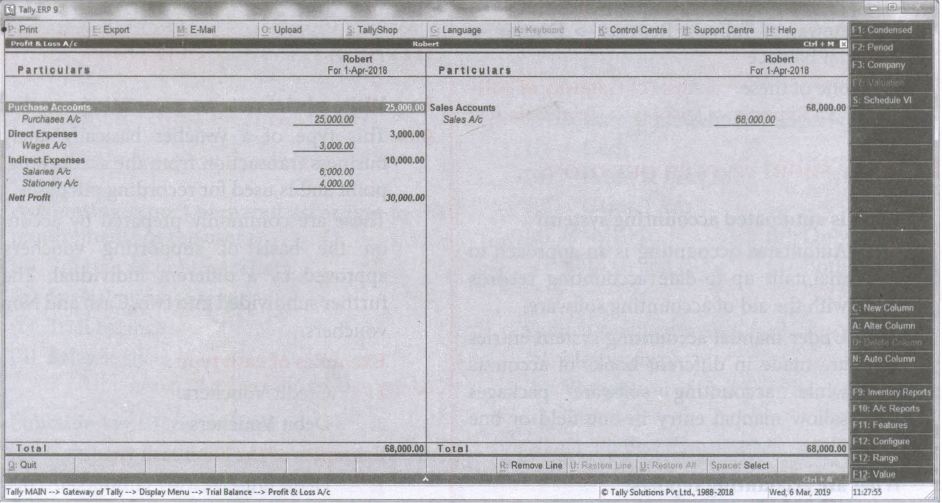
1.
If the goodwill is raised to the extent of retiring partners share _______ account is to be debited
Cash
Goodwill
All partner’s capital
Retiring partners capital
2.
Which ratio is the proportion of fixed income bearing funds to equity shareholders funds?
Debt equity ratio
Capital gearing ratio
Proprietary ratio
Profitability ratio
3.
All transactions related to payments either in cash or through bank are recorded using __________
journal voucher
sontra voucher
receipt voucher
payment voucher
4.
_____ shares have to be reissued at a price lesser than the face value.
Issue
Equity
Subscribed
Forfeited
5.
Financial statements are prepared based on _____________
past data
future cost
terminal cost
historical cost
6.
Indian partnership Act was enacted in the year ___________
1932
1956
1991
1992
7.
The difference between old profit sharing ratio and new profit sharing ratio at time of admission is _________ ratio.
old ratio
new ratio
sacrifice ratio
gain ratio
8.
In _____ system, only personal and cash accounts are opened.
Single entry
Double entry
Trial balance
Balance Sheet
9.
_________ is the profit earned by the similar business firms under normal conditions
Normal profit
Super profit
Average profit
All of these
10.
______is a fee collection from every member only once at the time of his or her admission into the organisation.
Entrance fee
Legacy
Donations
None of these
11.
Match List I with List II and select the correct answer using the codes given below:
| List I | List II |
| (i) Sacrificing ratio | 1. Investment fluctuation fund |
| (ii) Old profit sharing ratio | 2. Accumulated profit |
| (iii) Revaluation Account | 3. Goodwill |
| (iv) Capital Account | 4. Unrecorded liability |
| (i) | (ii) | (iii) | (iv) |
| 1 | 2 | 3 | 4 |
| (i) | (ii) | (iii) | (iv) |
| 3 | 2 | 4 | 1 |
| (i) | (ii) | (iii) | (iv) |
| 4 | 3 | 2 | 1 |
| (i) | (ii) | (iii) | (iv) |
| 3 | 1 | 4 | 2 |
12.
13.
A limited company’s sales has increased from Rs.1,25,000 to Rs.1,50,000. How does this appear in comparative income statement?
+ 20 %
+ 120 %
– 120 %
– 20 %
14.
Match the pair and identify the correct option
| (1) Under subscription | (i) Amount prepaid for calls |
| (2) Over subscription | (ii) Subscription above the offered shares |
| (3) Calls in arrear | (iii) Subscription below the offered shares |
| (4) Calls in advance | (iv) Amount unpaid on calls |
| (1) | (2) | (3) | (4) |
| (i) | (ii) | (iv) | (iv) |
| (1) | (2) | (3) | (4) |
| (iv) | (iii) | (ii) | (i) |
| (1) | (2) | (3) | (4) |
| (iii) | (ii) | (iv) | (i) |
| (1) | (2) | (3) | (4) |
| (iii) | (iv) | (i) | (ii) |
15.
The mathematical expression that provides a measure of the relationship between two figures is called
Conclusion
Ratio
Model
Decision
16.
In which voucher type credit purchase of furniture is recorded in Tally
Receipt voucher
Journal voucher
Purchase voucher
Payment voucher
17.
When the average profit is Rs. 25,000 and the normal profit is Rs. 15,000, super profit is __________
Rs. 25,000
Rs. 5,000
Rs. 10,000
Rs. 15,000
18.
19.
20.
Which one of the following statements is not true in relation to incomplete records?
It is an unscientific method of recording transactions
Records are maintained only for cash and personal accounts
It is suitable for all types of organisations
Tax authorities do not accept
21.
Calculate (i) Inventory turnover ratio (ii) Trade receivables turnover ratio (iii) Trade payables turnover ratio and (iv) Fixed assets turnover ratio from the following information obtained from Dolphin Ltd.
| Particulars | As on 31st March 2017 Rs. | As on 31st March 2018 Rs. |
|---|---|---|
| Inventory | 70,000 | 50,000 |
| Trade receivables | 40,000 | 30,000 |
| Trade payables | 20,000 | 25,000 |
| Fixed assets | 2,75,000 | 2,50,000 |
Additional information:
(i) Revenue from operations for the year Rs.5,25,000
(ii) Purchases for the year Rs.2,25,000
(iii) Cost of revenue from operations Rs.3,00,000
Assume that sales and purchases are for credit
22.
On 1.1.2019, Pandiyan died and on his death the following arrangements are made:
(i) Stock to be depreciated by 10 %
(ii) Land is to be apprecia!.e4. by Rs.11,000
(iii) To provide 3,000 for bad debts
(iv) The final amount due to Pandiyan was not paid
Prepare revaluation account, partner's capital account and the balance sheet of the firm after death
23.
Kokila and Mala were sharing profits in the ratio of 4:3. Chandra was admitted in the business as a partner with \(\frac{3}{7}\)th share in the profits of the firm which she takes \(\frac{2}{7}\) th from Kokila and \(\frac{1}{7}\) th from Mala. Find out New profit Ratio and the sacrificing ratio.
24.
Compute the amount of total purchases and total sales of Mr. Amit from the following information for the year ending on March 31, 2018.
| Rs. | |
|---|---|
| Total debtors as on April 01, 2017 | 40,000 |
| Total creditors as on April 01,2017 | 50,000 |
| Bills receivable as on April 01, 2017 | 30,000 |
| Bills payable as on April 01, 2017 | 45,000 |
| Discount received | 5,000 |
| Bad debts | 2,000 |
| Return inwards | 4,000 |
| Discount allowed | 3,000 |
| Cash sales | 10,000 |
| Cash purchases | 8,000 |
| Total debtors as on March 31, 2018 | 80,000 |
| Cash received from debtors | 1,00,000 |
| Cash paid to creditors | 80,000 |
| Cash received against bills receivable | 25,000 |
| Payment made against bills receivable | 40,000 |
| Total creditors as on March 31, 2018 | 40,000 |
| Bills payable as on March 31, 2018 | 50,000 |
| Bills receivable as on March 31,2018 | 35,000 |
25.
Following is the receipts and payments accounts of Literacy club for the year ended 31st March 2016
| Receipts | Rs. | Rs. | Payments | Rs. |
|---|---|---|---|---|
| To Balance c/d | 19,550 | By Salary | 3,000 | |
| By News papers | 2,050 | |||
| To Subscribtions | By Electricity bill | 1,000 | ||
| 2014·2015 | 1,200 | By Fixed deposit | 20,000 | |
| 2015·2016 | 26,500 | (on 1st July, 2015 @ | ||
| 500 | 9% per annum | |||
| 28,200 | By Books | 10,600 | ||
| By Rent | 6,800 | |||
| To slae old news paper | 1,250 | By Furniture | 10,500 | |
| To Government grants | 10,000 | By Balance dd | 11,200 | |
| To sale of old furniture | 5,700 | |||
| (book value Rs.7,000) | ||||
| To interest on fixed deposits | 450 | |||
| 65,150 | 65,150 |
Additional information:
(i) Subscription outstanding as on 31st March, 2015 were Rs. 2000 and on 31st March, 2016 Rs. 2,500.
(ii) On 31st March, 2016 Salary outstanding was Rs. 600 and rent outstanding was Rs. 1,200.
(iii) The club owned furniture Rs. 15,000 and books Rs. 7,000 on 1st April, 2015. Prepare income and expenditure account of the dub for the year ended 31st March 2016 and as certain capital fund on 31st March, 2015. Also prepare a balance sheet as on 31st March, 2016.
26.
From the Receipt and Payment Account given below, prepare the Income and Expenditure Account of clean Delhi club for the year ended March 31, 2017
| Receipts | Rs | Payments | Rs |
|---|---|---|---|
| To Balance b/d | By Salary | 1,500 | |
| Cash in hand | 3200 | By Rent | 800 |
| To Subscriptions | 22,500 | By Electricity | 3,500 |
| To Entrance fees | 1,250 | By Taxes | 1,700 |
| To Donations | 2,500 | By Printing stationery | 380 |
| To Rent of hall | 750 | By Sundry expenses | 920 |
| To Sale of investment | 3,000 | By Books purchased | 7,500 |
| By Fixed deposit with bank | 5,000 | ||
| (on31-3-2014) | |||
| By Balance c/d | |||
| Cash in hand 400 | |||
| Cash at bank 1,500 | 1,900 | ||
| 33,200 | 33,200 |
27.
Rajesh, Sathish and Mathan are partners sharing profits and losses in the ratio of 3 : 2 : 1 respectively. Their balance sheet as on 31.3.2017 is given below
| Liabilities | Rs | Rs | Asset | Rs | Rs |
|---|---|---|---|---|---|
| Capital accounts: | Premises | 4,00,000 | |||
| Rajesh | 4,00,000 | Machinery | 4,20,000 | ||
| Sathish | 3,00,000 | Debtors | 1,60,000 | ||
| Mathan | 2,50,000 | 9,50,000 | Stock | 3,00,000 | |
| General reserve | 1,20,000 | Cash at bank | 20,000 | ||
| Creditors | 50,000 | ||||
| Bills payable | 1,80,000 | ||||
| 13,00,000 | 13,00,000 |
Mathan retires on 31st March, 2017 subject to the following conditions:
(i) Rajsh and Sathish will share profits and losses in the ratio of 3:2
(ii) Assets are to be revalued as follows:
Machinery Rs. 3,90,000, Stock Rs. 2,90,000, Debtors Rs. 1,52,000.
(iii) Goodwill of the firm is valued at Rs. 1,20,000
Prepare necessary ledger accounts and the balance sheet immediately after the retirement of Mathan.
28.
From the following particulars, calculate the trend percentages of Anu Ltd.
| Particulars | Rs.in thousands | ||
|---|---|---|---|
| Year 1 | Year 2 | Year 3 | |
| I EQUITY AND LIABILITIES | |||
| Shareholders’ Fund | 500 | 550 | 600 |
| Non-current liabilities | 200 | 250 | 240 |
| Current liabilities | 100 | 80 | 120 |
| Total | 800 | 880 | 960 |
| II ASSETS | |||
| Non-current assets | 600 | 720 | 780 |
| Total | 800 | 880 | 960 |
29.
The following balance sheet has been prepared from the books of Pearl on 1-4-2018.
| Liabilities | Rs. | Assets | Rs. |
|---|---|---|---|
| Capital | 2,26,000 | Buildings | 1,00,000 |
| Sundry creditors: | Furniture | 10,000 | |
| Maya A/c | 24,000 | Stock | 20,000 |
| Sundry debtors | |||
| Peter | 50,000 | ||
| Cash in hand | 15,000 | ||
| Cash at bank | 55,000 | ||
| 2,50,000 | 2,50,000 |
During the year the following transactions took place.
(a) Wages paid by cash Rs. 2,000
(b) Salaries paid by cheque Rs. 5,000
(c) Cash purchases made for Rs. 3,000
(d) Good purchased on credit from Yazhini Rs. 15,000
(e) Goods sold on credit to Jothi Rs. 25,000
(f) Payment made to Yazhini through NEFT Rs. 5,000
(g) Cash received from Peter Rs. 30,000
(h) Cash sales made for Rs. 6,000
(i) Depreciate buildings at 10%
(j) Closing stock on 31.03.2019 Rs. 15,000
You are required to prepare trading and profit and loss account for the year ended 31-03-2019 and a balance sheet as on that date using Tally.
30.
State any six factors determining goodwill and explain.
31.
Antony and Ranjith started a business on 1st April 2018 with capitals of Rs. 4,00,000 and Rs. 3,00,000 respectively. According to the Partnership Deed, Antony is to get salary of Rs. 90,000 per annum, Ranjith is to get 25% commission on profit after allowing salary to Antony and interest on capital @ 5% p.a. but after charging such commission. Profit-sharing ratio between the two partners is 1:1. During the year, the firm earned a profit of Rs. 3,65,000.
Prepare profit and loss appropriation account. The firm closes its accounts on 31st March every year.
32.
Richard and Rizwan started a business on 1st January 2018 with capitals of Rs. 3,00,000 and Rs. 2,00,000 respectively. According to the Partnership Deed
(a) Interest on capital is to be provided @ 6% p.a.
(b) Rizwan is to get salary of Rs. 50,000 per annum.
(c) Richard is to get 10% commission on profit (after interest on capital and salary to Rizwan) after charging such commission.
(d) Profit-sharing ratio between the two partners is 3:2.
During the year, the firm earned a profit of Rs. 3,00,000.
Prepare profit and loss appropriation account. The firm closes its accounts on 31st December every year.
33.
From the following Receipts and Payments account of Coimbatore Cricket Club for the year ending 31st March 2016, prepare income and expenditure account for the year ending 31st March, 2016 and a balance sheet as on that date.
| Receipts | Rs. | Payments | Rs. |
|---|---|---|---|
| To Balance b/d: | By Maintenance | 5,000 | |
| Cash at bank | 8,000 | By Furniture | 15,000 |
| To Subscriptions | 11,000 | By Tournament expenses | 1,400 |
| To Sale of old bats and balls | 100 | By Secretary’s honorarium | 4,500 |
| To Subscription for tournament | 2,000 | By Bats and balls | 7,400 |
| To Legacies | 20,000 | By Balance c/d: | |
| Cash at bank | 7,800 | ||
| 41,100 | 41,100 |
Additional information:
On 1st April, 2015 the club had stock of balls and bats Rs. 3,000 and an advance subscription of Rs. 500. Surplus on account of tournament should be kept in reserve for permanent pavilion.Subscription due on 31.03.2016 was Rs. 2,000. Stock of bats and balls on 31.3.2016 was Rs. 1,000.
34.
Write a short note on
i) Intra-firm comparison
ii) Inter-firm comparison
35.
State where the following items shall appear in case the capital contributed by partners remain fixed
i) Interest on capital
ii) Withdrawal of capital
iii) Fresh capital introduced
iv) Drawings
v) Share of profit by a partner
36.
Durga and Naresh were partnership in a firm. They wanted to admit five more members in the firm. List any two categories of individuals other than minors who cannot be admitted by them.
37.
What are the possible reasons for keeping incomplete records?
38.
What is the purpose of calculating gaining ratio?
39.
From the following information calculate capital gearing ratio:
| Particulars | Rs. |
|---|---|
| I EQUITY AND LIABILITIES | |
| 1. Shareholders' funds | |
| (a) Share capital | |
| Equity share capital | 2,00,000 |
| 6% Preference share capital | 1,00,000 |
| (b) Reserves and surplus | |
| General reserve | 1,25,000 |
| Surplus | 75,000 |
| 2. Non-current liabilities | |
| Long-term borrowings (8% Debentures) | 2,00,000 |
| 3. Current liabilities | |
| Trade payables | 1,50,000 |
| Provision for tax | 50,000 |
| Total | 9,00,000 |
40.
What is over-subscription?
41.
State any five accounting reports.
42.
From the following information, find out the value of goodwill by capitalisation method:
(a) Average profit = Rs. 60,000
(b) Normal rate of return = 10%
(c) Capital employed = Rs. 4,50,000
43.
Chennai tennis club had Match fund showing credit balance of Rs. 24,000 on 1st April, 2018. Receipt to the fund during the year was Rs. 26,000. Match expenses incurred during the year was Rs. 33,000. How these items will appear in the final accounts of the club for the year ended 31st March, 2019?
44.
What is functional classifications of rational analysis? and types of functional classification.
45.
What are the characteristics of a company?
46.
The firm of A and B earned a profit of Rs.2,75,000 during the year ending on 31st March, 2015. They have decided to donate 10% of this profit to an NGO working for senior citizens. Pass necessary journal entry for the distribution of profits. Identify the values shown by the firm in donating a part of profit of NGO.
47.
What are the journal entries to be passed on revaluation of assets and liabilities?
48.
Explain the steps involved in preparing comparative statement
49.
Nathiya Textiles Ltd. forfeited 100 shares of Rs.10 each, Rs.8 called up, on which Mayuri had paid application and allotment money of Rs.6 per share. Of these 75 shares were re-issued to Soundarya by receiving Rs.7 per share paid up as Rs.8 per share. Pass journal entries for forfeiture and reissue.
50.
Kavitha, Kumudha and Lalitha are partners sharing profits and losses in the ratio of 5 : 3 : 3 respectively. Kumudha retires from the firm on 31st December, 2018. On the date of retirement, her capital account shows a credit balance of Rs. 2,00,000. Pass journal entries if:
i) The amount due is paid off immediately by cheque.
ii) The amount due is not paid immediately.
iii) Rs. 70,000 is paid immediately by cheque
51.
Bring out the limitations of ratio analysis.
52.
53.
From the following information, find out the value of goodwill by capitalisation method:
(i) Average profit Rs. 20,000
(ii) Normal rate of return 10%
(iii) Capital employed Rs. 1,50,000
54.
1.
(b)
Goodwill
2.
(b)
Capital gearing ratio
3.
(d)
payment voucher
4.
(d)
Forfeited
5.
(d)
historical cost
6.
(b)
1956
7.
(c)
sacrifice ratio
8.
(a)
Single entry
9.
(a)
Normal profit
10.
(a)
Entrance fee
11.
(b)
| (i) | (ii) | (iii) | (iv) |
| 3 | 2 | 4 | 1 |
12.
(c)
13.
(a)
+ 20 %
14.
(c)
| (1) | (2) | (3) | (4) |
| (iii) | (ii) | (iv) | (i) |
15.
(b)
Ratio
16.
(b)
Journal voucher
17.
(c)
Rs. 10,000
18.
(d)
19.
(a)
20.
(c)
It is suitable for all types of organisations
21.
(i) Inventory turnover ratio = \(\frac { Cost\quad of\quad revenue\quad from\quad operations }{ Average\quad inventory } \)
Average inventory = \(\frac { Opening\quad inventory+Closing\quad inventory }{ 2 } \)
=\(\frac { 70,000+50,000 }{ 2 } \) = 60,000
∴ Inventory turnover ratio =\(\frac { 3,00,000 }{ 60,000 } \) = 5 times.
(ii) Trade receivables turnover ratio = \(\frac { Credit\quad revenue\quad from\quad operations }{ Average\quad trade\quad receivables } \)
Average trade receivables = \(\frac { Opening\quad trade\quad receivables+Closing\quad trade\quad receivables }{ 2 } \)
= \(\frac { 40,000+30,000 }{ 2 } \) = 35,000
∴ Trade receivables turnover ratio = \(\frac { 5,25,000 }{ 35,000 } \) = 15 times
(iii) Trade payables turnover ratio = \(\frac { Net\quad credit\quad purchases }{ Average\quad trade\quad payables } \)
Average trade payables = \(\frac { Opening\quad trade\quad payables+Closing\quad trade\quad payables }{ 2 } \)
= \(\frac { 20,000+25,000 }{ 2 } =\frac { 45,000 }{ 2 } \)
= Rs.22,500
∴ Trade payables turnover ratio =\(\frac { 2,25,000 }{ 22,500 } \) = 10 times.
(iv) Fixed assets turnover ratio = \(\frac { Revenue\quad from\quad operations }{ Average\quad fixed\quad assets } \)
Average fixed assets = \(\frac { Opening\quad fixed\quad assets+Closing\quad fixed\quad assets }{ 2 } \)
= \(\frac { 2,75,000+2,50,000 }{ 2 } =\frac { 4,75,000 }{ 2 } \)
= Rs.2,62,500
∴ Fixed assets turnover ratio = \(\frac { 5,25,000 }{ 2,62,500 } \) = 2 times
22.
| Particulars | Rs | Rs | Particulars | Rs |
|---|---|---|---|---|
| To Stock A/c | 2,000 | ByLand A/c | 11,000 | |
| To Debtors A/c | 3,000 | |||
| To Profit on revaluation transferred to | ||||
| Sankar's capital Ale (6,000 x 3/6) | 3,000 | |||
| Saleem's capital Ale (6,000 X 2/6) | 2,000 | |||
| Pandian's capital Ale (6,000 X 1/6) | 1,000 | 6,000 | ||
| 11,000 | 11,000 |
| Particulars | Sankar Rs |
Saleem Rs |
Pandiyan Rs |
Particulars | Sankar Rs |
Saleem Rs |
Pandiyan Rs |
|---|---|---|---|---|---|---|---|
| To profit and loss | By Balance b/d | 50,000 | 40,000 | 10,000 | |||
| A/c | 3,000 | 2,000 | 1,000 | By General reserve | 18,000 | 12,000 | 6,000 |
| reserve | 18,000 | 12,000 | 6,000 | ||||
| To Pandian's | |||||||
| Executor's A/c | 16,000 | By Revaluation | |||||
| To Balance c/d | 68,000 | 52,000 | A/c (profit) | 3,000 | 2,000 | 1,000 | |
| 71,000 | 54,000 | 17,000 | 71,000 | 54,000 | 17,000 | ||
| By Balance b/d | 68,000 | 52,000 |
| Liabilitie | Rs | Rs | Assets | Rs | Rs |
|---|---|---|---|---|---|
| Capital account | Land | 80,000 | |||
| Sankar | 68,000 | Add: Appreciation | 11,000 | 91,000 | |
| Saleem | 52,000 | 1,20,000 | |||
| Pandians Executor's A/c | 16,000 | Stock | 20,000 | ||
| 14,000 | Less: Depreciation | 2,000 | 18,000 | ||
| Debtors | 30,000 | ||||
| Less: Bad debts | 3,000 | 27,000 | |||
| 1,50,000 | Cash at bank | 14,000 | |||
| 1,50,000 |
23.
New ratio: Kokila : Mala : Chandra
Old ratio 4 : 3 : -
Old share \(\frac{4}{3}\) : \(\frac{3}{7}\) : -
Sacrifice \(\frac{2}{7}\) : \(\frac{1}{7}\) : -
New ratio = Old ratio - sacrifice
New share \(=\frac { 4 }{ 7 } -\frac { 2 }{ 7 } \): \(\frac { 3 }{ 7 } -\frac { 1 }{ 7 } \) : \(\frac { 3 }{ 7 } \)
= \(\frac { 2 }{ 7 } \) : \(\frac { 2 }{ 7 } \) : \(\frac { 3 }{ 7 } \)
∴New ratio = 2 : 2 : 3
Sacrifice ratio = 2 : 1
24.
| Particulars | Rs. | Particulars | Rs. |
|---|---|---|---|
| To Balance b/d | 30,000 | By Cash | 25,000 |
| To Total Debtors | 30,000 | By Balance c/d | 35,000 |
| (Balancing figure) | 60,000 | 60,000 |
| Particulars | Rs. | Particulars | Rs. |
|---|---|---|---|
| To Cash | 40,000 | By Balance b/d | 45,000 |
| To Balance c/d | 50,000 | By Total creditors | 45,000 |
| (Balancing figure) | |||
| 90,000 | 90,000 |
| Particulars | Rs. | Particulars | Rs. |
|---|---|---|---|
| To Balance b/d | 40,000 | By Bad debts | 2,000 |
| To Sales | 1,79,000 | By Return inwards | 4,000 |
| (balancing figure) | By Discount allowed | 3,000 | |
| By Cash | 1,00,000 | ||
| By Bills receivable | 30,000 | ||
| (Transfer from bills receivable account) | |||
| By Balance c/d | 80,000 | ||
| 2,19,000 | 2,19,000 |
| Particulars | Rs. | Particulars | Rs. |
|---|---|---|---|
| To Discount received | 5,000 | By Balance b/d | 50,000 |
| To Cash | 80,000 | By Purchases | 1,20,000 |
| To Bills payable | 45,000 | (credit) | |
| (transfer from bills | (Balancing figure) | ||
| payable account) | |||
| To Balance c/d | 40,000 | ||
| 1,70,000 | 1,70,000 |
25.
| Liabilities | Rs | Assets | Rs |
|---|---|---|---|
| (balancing figure) | 43,550 | Cash in hand | 19,550 |
| (balancing figure) | Subscription outstanding | 2,000 | |
| Furniture | 15,000 | ||
| Books | 7,000 | ||
| 43,550 | 43,550 |
| Expenditure | Rs. | Rs. | Income | Rs. | Rs. |
|---|---|---|---|---|---|
| To Salary | 3,000 | By Subscriptions | 26,500 | ||
| Add: Outstanding | 600 | 3,600 | Add: Outstanding for 2015-16 | 1,700 | 28,200 |
| To Newspapers | 2,050 | By Sale of old newspaper | 1,250 | ||
| To Rent | 6,800 | By Interest on fixed deposit | 450 | ||
| Add: Outstanding | 1,200 | 8,000 | Add: Accrued interest | 900 | 1,350 |
| To Loss on sale of | |||||
| furniture (7000 - 5700) | 1,300 | ||||
| To Surplus | 24,850 | ||||
| (Excess of income over | |||||
| expenditure) | |||||
| 40,800 | 40,800 |
| Liabilities | Rs. | Rs. | Assets | Rs. | Rs. |
|---|---|---|---|---|---|
| Salary outstanding | 600 | Cash in hand | 11,200 | ||
| Rent outstanding | 1,200 | Subscription outstanding | |||
| Subscription | for 2014 - 15 | 800 | |||
| received in advance | 500 | (2000 - 1200) | |||
| Capital fund | 43,550 | for 2015 - 16 | 1,700 | 2,500 | |
| Add: Surplus | 24850 | 68,400 | Fixed depo | 20,000 | |
| Accrued interest on fixed | |||||
| deposit | 900 | ||||
| Furniture (15000-7000 + 10,500 | 18,500 | ||||
| Books (7,000 + 10,600 | 17,600 | ||||
| 70,700 | 70,700 |
26.
| Expenditure | Rs. | Income | Rs. |
|---|---|---|---|
| To Salary | 1,500 | By Subscriptions | 22,500 |
| To Rent | 800 | By Entrance fees | 1,250 |
| To Electricity | 3,500 | By Donation | 2,500 |
| To Printing & Stationery | 380 | ||
| To Surplus | |||
| (Excess of income over | |||
| expenditure) | |||
| 27,000 | 27,000 |
27.
| Particulars | Rs | Rs | Particulars | Rs | Rs |
|---|---|---|---|---|---|
| To Machinary A/c | 30,000 | By Profit on revaluation transferred | |||
| To Stock A/c | 10,000 | Rajesh capital A/c | 24,000 | ||
| To Debtors A/c | 8,000 | \(\left( 48,000\times \cfrac { 3 }{ 6 } \right) \) | |||
| Sathish's capital A/c | 16,000 | ||||
| \(\left( 48,000\times \cfrac { 2 }{ 6 } \right) \) | |||||
| Mathan's capital A/c | 8,000 | 48,000 | |||
| \(\left( 48,000\times \cfrac { 1 }{ 6 } \right) \) | |||||
| 48,000 | 48,000 |
| Particulars | Rajesh Rs |
Sathish Rs |
Mathan Rs |
Particulars | Rajesh Rs |
Sathish Rs |
Mathan Rs |
|---|---|---|---|---|---|---|---|
| To Mathan's capital A/c | 12,000 | 28,000 | - | By Balance b/d | 4,00,000 | 3,00,000 | 2,50,000 |
| To Revaluation A/c | 24,000 | 16,000 | 8,000 | By General | |||
| To Mathans loan A/c | - | - | 3,02,000 | revenue | 60,000 | 40,000 | 20,000 |
| To Balance c/d | 4,24,000 | 2,96,000 | - | By Rajesh's | |||
| capital A/c | - | - | 12,000 | ||||
| By Mathans | |||||||
| capital A/c | - | - | 28,000 | ||||
| 4,60,000 | 3,40,000 | 3,10,000 | 4,60,000 | 3,40,000 | 3,10,000 | ||
| By Balance b/d | 4,24,000 | 2,96,000 | - |
NOTE:
(i) Computing of gaining ratio
Share gained = New share - Old Share
Rajesh =\(\cfrac { 3 }{ 5 } -\cfrac { 3 }{ 5 } =\cfrac { 18-25 }{ 30 } =\cfrac { 3 }{ 30 } \)
Sathish = \(\cfrac { 2 }{ 5 } -\cfrac { 1 }{ 6 } =\cfrac { 12-5 }{ 30 } =\cfrac { 7 }{ 30 } \)
Therefore, the gaining of Rajesh and Sathish is 3:7
(ii) Adjustment for goodwill
Goodwill of the firm = Rs. 1,20,000
Share of goodwill of Mathan = \(Rs.1,20,000\times \cfrac { 2 }{ 6 } =Rs.40,000\)
It is to be adjusted in the capital accounts of Rajesh and Sathis in the gaining ratio 3:7
That is,
Rajesh : \(40,000\times \cfrac { 3 }{ 10 } =Rs.12,000\)
Sathish : \(40,000\times \cfrac { 7 }{ 10 } =Rs.28,000\)
| Liabilities | Rs | Rs | Assets | Rs | Rs |
|---|---|---|---|---|---|
| Capital accounts | Premises | 4,00,000 | |||
| Rajesh | 4,24,000 | Machinery | 4,20,000 | ||
| Sathish | 2,96,000 | 7,20,000 | Less: Depreciation | 30,000 | 3,90,000 |
| Mathans loan A/c | 3,02,000 | Debtors | 1,60,000 | ||
| Creditors | 50,000 | Less: Depreciation | 8,000 | 1,52,000 | |
| Bills payable | 1,80,000 | ||||
| Stock | 3,00,000 | ||||
| Less: Depreciation | 10,000 | 2,90,000 | |||
| Cash at bank | |||||
| 12,52,000 | 12,52,000 |
28.
| Particulars | in thousands | Trends percentage | ||||
|---|---|---|---|---|---|---|
| Year 1 | Year 2 | Year 3 | Year 1 | Year 2 | Year 3 | |
| I Equity and liabilities | ||||||
| Shares holder's fund | 500 | 550 | 600 | 100 | 110 | 120 |
| Non-current liabilities | 200 | 250 | 240 | 100 | 125 | 120 |
| Current liabilities | 100 | 80 | 120 | 100 | 80 | 120 |
| Total | 800 | 880 | 960 | 100 | 110 | 120 |
| II. Assets | ||||||
| Non-current assets | 600 | 720 | 780 | 100 | 120 | 130 |
| Current assets | 200 | 100 | 180 | 100 | 80 | 90 |
| Total | 800 | 880 | 960 | 100 | 110 | 120 |
29.
Following steps are to be followed to enter the transactions in Tally ERP 9
1. To create company:
Company Info > Create Company
Type the Name as Peral and keep all other fields as they are and choose 'Yes' to accept.
2. To maintain accounts only:
Gateway of Tally > F11 Accounting Features > General > Maintain accounts only: Yes > Accept Yes
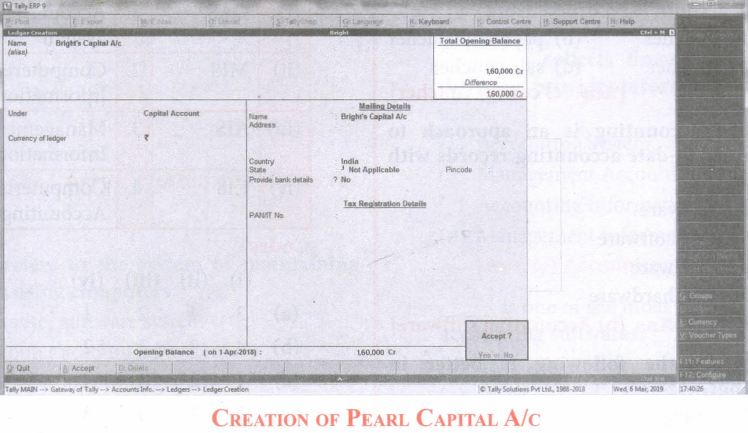
3. To create ledger accounts with opening balances:
Gateway of Tally > Masters > Accounts Info> Ledgers> Single Ledger> Create
| Creation of | Name | Under | Opening balance | Accept |
|---|---|---|---|---|
| Bright’s Capital A/c | Bright’s Capital A/c | Capital Account | 2,26,000 | Yes |
| Ramesh A/c (Sundry creditors) | Ramesh A/c | Sundry Creditors | 24,000 | Yes |
| Machinery A/c | Machinery A/c | Fixed Assets | 1,00,000 | Yes |
| Furnitures A/c | Furnitures A/c | Fixed Assets | 10,000 | Yes |
| Opening stock | Opening stock | Stock-in -Hand | 20,000 | Yes |
| Shankar A/c (Sundry debtors) | Shankar A/c | Sundry Debtors | 50,000 | Yes |
| Cash in hand | Cash | Cash-in-Hand | 15,000 | Yes |
| Cast at bank | Bank | Bank Accounts | 55,000 | Yes |
Note:
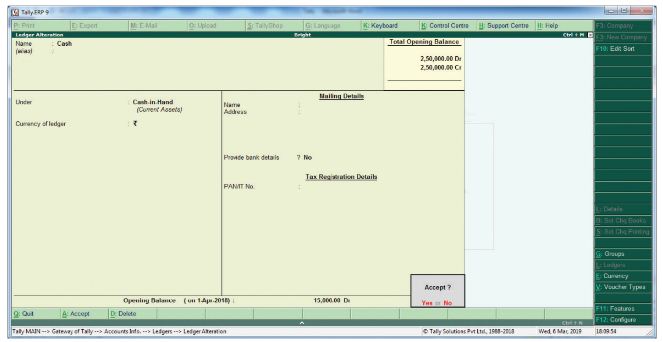
Cash account need not be created as it is a default ledger. Only the opening balance has to be recorded by altering the cash account.
To record the opening balance of Cash
Gateway of Tally > Masters > Accounts Info > Ledgers > Single Ledger > Alter
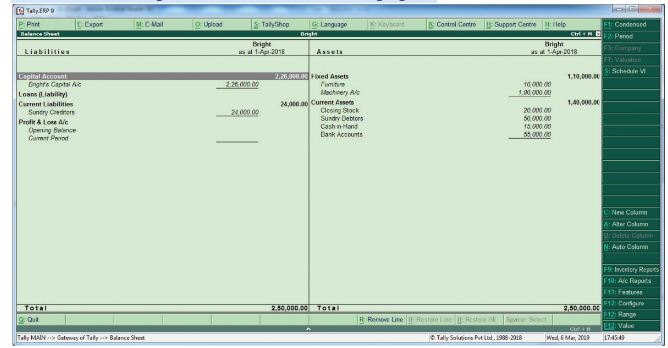
After creating the ledgers and recording the opening balances of ledger accounts the balance sheet of Bright is shown as in the following figure:
4. To create ledger accounts for transactions
| Creation of | Name | Under | Accept |
| Wages A/c | Wages A/c | Direct Expenses | Yes |
| Salaries A/c | Rent A/c | Indirect Expenses | Yes |
| Purchases A/c | Purchases A/c | Purchases Account | Yes |
| Senthamarai A/c | Senthamarai A/c | Sundry Creditors A/c | Yes |
| Sales A/c | Sales A/c | Sales Account | Yes |
| Pushparaj A/c | Pushparaj A/c | Sundry Debtors A/c | Yes |
| Depreciation A/c | Depreciation A/c | Indirect Expenses | Yes |
5. To enter transactions through vouchers
Gateway of Tally > Transactions > Accounting Vouchers
Example: Wages of Rs. 2,000 paid by Cash
F5: Payment Voucher
Account: Cash
Particulars: Wages A/c
Amount: Rs. 2,000
Narration: Wages paid by cash
Accept: Yes
In the similar way, record the other transactions. Use Payment Voucher for Salaries paid and payment to Senthamarai.
Use Purchase Voucher for credit purchases from Senthamarai and cash purchases.
Use Sales Voucher for credit sales to Pushparaj and cash sales.
Use Receipt Voucher for cash received from Shankar.
Use Journal Voucher for depreciation.
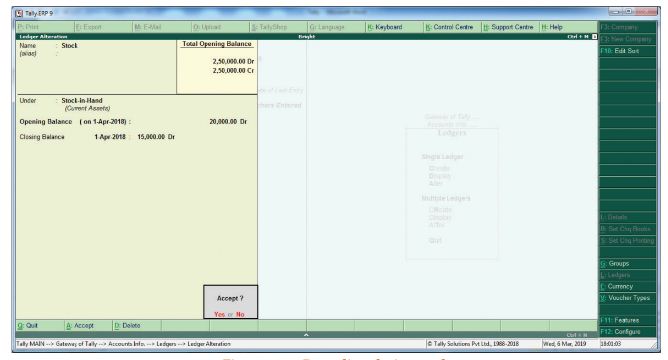
To record closing stock:
Since maintain accounts only is set to 'Yes' and integrate accounts and inventory is set to "No" under accounting features. Stock has to be recorded manually. Hence the closing stock has to be recorded by altering the stock account and while entering the data of closing stock, the date of opening stock has to be entered. The following procedure is to be followed:
Gateway of Tally > Masters > Accounts Info > Ledgers > Single Ledger > Alter > Stock > Closing balance > Date (opening date) > Amount > Accept Yes
6. To view reports:
(i) To view Profit and Loss Account:
F10: A/c Reports > Profit & Loss A/c > Alt + F1 (detailed) (or)
Gateway of Tally > Report > Profit & Loss A/c > Alt + F1 (detailed)
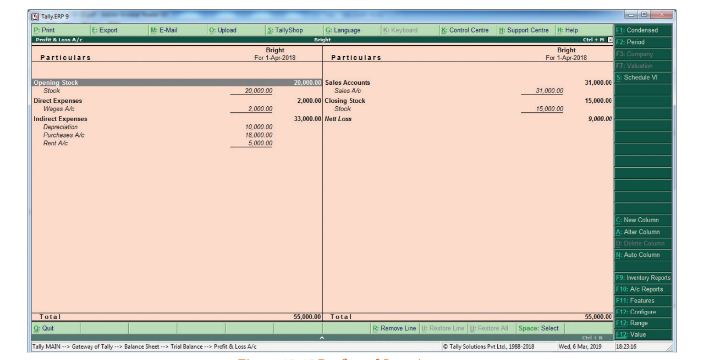
(ii) To view Balance sheet:
F10: A/c Reports > Balance sheet > Alt + F1 (detailed) (or)
Gateway of Tally > Reports > Balance Sheet > Alt + F1 (detailed)
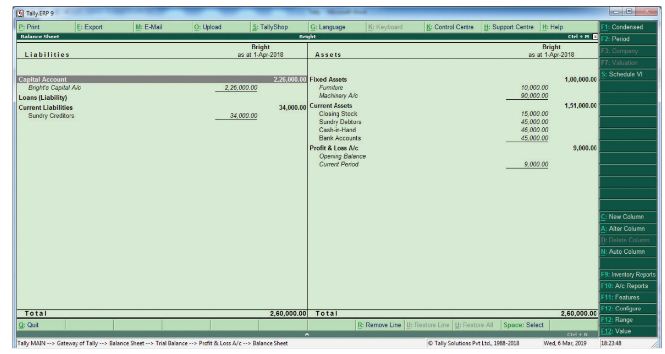
30.
Generally, the following factors determine the value of goodwill of a partnership firm:
(i) Profitability of the firm: A firm earning higher profits and having potential to generate higher profits in future will have higher value of good will.
(ii) Good quality of goods or services offered: If a firm enjoys good reputation among the customers and general public for the good quality of its products or services, the value of goodwill for the firm will be high.
(iii) Tenure of the business enterprise: A firm which has carried on business for several years will have higher reputation among its customers as it is better known to the customers.
(iv) Efficiency of management: A firm having efficient management will earn more profits and the value of its goodwill will be higher compared to a firm with less efficient managerial personnel.
(v) Degree of competition: In the case of business enterprises having no competition or negligible competition, the value of goodwill will be high
(vi) Other factors: There are other factors which add to the value of goodwill of a business such as popularity of the proprietor, impressive advertisements and publicity, good relations with customers, etc.
31.
| Particulars | Rs. | Rs. | Particulars | Rs. |
|---|---|---|---|---|
| To Interest on capital A/c | By Profit and loss A/c | 3,65,000 | ||
| Antony (4,00,000 \(\times\) 5%) | 20,000 | |||
| Ranjith (3,00,000 \(\times\) 5%) | 15,000 | 35,000 | ||
| To Salary to Antony | 90,000 | |||
| To Commission to Ranjith | 48,000 | |||
| To Partner's capital A/c (profit) | ||||
| Antony \(\left( 1,92,000\times \frac { 1 }{ 2 } \right) \) | 96,000 | |||
| Ranjith \(\left( 1,92,000\times \frac { 1 }{ 2 } \right) \) | 96,000 | 1,92,000 | ||
| 3,65,000 | 3,65,000 |
Profit before commission = 3,65,000 - (35,000 + 90,000) = Rs. 2,40,000
Commission = Net profit before commission \(\times\) \(\frac{Rate \ of \ commission}{(100+Rate \ of \ commission)}\)
Commission = 2,40,000 \(\times\) \(\frac{25}{125}\) = Rs. 48,000
32.
| Particulars | Rs. | Rs. | Particulars | Rs. |
|---|---|---|---|---|
| To Interest on capital A/c | By Profit and loss A/c | 3,00,000 | ||
| Richard (3,00,000 x 6%) | 18,000 | |||
| Rizwan (2,00,000 x 6%) | 12,000 | 30,000 | ||
| To Salary to Rizwan | 50,000 | |||
| To Commission to Richard | 20,000 | |||
| To Partners’ capital A/c (profit) | ||||
| Richard (3/5) | 1,20,000 | |||
| Rizwan (2/5) | 80,000 | 2,00,000 | ||
| 3,00,000 | 3,00,000 |
Calculation of commission:
Profit before commission = 3,00,000 – (50,000 + 30,000) = Rs. 2,20,000
Commission = Net profit before commission \(\times\) \(\frac { Rate\quad of\quad commission }{ (100+Rate\quad of\quad commission) } \)
Commission = 2,20,000 \(\times\) \(\frac { 10 }{ 110 } \) = Rs. 20,000
33.
To find the opening capital fund, opening balance sheet should be prepared.
| Liabilities | Rs. | Assets | Rs. |
|---|---|---|---|
| Capital fund | 10,500 | Stock of balls and bats | 3,000 |
| (Balancing figure) | Cash at bank | 8,000 | |
| Subscription received in advance | 500 | ||
| 11,000 | 11,000 |
| Expenditure | Rs. | Rs. | Income | Rs. | Rs. |
|---|---|---|---|---|---|
| To Maintenance | 5,000 | By Subscriptions | 11,000 | ||
| To Secretary’s honorarium | 4,500 | Add: Received in advance | |||
| To Bats and balls | 7,400 | in 2014-15 for 2015-16 | 500 | ||
| Add: Opening stock | 3,000 | 11,500 | |||
| 10,400 | Add: Outstanding for 2015-16 | 2,000 | 13,500 | ||
| Less: Closing stock | 1,000 | 9,400 | By Sale of old bats and balls | 100 | |
| By Excess of expenditure | |||||
| over income (deficit) | 5,300 | ||||
| 18,900 | 18,900 |
| Liabilities | Rs. | Rs. | Assets | Rs. |
|---|---|---|---|---|
| Capital fund | 10,500 | Furniture | 15,000 | |
| Less : Excess of expenditure | Stock of balls and bats | 1,000 | ||
| over income (deficit) | 5,300 | 5,200 | Subscriptions outstanding | 2,000 |
| Reserve for Pavilion Fund | Cash at bank | 7,800 | ||
| Subscriptions for tournament | 2,000 | |||
| Less: Tournament Expenses | 1,400 | 600 | ||
| Legacies | 20,000 | |||
| 25,800 | 25,800 |
34.
(i) Intra-firm comparison is comparison within the organisation among different departments, division etc
(ii) Inter-firm comparison is comparison of one firm with other firm or firms in the industry.
35.
(i) Credit side of partner's current account.
(ii) Debit side of partner's capital account
(iii) Credit of partner's capital account
(iv) Debit side of partner's current account
(v) Credit side of partner's current account
36.
The individual other than minors who cannot be admitted by them are
(i) Person of unsound mind
(ii) Person of disqualified by law
37.
(i) Simple method: Proprietors, who do not have the proper knowledge of accounting principles. Find it much convenient and easier to maintain their business records under this system.
(ii) Less expensive: It is an economical mode of maintaining records as there is no need to appoint specialised accountant.
(iii) Flexible: Owner may record transactions as particular own needs. It can be easily adjusted or changed whenever needed.
(iv) Less time consuming: Maintaining books according to the single entry system is less time consuming, as only few books are to be maintained. Further the books are not as comprehensive as they are under double entry system.
38.
The purpose of finding the gaining ratil:>is to bear the goodwill to be paid to the retiring partner.
The share gained is calculated as follows:
Share gained = New share - Old share
Gaining ratio = Ratio of share gained bythe continuing partners.
39.
Capital gearing ratio = \(\frac{Funds\ bearing\ fixed\ interest\ and\ fixed\ dividend}{Equity\ shareholders'funds}\)
= \(\frac{3,00,000}{4,00,000}\) = 0.75:1
Funds bearing fixed interest and dividend = 6% Preference share capital + 8% Debentures
= 1,00,000 + 2,00,000 = Rs.3,00,000
Equity shareholder’s funds = Equity share capital + General reserve + Surplus
= 2,00,000 + 1,25,000 + 75,000 = Rs.4,00,000
40.
When the number of shares applied for is more than the number of shares offered for subscription, it is said to be over subscription.
41.
Routine accounting reports include
(a) Day books / Journal
(b) Ledger
(c) Trial balance
(d) Income statement
(e) Balance sheet
(f) Cash flow statement
42.
Total capitalised value of the average profit = \(\frac { Average\ profit }{ Normal\ rate\ of\ return } \)\(\times\) 100
=\(\frac { 60,000 }{ 10 } \) \(\times\) 100
= Rs. 6,00,000
Goodwill = Total capitalised value of the average profit – Capital employed
= 6,00,000 – 4,50,000
= Rs. 1,50,000
43.
| Liabilities | Rs | Rs | Assets | Rs |
|---|---|---|---|---|
| Match fund | 24,000 | |||
| Add: Receipt the fund | 26,000 | |||
| 50,000 | ||||
| Less: Match expenses | 33,000 | 17,000 |
44.
Functional classification of ratio is based on the purpose for which ratios are computed and it is the most commonly used classification. Under the functional classification, the ratios are classified as follows:
(i) Liquidity ratios
(ii) Long term solvency ratios
(iii) Turnover ratios
(iv) Profitability ratios
45.
Following are the characteristics of a company:
(a) Voluntary association: A company is a voluntary association of persons. No law can compel persons to form a company
(b) Separate legal entity: Company is an artificial person. It has a separate legal entity which is separate and distinct from its members.
(c) Common seal: A company may have a common seal which can be affixed on the documents.
(d) Perpetual succession: A company continues for ever. Its continuity is not affected by the changes in its members. It can be wound up only by law.
(e) Limited liability: The liability of the shareholders of the company is limited to the extent of face value of the shares held by the shareholders.
(f) Transferability of shares: The shares of a company are freely transferable except incase of a private company.
46.
| Date | Particulars | L.f | Debit Rs. |
Credit Rs. |
|---|---|---|---|---|
| Profit and loss appropriation A/c Dr | 2,47,500 | |||
| To A's capital A/c | 1,23,750 | |||
| To A's capital A/c (Being profit transferred to capital account) | 1,23,750 |
Values shown by the firm are
i. Responsibility :
Firm has shown responsibility towards senior citizens by giving them their dues.
ii. Compassion:
Partners have shown compassion towards senior citizens by fulfilling their duties towards senior citizens .
47.
| Date | Particulars | L.F | Debit Rs. |
Credit Rs. |
|
|---|---|---|---|---|---|
| 1. For increase in the value of asset | |||||
| Concerned asset A/c | Dr | XXX | |||
| To Revaluation A/c | XXX | ||||
| 2. For decrease in the value of asset | |||||
| Revaluation A/c | Dr | XXX | |||
| To Concerned asset A/c | XXX | ||||
| 3. For increase in the amount of liabilities | |||||
| Revaluation A/c | Dr | XXX | |||
| To Concerned liabilities A/c | XXX | ||||
| 4. For decrease in the amount of liability | |||||
| Concerned liability A/c | Dr | XXX | |||
| To Revaluation A/c | XXX | ||||
| 5. For recording an unrecorded asset | |||||
| Concerned asset A/c | Dr | XXX | |||
| To Revaluation A/c | XXX | ||||
| 6. For recording an unrecorded liability | |||||
| Revaluation A/c | Dr | XXX | |||
| To Concerned liability A/c | XXX | ||||
| 7. For transferring the balance in revaluation Alc | |||||
| (a) If there is profit on revaluation | |||||
| Revaluation A/c | Dr | XXX | |||
| To Old partner's capital A/c (individually in old ratio) |
XXX | ||||
| (b) If there is loss on revaluation | |||||
| Old partner's capital Alc (individually in old ratio) | XXX | ||||
| To Revaluation Ale | XXX |
48.
A comparative statement has five columns. Following are the steps to be followed in preparation of the comparative statement.
(i) Column 1: In this column, particulars of items of income statement or balance sheet are written.
(ii) Column 2: Enter absolute amount of year 1
(iii) Column 3: Enter absolute amount of year 2
(iv) Column 4: Show the difference in amounts between year 1 and year 2. If there is an increase in year 2, put plus sign and if there is decrease put minus sign.
(v) Column 5: Show percentage increase or decrease of the difference amount shown in column 4 by dividing the amount shown in column 4 (absolute amount of increase or decrease) by column 2 (year 1 amount). That is,
Percentage increase or decrease
\(\frac{Absolute \ amount \ of \ increase \ or \ decrease}{Year \ 1 \ amount}\times100\)
Format of comparative statement:
| Particular | Year 1 | Year 2 | Absolute amount of increase (+) or Decrease (-) |
Percentage increase (+) ordecreases (-) |
|---|---|---|---|---|
| Rs. | Rs. | Rs. | ||
| (1) | (2) | (3) | (4) | (5) |
49.
| Date | Particulars | L.F | Debit Rs. | Credit Rs. | |
|---|---|---|---|---|---|
| Share capital A/c (100 x 8) | Dr | 800 | |||
| To Equity share first call A/c (100 x 2) | 200 | ||||
| To Forfeited shares A/c (100 x 6) | 600 | ||||
| (Forfeiture of 700 shares, Rs.8 called up) | |||||
| Bank A/c (75 x 7) | Dr | 525 | |||
| Forfeited shares A/c | Dr | 225 | |||
| To Share capital A/c | 750 | ||||
| (Reissue of 75 forfeited Share) | |||||
| Forfeited shares A/c | Dr | 375 | |||
| To Capital reserve A/c | 375 | ||||
| (Balance left in shares forfeited account transferred to capital reserve A/c) |
50.
| Date | Particulars | L.F | Debit Rs. |
Credit Rs. |
|
|---|---|---|---|---|---|
| 2018 Dec. 31 |
(i) Kumudha’s capital A/c | Dr. | 2,00,000 | ||
| To Bank A/c | 2,00,000 | ||||
| (Amount due paid immediately) | |||||
| " | (ii) Kumudha’s capital A/c | Dr. | 2,00,000 | ||
| To Kumudha’s loan A/c | 2,00,000 | ||||
| (Amount due transferred to loan account) | |||||
| " | (iii) Kumudha’s capital A/c | 2,00,000 | |||
| To Bank A/c | 70,000 | ||||
| To Kumudha’s loan A/c | 1,30,000 | ||||
| (Rs. 70,000 paid and the balance transferred to loan account) |
51.
Following are the limitations of ratio analysis:
(i) Accuracy of financial information : The accuracy of a ratio depends on the accuracy of information taken from financial statements.
(ii) Consistency in preparation of financial statements: Inter-firm comparisons with the help of ratio analysis will be meaningful only if the firms follow uniform accounting procedures consistently.
(iii) Non-availability of standards or norms: Ratios will be meaningful only if they are compared with accepted standards or norms. Only few financial ratios have universally recognised standards.
(iv) Change in price level : Ratio analysis may not reflect price level changes and current values as they are calculated based on historical data given in financial statements.
52.
53.
Capitalised value of the business = \(\frac{Average\ profit}{Normal\ rate\ of\ return}\times100\)
= \(\frac{20,000}{10}\times100\)
= Rs. 2,00,000
Capital employed = Fixed assets (excluding goodwill) + Current assets - Current Liabilities
Capital employed = Tangible assets of the firm - Liabilities of the firm
Net tangible assets = 2,20,000 - 70,000 = Rs. 1,50,000
Goodwill = Total capitalised value of the average profit - Capital employed
= 2,00,000 - 1,50,000
= Rs. 50,000
54.

12th Standard Syllabus & Materials
12th Standard
TN 12th Computer Applications களப்பெயர் முறைமை (DNS) Sample Question Papers Study Material - QB365 Set A
NEW12th Standard
TN 12th Computer Applications வலையமைப்பு எடுத்துக்காட்டுகள் மற்றும் நெறிமுறைகள் Sample Question Papers Study Material - QB365 Set A
NEW12th Standard
TN 12th Computer Applications கணினி வலையமைப்பு ஓர் அறிமுகம் Sample Question Papers Study Material - QB365 Set A
NEW12th Standard
TN 12th Computer Applications PHP-உடன் MySQL-ஐ இணைத்தல் Sample Question Papers Study Material - QB365 Set A



Tamilnadu Stateboard 12th Standard Subjects

Maths

Chemistry

Physics

Biology

Computer Science

Business Maths and Statistics

Economics

Commerce
Accountancy

History

Computer Applications
Biology
Computer Technology
Computer Applications
Computer Science
Business Maths and Statistics
Commerce
Economics
Maths
Chemistry
Physics
Computer Technology
History
Accountancy

Tamil

English

French
Tamilnadu Stateboard Standards
