
 100% FREE ACCESS
12th Standard Syllabus & Materials
12th Standard
TN 12th Maths Applications of Matrices and Determinants Sample Question Papers Study Material - QB365 Set A
NEW12th Standard
TN 12th Computer Applications மின்னணு தரவு பரிமாற்றம் Sample Question Papers Study Material - QB365 Set A
NEW12th Standard
TN 12th Computer Applications மின் - வணிக பாதுகாப்பு அமைப்புகள் Sample Question Papers Study Material - QB365 Set A
NEW12th Standard
TN 12th Computer Applications மின்னணு செலுத்தல் முறைகள் Sample Question Papers Study Material - QB365 Set A
NEW12th Standard
TN 12th Computer Applications மின் - வணிகம் Sample Question Papers Study Material - QB365 Set A
NEW12th Standard
TN 12th Computer Applications திறந்த மூல கருத்துருக்கள் Sample Question Papers Study Material - QB365 Set A

Published on: 31/10/2019
Botany - Asexual and Sexual Reproduction in Plants
Download Tamil Nadu 12th Standard Biology question papers, model tests, one-mark questions, important questions, and public exam papers in PDF format. Free study materials and answer keys for TN State Board students.
Questions + Answers key
Take MCQ Biology Test1.
Which of the following represent megagametophyte?
Ovule
Embryo sac
Nucellus
Endosperm
2.
Identify the incorrect pair
sporopollenin - exine of pollen grain
tapetum – nutritive tissue for developing microspores
Nucellus – nutritive tissue for developing embryo
obturator – directs the pollen tube into micropyle
3.
Pollen tube was discovered by ______.
J.G. Kolreuter
G.B. Amici
E. Strasburger
E. Hanning
4.
Identify the correctly matched pair.
Tuber - Allium Cepa
Sucker - Pistia
Rhizome - Musa
Stolon - Zingiber
5.
An eminent Indian embryologist is ______.
S.R. Kashyap
P. Maheswari
M.S. Swaminathan
K.C. Mehta
6.
Define totipotency.
7.
What are diaspores?
8.
9.
Define the term Diplospory
10.
List any two strategy adopted by bisexual flowers to prevent self-pollination.
11.
What is layering?
12.
List out two sub-aerial stem modifications with example.
13.
What is reproduction?
14.
List out the functions of tapetum.
15.
What is endothelium
16.
Distinguish mound layering and air layering.
17.
18.
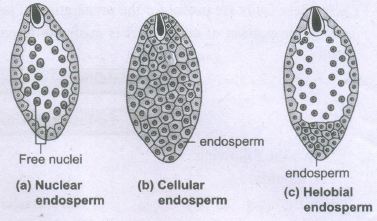
What is endosperm. Explain the types.
19.
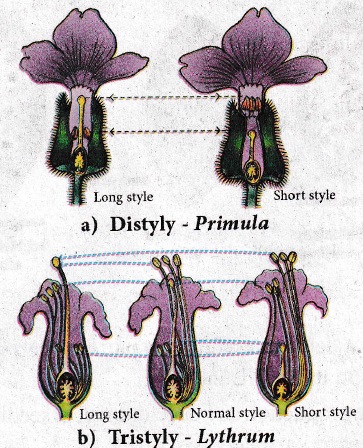
Write short note on Heterostyly.
20.
Campylotropous
21.
Offset
22.
Corm
23.
Rhizome
24.
Binary fission
25.
Conidia
1.
(b)
Embryo sac
2.
(c)
Nucellus – nutritive tissue for developing embryo
3.
(b)
G.B. Amici
4.
(c)
Rhizome - Musa
5.
(b)
P. Maheswari
6.
The genetic ability of a plant cell to produce the entire plant under suitable conditions is said to be totipotency.
7.
The unit of reproductive structures used in vegetative propagation is called diaspore or reproductive propagules.
8.
9.
A diploid embryosac is formed from megaspore mother cell without a regular meiotic division
Example:
Eupatorium, Aerva
10.
Dichogamy stamens and stigmas mature at different times (protandry, Protogyny) Herkogamy - Stamens and stigmas are arranged in such a way, self pollination become impossible.
11.
The stem of a parent plant is allowed to develop roots. After formation of roots, the rooted part is cut and separated and planted to grow into a new plant (eg) Ixora and Jasminum.
12.
Sucker - chrysanthemum
Stolon - jasmine
13.
Reproduction is a biological process in which an organism give rise to offsprings. This helps to maintain continuity of its species.
14.
Supplies nutrition to the developing microspores contributes sporopollenin through, ubisch bodies. This plays an important role in pollen wall formation. The pollen kit material is contributed by tapetal cells, and is later, transferred to the pollen surface. Exine protein responsible for rejection reaction are derived from tapetal cells.
15.
In some species (unitegmic, tenuinucellate) the inner layer of integument becomes specialized, The layer is nutritive in function for the embryosac. This layer is called endothelium or integumentary tapetum.
Example:
Asteraceae.
16.
| Mound Layering | Air Layering |
|---|---|
| A lower flexible branch of the plant is selected. | A healthy, stiff branch of the plant is selected. |
| The branch is bent to the ground. | The stem is girdled at the nodal region hormones applied. |
| A part of the branch is buried in the soil leaving the tips exposed and allowed for rooting | The girdled portion is covered with Damp or moist soil and allowed for rooting. |
17.
18.
(i) The primary endosperm nucleus divides immediately after fertilization and develops into an endosperm.
(ii) It is a nutritive tissue, and regulatory structure by undergoing repeated mitosis to form triploid (3n) endosperm that nourishes the developing embryo. Depending upon the mode of development three types of endosperm are recognized.
1) Nuclear endosperm:
(i) Primary endosperm, (PEN) nucleus undergoes several mitotic divisions. There is no cell wall formation So free nuclear condition exists in the endosperm.
Example:
Coccinia, Capsella, Arachis
2) Cellular endosperm:
(i) Primary endosperm nucleus divides into two nuclei There is cell wall formation.
(ii) Subsequent division also follows cell wall formation. It is said to be cellular endosperm
Example:
Adoxa, Helianthus, Scoparia.
3) Helobial endosperm:
(i) Primary Endosperm Nucleus moves towards the base of embryo sac.
(ii) Divides into two nuclei cell wall formation occurs forming a large micropylar chamber and a small chalazal chamber.
(iii) The nucleus of micropylar chamber further undergoes several free nuclear divisions. The nucleus of the chalazal chamber may or may not divide.
Example:
Hydrilla, Vallisneria.
19.
(i) Some plants produce two or three different forms of flowers the length of stamen and style differ in them pollination will take place only between organs of same length.
(ii) So cross pollination is only possible. Distyly (eg) Primula-produces two forms of flowers.
| Pin or long style | Thrum eyed or short style |
| Long stamen | Short stamen |
| Long stigmatic papillae | Small stigmatic papillae |
| Small pollen grains | Large pollen grains |
(iii) Stigma of thrum eyed anther of the pin lie in same level, Anther of the thrum eyed stigma of the pin lie in same level.
(iv) So effective cross pollination occurs, Tristyly - (eg) Lythrum
(v) The plant produces three kinds of flowers having difference in length of stamen and style.
(vi) Pollen from flowers of one type pollinate only the other two types can but not their, own type.
20.
hilum, micropyle and chalaza of ovule lie adjacent to one another
21.
Pistia stratiotes
22.
Colocasia
23.
Zingiber officinale
24.
Bacteria
25.
Aspergillus

12th Standard Syllabus & Materials
12th Standard
TN 12th Computer Applications வலையமைப்பு வடமிடல் Sample Question Papers Study Material - QB365 Set A
NEW12th Standard
TN 12th Computer Applications களப்பெயர் முறைமை (DNS) Sample Question Papers Study Material - QB365 Set A
NEW12th Standard
TN 12th Computer Applications வலையமைப்பு எடுத்துக்காட்டுகள் மற்றும் நெறிமுறைகள் Sample Question Papers Study Material - QB365 Set A
NEW12th Standard
TN 12th Computer Applications கணினி வலையமைப்பு ஓர் அறிமுகம் Sample Question Papers Study Material - QB365 Set A



Tamilnadu Stateboard 12th Standard Subjects

Maths

Chemistry

Physics
Biology

Computer Science

Business Maths and Statistics

Economics

Commerce

Accountancy

History

Computer Applications
Biology
Computer Technology
Computer Applications
Computer Science
Business Maths and Statistics
Commerce
Economics
Maths
Chemistry
Physics
Computer Technology
History
Accountancy

Tamil

English

French
Tamilnadu Stateboard Standards

