
 100% FREE ACCESS
12th Standard Syllabus & Materials
12th Standard
TN 12th Maths Applications of Matrices and Determinants Sample Question Papers Study Material - QB365 Set A
NEW12th Standard
TN 12th Computer Applications மின்னணு தரவு பரிமாற்றம் Sample Question Papers Study Material - QB365 Set A
NEW12th Standard
TN 12th Computer Applications மின் - வணிக பாதுகாப்பு அமைப்புகள் Sample Question Papers Study Material - QB365 Set A
NEW12th Standard
TN 12th Computer Applications மின்னணு செலுத்தல் முறைகள் Sample Question Papers Study Material - QB365 Set A
NEW12th Standard
TN 12th Computer Applications மின் - வணிகம் Sample Question Papers Study Material - QB365 Set A
NEW12th Standard
TN 12th Computer Applications திறந்த மூல கருத்துருக்கள் Sample Question Papers Study Material - QB365 Set A

Published on: 03/01/2020
Botany - Asexual and Sexual Reproduction in Plants
Download Tamil Nadu 12th Standard Biology question papers, model tests, one-mark questions, important questions, and public exam papers in PDF format. Free study materials and answer keys for TN State Board students.
Questions + Answers key
Take MCQ Biology Test1.
Which is the most common type of style seen in monocots
Open type
Closed type
Solid type
Half closed type
2.
Exalbuminous seeds are ________________
Pea, castor, paddy
Paddy, Coconut, Groundnut
Beans, coconut, castor
Groundnut, pea, beans
3.
Identify the mismatched pair:
Epidermal layer - Protective infunction
Eridothecium layer - Helps in dehiscence of anther
Middle layer - Persistent layer
Tapetum - Nutritive in function
4.
Which is not a part of mature seed?
Funiculus
Testa and tegmen
hilum
Chalaza
5.
Which of the following aquatic plant is popularly known as the "Terror of Bengal"?
Eichhornia crassipes
Vallisneria spiralis
Pistia stratiotes
Zostera marina
6.
Assertion(A) : Sporopollenin preserves pollen in fossil deposits
Reason (R): Sporopollenin is resistant to physical and biological decomposition
assertion is true; reason is false
assertion is false; reason is true
Both Assertion and reason are not true
Both Assertion and reason are true.
7.
Arrange the layers of anther wall from locus to periphery
Epidermis, middle layers, tapetum, endothecium
Tapetum, middle layers, epidermis, endothecium
Endothecium, epidermis, middle layers, tapetum
Tapetum, middle layers endothecium epidermis
8.
Size of pollen grain in Myosotis ______.
10 micrometer
20 micrometer
200 micrometer
2000 micrometer
9.
Describe the development of monosporic embryo sac.
10.
Explain the conventional methods adopted in vegetative propagation of higher plants.
11.
What is pollen pistil interaction?
12.
Define Homogamy with an example
13.
Draw and label the structure of a typical pollen grain
14.
Name the vegetative propagules of the following plants
(a) Allium cepa
(b) Zingiber Officinalis
(c) Agave
(d) Colocasia
15.
‘Pollination in Gymnosperms is different from Angiosperms’ – Give reasons.
16.
List any two strategy adopted by bisexual flowers to prevent self-pollination.
17.
Cite one common feature and one contrast feature shared between apomixis and parthenocarpy
18.
What is apospory?
19.
Geitonogamy is similar to autogamy. Justify the statement.
20.
What do you know about bee pollen?
21.
“Endothecium is associated with dehiscence of anther” Justify the statement
22.
What is polyembryony. How it can commercially exploited.
23.
________________ is a carotenoid derivative of exine layer which provides resistance to pollen grains.
1.
(a)
Open type
2.
(d)
Groundnut, pea, beans
3.
(c)
Middle layer - Persistent layer
4.
(d)
Chalaza
5.
(a)
Eichhornia crassipes
6.
(d)
Both Assertion and reason are true.
7.
(d)
Tapetum, middle layers endothecium epidermis
8.
(a)
10 micrometer
9.
The functional megaspore is the first cell of the embryo sac or female gametophyte. The megaspore elongates along the micropylar-chalazal axis. The nucleus undergoes a mitotic division. Wall formation does not follow the nuclear division. A large central vacuole now appears between the two daughter nuclei. The vacuole expands and pushes the nuclei towards the opposite poles of the embryo sac. Both the nuclei divide twice mitotically, forming four nuclei at each pole. At this stage, all the eight nuclei are present in a common cytoplasm (free nuclear division). After the last nuclear division, the cell undergoes appreciable elongation, assuming a sac-like appearance. This is followed by the cellular organization of the embryo sac. Of the four nuclei at the micropylar end of the embryo sac, three organize into an egg apparatus, the fourth one is left free in the cytoplasm of the central cell as the upper polar nucleus. Three nuclei of the chalazal end form three antipodal cells whereas the fourth one functions as the lower polar nucleus. Depending on the plant the 2 polar nuclei may remain free or may fuse to form a secondary nucleus (central cell). The egg apparatus is made up of a central egg cell and two synergids, one on each side of the egg cell. Synergids secrete chemotropic substances that help to attract the pollen tube. The special cellular thickening called filiform apparatus of synergids to help in the absorption, conduction of nutrients from the nucellus to embryo sac. It also guides the pollen tube into the egg. Thus, a 7 celled with 8 nucleated embryo sac is formed.
10.
Artificial propagation of higher plants used by man for a very long time are called conventional methods
1) Cutting
The cut parts from (root, stem, leaf) parent plant are grown in suitable medium. They grow into new plants
Example:
(i) Root Cutting - Malus.
(ii) Stem Cutting - Hibiscus.
(iii) Leaf cutting - Begonia.
2) Grafting
Parts of two different plants are joined so that they continue to grow as one plant of the two plants the plant which is in contact with the soil is called stock the plant used for grafting is called scion.
Example:
(i) Citrus, Mango.
(ii) There are different types of grafting based on the method of uniting the scion and stock.
Layering
The stem of the parent plant is allowed to develop roots while still intact. After the roots formation rooted part is cut and planted to grow as a new plant.
Example:
Ixora, Jasminum
It is of two types - Mound / Air layering.
11.
The events from pollen deposition on the stigma to the entry of pollen tube into the ovule is called pollen - pistil interaction. It is a dynamic process which involves recognition of pollen and to promote or inhabit its germination and growth.
12.
When the stamens and stigma of a flower mature at the same time it is said to be homogamy. It favours self-pollination to occur. Example: Mirabilis jalapa.
13.
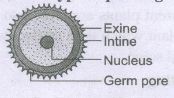
14.
(a) Allium cepa - Bulb
(b) Zingiber officinal is - Rhizome
(c) Agave - Bulbils
(d) Colocasia - Corm
15.
Gymnosperms - Pollination is said to be direct as the pollen are deposited directly on the exposed ovules Angiosperms - Pollination is said to be indirect as the pollen are deposited on the stigma of the pistil.
16.
Dichogamy stamens and stigmas mature at different times (protandry, Protogyny) Herkogamy - Stamens and stigmas are arranged in such a way, self pollination become impossible.
17.
Common features: Fertilization (Syngamy) is absent in both apomixis and parthenocarpy.
Contrast features: Parthenocarpic fruits does not develop seeds, whereas in apomixis seeds are developed.
18.
Megaspore mother cell undergoes the normal meiosis and four megaspores formed gradually disappear. A nucellar cell becomes activated and develops into a diploid embryo sac. This type of apospory is also called somatic apospory. Examples Hieracium and Parthenium.
19.
When the pollen deposits on another flower of the same individual plant, it is said to be geitonogamy. It usually occurs in plants which show monoecious condition. It is functionally cross-pollination but is similar to autogamy because the pollen comes from the same plant
20.
(i) Bee pollen is a natural substance with high proteins, carbohydrate, and a trace amount of vitamins and minerals.
(ii) It is used as a dietary supplement as tablets.
(iii) It increases the performance of athletes, racehorses and also heals burn wounds.
21.
Endothecium is a single layer of radially elongated cells, The inner tangential wall of this cell develops bands of a cellulose, The cells are hygroscopic. The stomium of anther lobe lack these thickenings. Stomium along with the hygroscopic nature of endothecium helps in the dehiscence of anther
22.
Occurrence of more than one embryo in a seed is called polyembryony.
The seedlings formed from the nucellar tissue in citrus are found better clones for orchards. Embryos derived through polyembryony are found virus free.
23.
()
Sporopollenin

12th Standard Syllabus & Materials
12th Standard
TN 12th Computer Applications வலையமைப்பு வடமிடல் Sample Question Papers Study Material - QB365 Set A
NEW12th Standard
TN 12th Computer Applications களப்பெயர் முறைமை (DNS) Sample Question Papers Study Material - QB365 Set A
NEW12th Standard
TN 12th Computer Applications வலையமைப்பு எடுத்துக்காட்டுகள் மற்றும் நெறிமுறைகள் Sample Question Papers Study Material - QB365 Set A
NEW12th Standard
TN 12th Computer Applications கணினி வலையமைப்பு ஓர் அறிமுகம் Sample Question Papers Study Material - QB365 Set A



Tamilnadu Stateboard 12th Standard Subjects

Maths

Chemistry

Physics
Biology

Computer Science

Business Maths and Statistics

Economics

Commerce

Accountancy

History

Computer Applications
Biology
Computer Technology
Computer Applications
Computer Science
Business Maths and Statistics
Commerce
Economics
Maths
Chemistry
Physics
Computer Technology
History
Accountancy

Tamil

English

French
Tamilnadu Stateboard Standards

