
 100% FREE ACCESS
12th Standard Syllabus & Materials
12th Standard
TN 12th Computer Applications மின்னணு தரவு பரிமாற்றம் Sample Question Papers Study Material - QB365 Set A
NEW12th Standard
TN 12th Computer Applications மின் - வணிக பாதுகாப்பு அமைப்புகள் Sample Question Papers Study Material - QB365 Set A
NEW12th Standard
TN 12th Computer Applications மின்னணு செலுத்தல் முறைகள் Sample Question Papers Study Material - QB365 Set A
NEW12th Standard
TN 12th Computer Applications மின் - வணிகம் Sample Question Papers Study Material - QB365 Set A
NEW12th Standard
TN 12th Computer Applications திறந்த மூல கருத்துருக்கள் Sample Question Papers Study Material - QB365 Set A
NEW12th Standard
TN 12th Computer Applications வலையமைப்பு வடமிடல் Sample Question Papers Study Material - QB365 Set A

Published on: 04/11/2019
Botany - Ecosystem
Download Tamil Nadu 12th Standard Biology question papers, model tests, one-mark questions, important questions, and public exam papers in PDF format. Free study materials and answer keys for TN State Board students.
Questions + Answers key
Take MCQ Biology Test1.
Which of the following is not a sedimentary cycle
Nitrogen cycle
Phosphorous cycle
Sulphur cycle
Calcium cycle
2.
Which of the following is / are not the mechanism of decomposition
Eluviation
Catabolism
Anabolism
fragmentation
3.
Ecosystem consists of ____.
decomposers
producers
consumers
all of the above
4.
5.
Pond is a type of ______.
forest ecosystem
grassland ecosystem
marine ecosystem
fresh water ecosystem
6.
Which of the following is not a abiotic component of the ecosystem?
Bacteria
Humus
Organic compounds
Inorganic compounds
7.
What are Blue carbon ecosystems?
8.
9.
What is energy flow?
10.
Name the category of organisms that occupy the first tropic level (T1) and fourth tropic level (T4) in an ecosystem,
11.
What is standing crop?
12.
What are biotic components?
13.
Define 'Standing state' with regard to ecosystem.
14.
Mention any two climatic factors and edaphic factors of an ecosystem.
15.
Pyramid of energy is always upright. Give reasons
16.
17.
18.
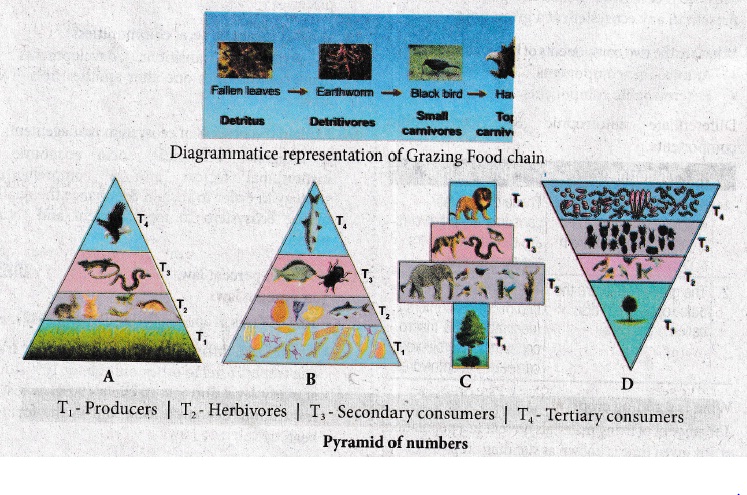
Shape of pyramid in a particular ecosystem is always different in shape. Explain with example.
19.
Name of the food chain which is generally present in all type of ecosystem. Explain and write their significance.
20.
Halosere
21.
Lithosere
22.
Organic factor
23.
Edaphic factor
24.
Climatic factor
25.
List out the characteristics of ecological succession.
26.
Explain various steps involved in decomposition (or) Write the steps involved in the mechanism decomposition.
1.
(a)
Nitrogen cycle
2.
(c)
Anabolism
3.
(d)
all of the above
4.
(b)
5.
(d)
fresh water ecosystem
6.
(a)
Bacteria
7.
Sea grasses and mangroves of Estuarine and coastal ecosystems are the most efficient in carbon sequestration. Hence, these ecosystems are called as "Blue carbon ecosystems".
8.
9.
The transfer of energy in an ecosystem between trophic levels can be termed as energy flow. It is the key function in an ecosystem. Energy flow is always unidirectional in an ecosystem.
10.
Producers (autotrophs) occupy the first tropic level (T1) whereas the fourth tropic level (T4) is occupied by Tertiary Consumers (Secondary carnivore).
11.
The amount of living materials present in a population at any given time is known as standing crop.
12.
Biotic (living) components includes all living organisms like plants, animals, fungi and bacteria. They form the trophic structures of any ecosystem.
13.
The total inorganic substances present in any ecosystem at a given time is called standing quality (or) standing state.
14.
(a) Climatic factors: Light and Air.
(b) Edaphic factors: Soil and pH of soil.
15.
There is a gradual decrease in energy transfer at successive tropic levels from producers to higher levels, hence the pyramid of energy is always upright.
16.
17.
18.
Pyramid of number
(i) In a forest ecosystem the pyramid of number is different in shape, it is because the base (T 1) of the pyramid occupies large sized trees (producer) which are lesser in number.
(ii) Herbivores (T2) occupying second trophic level, are more in number than the producers (T1).
(iii) In final trophic level (T4) tertiary consumers (lion) are lesser in number than the secondary consumers (T3).
(iv) Therefore, the pyramid of numbers in forest ecosystem looks spindle-shaped.
Pyramid of biomass
(i) In forest ecosystem, there is a gradual decrease in biomass of organisms at successive trophic levels from producers to top carnivores (Tertiary consumer). Therefore, the pyramid of biomass looks upright.
19.
Detritus food chain
(i) This type of food chain begins with dead organic matter which is an important source of energy.
(ii) A large amount of organic matter is derived from the dead plants, animals and their excreta.
(iii) This type of food chain is present in all ecosystems
(iv) The transfer of energy from the dead organic matter is transferred through a series of organisms called detritus consumers. (detrivores)-Small carnivores -large (top) carnivores with repeated eating and being eaten respectively.
20.
Succession initiating on saline water
21.
Succession initiating on barren rock
22.
Humic substances
23.
pH of soil
24.
precipitation
25.
Characteristics of ecological succession
(I) It is a systematic process which causes changes in specific structure of plant community.
(II) It is resultant of changes of abiotic and biotic factors.
(III) It transforms unstable community into a stable community.
(IV) Gradual progression in species diversity, total biomass, niche specialisation, and humus content of soil takes place.
(V) It progresses from simple food chain to complex food web.
(VI) It modifies the lower and simple life form to the higher life forms.
(VII) It creates inter-dependence of plants and animals.
26.
Mechanism of decomposition
Decomposition is a step wise process of degradation mediated by enzymatic reactions.
Detritus acts as a raw material for decomposition.
It occurs in the following steps.
(a) Fragmentation - The breaking down of detritus into smaller particles by detritivores like bacteria, fungi and earth worm is known as fragmentation. These detritivores secrete certain substances to enhance the fragmentation process and increase the surface area of detritus particles.
(b) Catabolism - The decomposers produce some extracellular enzymes in their surroundings to break down complex organic and inorganic compounds in to simpler ones. This is called catabolism.
(c) Leaching or Eluviation - The movement of decomposed, water soluble organic and inorganic compounds from the surface to the lower layer of soil or the carrying away of the same by water is called leaching or eluviation.
(d) Humification - It is a process by which simplified detritus is changed into dark coloured amorphous substance called humus. It is highly resistant to microbial action, therefore decomposition is very slow. It is the reservoir of nutrients.
(e) Mineralisation - Some microbes are involved in the release of inorganic nutrients from the humus of the soil, such process is called mineralisation.

12th Standard Syllabus & Materials
12th Standard
TN 12th Computer Applications களப்பெயர் முறைமை (DNS) Sample Question Papers Study Material - QB365 Set A
NEW12th Standard
TN 12th Computer Applications வலையமைப்பு எடுத்துக்காட்டுகள் மற்றும் நெறிமுறைகள் Sample Question Papers Study Material - QB365 Set A
NEW12th Standard
TN 12th Computer Applications கணினி வலையமைப்பு ஓர் அறிமுகம் Sample Question Papers Study Material - QB365 Set A
NEW12th Standard
TN 12th Computer Applications PHP-உடன் MySQL-ஐ இணைத்தல் Sample Question Papers Study Material - QB365 Set A



Tamilnadu Stateboard 12th Standard Subjects

Maths

Chemistry

Physics
Biology

Computer Science

Business Maths and Statistics

Economics

Commerce

Accountancy

History

Computer Applications
Biology
Computer Technology
Computer Applications
Computer Science
Business Maths and Statistics
Commerce
Economics
Maths
Chemistry
Physics
Computer Technology
History
Accountancy

Tamil

English

French
Tamilnadu Stateboard Standards

