
 100% FREE ACCESS
12th Standard Syllabus & Materials
12th Standard
TN 12th Maths Applications of Matrices and Determinants Sample Question Papers Study Material - QB365 Set A
NEW12th Standard
TN 12th Computer Applications மின்னணு தரவு பரிமாற்றம் Sample Question Papers Study Material - QB365 Set A
NEW12th Standard
TN 12th Computer Applications மின் - வணிக பாதுகாப்பு அமைப்புகள் Sample Question Papers Study Material - QB365 Set A
NEW12th Standard
TN 12th Computer Applications மின்னணு செலுத்தல் முறைகள் Sample Question Papers Study Material - QB365 Set A
NEW12th Standard
TN 12th Computer Applications மின் - வணிகம் Sample Question Papers Study Material - QB365 Set A
NEW12th Standard
TN 12th Computer Applications திறந்த மூல கருத்துருக்கள் Sample Question Papers Study Material - QB365 Set A

Published on: 03/01/2020
Botany - Plant Tissue Culture
Download Tamil Nadu 12th Standard Biology question papers, model tests, one-mark questions, important questions, and public exam papers in PDF format. Free study materials and answer keys for TN State Board students.
Questions + Answers key
Take MCQ Biology Test1.
The term used to define the ability of a cell to generate entire individual is
Pluripotent
Totipotent
Multipotent
Unipotent
2.
Assertion (A) : Sterilization helps to overcome microbes.
Reason (R) : Explants are autoclaved.
Both A and R are correct but R is not a correct explanation to A
R explains A
A is correct R is incorrect
Both A and R incorrect
3.
Protoplast are the cells devoid of ___________
Cell wall
Cell membrane
Plasma membrane
both A and B
4.
Solidifying agent used in plant tissue culture is _____.
Nicotinic acid
Cobaltous chloride
EDTA
Agar
5.
Micro propagation involves _____.
vegetative multiplication of plants by using micro-organisms.
vegetative multiplication of plants by using small explants.
vegetative multiplication of plants by using microspores.
Non-vegetative multiplication of plants by using microspores and megaspores.
6.
Geographical Indication refers to the products confined to a specific geographical origin. Name any three Tamil Nadu products of your knowledge that hold GI tag.
7.
Prepare a protocol for virus free meristem tip culture.
8.
Name any three secondary metabolites obtained from plants and mention their medicinal aspects.
9.
10.
11.
Explain the basic concepts involved in plant tissue culture
12.
Source of agar is ___________.
13.
Define Bioethics.
14.
Name any two widely used cryoprotectants.
15.
Define (a) Callus (b) Embryoids
16.
What is the term totipotency refers to?
1.
(b)
Totipotent
2.
(c)
A is correct R is incorrect
3.
(a)
Cell wall
4.
(d)
Agar
5.
(b)
vegetative multiplication of plants by using small explants.
6.
Kanchipuram Silk, Tanjavore dancing doll, Madurai malli.
7.
Protocol for virus free meristem tip culture
\(\downarrow\)
Apical meristem tip with 1 or 2 leaf primordia are excised in sterile condition from the explant
\(\downarrow\)
In vitro culture in 10 ml of solid MS medium supplemented with growth hormones
\(\downarrow\)
Cultures are maintained at 24±1°C in dark for 3 days followed by normal illumination of 2400Lux
\(\downarrow\)
Plantlets developed from meristem tip culture after organogenesis process, transferred to hardening process
\(\downarrow\)
Transferred to field condition
8.
| Secondary Metabolites | Medicinal use |
| Capsaicin | Rheumatic pain treatment |
| Vincristine | Anti-carcinogenic |
| Quinine | Anti-malarial |
9.
10.
11.
Basic concepts of Tissue Culture
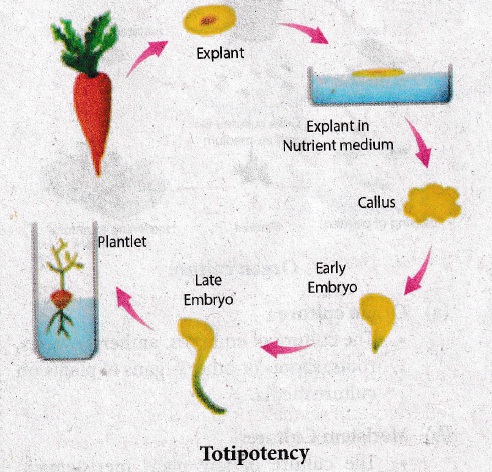
Basic concepts of plant tissue culture are totipotency, differentiation, dedifferentiation and redifferentiation.
Totipotency
The property of live plant cells that they have the genetic potential when cultured in nutrient medium to give rise to a complete individual plant.
Differentiation
The process of biochemical and structural changes by which cells become specialized in form and function.
Redifferentiation
The further differentiation of already differentiated cell into another type of cell. For example, when the component cells of callus have the ability to form a whole plant in a nutrient medium, the phenomenon is called redifferentiation.
Dedifferentiation
The phenomenon of the reversion of mature cells to the meristematic state leading to the formation of callus is called dedifferentiation. These two phenomena of redifferentiation and dedifferentiation are the inherent capacities of living plant cells or tissue. This is described as totipotency.
12.
()
Marine algae (Sea weeds)
13.
Bioethics refers to the study of ethical issues emerging from advances in biology and medicine. It is also a moral discernment as it relates to medical policy and practice.
14.
(a) Dimethyl sulphoxide
(b) Glycerol
15.
(a) Callus is a mass of unorganized growth of plant cells or tissues in in vitro culture medium.
(b) The callus cells undergoes differentiation and produces somatic embryos, known as Embryoids.
16.
The property of live plant cells that they have the genetic potential when cultured in nutrient medium to give rise to a complete individual plant.

12th Standard Syllabus & Materials
12th Standard
TN 12th Computer Applications வலையமைப்பு வடமிடல் Sample Question Papers Study Material - QB365 Set A
NEW12th Standard
TN 12th Computer Applications களப்பெயர் முறைமை (DNS) Sample Question Papers Study Material - QB365 Set A
NEW12th Standard
TN 12th Computer Applications வலையமைப்பு எடுத்துக்காட்டுகள் மற்றும் நெறிமுறைகள் Sample Question Papers Study Material - QB365 Set A
NEW12th Standard
TN 12th Computer Applications கணினி வலையமைப்பு ஓர் அறிமுகம் Sample Question Papers Study Material - QB365 Set A



Tamilnadu Stateboard 12th Standard Subjects

Maths

Chemistry

Physics
Biology

Computer Science

Business Maths and Statistics

Economics

Commerce

Accountancy

History

Computer Applications
Biology
Computer Technology
Computer Applications
Computer Science
Business Maths and Statistics
Commerce
Economics
Maths
Chemistry
Physics
Computer Technology
History
Accountancy

Tamil

English

French
Tamilnadu Stateboard Standards

