
 100% FREE ACCESS
12th Standard Syllabus & Materials
12th Standard
TN 12th Computer Applications மின்னணு தரவு பரிமாற்றம் Sample Question Papers Study Material - QB365 Set A
NEW12th Standard
TN 12th Computer Applications மின் - வணிக பாதுகாப்பு அமைப்புகள் Sample Question Papers Study Material - QB365 Set A
NEW12th Standard
TN 12th Computer Applications மின்னணு செலுத்தல் முறைகள் Sample Question Papers Study Material - QB365 Set A
NEW12th Standard
TN 12th Computer Applications மின் - வணிகம் Sample Question Papers Study Material - QB365 Set A
NEW12th Standard
TN 12th Computer Applications திறந்த மூல கருத்துருக்கள் Sample Question Papers Study Material - QB365 Set A
NEW12th Standard
TN 12th Computer Applications வலையமைப்பு வடமிடல் Sample Question Papers Study Material - QB365 Set A

Published on: 02/11/2019
Botany - Principles and Processes of Biotechnology
Download Tamil Nadu 12th Standard Biology question papers, model tests, one-mark questions, important questions, and public exam papers in PDF format. Free study materials and answer keys for TN State Board students.
Questions + Answers key
Take MCQ Biology Test1.
The bacteria responsible for causing Crown Gall:
Escherichia coli
Bacillus subtilis
Bacillus thuringiensis
Agrobacterium tumefaciens
2.
Zymology deals with __________
Study of yeast fungus and its practical applications.
Study of fermentation and its uses.
Study of Bioreactors and their construction methodology.
Study of zymase producing microbes and its benefits.
3.
Some of the characteristics of Bt cotton are ______.
Long fibre and resistant to aphids
Medium yield, long fibre and resistant to beetle pests
high yield and production of toxic protein crystals which kill dipteran pests.
High yield and resistant to ball worms
4.
An analysis of chromosomal DNA using the southern hybridisation technique does not use _____.
Electrophoresis
Blotting
Autoradiography
Polymerase Chain Reaction
5.
Which of the following one is used as a Biosensors?
Electrophoresis
Bioreactors
Vectors
Electroporation
6.
Plasmids are ______.
circular protein molecules
required by bacteria
tiny bacteria
confer resistance to antibiotics
7.
8.
9.
Write the advantages of herbicide tolerant crops
10.
11.
Mention the application of Biotechnology.
12.
How do you use the biotechnology in modern practice?
13.
What is Restriction Endonuclease?
14.
Define fermentation.
15.
16.
What are the enzymes you can used to cut terminal end and internal phospho di ester bond of nucleotide sequence?
17.
What are the materials used to grow microorganism like Spirulina?
18.
What is SCP? Mention its nutritional value.
19.
How will you identify a vector ?
20.
What do you know about the word pBR332?
21.
Development of PCR technology
22.
First transgenic animal
23.
Monoclonal antibodies
24.
One gene one enzyme hypothesis
1.
(d)
Agrobacterium tumefaciens
2.
(b)
Study of fermentation and its uses.
3.
(d)
High yield and resistant to ball worms
4.
(d)
Polymerase Chain Reaction
5.
(a)
Electrophoresis
6.
(d)
confer resistance to antibiotics
7.
(d)
8.
9.
Advantages of Herbicide Tolerant Crops:
1. Weed control improves higher crop yields;
2. Reduces spray of herbicide;
3. Reduces competition between crop plant and weed;
4. Use of low toxicity compounds which do not remain active in the soil; and
5. The ability to conserve soil structure and microbes.
10.
11.
Applications of Biotechnology
1. Biotechnology is one of the most important applied interdisciplinary sciences of the 21st century. It is the trusted area that enables us to find the beneficial way of life.
2. Biotechnology has wide applications in various sectors like agriculture, medicine, environment and commercial industries.
3. This science has an invaluable outcome like transgenic varieties of plants e.g. transgenic cotton (Bt-cotton), rice, tomato, tobacco, cauliflower, potato and banana.
4. The development of transgenics as pesticide resistant, stress resistant and disease resistant varieties of agricultural crops is the immense outcome of biotechnology.
5. The synthesis of human insulin and blood protein in E.coli and utilized for insulin deficiency disorder in human is a breakthrough in biotech industries in medicine.
6. The synthesis of vaccines, enzymes, antibiotics, dairy products and beverages are the products of biotech industries.
7. Biochip based biological computer is one of the successes of biotechnology.
8. Genetic engineering involves genetic manipulation, tissue culture involves aseptic cultivation of totipotent plant cell into plant clones under controlled atmospheric conditions.
9. Single cell protein from Spirulina is utilized in food industries.
10. Production of secondary metabolites, biofertilizers, biopesticides and enzymes.
11. Biomass energy, biofuel, bioremediation and phytoremediation for environmental biotechnology.
12.
Modern biotechnology
(i) There are two main features of this technology, that differentiated it from the conventional technology are its
i) ability to change the genetic material for getting new products with specific requirements through recombinant DNA technology
ii) ownership of the newly developed technology and its social impact.
(ii) Modern biotechnology embraces all methods of genetic modification by recombinant DNA and cell fusion technology.
The major focus of biotechnology are
(i) Fermentation for production of acids, enzymes, alcohols, antibiotics, fine chemicals, vitamins and toxins
(ii) Biomass for bulk production of single cell protein , alcohol, and biofuel
(iii) Enzymes as biosensors, in processing industry
(iv) Biofuels for production of hydrogen, alcohol, methane
(v) Microbial inoculants as biofertilizer, and nitrogen fixers
(vi) Plant and animal cell culture for production of secondary metabolites, monoclonal antibodies
(vii) Recombinant DNA technology for production of fine chemicals, enzymes, vaccines, growth hormones, antibiotics, and interferon.
(viii) Process engineering - tools of biotechnology is used for effluent treatment , water recycling.
13.
A restriction enzyme or restriction endonuclease is an enzyme that cleaves DNA into fragments at or near specific recognition sites within the molecule known as restriction sites.
14.
Fermentation refers to the metabolic process in which organic molecules (normally glucose) are converted into acids, gases, or alcohol in the absence of oxygen or any electron transport chain with oxygen.
15.
16.
Restriction endonuclease. e.g: Hind II, EcoR I, Pvul, Bam H I, Taq I.
17.
Spirulina can be grown easily on materials like waste water from potato processing plants (containing starch), straw, molasses, animal manure and even sewage, to produce large quantities.
18.
Single Cell Protein (SCP) are dried cells of microorganisms that are used as protein supplement in human foods or animal feeds. SCP are rich in proteins, aminoacids, vitamins, carbohydrates, fats and minerals. It is used as food source by Astronauts and Antarctica expedition scientists.
19.
Properties of Vectors:
1. Vectors are able to replicate autonomously to produce multiple copies of them along with their DNA insert in the host cell.
2. It should be small in size and of low molecular weight, less than 10 Kb (kilo base pair) in size so that entry/transfer into host cell is easy.
3. Vector must contain an origin of replication so that it can independently replicate within the host.
4. It should contain a suitable marker such as antibiotic resistance, to permit its detection in transformed host cell.
5. Vector should have unique target sites for integration with DNA insert and should have the ability to integrate with DNA insert it carries into the genome of the host cell. Most of the commonly used cloning vectors have more than one restriction site. These are Multiple Cloning Site (MCS) or polylinker. Presence of MCS facilitates the use of restriction enzyme of choice.
20.
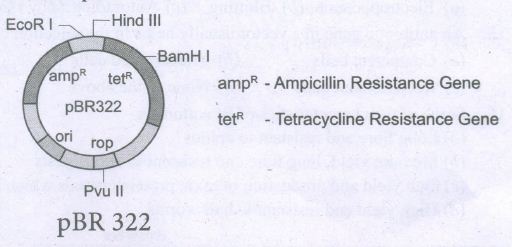
(i) pBR 322 plasmid is a reconstructed plasmid and most widely used as cloning vector;
(ii) It contains 4361 base pairs. In pBR, p denotes plasmid, Band R respectively the names of scientist Boliver and Rodriguez who developed this plasmid.
(iii) The number 322 is the number of plasmid developed from their laboratory.
(iv) It contains ampR and tetR two different antibiotic resistance genes and recognition sites for several restriction enzymes.
(v) ori and antibiotic resistance genes. Rop codes for the proteins involved in the replication of the plasmid.
21.
Kary Mullis
22.
Ian Wilmet
23.
Kohler and Milstein
24.
Beadle and Tatum

12th Standard Syllabus & Materials
12th Standard
TN 12th Computer Applications களப்பெயர் முறைமை (DNS) Sample Question Papers Study Material - QB365 Set A
NEW12th Standard
TN 12th Computer Applications வலையமைப்பு எடுத்துக்காட்டுகள் மற்றும் நெறிமுறைகள் Sample Question Papers Study Material - QB365 Set A
NEW12th Standard
TN 12th Computer Applications கணினி வலையமைப்பு ஓர் அறிமுகம் Sample Question Papers Study Material - QB365 Set A
NEW12th Standard
TN 12th Computer Applications PHP-உடன் MySQL-ஐ இணைத்தல் Sample Question Papers Study Material - QB365 Set A



Tamilnadu Stateboard 12th Standard Subjects

Maths

Chemistry

Physics
Biology

Computer Science

Business Maths and Statistics

Economics

Commerce

Accountancy

History

Computer Applications
Biology
Computer Technology
Computer Applications
Computer Science
Business Maths and Statistics
Commerce
Economics
Maths
Chemistry
Physics
Computer Technology
History
Accountancy

Tamil

English

French
Tamilnadu Stateboard Standards

