
 100% FREE ACCESS
12th Standard Syllabus & Materials
12th Standard
TN 12th Computer Applications மின்னணு தரவு பரிமாற்றம் Sample Question Papers Study Material - QB365 Set A
NEW12th Standard
TN 12th Computer Applications மின் - வணிக பாதுகாப்பு அமைப்புகள் Sample Question Papers Study Material - QB365 Set A
NEW12th Standard
TN 12th Computer Applications மின்னணு செலுத்தல் முறைகள் Sample Question Papers Study Material - QB365 Set A
NEW12th Standard
TN 12th Computer Applications மின் - வணிகம் Sample Question Papers Study Material - QB365 Set A
NEW12th Standard
TN 12th Computer Applications திறந்த மூல கருத்துருக்கள் Sample Question Papers Study Material - QB365 Set A
NEW12th Standard
TN 12th Computer Applications வலையமைப்பு வடமிடல் Sample Question Papers Study Material - QB365 Set A

Published on: 31/08/2020
12th Biology English Medium Important 2 Mark Book Back Questions (New Syllabus) 2020
Download Tamil Nadu 12th Standard Biology question papers, model tests, one-mark questions, important questions, and public exam papers in PDF format. Free study materials and answer keys for TN State Board students.
Questions + Answers key
Take MCQ Biology Test1.
How does immune system work?
2.
How are microbial inoculants used to increase the soil fertility?
3.
4.
Pyramid of energy is always upright. Give reasons
5.
‘Green algae are not likely to be found in the deepest strata of the ocean’. Give at least one reason.
6.
7.
Expand
(i) CFC
(ii) AQI
(iii) PAN
8.
9.
10.
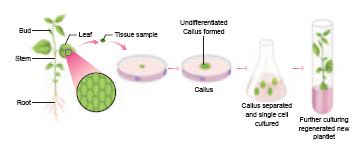
What is the name of the process given below? Write its 4 types.
11.
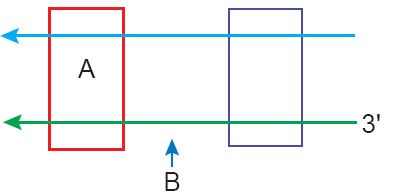
Name the parts marked ‘A’ and ‘B’ in the given transcription unit:
12.
Expand the acronyms
a. FSH
b. LH
c. hCG
d. hPL
13.
What is haplodiploidy?
14.
What are interferons? Mention their role.
15.
Name the phenomenon where the female gamete directly develops into a new organism with an avian example.
16.
What is meant by true breeding or pure breeding lines / strain?
17.
Mention the contribution of Hofmeister towards Embryology.
18.
Explain the three major categories in which fossilization occur?
19.
If you cross dominant genotype PV/PV male Drosophila with double recessive female and obtain F1 hybrid. Now you cross F1 male with double recessive female.
i) What type of linkage is seen?
ii) Draw the cross with correct genotype.
iii) What is the possible genotype in F2 generation?
20.
Discuss which wood is better for making furniture.
21.
What is genetically engineered Insulin?
22.
Select the correct term from the bracket and complete the given branching tree
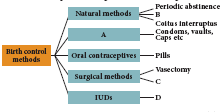
(Barriers, Lactational amenorrhoea, CuT, Tubectomy)
23.
You are working in a biotechnology lab with a bacterium namely E.coli. How will you cut the nucleotide sequence? explain it.
1.
The immune responses may be primary or secondary.
(i) The primary immune response occurs when a pathogen comes in contact with the immune system for the first time.
(ii) The secondary immune response occurs when a person is exposed to the same antigen again. During this time, immunological memory has been established and the immune system can start producing antibodies immediately. Within hours after recognition of the antigen, a new army of plasma cells are generated. Within 2 to 3 days, the antibody concentration in the blood rises steeply to reach much higher level than primary response. This is also called as "booster response".
2.
Micro organisms are efficient in fixing nitrogen, solubilizing phosphate and decomposing cellulose. They improve soil fertility, plant growth. They are ecofriendly and cost-effective than chemical fertilizers. Example. Azospirillum.
3.
4.
There is a gradual decrease in energy transfer at successive tropic levels from producers to higher levels, hence the pyramid of energy is always upright.
5.
The blue green light have short wavelength & penetrates into the water. Green algae is unable to use that component of light. Blue light can penetrate up to 500 ft depth therefore algae are unlikely to survive below that depth.
6.
7.
(i) CFC - Chloro fluoro carbon
(ii) AQI - National Air Quality Index
(iii) PAN - Peroxyacetyl Nitrate
8.
9.
10.
Name of the process-Plant tissue culture Types:
(a) Organ culture
(b) Meristem culture
(c) Protoplast culture
(d) Cell culture
11.
A - \(5^{\prime} \rightarrow 3^{\prime}\) is called a coding strand.
B - \(3^{\prime} \rightarrow 5^{\prime}\) is called a template strand.
12.
(a) FSH - Follicular Stimulating Hormone
(b) LH - Lutinizing Hormone
(c) hCG - Human Chorionic Gonadotropin
(d) hPL - Human Placental Lactogen.
13.
Haplodiploidy is a sex determination system in which males develop from unfertilized eggs are haploid, and female develops from fertilized egg and is diploid.
It is sometimes called arrhenotoky.
e.g., Honeybees, ants, and wasps.
14.
Interferons: These are the proteins made and released by host cells in response to the presence of pathogens such as viruses, bacteria, parasites etc
RoIe: They inhibit viral infections and stimulate the entire immune system to fight disease. They also regulate many kinds of cell functions
15.
Parthenogenesis is the phenomenon in which female gamete directly develops into a new organism. (e,g:) Honeybee (male or drone).
16.
A true breeding lines means it has undergone continuous self pollination having stable trait inheritance from parent to off spring.
17.
Hofmeister described the structure of pollen tetrad
18.
Fossilization is the process by which plant and animal remains are preserved in sedimentary rocks. They fall under three main categories.
(i) Actual remains
The original hard parts such as bones, teeth or shells are preserved as such in the earth's atmosphere, which is not the common method of fozzilization.
2. When marine animals die, their hard parts such as bones, shells etc. are covered with sediments and are protected from further deterioration.
3. Such parts get preserved in vast ocean, the salinity in them prevents decay.
4. The sediments become hardened to form definite layers (or) strata.
5. For example wooly mammoth that lived 22 thousand years ago were preserved in the frozen coast of Siberia as such, several human beings and animals living in the animals living in the ancient city of pompeii were preserved infact by volcanic ash which gushed out from Mount Vesuvivs.
(ii) Petrifaction
1. After death of animals their original portion of their body may be replaced molecule for molecule by minerals and the original substance being lost through disintegration.
2. This method of fozzilation is called pertifaction.
3. The principle minerals involved in this type fozzilation are iron, pyrites, silica, calcium, carbonate, and bicarbonates of calcium and magnesium.
(iii) Natural moulds and casts
1. Even after disintegration, the body of an animal might leave indelible impression on the soft mud which later becomes hardened into stones. Such impressions are called moulds.
2. The cavities of the moulds may get filled up by hard minerals and get fozzillized, which are called casts.
3. Hardened faecal. matter termed as coprolites occur as tiny pellets.
4. Analysis of the coprolites enable us to understand the nature of diet, the pre historic animals thrived on.
19.
(i) Incomplete linkage
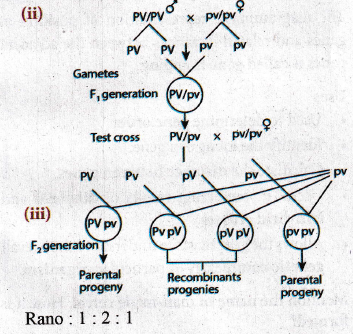
Rano : 1:2:1
20.
1. Tectona grandis is the plant gives wood better for making furniture.
2. It is one of the best timber in the world.
3. The heart wood is yellow to golden brown turner darker.
4. Durability and immune to attack of termites and fungi is well known.
21.
1. Production of insulin by recombinant DNA technology started in the late 1970s.
2. This technique involved the insertion of human insulin gene on the plasmids of E. coli.
3. The polypeptide chains are synthesized as a precursor called pre-pro insulin, which contains A and B segments linked by a third chain (C) and preceded by a leader sequence.
4. The leader sequence is removed after translation and the C chain is excised, leaving the A and B polypeptide chains.
5. Insulin was the first eyer pharmaceutical product of recombinant DNA technology administered to human. In 1986 human insulin was marketed under the trade name humulin.
22.
A - Barrier methods
B - Lactational amenorrhoea
C - Tubectomz
D - CuT
23.
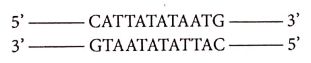
(i) ECORI is from Escherichia ( E ) coli (co), strain RY 13 (R) & first endonuclease (I) to be discovered.
(ii) It contains 2 different antibiotics resistance genes & recognition site for several restriction enzymes.
(iii) This sequence is referred to as a restriction site & is generally -palindromic which means that the sequence in both DNA strands at this site read same in 5' - 3' direction & in-the 3'-5' direction.
(iv) The exact kind of cleavage produced by a restriction enzyme is important in the design of a gene cloning experiment.
(v) Some cleave both strands of DNA through the centre resulting in blunt or flush end.
(vi) These are known as symmetric cuts.
(vii) Some enzymes cut in a way producing protruding & recessed ends known as sticky or cohesive end.
(viii) These are known as staggered or asymmetric cuts.

12th Standard Syllabus & Materials
12th Standard
TN 12th Computer Applications களப்பெயர் முறைமை (DNS) Sample Question Papers Study Material - QB365 Set A
NEW12th Standard
TN 12th Computer Applications வலையமைப்பு எடுத்துக்காட்டுகள் மற்றும் நெறிமுறைகள் Sample Question Papers Study Material - QB365 Set A
NEW12th Standard
TN 12th Computer Applications கணினி வலையமைப்பு ஓர் அறிமுகம் Sample Question Papers Study Material - QB365 Set A
NEW12th Standard
TN 12th Computer Applications PHP-உடன் MySQL-ஐ இணைத்தல் Sample Question Papers Study Material - QB365 Set A



Tamilnadu Stateboard 12th Standard Subjects

Maths

Chemistry

Physics
Biology

Computer Science

Business Maths and Statistics

Economics

Commerce

Accountancy

History

Computer Applications
Biology
Computer Technology
Computer Applications
Computer Science
Business Maths and Statistics
Commerce
Economics
Maths
Chemistry
Physics
Computer Technology
History
Accountancy

Tamil

English

French
Tamilnadu Stateboard Standards

