
 100% FREE ACCESS
12th Standard Syllabus & Materials
12th Standard
TN 12th Computer Applications மின்னணு தரவு பரிமாற்றம் Sample Question Papers Study Material - QB365 Set A
NEW12th Standard
TN 12th Computer Applications மின் - வணிக பாதுகாப்பு அமைப்புகள் Sample Question Papers Study Material - QB365 Set A
NEW12th Standard
TN 12th Computer Applications மின்னணு செலுத்தல் முறைகள் Sample Question Papers Study Material - QB365 Set A
NEW12th Standard
TN 12th Computer Applications மின் - வணிகம் Sample Question Papers Study Material - QB365 Set A
NEW12th Standard
TN 12th Computer Applications திறந்த மூல கருத்துருக்கள் Sample Question Papers Study Material - QB365 Set A
NEW12th Standard
TN 12th Computer Applications வலையமைப்பு வடமிடல் Sample Question Papers Study Material - QB365 Set A

Published on: 31/08/2020
12th Biology English Medium Important 2 Mark Creative Questions (New Syllabus) 2020
Download Tamil Nadu 12th Standard Biology question papers, model tests, one-mark questions, important questions, and public exam papers in PDF format. Free study materials and answer keys for TN State Board students.
Questions + Answers key
Take MCQ Biology Test1.
Mention any two differences between Homo habilis and Homo erectus
2.
Thorn of Bougainvillea and tendrils of Pisum sativum represent homology. How?
3.
Expand (a) ETS and (b) YAC.
4.
When and why do snails go into aestivation?
5.
What is Q10 value? How it is calculated?
6.
What does 4R stands for?
7.
Degeneracy of codon - comment.
8.
Name the various types of prokaryotic DNA polymerase. State their role in replication process.
9.
Rhizobium is a bacteria but acts as bio-fertilization. How?
10.
Name the bacterial species involved in ethanol production.
11.
When does a species is categorized as endangered?
12.
Name any four biogeographic zones in India.
13.
Mention any two drugs to treat insomnia patient
14.
List out the benefits of recombinant vaccines.
15.
Point out any four peripheral lymphoid organs.
16.
What steps should be taken to maintain good health?
17.
Write a note on Huntington's chorea.
18.
Name the products of the following combinations.
(a) Bacterial plasmid + cos - site = ________
(b) Bacterial plasmid + phage DNA = _______
19.
Define Barr body.
20.
Write an palindrome sequence of DNA.
21.
Name the organs developed from embryonic ectoderm
22.
Name the cells noticed in the epithelial layer of seminiferous tubule
23.
Name any four chemical mutagens.
24.
What are bivalents? When does this condition is noticed in a cell?
25.
Name the four types of fission seen in animals
26.
Provide any four intergenic gene interactions.
27.
Name the first and second law of Mendel.
28.
What is coleoptile and coleorhiza?
29.
What is pollen pistil interaction?
30.
State the role of filiform apparatus found in embryo sac of angiosperm.
31.
Define totipotency.
32.
Cite few examples of biomolecules that contain phosphorus.
33.
What are trichophyllous plants? Give example.
34.
Define soil profile.
35.
Sequentially arrange the different units of ecological hierarchy.
36.
How Net Primary Productivity be derived?
37.
Write the composition of vitamins used in MS medium.
38.
Name any two allopolyploid plant species
39.
List out the benefits of EIA to society.
40.
Where did Montreal Protocol was held? State its objectives.
41.
Write the binomial and the family to which lady's finger belongs to.
42.
What is paleontology?
43.
What is Ozone?
44.
What is CVS?
45.
What are the characteristics of an ideal contraceptive?
46.
Define species diversity.
47.
Why is curd more nutritious than milk?
48.
What is zymology?
49.
What are ecological equivalents?
50.
What is annealing?
51.
What is spermiation?
52.
Define fertilisation.
53.
What is genophore?
54.
Name the types of natural parthenogenesis.
55.
What is plasmotomy?
56.
What is Lyon's hypothesis?
57.
What is western blot test?
58.
What are helper T cells?
1.
| Homo habilis | Homo erectus |
|---|---|
| The brain capacity was between 650-800 cc. They were probably vegetarians. | The brain capacity was around 900 cc. They probably ate meat. |
2.
The thorn of Bougainvillea and the tendrils of Curcurbita and Pisum sativum represent homology. The thorn in former is used as a defense mechanism from grazing animals and the tendrils of latter is used as a support for climbing.
3.
ETS: Expressed Sequence Tags
YAC: Yeast Artificial Chromosomes
4.
Snails undergo aestivation during summer to avoid heat and overcome desiccation
5.
The effect of temperature on the rate of reaction is expressed in terms of temperature coefficient or Q10 value. The Q10 values are estimated taking the ratio between the rate of reaction at XoC and rate of reaction at (X-10°C).
6.
'4R' refers to Refuse, Reduce, Reuse and Recycle methods to manage plastic waste.
7.
A degenerate code means that more than one triplet codon could code for a specific amino acid. For example, codons GUU, GUC, GUA and GUG code for valine.
8.
DNA polymerase I }
DNA polymerase II } Involved in DNA repair mechanism
DNA polymerase III} Involved in DNA replication
9.
Rhizobium is a symbiotic nitrogen-fixing bacteria which infects the root nodules of leguminous plants and fixes free atmospheric nitrogen into organic forms
10.
Zymomonas mobilis and Sarcina ventriculi
11.
A species that has been categorized as very likely to become extinct is an endangered species.
12.
(a) Himalayas
(b) Indian deserts
(c) Trans-Himalayan region
(d) Western ghats.
13.
1. methamphetamine
2. Lysergic acid diethylamide (LSD)
14.
Vaccines produced by recombinant techniques have definite advantages like producing target proteins, long lasting immunity and trigger immune response only against specific pathogens with less toxic effects.
15.
Lymph nodes, spleen, tonsils, MALT
16.
Personal hygiene, regular exercise, and a balanced diet are very important to maintain good health.
17.
Huntington's chorea is inherited as an autosomal dominant lethal gene in man. It is characterized by involuntary jerking of the body and progressive degeneration of the nervous system, accompanied by gradual mental and physical deterioration. The patients with this disease usually die between the age of 35 and 40.
18.
(a) Cosmid
(b) Phagemid
19.
In 1949, Barr and Bertram first observed a condensed body in the nerve cells of female cat which was absent in the male. This condensed body was called sex chromatin by them and was later referred as Barr body.
20.
5' CATTATATAATG 3'
3' GTAATATATTAC 5'
21.
Brain and spinal cord (CNS), peripheral nervous system (PNS), epidermis and its derivatives and mammary glands
22.
(a) Sertoli cells or Nurse cells
(b) Spermatogonic cells or male germ cells.
23.
(a) Ethyl methanesulphonate (EMS)
(b) Mustard gas
(c) Maganous salt
(d) Formaldehyde
24.
During zygotene stage of prophase I of meiosis I, homologous chromosomes are aligned side by side resulting in a pair of homologous chromosomes called bivalents.
25.
Binary fission, Multiple fission, Sporulation and Strobilation
26.
(a) Incomplete dominance
(b) Codominance
(c) Multiple alleles
(d) Pleiotropic genes are common examples for intragenic interaction.
27.
i) The Law of Dominance,
ii) The Law of Segregation
28.
In monocot embryo, the plumule is covered by a protective sheath called coleoptile and the radicle along with root cap is covered by a protective sheath called coleorhiza.
29.
The events from pollen deposition on the stigma to the entry of pollen tube into the ovule is called pollen - pistil interaction. It is a dynamic process which involves recognition of pollen and to promote or inhabit its germination and growth.
30.
(a) Filiform apparatus helps in absorption conduction of nutrients from nucellus to embryo sac
(b) It guides the pollen tube into the egg.
31.
The genetic ability of a plant cell to produce the entire plant under suitable conditions is said to be totipotency.
32.
DNA, RNA, ATP and NADP.
33.
In xerophytic plants, with the leaves and stem are covered with hairs are called trichophyllous plants. Example: Cucurbits (Melothria and Mulda)
34.
Soil is commonly stratified into horizons at different depth. These layers differ in their physical, chemical and biological properties. This succession of super-imposed horizons is called soil profile.
35.
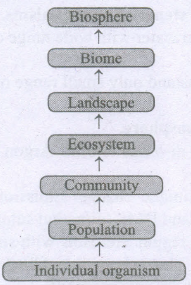
36.
Net Primary Productivity (NPP) is derived by the difference between Gross primary productivity (GPP) and respiration.
NPP = GPP - Respiration
37.
Glycine 2.0 mg/l, Nicotinic acid 0.5 mg/l, Pyridoxin HCI 0.5 mg/l and Thiamine HCI 0.1 mg/l.
38.
Triticale (Triticum durum x Secale cereale).
Raphanobrassica (Brassica oleraceae x Raphanus sativus).
39.
The benefits of EIA to society
(i) A healthier environment
(ii) Maintenance of biodiversity
(iii) Decreased resource usage
(iv) Reduction in gas emission and environment damage
40.
The International treaty called the Montreal Protocol (1987) was held in Canada on substances that deplete ozone layer and the main goal of it is gradually eliminating the production and consumption of ozone depleting substances and to limit their damage on the Earth's ozone layer.
41.
Binomial of lady's finger is Abelmoschus esculentus.
Family: Malvaceae.
42.
It is the study of prehistoric life through fossils
43.
Ozone is found in the layer of the atmosphere called stratosphere. It acts as a protective covering that absorbs ultraviolet radiation from the sun. It is found about 15 and 50 kilometers from the ground level.
44.
CVS - Chorionic Villus Sampling. CVS is a prenatal test that involves taking a sample of the placental tissue to test for chromosomal abnormalities.
45.
An ideal contraceptive should be user friendly easily available, with least side effects and should not interfere with sexual drive.
46.
Species diversity refers to the variety in number and richness of the species in any habitat.
47.
Curd is more nutritious than milk Since it contains a number of organic acids and vitamins
48.
Zymology an applied science which deals with the biochemical process of fermentation and its practical uses.
49.
Species that occupy the same niche in different geographical regions, are termed 'ecological equivalents'
50.
In polymerase chain reaction, annealing is a process where the denatured target DNA strands are cooled rapidly allowing the primers to bind to the sequences on each of the two strands flanking the target DNA.
51.
Sperms are finally released into the cavity of seminiferous tubules by a process called spermiation. It follows spermiogenesis.
52.
Fusion of male and female gametes to form zygote, is called fertilisation.
53.
The DNA as a nucleoid is organized into large loops held by protein. DNA of prokaryotes is almost circular and lacks chromatin organization, hence termed genophore.
54.
(i) Arrhenotoky - e.g. honey bees
(ii) Thelytoky - e.g. Solenobia
(iii) Amphitoky - e.g. Aphis.
55.
(i) Plasmotomy is the division of multinucleated parent into many multinucleate daughter individuals, with the division of nuclei.
(ii) Nuclear division occurs later to maintain normal number of nuclei (e,g:) Opalina and Pelomyxa.
(iii) Plasmotomy occurs in Opalina and Pelomyxa.
(iv) It is a method of asexual reproduction
56.
Mary Lyon suggested that Barr bodies represented an inactive chromosome, which in females becomes tightly coiled into a heterochromatin, a condensed and visible form of chromatin. The number of Barr bodies observed in cell was one less than the number of X-Chromosome. XO females have no Barr body, whereas XXY males have one Barr body.
57.
It is a test which is more reliable and is a confirmatory test to detect the presence of viral core proteins in the case of HIV infection.
58.
Helper T cells are a type of T lymphocytes and release a chemical called cytokine which activates B lymphocyte.

12th Standard Syllabus & Materials
12th Standard
TN 12th Computer Applications களப்பெயர் முறைமை (DNS) Sample Question Papers Study Material - QB365 Set A
NEW12th Standard
TN 12th Computer Applications வலையமைப்பு எடுத்துக்காட்டுகள் மற்றும் நெறிமுறைகள் Sample Question Papers Study Material - QB365 Set A
NEW12th Standard
TN 12th Computer Applications கணினி வலையமைப்பு ஓர் அறிமுகம் Sample Question Papers Study Material - QB365 Set A
NEW12th Standard
TN 12th Computer Applications PHP-உடன் MySQL-ஐ இணைத்தல் Sample Question Papers Study Material - QB365 Set A



Tamilnadu Stateboard 12th Standard Subjects

Maths

Chemistry

Physics
Biology

Computer Science

Business Maths and Statistics

Economics

Commerce

Accountancy

History

Computer Applications
Biology
Computer Technology
Computer Applications
Computer Science
Business Maths and Statistics
Commerce
Economics
Maths
Chemistry
Physics
Computer Technology
History
Accountancy

Tamil

English

French
Tamilnadu Stateboard Standards

