
 100% FREE ACCESS
12th Standard Syllabus & Materials
12th Standard
TN 12th Maths Applications of Matrices and Determinants Sample Question Papers Study Material - QB365 Set A
NEW12th Standard
TN 12th Computer Applications மின்னணு தரவு பரிமாற்றம் Sample Question Papers Study Material - QB365 Set A
NEW12th Standard
TN 12th Computer Applications மின் - வணிக பாதுகாப்பு அமைப்புகள் Sample Question Papers Study Material - QB365 Set A
NEW12th Standard
TN 12th Computer Applications மின்னணு செலுத்தல் முறைகள் Sample Question Papers Study Material - QB365 Set A
NEW12th Standard
TN 12th Computer Applications மின் - வணிகம் Sample Question Papers Study Material - QB365 Set A
NEW12th Standard
TN 12th Computer Applications திறந்த மூல கருத்துருக்கள் Sample Question Papers Study Material - QB365 Set A

Published on: 31/08/2020
12th Biology English Medium Sample 2 Mark Creative Questions (New Syllabus) 2020
Download Tamil Nadu 12th Standard Biology question papers, model tests, one-mark questions, important questions, and public exam papers in PDF format. Free study materials and answer keys for TN State Board students.
Questions + Answers key
Take MCQ Biology Test1.
Human appendix is a vestige. Give reason
2.
Name the four codons that codes valine.
3.
Define alpine zone
4.
List out the green house gases. (Any four)
5.
Which is the widely accepted model of DNA replication? Who has proved it?
6.
Write a brief note on Cyclosporin A.
7.
Saccharomyces cerevisiae is called as brewer's yeast. Justify
8.
Who derived the term antibiotic? Name the antibiotic which he discovered
9.
What may be the reasons for the entry of wild lives into the agricultural lands or towns?
10.
Enlist the factors that determine the distribution of biodiversity.
11.
Name an opioid drug and its source plant. How it is useful in medical field?
12.
What is antibody affinity?
13.
Name the disease that are treated by using interferons.
14.
What is diapedesis?
15.
Differentiate between infectious and non-infections disease.
16.
Observe the given flow chart and complete it.
17.
State Wiener Hypothesis on Rb-factor.
18.
Write an palindrome sequence of DNA.
19.
Explain the term C-section.
20.
What is ploidy?
21.
What are bivalents? When does this condition is noticed in a cell?
22.
Name the four types of fission seen in animals
23.
What is genotype & phenotype?
24.
Distinguish between anemophilous flowers and ornithophilous flowers
25.
What is Nucellus
26.
Write the names of organisms that undergo the following types of asexual reproduction.
(a) Budding
(b) fragmentation
(c) Regeneration
(d) Gemma cup formation.
27.
What is Eltonian pyramid?
28.
How the steepness of mountain affects the vegetation?
29.
What is Niche?
30.
Name the macro consumers and micro consumers.
31.
Write the composition of vitamins used in MS medium.
32.
Name any two allopolyploid plant species
33.
Explain the term Carbon sink.
34.
Where did Montreal Protocol was held? State its objectives.
35.
Point out the uses of sugarcane.
36.
Name the periods of Mesozoic era. Also mention the flora and fauna dominates during that periods.
37.
What is a Foetoscope?
38.
What are methanogens?
39.
How are antibiotics classified?
40.
State Bergmann's rule.
41.
What are Interferons?
42.
What is orchidectomy?
43.
What is Placentation?
44.
What are non-infectious diseases?
45.
What is base pair rule?
46.
What is autogamy?
47.
What is western blot test?
1.
Human appendix is the remnant of caecum which is functional in the digestive tract of herbivorous animals like rabbit. Cellulose digestion takes place in the caecum of these animals. Due to change in the diet containing less cellulose, caecum in human became functionless and is reduced to a vennifonn appendix, which is vestigial.
2.
GUU, GUC, GUA and GUG
3.
The alpine zone between Timberline and snow zone includes in the descending order, a subs now the zone immediately below the snow zone, a meadow zone in the centre and a shrub zone which gradually merges into the timber zone.
4.
a) CO2
b) CFCs
c) Methane
d) Nitrous oxide
5.
Semi-conservative replication model. It was proved by Meselson and Stahl in 1958.
6.
Cyclosporin A, an immunosuppressant used in organ transplantation is produced from the fungus Trichoderma polysporum. It is also used for its anti-inflammatory, anti-fungal and anti-parasitic properties.
7.
Saccharomyces cerevisiae commonly called brewer's yeast is used for fermenting malted cereals and fruit juices to produce various alcoholic beverages. Wine and beer are produced without distillation, whereas whisky, brandy and rum are obtained by fermentation and distillation.
8.
The term antibiotic was used first by Selman Waksman in 1943. He discovered Streptomycin.
9.
(a) Habitat loss / Habitat fragmentation
(b) Lack of food or water source
10.
Temperature, precipitation, distance from the equator (latitudinal gradient), altitude from sea level (altitudinal gradient) are some of the factors that determine biodiversity distribution patterns.
11.
Morphine is an opioid drug which is extracted from flowers of the poppy plant.
It is used as a strong pain killer during surgery
12.
Antibody affinity is the strength of the reaction between a single antigenic determinant and a single combining site on the antibody.
13.
Interferons are used for the treatment of various diseases like cancer, AIDS, multiple sclerosis, hepatitis C and herpes zoster
14.
Tissue damage and infection induce leakage of vascular fluid, containing chemotactic signals like serotonin, histamine, and prostaglandins. They influx the phagocytic cells into the affected area. This phenomenon is called diapedesis,
15.
| Infectious disease | Non-infectious disease |
|---|---|
| Disease which are transmitted form one person to another are called infectious disease. e.g. Common cold | Disease which do not transmitted form one person to another are called non-infectious disease. e.g. Anaemia |
16.
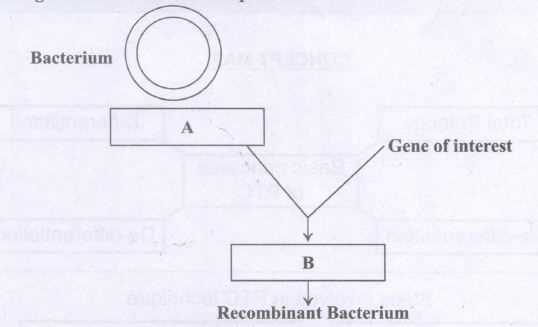
A. Plasmid
B. rDNA / chimeric DNA
17.
Wiener proposed the existence of eight alleles (R1, R2, R0,RZ, r, r1, r11, rY) at a single Rh locus. All genotypes carrying a dominant 'R allele' (Rl, R2 ,R0,RZ)will produce 'Rh-positive' phenotype and double recessive genotypes (rr, rr1, rr11, rry) will give rise to Rh-negative phenotype.
18.
5' CATTATATAATG 3'
3' GTAATATATTAC 5'
19.
When normal vaginal delivery is not possible due to factors like position of the baby and nature of the placenta, the baby is delivered through a surgical incision in the woman's abdomen and uterus. It is also termed as abdominal delivery or Caesarean Section or 'C' Section.
20.
Sometimes, the chromosome number of somatic cells changed due to addition or elimination of individual chromosome or basic set of chromosomes. This condition in known as ploidy.
21.
During zygotene stage of prophase I of meiosis I, homologous chromosomes are aligned side by side resulting in a pair of homologous chromosomes called bivalents.
22.
Binary fission, Multiple fission, Sporulation and Strobilation
23.
The term genotype is the genetic constitution of an individual. The term phenotype refers to the observable characteristic of an organism.
24.
| Anemophilous Flowers | Ornithophilous Flowers |
|---|---|
| (a) Small sized flowers | Large sized flowers |
| (b) Colorless | Brightly colored |
| (c) Donor produce nectar | Produce large quantity of nectar |
| E.g: Grasses | Bombax |
25.
The body of the ovule is made up of a central mass of parenchymatous tissue called nucellus which has large reserve food materials.
26.
(a) Budding - Hydra
(b) Fragmentation - Spirogyra
(c) Regeneration - Planaria
(d) Gemma cup formation - Marchantia
27.
Eltonian pyramid or Ecological pyramid is a graphic representation of the trophic structure and function at successive trophic levels of an ecosystem.
28.
The steepness of the mountain or hill allows the rain to run off. As a result the loss of water causes water deficit and quick erosion of the top soil resulting in poor vegetation. On the other hand, the plains and valley are rich in vegetation due to the slow drain of surface water and better retention of water in the soil.
29.
An ecological niche refers to an organism's place in the biotic environment and its functional role in an ecosystem.
30.
(i) Macro consumers are herbivores, carnivores and omnivores.
(ii) Micro consumers are decomposers.
31.
Glycine 2.0 mg/l, Nicotinic acid 0.5 mg/l, Pyridoxin HCI 0.5 mg/l and Thiamine HCI 0.1 mg/l.
32.
Triticale (Triticum durum x Secale cereale).
Raphanobrassica (Brassica oleraceae x Raphanus sativus).
33.
Any system having the capacity to accumulate more atmospheric carbon during a given time interval than releasing CO2, Example: forest, soil, ocean are natural sinks. Landfills are artificial sinks.
34.
The International treaty called the Montreal Protocol (1987) was held in Canada on substances that deplete ozone layer and the main goal of it is gradually eliminating the production and consumption of ozone depleting substances and to limit their damage on the Earth's ozone layer.
35.
Sugar cane is the raw material for extracting white sugar. Sugarcane supports large number of industries like sugar mills producing refined sugars, distilleries producing liquor grade ethanol and millions of jaggery manufacturing units. Fresh sugarcane juice is a refreshing drink. Molasses is the raw material for the production of ethyl alcohol.
36.
Mesozoic era is divided into three periods namely Triassic, Jurassic and Cretaceous.
Dominating Fauna: Reptiles and Dinosaurs
Dominating Flora: Conifers, Ferns and Ginkgon.
37.
(i) Foetoscope is used to monitor the foetal heart rate and other functions during late pregnancy and labour. The average foetal heart rate is between 120 and 160 beats per minute.
(ii) An abnormal foetal heart rate or pattern may mean that the foetus is not getting enough oxygen and it indicates other problems.
38.
Methane producing bacteria are called methanogens
Eg.Methanobacterium.
It is present in anaerobic sludge and rumen of cattle. It plays a role in Gobar gas production.
39.
Antibiotics are classified as:
Broad-spectrum antibiotics: They act against a wide range of disease-causing bacteria.
Eg.streptomycin
Narrow-spectrum antibiotics They are active against a selected group of bacterial types
40.
Birds and mammals attain greater body size in colder regions than warmer regions (Bergmann's rule).
41.
Interferons are proteinaceous, antiviral, species specific substances produced by mammalian cells when infected with viruses.
42.
Castration or surgical removal of testis is known as orchidectomy.
43.
The process of formation of placenta which is the intimate connection between foetus and uterine wall of the mother for exchange of nutrients is called Placentation.
44.
Non-infection diseases are not transmitted from an infected person to a healthy person. In origin they may be genetic (cystic fibrosis), nutritional (vitamin deficiency diseases) and degenerative (arthritis, heart attack, stroke).
45.
Erwin Chargaff changes observed that in DNA, Adenine pairs with Thymine (A = T) with two hydrogen bonds and Guanine pairs with Cytosine (G ☰ C) with three hydrogen bonds.
The ratios between Adenine with Thymine and Guanine with Cytosine are constant and equal. This base pairing gives a unique property to DNA.
46.
It is a type of fertilization In autogamy, the male and female gametes are produced by the same cell or same organism and both the gametes fuse together to form a zygote.
E.g. Actinosphaerium and Paramecium
47.
It is a test which is more reliable and is a confirmatory test to detect the presence of viral core proteins in the case of HIV infection.

12th Standard Syllabus & Materials
12th Standard
TN 12th Computer Applications வலையமைப்பு வடமிடல் Sample Question Papers Study Material - QB365 Set A
NEW12th Standard
TN 12th Computer Applications களப்பெயர் முறைமை (DNS) Sample Question Papers Study Material - QB365 Set A
NEW12th Standard
TN 12th Computer Applications வலையமைப்பு எடுத்துக்காட்டுகள் மற்றும் நெறிமுறைகள் Sample Question Papers Study Material - QB365 Set A
NEW12th Standard
TN 12th Computer Applications கணினி வலையமைப்பு ஓர் அறிமுகம் Sample Question Papers Study Material - QB365 Set A



Tamilnadu Stateboard 12th Standard Subjects

Maths

Chemistry

Physics
Biology

Computer Science

Business Maths and Statistics

Economics

Commerce

Accountancy

History

Computer Applications
Biology
Computer Technology
Computer Applications
Computer Science
Business Maths and Statistics
Commerce
Economics
Maths
Chemistry
Physics
Computer Technology
History
Accountancy

Tamil

English

French
Tamilnadu Stateboard Standards

