
 100% FREE ACCESS
12th Standard Syllabus & Materials
12th Standard
TN 12th Computer Applications மின்னணு தரவு பரிமாற்றம் Sample Question Papers Study Material - QB365 Set A
NEW12th Standard
TN 12th Computer Applications மின் - வணிக பாதுகாப்பு அமைப்புகள் Sample Question Papers Study Material - QB365 Set A
NEW12th Standard
TN 12th Computer Applications மின்னணு செலுத்தல் முறைகள் Sample Question Papers Study Material - QB365 Set A
NEW12th Standard
TN 12th Computer Applications மின் - வணிகம் Sample Question Papers Study Material - QB365 Set A
NEW12th Standard
TN 12th Computer Applications திறந்த மூல கருத்துருக்கள் Sample Question Papers Study Material - QB365 Set A
NEW12th Standard
TN 12th Computer Applications வலையமைப்பு வடமிடல் Sample Question Papers Study Material - QB365 Set A

Published on: 20/01/2020
Download Tamil Nadu 12th Standard Biology question papers, model tests, one-mark questions, important questions, and public exam papers in PDF format. Free study materials and answer keys for TN State Board students.
Questions + Answers key
Take MCQ Biology Test1.
List out the significance of ploidy.
2.
What is co evolution?
3.
Describe Population Age Distribution
4.
Amniocentesis, the foetal sex determination test, is banned in our country, Is it necessary? Comment.
5.
List the common withdrawal symptoms of drugs and alcohol abuse.
6.
Point out the effects of Noise pollution
7.
Describe the stages of Sewage treatment process
8.
Explain the process of oogenesis.
9.
Explain various edaphic factors that affect vegetation.
10.
How Eichhornia crassipes spoils the Indian ecosystem?
11.
Write a note on extinction and its types
12.
Write the characteristics of tundra.
13.
Explain the events in life cycle of plasmodium in the secondary host/Man
14.
Explain the role of thymus as an lymphoid organ.
15.
List out the new breeding techniques involved in developing new traits in plant breeding.
16.
Mention the advantages (3) and disadvantages of cloning (3).
17.
How is the two stage process of protein synthesis advantageous?
18.
The following is the illustration of the sequence of ovarian events (a-i) in a human female.
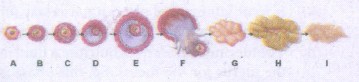
a) Identify the figure that illustrates ovulation and mention the stage of oogenesis it represents.
b) Name the ovarian hormone and the pituitary hormone that have caused the above-mentioned events.
c) Explain the changes that occurs in the uterus simultaneously in anticipation.
d) Write the difference between C and H.
19.
Explain the inheritance of sex linked characters in human being.
20.
How does Neanderthal man differ from the modern man in appearance?
1.
Many polyploids are more vigorous and more adaptable than diploids.
(i) Many ornamental plants are autotetraploids and have larger flower and longer flowering duration than diploids.
(ii) Autopolyploids usually have increase in fresh weight due to more water content.
(iii) Aneuploids are useful to determine the phenotypic effects of loss or gain of different chromosomes.
(iv) Many angiosperms are allopolyploids and they play a role in an evolution of plants.
2.
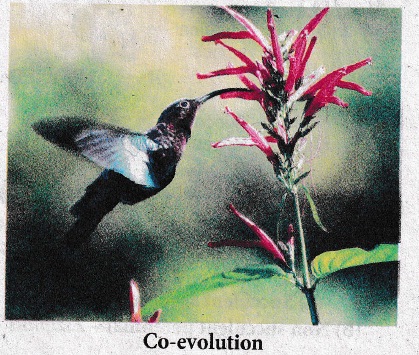
Co-evolution: The interaction between organisms, when continues for generations, involves reciprocal changes in genetic and morphological characters of both organisms. This type of evolution is called co-evolution. It is a kind of co-adaptation and mutual change among interactive species.
3.
(i) The proportion of the age groups in a population is its age distribution attribute.
(ii) This determines the reproductive status of the population at the given time and is an indicator of the future population size.
(iii) Usually a rapidly growing population will have larger proportion of young individuals.
(iv) A stable population will have an even distribution of various age classes.
(v) A declining population tends to have a larger proportion of older individuals
4.
1. Amniocentesis is the pre-natal diagnostic technique in which a sample of amniotic fluid from the womb of a pregnant woman is taken during early stages of embryonic development and the cells are cultured and analysed synthetically.
2. Any chromosomal disorder or a metabolic error can be detected and if necessary MTP can be advised.
3. But this technique is misused for knowing the sex of the foetus followed by female foeticide.
4. Female foeticide refers to aborting the female in the mother's womb.
5. In order to prevent female foeticide and infanticide, Government of India has taken various steps like PCPNDT Act .(preconception and prenatal diagnostic technique act-1994) enacted to ban the identification of sex and to prevent the use of prenatal diagnostic techniques for selective abortion.
5.
(i) Mild tremors to convulsions.
(ii) Severe agitation and fits.
(iii) Depressed mood.
(iv) Anxiety.
(v) Nervousness.
(vi) Restlessness.
(vii) Irritability.
(viii) Insomnia.
(ix) Dryness of throat.
6.
1. According to the USEPA (United States Environmental Protection Agency) there are direct links between noise and health. Heart disease, high blood pressure, stress related illness, sleep disruption, hearing loss (deafness), and productivity loss are the problems related to noise pollution.
2. Increased stress and tension, nervousness, irritability, anxiety, depression and panic attacks.
3. Peptic ulcer, severe head ache and memory loss.
4. Marine animals are affected by noise-pollution from offshore activities and port activities.
5. Fire crackers frighten animals. Birds are often affected by increased air traffic.
7.
Sewage treatment is usually performed in the following three stages
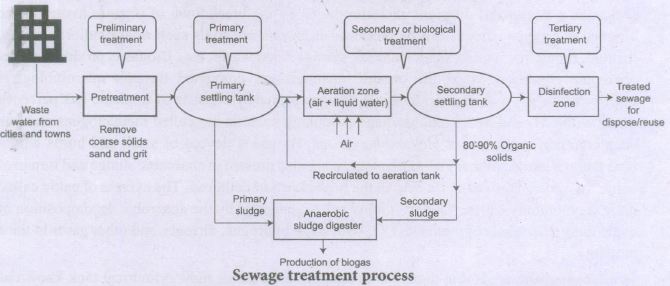
Primary treatment: Primary treatment involves the physical removal of solid and particulate organic and inorganic materials from the sewage through filtration and sedimentation. Floating debris is removed by sequential filtration. Then the grit (soil and small pebbles) are removed by sedimentation. All solids that settle form the primary sludge and the supernatant forms the effluent. The effluent from the primary settling tank is taken for secondary treatment.
Secondary treatment or biological treatment: The primary effluent is passed into large aeration tanks where it is constantly agitated mechanically and air is pumped into it. This allows vigorous growth of useful aerobic microbes into floc (masses of bacteria associated with fungal filaments to form mesh like structures). While growing, these microbes consume the major part of the organic matter in the effluent. This significantly reduces the BOD (Biochemical oxygen demand or Biological oxygen demand). BOD refers to the amount of the oxygen that would be consumed, if all the organic matter in one litre of water were oxidized by bacteria. The sewage water is treated till the BOD is reduced. The greater the BOD of the waste water more is its polluting potential. Once the BOD of sewage water is reduced significantly, the effluent is then passed into a settling tank where the bacterial "floes" are allowed to sediment. This sediment is called activated sludge. A small part of activated sludge is pumped back into the aeration tank to serve as the inoculum. The remaining major part of the sludge is pumped into large tanks called anaerobic sludge digesters. Here, the bacteria which grow anaerobically, digest the bacteria and the fungi in the sludge. During this digestion, bacteria produce a mixture of gases such as methane, hydrogen sulphide and CO2. These gases form biogas and can be used as a source of energy.
Tertiary treatment: Tertiary treatment is the final process that improves the quality of the waste water before it is reused, recycled or released into natural water bodies. This treatment removes the remaining inorganic compounds and substances, such as nitrogen and phosphorus. UV is an ideal disinfectant for wastewater since it does not alter the water quality - except for inactivating microorganisms. UV is a chemical free process that can completely replace the existing chlorination system and also inactivates chlorine-resistant microorganisms like Cryptosporidium and Giardia.
8.
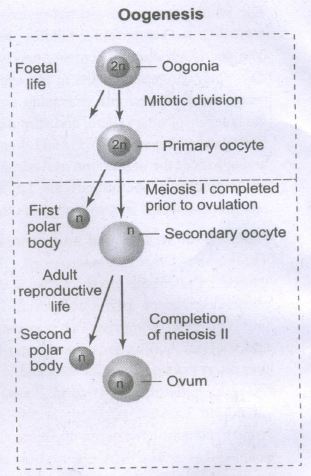
Oogenesis is the process of development of the female gamete or ovum or egg in the ovaries. During foetal development, certain cells in the germinal epithelium of the foetal ovary divide by mitosis and produce millions of egg mother cells or oogonia. No more oogonia are formed or added after birth. The oogonial cells start dividing and enter into Prophase- I of meiotic division-I to form the primary oocytes which are temporarily arrested at this stage. The primary oocytes then get surrounded by a single layer of granulosa cells to form the primordial or primary follicles. A large number of follicles degenerate during the period from birth to puberty, so at puberty, only 60,000 to 80,000 follicles are left in each ovary. The primary follicle gets surrounded by many layers of granulosa cells and a new theca layer to form the secondary follicle. A fluid filled space, the antrum develops in the follicle and gets transformed into a tertiary follicle. The theca layer gets organized into an inner theca intema and an outer theca extema. At this time, the primary oocyte within the tertiary follicle grows in size and completes its first meiotic division and forms the secondary oocyte. It is an unequal division resulting in the formation of a large haploid secondary oocyte and a first polar body. The first polar body disintegrates. During fertilization, the secondary oocyte undergoes second meiotic division and produces a large cell, the ovum, and a second polar body. The second polar body also degenerates. The tertiary follicle eventually becomes a mature follicle or Graafian follicle. If fertilization does not take place, the second meiotic division is never completed and the egg disintegrates. At the end of gametogenesis in females, each primary oocyte gives rise to only one haploid ovum.
9.
The important edaphic factors which affect vegetation are as follows:
1. Soil moisture: Plants absorbs rain water and moisture directly from the air.
2. Soil water: Soil water is more important than any other ecological factors affecting the distribution of plants. Rain is the main source of soil water. Capillary water held between pore spaces of soil particles and angles between them is the most important form of water available to the plants.
3. Soil reactions: Soil may be acidic or alkaline or neutral in their reaction. pH value of the soil solution determines the availability of plant nutrients. The best pH range of the soil for cultivation of crop plants is 5.5 to 6.8.
4. Soil nutrients: Soil fertility and productivity is the ability of soil to provide all essential plant nutrients such as minerals and organic nutrients in the form of ions.
5. Soil temperature: Soil temperature of an area plays an important role in determining the geographical distribution of plants. Low temperature reduces use of water and solute absorption by roots.
6. Soil atmosphere: The spaces left between soil particles are called pore spaces which contains oxygen and carbon-di-oxide.
7. Soil organisms: Many organisms existing in the soil like bacteria, fungi, algae, protozoans, nematodes, insects and earthworms, etc., are called soil organisms.
10.
Eichhornia crassipes is an invasive weed native to South America. It was introduced as aquatic ornamental plant, which grows faster throughout the year. Its widespread growth is a major cause of biodiversity loss worldwide. It affects the growth of phytoplankton and finally changing the aquatic ecosystem.
It also decreases the oxygen content of the waterbodies which leads to eutrophication. It poses a threat to human health because it creates a breeding habitat for disease-causing mosquitoes (particularly Anopheles) and snails with its free-floating dense roots and semi submerged leaves. It also blocks sunlight entering deep and the water ways hampering agriculture, fisheries, recreation, and hydropower.
11.
Species is considered extinct when none of its members are alive anywhere in the world. If individuals of a species remain alive only in captivity or other human controlled conditions, the species is said to be extinct in the wild. In both of these situations, the species would be considered globally extinct. A species in considered to be locally extinct when it is no longer found in an area it once inhabited but is still found elsewhere in the wild.
Types of extinctions:
(i) Natural extinction is a slow process of replacement of existing species with better adapted species due to changes in environmental conditions, evolutionary changes, predators and diseases. A small population can get extinct sooner than the large population due to inbreeding depression (less adaptivity and variation).
(ii) Mass extinction: The earth has experienced quite a few mass extinctions due to environmental catastrophes. A mass extinction occurred about 225 million years ago during the Permian, where 90% of shallow water marine invertebrates disappeared.
(iii) Anthropogenic extinctions: These are abetted by human activities like hunting, habitat destruction, over exploitation, urbanization and industrialization. Some examples of extinctions are Dodo of Mauritius and Steller's sea cow of Russia. Amphibians seem to be at higher risk of extinction because of habitat destruction.
12.
(i) Extremely cold climate
(ii) Low biotic diversity
(iii) Simple vegetation structure
(iv) Limitation of drainage
(v) Short season of growth and reproduction
(vi) Energy and nutrients in the form of dead organic material
(vii) Large population oscillations
13.
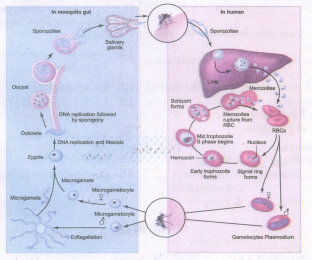
(i) Plasmodium vivax is a digenic parasite, involving two hosts, man as the secondary host and female Anopheles mosquito as the primary host. The life cycle of Plasmodium involves three phases namely schizogony, gamogony and sporogony (f.g)
(ii) The parasite first enters the human blood stream through the bite of an infected female Anopheles mosquito. As it feeds, the mosquito injects the saliva containing the sporozites.
(iii) The sporozoites within the blood stream enter the hepatic cells of the liver and undergoes multiple asexual fission (schizogony). This produces merozoites which are released from liver cells.
(iv) The merozoites penetrate the RBC's. Inside the RBC of Blood, the merozoite of Plasmodium to develop as unicellular trophozoites. The trophozoite grows in size and a central vacuole develops pushing them to one side of cytoplasm and becomes the signet ring stage.
(v)The trophozoite nucleus then divides asexually to produce the The schizont divides and produces on nucleated merozoites.
(vi) Eventually the erythrocyte lyses, releasing the merozoites and haemozoin toxin into the blood stream to infect other erythrocytes. Lysis of red blood cells results in cycles of fever and other symptoms. This erythrocytic stage is cyclic and repeats itself approximately every 48 to72 or longer depending on the species of Plasmodium involved. The sudden release of merozoites triggers an attack on the RBCs.
(vii) Occasionally, merozoites differentiate into macrogametocytes and microgametocytes When these are ingested by a mosquito, they develop into male and female gametes respectively
In the mosquito's gut, the infected erythrocytes lyse and male and female gametes fertilize to form a diploid zygote called ookinete. The ookinete migrates to the mosquito's gut wall and develops into an oocyte.
The oocyte undergoes meiosis by a process called sporogony to form sporozoites. These sporozoites migrate to the salivary glands of the mosquito. The cycle is now completed and when the mosquito bites another human host, the sporozoites are injected and the cycle begins a new.
The pathological changes caused by malaria, affect not only the erythrocytes but also the spleen and other visceral organs. Incubation period of malaria is about 12 days. The early symptoms of malaria are headache, nausea and muscular pain. The classic symptoms first develop with the synchronized release of merozoites, hemozoin toxin and erythrocyte debris into the bloodstream resulting in malarial paroxysms - shivering chills, high fever followed by sweating. Fever and chills are caused partly by malarial toxins that induce macrophages to release tumor necrosis factor (TNF-a) and interleukin.
14.
Thymus is most active during the neonatal an pre-adolescent periods. The thymus is a flat and bilobed organ located behind the sternum, above the heart.
(ii) Each lobe of the thymus contains numerous lobules, separated from each other by connective tissue called septa. Each lobule is differentiated into an outer cortex and an inner medulla.
(iii) Within each lobule, the developing T cells called thymocytes are arranged into outer cortex and inner medulla. The inner medulla contains immature thymocytes and outer cortex has matured thymocytes.
(iv) One of its main secretions is the hormone thymosin. It stimulates the T cell to become mature and immunocompetent. By the early teens, the thymus begins to atrophy and is replaced by adipose tissue.
15.
(i) Hybridization, Mutation breeding, Polyploid breeding, Breeding for developing resistance to diseases, Biofortification, Breeding for resistance to insect pests, New Breeding Techniques (NBT) such as.
(ii) CRISPR/ Cas (Cutting and modifying the genome during the repair process by tool).
(iii) ODM: Oligonucleotide - directed mutagenesis
(iv) Transferring a gene from an identical or closely related species (Cisgenesis).
(v) Organising processes that alter gene activity without altering the DNA itself (Epigenetic methods).
16.
Advantages
1. Offers benefits for clinical traits and medical research.
2. It can help in the production of help in the production of proteins and drugs in the field of medicine.
3. Aids in stem cell research
4. Animal cloning could help to save endangered species.
Disadvantages
1. In animal and human activities, it as a threat to biodiversity saying that this alters evolution which will have an impact on populations and ecosystem.
2. The process is tedious and very expensive.
3. It can cause animals to suffer
4. Reports show that animal surrogates were manifesting adverse outcomes and cloned animals were affected with disease and have high mortality rate.
5. It might compromises human health through consumption of cloned animal meat.
6. Cloned animals age faster than normal animals and are less healthy than the parent organisms as discovered in Dolly.
7. Cloning can lead to occurrence of genetic disorders in animals.
8. More than 90% of cloning attempts fail to produce a viable offspring.
17.
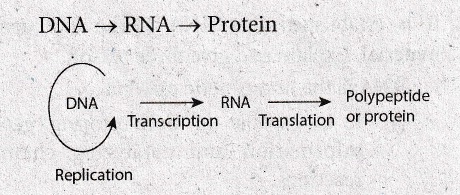
1. The process protein synthesis actually consists of two stages-transcription and translation.
2. In eukaryotic cells, transcription takes place in the nucleus. During transcription, DNA is used as a template to make a molecule of messenger RNA (mRNA). The molecule of mRNA then leaves the nucleus and reaches ribosome in the cytoplasm, where translation occurs.
3. During translation, the genetic code in mRNA is read and used to make a protein.
4. These two processes are summedup by the central dogma of molecular biology
18.
(a) The figure 'F' represent ovulation.
Stage of oogenesis - Ovulatory or luteal stage of oogenesis
(b) (i) The ovarian hormone is progesterone which is released during ovulation.
(ii) The pituitary hormones are the follicle-stimulating hormone (FSH) and Luteinizing hormone (LSH) which are released during and ovulation from anterior pituitary gland.
(c) The endometrium of the uterus gets thickened and blood supply to the endometrium increase.
(d) Figure 'C' represents the secondary follicle and figure h represents the degenerating corpus luteum.
| Secondary follicle | Corpus luteurn |
| lt is surrounded by layers of granulosa cells | Absence of granulosa cells |
| Theca layer is present | Theca layer is absent. |
19.
(i) The inheritance of a trait that is determined by a gene located on one of the sex chromosomes is called sex linked inheritance.
(ii) Genes present on the differential region of X or Y chromosomes are called sex linked genes. The genes present in the differential region of "X" chromosome are called X linked genes. The X-linked genes have no corresponding alleles in the Y chromosome.
(iii) The genes present in the differential region of Y chromosome are called Y- linked or holandric genes. The Y linked genes have no corresponding allele in X chromosome.
(iv) The Y linked genes inherit along with Y chromosome and they phenotypically express only in the male sex.
(v) Sex linked inherited traits are more common in males than females because, males are hemizygous and therefore express the trait when they inherit one mutant allele.
(vi) The X - linked and Y - linked genes in the differential region (non-homologus region) do not undergo pairing or crossing over during meiosis. The inheritance of X or Y linked genes is called sex-linked inheritance.
X linked Inheritance - Eg. Colour blindness
Y linked Inheritance - Eg. hypertrichosis
20.
(i) Neanderthal human was found in Neander Valley, Germany with a brain size of 1400 cc and lived between 34,000 - 1,00,000 years ago.
(ii) They differ from the modern. human in having semierect posture, flat cranium, sloping forehead, thin large orbits, heavy brow ridges, protruding jaws and no chin.

12th Standard Syllabus & Materials
12th Standard
TN 12th Computer Applications களப்பெயர் முறைமை (DNS) Sample Question Papers Study Material - QB365 Set A
NEW12th Standard
TN 12th Computer Applications வலையமைப்பு எடுத்துக்காட்டுகள் மற்றும் நெறிமுறைகள் Sample Question Papers Study Material - QB365 Set A
NEW12th Standard
TN 12th Computer Applications கணினி வலையமைப்பு ஓர் அறிமுகம் Sample Question Papers Study Material - QB365 Set A
NEW12th Standard
TN 12th Computer Applications PHP-உடன் MySQL-ஐ இணைத்தல் Sample Question Papers Study Material - QB365 Set A



Tamilnadu Stateboard 12th Standard Subjects

Maths

Chemistry

Physics
Biology

Computer Science

Business Maths and Statistics

Economics

Commerce

Accountancy

History

Computer Applications
Biology
Computer Technology
Computer Applications
Computer Science
Business Maths and Statistics
Commerce
Economics
Maths
Chemistry
Physics
Computer Technology
History
Accountancy

Tamil

English

French
Tamilnadu Stateboard Standards

