
 100% FREE ACCESS
12th Standard Syllabus & Materials
12th Standard
TN 12th Maths Applications of Matrices and Determinants Sample Question Papers Study Material - QB365 Set A
NEW12th Standard
TN 12th Computer Applications மின்னணு தரவு பரிமாற்றம் Sample Question Papers Study Material - QB365 Set A
NEW12th Standard
TN 12th Computer Applications மின் - வணிக பாதுகாப்பு அமைப்புகள் Sample Question Papers Study Material - QB365 Set A
NEW12th Standard
TN 12th Computer Applications மின்னணு செலுத்தல் முறைகள் Sample Question Papers Study Material - QB365 Set A
NEW12th Standard
TN 12th Computer Applications மின் - வணிகம் Sample Question Papers Study Material - QB365 Set A
NEW12th Standard
TN 12th Computer Applications திறந்த மூல கருத்துருக்கள் Sample Question Papers Study Material - QB365 Set A

Published on: 20/01/2020
Download Tamil Nadu 12th Standard Biology question papers, model tests, one-mark questions, important questions, and public exam papers in PDF format. Free study materials and answer keys for TN State Board students.
Questions + Answers key
Take MCQ Biology Test1.
Why do submerged plants receive weak illumination than exposed floating plants in a lake?
2.
Why is the offspring formed by asexual reproduction referred as a clone?
3.
What is Cantharophily.
4.
Complete the flow chart by mentioning the ploidy of cells in boxes.
5.
How exogenous buds are developed by Hydra?
6.
What are the human activities that disturb an ecosystem?
7.
A plant breeder developed a hybrid sugarcane by grafting two different varieties with desirable characters. The resultant hybrid showed excellent growth and productivity with increased sucrose content compared to its parental forms.
(I) What does this phenomenon refers to?
(il) How this condition can be maintained through further generation?
8.
Mention any three sources of carbon dioxide emission.
9.
What is Ferguson reflex?
10.
What is strobilation?
11.
Mention preventive measures for AIDS.
12.
Why is an antibody molecule represented as H2 L2?
13.
What are millets? What are its types? Give example for each type.
14.
Differentiate between Somatic cell gene therapy and germline gene therapy
15.
Why is biodiversity so important and worthy of protection?
16.
What are the strategies to be implemented in India to attain total reproductive health?
17.
What are restriction enzyme. Mention their type with role in Biotechnology.
18.
“Endothecium is associated with dehiscence of anther” Justify the statement
19.
Explain stabilizing, directional and disruptive selection with examples
20.
How is sex determined in human beings?
1.
Submerged plants are unable to obtain full illumination because a lot of sunlight is absorbed by overlying layers of water this is not the case for exposed floating plants that receive sunlight directly.
2.
Offsprings produced by asexual reproduction are called clones, because they are genetically as well as morphologically similar to the parent organism.
They are not only similar to one another, but are also exact copies of their parent (e,g): Amoeba, Spirogyra, Hydra, Yeast, etc.
3.
Pollination carried out by beetle is called cantharophily.
4.
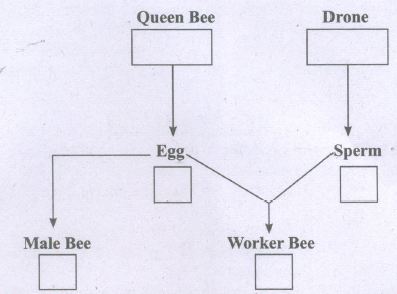
Queen Bee, Worker Bee - Diploid (2n)
Drones (Male Bee), Egg, sperm - Haploid (n)
5.
When buds are formed on the outer surface of the parent body, it is known as exogenous budding e.g. Hydra. In Hydra when food is plenty, the ectoderm cells increase and form a small elevation on the body surface. Ectoderm and endoderm are pushed out to form the bud. The bud contains an interior lumen in continuation with the parent's gastrovascular cavity. The bud enlarges, develops a mouth and a circle of tentacles at its free end. When fully grown, the bud constricts at the base and finally separates from the parent body and leads an independent life.
6.
(I) Habitat destruction.
(II) Deforestation and over-grazing.
(III) Erosion of soils.
(IV) Introduction of non-native species.
(V) Over harvesting of plant material.
(VI) Pollution of land, water and air.
(VII) Run off pesticides, fertilizers and animal wastes.
7.
(i) Heterosis or Hybrid vigour
(ii) Vegetative propagation is the best-suited measure to maintain the vigorousity of hybrid.
8.
(i) Coal based power plants, by the burning of fossil fuels for electricity generation.
(ii) Combustion of fuels in the engines of automobiles, commercial vehicles, and air planes contribute the most of global warming.
(iii) Agricultural practices like stubble burning result in emission of CO2.
9.
(i) During parturition the descent of the foetus causes dilation of cervix of the uterus and vaginal canal resulting in a neurohumoral reflex called Foetal ejection reflex or Ferguson reflex.
(ii) This initiates the secretion of oxytocin from the neurohypophysis which in turn brings about the powerful contraction of the uterine muscles and leads to the expulsion of the baby through the birth canal.
10.
(i) In some metazoan animals, a special type of transverse fission called strobilation occurs.
(ii) In the process of strobilation, several transverse fissions occur simultaneously giving rise to a number of individuals which often do not separate immediately from each other. E.g. Aurelia.
11.
(i) Use of safe blood for transfusion
(ii) Use of disposable needles
(iii) Prevention of drug abuse
(iv) Advocating safe sex
12.
Porter and Edelman revealed the basic structure of the immunoglobulin. An antibody molecule is Y shaped structure that comprises of four polypeptide chains, two identical light chains (L) of molecular weight 25,000 Da (approximately 214 amino acids) and two identical heavy chains (H) of molecular weight 50,000 Da (approximately 450 amino acids). The polypeptide chains are linked together by di-sulphide (S-S) bonds. One light chain is attached to each heavy chain and two heavy chains are attached to each other to form a Y shaped structure. Hence, an antibody is represented by H2 L2.
13.
| S.No | Common name | Botanical name |
| 1 | Foxtail Millet | Staria italica |
| 2 | Kodo Millet | Paspalum scrobiculatum |
14.
| S.No. | SOMATIC CELL GENE THERAPY | GERMLINE GENE THERAPY |
|---|---|---|
| i. | Therapeutic genes transferred into the somatic cells. | Therapeutic genes transferred into the germ cells. |
| ii. | Introduction of genes into bone marrow cells, blood cells, skin cells, etc., | Genes introduced into eggs and sperms. |
| iii. | Will not be inherited in later generations. | Heritable and passed on to later generations. |
15.
Biodiversity is the variety of life on earth. That is, it is the number of different species of flora and fauna including microorganisms. These organisms can inhabit different ecosystems with, varying conditions like the Rainforests, Coral reefs, Grasslands, Deserts, Tundra, and the Polar icecaps. This variety (Biodiversity) is essential for the wellbeing of our planet and sustenance of life as a whole. The importance of biodiversity can be viewed and measured as:
a)Ecosystem services
b) Biological resources
c) Social benefits of biodiversity
The organization and functioning of ecosystems world over are affected and dependent on biodiversity and its richness. The major functional attributes are:
(i) Continuity of nutrient cycles or biogeochemical cycles (N2, C, a,o, P, S cycles)
(ii) Soil formation, conditioning or maintenance of soil health (fertility) by soil microbial diversity along with the different trophic members
(iii) Increases ecosystem productivity and provide food resources
(iv) Act as water traps, filters, water flow regulators and water purifiers (forest cover and vegetation)
(v) Climate stability (forests are essential for rainfall, temperature regulation, CO2 absorption, which in turn regulate the density and type of vegetation)
(vi) Forest resource management and sustainable development
(vii) Maintaining a balance between biotic components
(viii) Cleaning up of pollutants - microbes are the biggest degraders of molecules including many anthropogenic ones which are present in effluents, sewage, garbage and agro-chemicals
(ix) Ecological stability - the varieties and richness of species contribute to ecological stability and survival of species. Biodiverse regions are reservoirs of biological resources like food resources, gene pool, genetic resource, medicinal resources, bioprospecting
(x) To provide unique aesthetic value and hotspots for Ecotourism. Along with forest resources and wildlife, it has commercial significance
(xi) An indicator of the health of the ecosystem. Endemism is a crucial indicator of richness.
16.
(i) Creating awareness and providing medical assistance to build a healthy society.
(ii) Introducing sex education in schools to provide information about adolescence and adolescence related changes.
(iii) Educating couples and those in the marriageable age groups about the available birth control methods and family planning norms.
17.
A restriction enzyme or restriction endonuclease is an enzyme that cleaves DNA into fragments at or near specific recognition sites within the molecule known as restriction sites.
Types
(i) Exonucleases - which remove nucleotides one at a time from the end of a DNA molecule. e.g. Bal 31, Exonuclease III.
(ii) Endonucleases - which break the internal phosphodiester bonds within a DNA molecule. e.g. Hind II, EcoRI, PvulI, BamHI, TaqI.
(iii) The restriction enzymes are called as molecular scissors
(iv) They are used in recombinant DNA technology as they recognize & cut DNA within a specific sequence.
18.
Endothecium is a single layer of radially elongated cells, The inner tangential wall of this cell develops bands of a cellulose, The cells are hygroscopic. The stomium of anther lobe lack these thickenings. Stomium along with the hygroscopic nature of endothecium helps in the dehiscence of anther
19.
(i) Stabilizing selection (centripetal selection):
1. This type of selection operates in a stable environment.
2. The organisms with average phenotypes survive where as the extreme individuals from both the ends are eliminated.
3. There is no speciation but the phenotypic stability is maintained within the population over generation.
4. For example, measurements of sparrows that survived the storm clustered around the mean and the sparrows that failed to survive the storm clustered around the extremes of the variation showing stabilizing selection.
(ii) Directional selection:
1. The environment which undergoes gradual change is subjected to directional selection.
2. This type of selection removes the individuals from one end towards the other end of phenotypic distribution.
3. For example size differences between male and female alike extremely but different in body weight.
4. Females show directional selection in reflection to body weight.
(iii) Disruptive selection (centrifugal selection)
1. Under homogenous environmental changes into heterogenous environment this type of selection is operational.
2. The organisms of both the extreme phenotypes are selected whereas individuals with average phenotypes are eliminated. This results in splitting of the population into sub-population/species. This is rare form of selection but leads to the formation of two or more different species.
3. It is also called adaptive radiation (e. g.) Darwin finches -beak size in relation to seed size inhabiting Galapagos islands.
20.
1. The sex determining mechanism of humans is XX-XY type.
2. In humans, out of 23 pairs of chromosomes present, 22 pairs are exactly same in both males and females known as autosomes (body).
3. The 23rd chromosome is the sex chromosome. (i.e) Pair of X-chromosome (XX) is present in females and males having one X and one Y chromosome (XY).
4. During, spermatogenesis, in case of males two types of gametes are produced (x and y).
5. The 50% total sperms produced carry X-chromosomes and the rest 50% carry Y - chromosomes besides autosomes. This condition is called male diagamety.
6. The Y containing sperms and X containing sperms are called androsperms and gynosperms respectively.
7. Female produces only one type of ovum with an X-chromosome. If an ovum fertilizes with a sperm carrying X chromosome the zygote develops into a female (XX) and if an ovum is fertilized with sperm carrying Y-chromosome, zygote thus, formed will be male (YY).
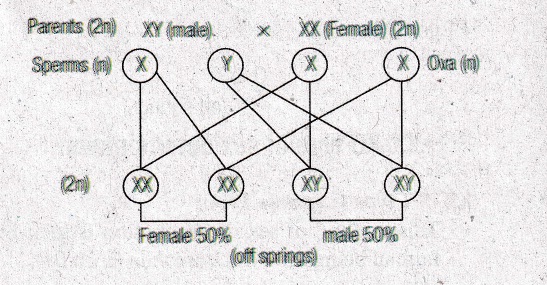
8. Hence, the genetic makeup of sperm, which fertilizes the ovum determines the sex of a child there are 50% chances of having either a male or female in each progeny.
9. Thus, it is by chance phenomenon, so women should not be blamed for giving birth to a girl child

12th Standard Syllabus & Materials
12th Standard
TN 12th Computer Applications வலையமைப்பு வடமிடல் Sample Question Papers Study Material - QB365 Set A
NEW12th Standard
TN 12th Computer Applications களப்பெயர் முறைமை (DNS) Sample Question Papers Study Material - QB365 Set A
NEW12th Standard
TN 12th Computer Applications வலையமைப்பு எடுத்துக்காட்டுகள் மற்றும் நெறிமுறைகள் Sample Question Papers Study Material - QB365 Set A
NEW12th Standard
TN 12th Computer Applications கணினி வலையமைப்பு ஓர் அறிமுகம் Sample Question Papers Study Material - QB365 Set A



Tamilnadu Stateboard 12th Standard Subjects

Maths

Chemistry

Physics
Biology

Computer Science

Business Maths and Statistics

Economics

Commerce

Accountancy

History

Computer Applications
Biology
Computer Technology
Computer Applications
Computer Science
Business Maths and Statistics
Commerce
Economics
Maths
Chemistry
Physics
Computer Technology
History
Accountancy

Tamil

English

French
Tamilnadu Stateboard Standards

