
 100% FREE ACCESS
12th Standard Syllabus & Materials
12th Standard
TN 12th Computer Applications மின்னணு தரவு பரிமாற்றம் Sample Question Papers Study Material - QB365 Set A
NEW12th Standard
TN 12th Computer Applications மின் - வணிக பாதுகாப்பு அமைப்புகள் Sample Question Papers Study Material - QB365 Set A
NEW12th Standard
TN 12th Computer Applications மின்னணு செலுத்தல் முறைகள் Sample Question Papers Study Material - QB365 Set A
NEW12th Standard
TN 12th Computer Applications மின் - வணிகம் Sample Question Papers Study Material - QB365 Set A
NEW12th Standard
TN 12th Computer Applications திறந்த மூல கருத்துருக்கள் Sample Question Papers Study Material - QB365 Set A
NEW12th Standard
TN 12th Computer Applications வலையமைப்பு வடமிடல் Sample Question Papers Study Material - QB365 Set A

Published on: 12/11/2019
Download Tamil Nadu 12th Standard Biology question papers, model tests, one-mark questions, important questions, and public exam papers in PDF format. Free study materials and answer keys for TN State Board students.
Questions + Answers key
Take MCQ Biology Test1.
Pick out the eurythermal organism
Fish
Frog
Tiger
Lizards
2.
DOPA stands for __________
3,4 - dihydroxy phenyl acetate
3,4 - dihydroxy phenyl alanine
3,4 - dihydroxy phenyl asparate
3,4 - dihydroxy phenyl aldehyde
3.
Assertion (A) : Plains and valleys are rich in vegetation
Reason (R): Slow drain of surface water and better water retention is noticed.
A is true R is false
R explains A
A and R are false
A and R are true. But R does not explains A
4.
Identify the plant species that is not used as a live fence.
Sesbania grandiflora
Acacia species
Petunia species
Erythrina species
5.
Theory of chemical evolution was proposed by ___________________
Stanley
Urey
Lamarck
Wiessmann
6.
One after following statement is wrong. Find out.
I Bhang affects the cardiovascular system
II Opium acts a depresent on the central nervous system
III Lysergic acid diethylamide distorts the way one sees, hears and feels
IV Barbiturates slows down the activity of the fore brain.
I II IV
II IV
all the above
none of the above
7.
Assertion (A): The acrosome of the Sperm cell contains Sperm lysin.
Reason (R): Sperm lysin destroys the deformed Sperm cells.
R explains A
A is right R is wrong
A an R are right R does not explains A
Both A and R are wrong
8.
Allergy involves
IgE
IgG
IgA
IgM
9.
CO2 is not released during
Alcoholic fermentation
Lactate fermentation
Aerobic respiration in animals
Aerobic respiration in plants
10.
Which of the following forests is known as the lungs of the planet earth?
Tundra forest
Rain for forest of north east India
Taiga forest
Amazon rain forest
11.
Which of the following statement is correct
Agar is not extracted from marine algae such as seaweeds
Callus undergoes differentiation and produces somatic embryoids.
Surface sterilization of explants is done by using mercuric bromide
PH of the culture medium is 5.0 to 6.0
12.
The approach which does not give the defined action of contraceptive is
Hormonal contraceptive-Prevents entry of sperms, prevent ovulation and fertilization
Vasectomy-Prevents spermatogenesis
Barrier method-Prevents fertilization
Intra uterine device-Increases phagocytosis of sperms, suppresses sperm motility and fertilizing capacity of sperms
13.
14.
15.
How primary immune response differ from secondary immune response?
16.
Explain various steps involved in decomposition (or) Write the steps involved in the mechanism decomposition.
17.
Write the characteristics of tundra.
18.
Write notes on binary fission in animals.
19.
The following is the illustration of the sequence of ovarian events (a-i) in a human female.
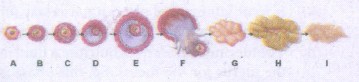
a) Identify the figure that illustrates ovulation and mention the stage of oogenesis it represents.
b) Name the ovarian hormone and the pituitary hormone that have caused the above-mentioned events.
c) Explain the changes that occurs in the uterus simultaneously in anticipation.
d) Write the difference between C and H.
20.
21.
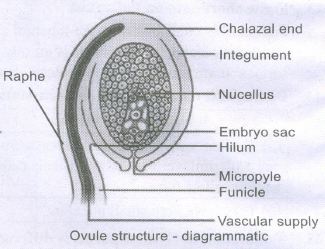
With a suitable diagram explain the structure of an ovule.
22.
In each of the following questions there are two statements. One is assertion (A) and other is reasoning (R). Mark the correct answer as
Assertion (A) : In bee society, all the members are diploid except drones.
Reason (R) : Drones are produced by parthenogenesis
Codes:
A. If both A and R are true and R is correct explanation for A
B. If both A and R are true but R is not the correct explanation for A
C. If A is true but R is false
D. If both A and R are false.
If both A and R are true and R is correct explanation for A
If both A and R are true but R is not the correct explanation for A
If A is true but R is false
If both A and R are false
23.
Point out any four conditions under which Hardy Weinberg's equilibrium is not attained.
24.
Complete the table by filling the gaps.
| Disease | Causative agent | Symptoms |
| Gonnorrhea | A | Affects urethra & cervix, painful urination |
| B | Human Immuno Virus | Enlarged lymph node, night sweat, weight reduction |
| Hepatitis | Hepatitis-B- Virus | C |
25.
What are comutagens ?
26.
What are Secondary metabolites? Give example.
27.
What are the King and Queen of spices? Explain about them and their uses.
28.
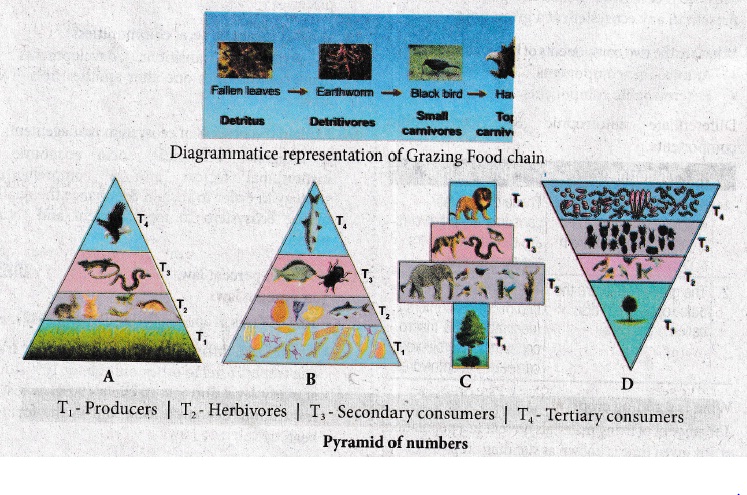
Name of the food chain which is generally present in all type of ecosystem. Explain and write their significance.
29.
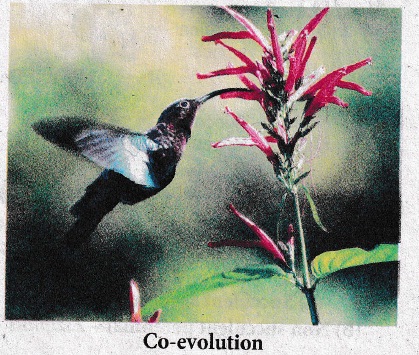
What is co evolution?
30.
List any two adaptive features evolved in parasites enabling them to live successfully on their host?
31.
How will you identify a vector ?
32.
Mention the importance of the position of the testes in humans.
33.
The unicellular organisms which reproduce by binary fission are considered immortal. Justify
34.
35.
What are non-sense codons?
36.
Name any four antibiotics
37.
Name few endangered species protected in Arignar Anna Zoological Park.
38.
Name any four chemical mutagens.
39.
Mention the way by which culture media and explants are sterilized.
40.
Mention any two free-living nitrogen-fixing bacteria.
41.
Give definitions for organic farming?
42.
43.
1.
(c)
Tiger
2.
(b)
3,4 - dihydroxy phenyl alanine
3.
(b)
R explains A
4.
(c)
Petunia species
5.
(b)
Urey
6.
(d)
none of the above
7.
(b)
A is right R is wrong
8.
(a)
IgE
9.
(b)
Lactate fermentation
10.
(b)
Rain for forest of north east India
11.
(b)
Callus undergoes differentiation and produces somatic embryoids.
12.
(b)
Vasectomy-Prevents spermatogenesis
13.
(b)
14.
(b)
15.
| S.No | Primary Immune Response | Secondary Immune Response |
|---|---|---|
| 1. | It occurs as a result of primary contact with an antigen. | It occurs as a result of second and subsequent contacts with the same antigen |
| 2. | Antibody level reaches peak in 7 to 10 days | Antibody level reaches peak in 3 to 5 days. |
| 3. | Prolonged period is required to establish immunity | It establishes immunity in a short time. |
| 4. | There is rapid decline in antibody level | Antibody level remains high for longer period. |
| 5. | It appears mainly in the lymph nodes and spleen. | It appears mainly in the bone marrow followed by the spleen and lymph nodes |
16.
Mechanism of decomposition
Decomposition is a step wise process of degradation mediated by enzymatic reactions.
Detritus acts as a raw material for decomposition.
It occurs in the following steps.
(a) Fragmentation - The breaking down of detritus into smaller particles by detritivores like bacteria, fungi and earth worm is known as fragmentation. These detritivores secrete certain substances to enhance the fragmentation process and increase the surface area of detritus particles.
(b) Catabolism - The decomposers produce some extracellular enzymes in their surroundings to break down complex organic and inorganic compounds in to simpler ones. This is called catabolism.
(c) Leaching or Eluviation - The movement of decomposed, water soluble organic and inorganic compounds from the surface to the lower layer of soil or the carrying away of the same by water is called leaching or eluviation.
(d) Humification - It is a process by which simplified detritus is changed into dark coloured amorphous substance called humus. It is highly resistant to microbial action, therefore decomposition is very slow. It is the reservoir of nutrients.
(e) Mineralisation - Some microbes are involved in the release of inorganic nutrients from the humus of the soil, such process is called mineralisation.
17.
(i) Extremely cold climate
(ii) Low biotic diversity
(iii) Simple vegetation structure
(iv) Limitation of drainage
(v) Short season of growth and reproduction
(vi) Energy and nutrients in the form of dead organic material
(vii) Large population oscillations
18.
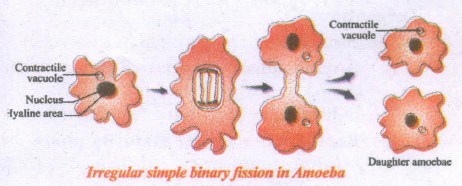
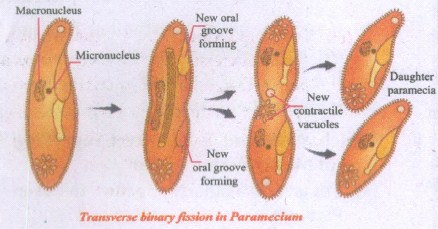
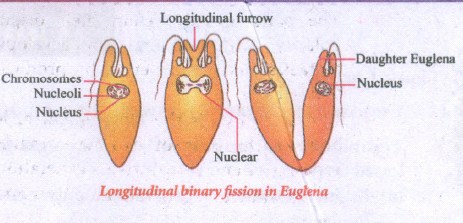
In binary fission, the parent organism divides into two halves and each half forms a daughter individual. The nucleus divides first amitotically or mitotically (karyokinesis), followed by the division of the cytoplasm (cytokinesis). The resultant offsprings are genetically identical to the parent. Depending on the plane of fission, binary fission is of the following types
(i) Simple irregular binary fission
(ii) Transverse binary fission
(iii) Longitudinal binary fission
(iv) Oblique binary fission
(i) Simple irregular binary fission is seen in Amoeba like irregular shaped organisms, where the plane of division is hard to observe. The contractile vacuoles cease to function and disappear. The nucleoli disintegrate and the nucleus divides mitotically. The cell then constricts in the middle, so the cytoplasm divides and forms two daughter cells.
(ii) In Transverse binary fission, the plane of the division runs along the transverse axis of the individual. E.g. Paramecium and Planaria. In Paramecium the macronucleus divides by amitosis and the micronucleus divides by mitosis.
(iii) In Longitudinal binary fission the nucleus and the cytoplasm divides in the longitudinal axis of the organism. In flagellates, the flagellum is retained usually by one daughter cell. The basal granule is divided into two and the new basal granule forms a flagellum in the other daughter individual. E.g. Vorticella and Euglena.
(iv) In Oblique binary fission the plane of division is oblique. It is seen in dinoflagellates. E.g. Ceratium.
19.
(a) The figure 'F' represent ovulation.
Stage of oogenesis - Ovulatory or luteal stage of oogenesis
(b) (i) The ovarian hormone is progesterone which is released during ovulation.
(ii) The pituitary hormones are the follicle-stimulating hormone (FSH) and Luteinizing hormone (LSH) which are released during and ovulation from anterior pituitary gland.
(c) The endometrium of the uterus gets thickened and blood supply to the endometrium increase.
(d) Figure 'C' represents the secondary follicle and figure h represents the degenerating corpus luteum.
| Secondary follicle | Corpus luteurn |
| lt is surrounded by layers of granulosa cells | Absence of granulosa cells |
| Theca layer is present | Theca layer is absent. |
20.
21.
(i) A mature ovule (megasporangium) consist of a stalk and a body
(ii) Funicle - The stalk of the ovule by which it attaches the ovule to the placenta.
(iii) Integuments - one or two protective covering around the nucellus
(iv) Micropyle - Pore present at the tip of the ovule where the integument is absent
(v) Chalaza - The basal region of the body of the ovule where the nucellus, the integument and funicle meet or merge
(vi) Embryosac- The female gametophyte oval sac like structure in the nucellus, toward the micropylar end.
22.
A. If both A and R are true and R is correct explanation for A
23.
(i) Selected mating
(ii) Flow of genes (either by immigration or emmigration)
(iii) Occurrence of mutation
(iv) Definite population size
24.
A - Neisseria Gonorrhoea
B - AIDS
C - Jaundice
25.
Comutagens:
The compounds which are not having own mutagenic properties but can enhance the effects of known mutagens are called comutagens.
Example: Ascorbic acid increase the damage caused by hydrogen peroxide.
26.
Secondary metabolites are chemical compounds that are not required by the plant for normal growth and development but are produced in the plant as 'byproducts' of cell metabolism. For Example: Biosynthesis and isolation of indole alkaloids from Catharanthus roseus plant cell culture.
27.
| Queen of Spices | King of Spices |
| Cardamom (Elettaria cardamomum) |
Black pepper (Piper nigrum) |
| Family : Zingiberaceae | Family : Piperaceae |
28.
Detritus food chain
(i) This type of food chain begins with dead organic matter which is an important source of energy.
(ii) A large amount of organic matter is derived from the dead plants, animals and their excreta.
(iii) This type of food chain is present in all ecosystems
(iv) The transfer of energy from the dead organic matter is transferred through a series of organisms called detritus consumers. (detrivores)-Small carnivores -large (top) carnivores with repeated eating and being eaten respectively.
29.
Co-evolution: The interaction between organisms, when continues for generations, involves reciprocal changes in genetic and morphological characters of both organisms. This type of evolution is called co-evolution. It is a kind of co-adaptation and mutual change among interactive species.
30.
1. Cuscuta is a total stem parasite of the host plant Acacia, Duranta and many other plants Cuscuta even gets flower inducing hormone from its host Plant.
2. Balanophora, orobanche and Refflesia are the total root parasites found on higher plants.
31.
Properties of Vectors:
1. Vectors are able to replicate autonomously to produce multiple copies of them along with their DNA insert in the host cell.
2. It should be small in size and of low molecular weight, less than 10 Kb (kilo base pair) in size so that entry/transfer into host cell is easy.
3. Vector must contain an origin of replication so that it can independently replicate within the host.
4. It should contain a suitable marker such as antibiotic resistance, to permit its detection in transformed host cell.
5. Vector should have unique target sites for integration with DNA insert and should have the ability to integrate with DNA insert it carries into the genome of the host cell. Most of the commonly used cloning vectors have more than one restriction site. These are Multiple Cloning Site (MCS) or polylinker. Presence of MCS facilitates the use of restriction enzyme of choice.
32.
1. Testes are the primary male sex organs.
2. They are a pair of ovoid bodies lying in the scrotum.
3. The scrotum is a sac of skin that hangs outside the abdominal cavity.
4. Since viable sperms cannot be produced at normal body temperature, the scrotum is placed outside the abdominal cavity to provide a temperature 2-3°C lower than the normal internal body temperature.
5. Thus, the scrotum acts as a thermoregulator for spermatogenesis.
33.
1. In unicellular organism there is no special structure for reproduction.
2. In binary fission the entire parent body constitute the reproductive unit and disappears when its division into two daughter unicellular cell is completed.
3. These two daughter cells function as two new individuals.
4. There is no remains of parent body cell and parent cannot be said to have died.
5. In fact after binary fission parent continues living as two daughter individual.
Hence, the unicellular organisms which undergo binary fission are called immortal (no natural death).
34.
35.
UGA, UAA and UAG are the non-sense codons, which terminates translation.
36.
Erythromycin, Chloromycetin, Neomycin, Kanamycin
37.
Royal Bengal Tiger, Lion Tailed Macaque, Nilgiri Langur and Gray Wolf.
38.
(a) Ethyl methanesulphonate (EMS)
(b) Mustard gas
(c) Maganous salt
(d) Formaldehyde
39.
1. Culture media are sterilized by Autoclaving.
2. Explants are surface sterilized by chemicals.
40.
Azotobacter and Clostridium
41.
Organic farming is an alternative agricultural system in which plants/crops are cultivated in natural ways by using biological inputs to maintain soil fertility and ecological balance thereby minimizing pollution and wastage.
42.
43.

12th Standard Syllabus & Materials
12th Standard
TN 12th Computer Applications களப்பெயர் முறைமை (DNS) Sample Question Papers Study Material - QB365 Set A
NEW12th Standard
TN 12th Computer Applications வலையமைப்பு எடுத்துக்காட்டுகள் மற்றும் நெறிமுறைகள் Sample Question Papers Study Material - QB365 Set A
NEW12th Standard
TN 12th Computer Applications கணினி வலையமைப்பு ஓர் அறிமுகம் Sample Question Papers Study Material - QB365 Set A
NEW12th Standard
TN 12th Computer Applications PHP-உடன் MySQL-ஐ இணைத்தல் Sample Question Papers Study Material - QB365 Set A



Tamilnadu Stateboard 12th Standard Subjects

Maths

Chemistry

Physics
Biology

Computer Science

Business Maths and Statistics

Economics

Commerce

Accountancy

History

Computer Applications
Biology
Computer Technology
Computer Applications
Computer Science
Business Maths and Statistics
Commerce
Economics
Maths
Chemistry
Physics
Computer Technology
History
Accountancy

Tamil

English

French
Tamilnadu Stateboard Standards

