
 100% FREE ACCESS
12th Standard Syllabus & Materials
12th Standard
TN 12th Computer Applications மின்னணு தரவு பரிமாற்றம் Sample Question Papers Study Material - QB365 Set A
NEW12th Standard
TN 12th Computer Applications மின் - வணிக பாதுகாப்பு அமைப்புகள் Sample Question Papers Study Material - QB365 Set A
NEW12th Standard
TN 12th Computer Applications மின்னணு செலுத்தல் முறைகள் Sample Question Papers Study Material - QB365 Set A
NEW12th Standard
TN 12th Computer Applications மின் - வணிகம் Sample Question Papers Study Material - QB365 Set A
NEW12th Standard
TN 12th Computer Applications திறந்த மூல கருத்துருக்கள் Sample Question Papers Study Material - QB365 Set A
NEW12th Standard
TN 12th Computer Applications வலையமைப்பு வடமிடல் Sample Question Papers Study Material - QB365 Set A

Published on: 27/11/2019
Molecular Genetics
Download Tamil Nadu 12th Standard Biology question papers, model tests, one-mark questions, important questions, and public exam papers in PDF format. Free study materials and answer keys for TN State Board students.
Questions + Answers key
Take MCQ Biology Test1.
The experiment conducted by Griffith was based on_________.
Transduction
Replication
Transformation
Conjucation
2.
One gene one enzyme hypothesis was proposed by Beadle and Tatum based on ________
Yeast
Drosophila
E. coli
Neurospora
3.
4.
Which of the following is the correct sequence of event with reference to the central dogma?
Transcription, Translation, Replication
Transcription, Replication, Translation
Duplication, Translation, Transcription
Replication, Transcription, Translation
5.
What is the basis for the difference in the synthesis of the leading and lagging strand of DNA molecules?
Origin of replication occurs only at the 5' end of the molecules
DNA ligase works only in the 3' → 5' direction
DNA polymerase can join new nucleotides only to the 3' end of the growing stand.
Helicases and single-strand binding proteins that work at the 5' end
6.
What is nucleosome? How many base pairs are there in a typical nucleosome?
7.
What makes the DNA and RNA as acidic molecules?
8.
Why tRNA is called an adapter molecule?
9.
Give reasons: ‘Genetic code is universal’.
10.
Define termination in protein synthesis.
11.
What is initiation complex in transcription?
12.
State one gene one enzyme hypothesis
13.
In E.coli, three enzymes β- galactosidase, permease and transacetylase are produced in the presence of lactose. Explain why the enzymes are not synthesized in the absence of lactose.
14.
Differentiate - Leading stand and lagging strand
15.
Give a detailed account of a transcription unit.
16.
Describe the steps involved in DNA finger printing.
17.
Explain the formation of a nucleosome.
18.
How is the two stage process of protein synthesis advantageous?
19.
Why the human genome project is called a mega project?
1.
(c)
Transformation
2.
(d)
Neurospora
3.
(d)
4.
(d)
Replication, Transcription, Translation
5.
(c)
DNA polymerase can join new nucleotides only to the 3' end of the growing stand.
6.
The negatively charged DNA is wrapped around the positively charged histone octamere to form a structure called nucleosome. A typical nucleosome contains 200 bp of DNA helix
7.
The phosphate functional group (PO4) gives DNA and RNA the property of an- acid at physiological pH, hence the name nucleic acid.
8.
tRNA on one hand binds to specific amino acids and on the other hand reads the codon of the amino acid bound to it through its anticodon, it is called as adapter molecule.
9.
1. The genetic code is universal. It means that all known living systems use nucleic acids and the same three base codons (triplet codon) direct the synthesis of protein from amino acids. E.g, mRNA ,(UUU) codon codes for phenylalanine in all cells of all organisms.
2. Some exceptions are reported in prokaryotic, mitochondrial and chloroplast genomes. However similarities are more common than differences.
10.
Termination is the third phase of translation Termination of protein synthesis occurs when one of the three stop codons appears in the 'A' site of the ribosome. (UAA, UAG, UGA)
11.
The assembly of the ribosomal subunits, mRNA and tRNA represent the initiation complex.
12.
The experiments of George Beadle and Edward Tatum in the early 1940's on Neurospora crassa (the red bread mould) led them to propose one gene-one enzyme hypothesis, which states that one gene controls the production of one enzyme. This is called one gene one enzyme hypothesis.
13.
When lactose is absent "i" gene regulates and produces repressor mRNA in the absence of lactose, which blocks the transcription. The repressor protein binds to the operator region of the operon and as a result prevents RNA polymerase from binding to the operon. The operon will be switched off (stop) in this situation.
14.
During DNA replication, One acts as the leading strand and the other is the lagging strand.
| Leading Strand | Lagging Strand |
|---|---|
| lt is continuously formed as replicated strand of DNA without any gap |
It is replicated strand of DNA which is formed by the joining of short segments called okazaki segment |
| The growth of leading strand is in 5' → 3'direction | Each okazaki segment grows in 5' → 3'direction but the growth of the lagging strand is in 5' → 3'direction. |
| lt does not require DNA ligase for its growth and used in PCR | DNA ligase is required for the formation of lagging strand from okazaki segments |
15.
A transcriptional unit in DNA is defined by three regions, a promoter, the structural gene, and a terminator. The promoter is located towards the 5' end. It is a DNA sequence that provides binding site for RNA polymerase. The presence of promoter in a transcription unit defines the template and coding strands. The terminator region located towards the 3' end of the coding strand contains a DNA sequence that causes the RNA polymerase to stop transcribing. In eukaryotes the promoter has AT-rich regions called TATA box (Goldberg- Rogness box) and in prokaryotes, this region is called Pribnow box. Besides promoter, eukaryotes also require an enhancer. The two strands of the DNA in the structural gene of a transcription unit have opposite polarity. DNA dependent RNA polymerase catalyses the polymerization in only one direction, the strand that has the polarity 3'\(\rightarrow\)5' acts as a template, and is called the template strand. The other strand which has the polarity 5'\(\rightarrow\)3' has a sequence same as RNA (except thymine instead of uracil) and is displaced during transcription. This strand is called coding strand.
The structural gene may be monocistronic (eukaryotes) or polycistronic (prokaryotes). In eukaryotes, each mRNA carries only a single gene and encodes information for only a single protein and is called monocistronic mRNA. In prokaryotes, clusters of related genes, known as operon, often found next to each other on the chromosome are transcribed together to give a single mRNA and hence are polycistronic.
16.
Steps in DNA printing:
i) Extraction of DNA: The process of DNA fingerprinting starts with obtaining a sample of DNA from blood, semen, vaginal fluids, hair roots, teeth, bones, etc.,
ii) Polymerase chain reaction (PCR) In many situations, there is only a small amount of DNA available for fingerprinting. If needed many copies / f the DNA can be produced by PCR (DNA amplification).
iii) Fragmenting DNA: DNA is treated with restriction enzymes which cut the DNA into smaller fragments at specific sites.
iv) Separation of DNA electrophoresis: During electrophoresis in an agarose gel, the DNA fragments are separated into bands of different sizes. The bands of separated DNA are sieved out of the gel using a nylon membrane (treated with chemicals that allow for it to break the hydrogen bonds of DNA so there are single strands).
v) Denaturing DNA: The DNA on gels is denatured by using alkaline chemicals or by heating.
vi) Blotting: The DNA band pattern in the gel is transferred to a thin nylon membrane placed over the 'size fractionated DNA strand' by Southern blotting.
vii) Using probes to identify specific DNA: A radioactive probe (DNA labeled with a radioactive substance) is added to the DNA bands. The probe attaches by base pairing to those restriction fragments that are complementary to its sequence. The probes can also be prepared by using either. 'fluorescent substance' or 'radioactive isotopes'.
viii) Hybridization with probe: After the probe hybridizes and the excess probe washed off, a photographic film is placed on the membrane containing 'DNA hybrids'.
ix) Exposure film to make a genetic/ DNA Fingerprint: The radioactive label exposes the film to form an image (image of bands) corresponding to specific DNA bands. The thick and thin dark bands form a pattern of bars which constitutes a genetic fingerprint.
17.
(i) In eukaryotes, chromatin is formed by a series of repeating units called nucleosomes.
(ii) Korenberg proposed a model for the nucleosome, in which 2 molecules of the four histone proteins H2A, H2B, H3 AND H4 are organized to form a unit of eight molecules called histone octamere.
(iii) The negatively charged DNA is wrapped around the positively charged histone octamer to form a structure called nucleosome. A typical nucleosome contains 200 bp of DNA helix.
(iv) The histone octameres are in close contact and DNA is coiled on the outside of nucleosome.
(v) Neighbouring nucleosomes are connected by linker DNA (Hl) that is exposed to enzymes. The DNA makes two complete turns around the histone octameres and the two turns are sealed off by an HI molecule
(vi) Chromatin lacking HI has beads on a string appearance in which DNA enters and leaves the nucleosomes at random places.
(vii) HI of one nucleosome can interact with HI of the neighbouring nucleosomes resulting in the further folding of the fibre.
18.
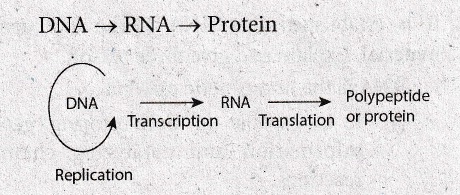
1. The process protein synthesis actually consists of two stages-transcription and translation.
2. In eukaryotic cells, transcription takes place in the nucleus. During transcription, DNA is used as a template to make a molecule of messenger RNA (mRNA). The molecule of mRNA then leaves the nucleus and reaches ribosome in the cytoplasm, where translation occurs.
3. During translation, the genetic code in mRNA is read and used to make a protein.
4. These two processes are summedup by the central dogma of molecular biology
19.
Human genome project was considered to be a mega project because
1. It had a specific goal to sequence for everybase pair present in the human genome. (Human Genome has 3.1647 billion nucleotide base pairs).
2. It took around 13 years of completion and got accomplished in year 2006.
3. It was a large-scale project, which aimed at developing new technology and generating new information in the field of genomic studies.
4. As a result of it, several news areas and avenues have opened up in the field of genetics, biotechnology and medical sciences.
5. It provided clues regarding the understanding of human biology.

12th Standard Syllabus & Materials
12th Standard
TN 12th Computer Applications களப்பெயர் முறைமை (DNS) Sample Question Papers Study Material - QB365 Set A
NEW12th Standard
TN 12th Computer Applications வலையமைப்பு எடுத்துக்காட்டுகள் மற்றும் நெறிமுறைகள் Sample Question Papers Study Material - QB365 Set A
NEW12th Standard
TN 12th Computer Applications கணினி வலையமைப்பு ஓர் அறிமுகம் Sample Question Papers Study Material - QB365 Set A
NEW12th Standard
TN 12th Computer Applications PHP-உடன் MySQL-ஐ இணைத்தல் Sample Question Papers Study Material - QB365 Set A



Tamilnadu Stateboard 12th Standard Subjects

Maths

Chemistry

Physics
Biology

Computer Science

Business Maths and Statistics

Economics

Commerce

Accountancy

History

Computer Applications
Biology
Computer Technology
Computer Applications
Computer Science
Business Maths and Statistics
Commerce
Economics
Maths
Chemistry
Physics
Computer Technology
History
Accountancy

Tamil

English

French
Tamilnadu Stateboard Standards

