
 100% FREE ACCESS
12th Standard Syllabus & Materials
12th Standard
TN 12th Computer Applications மின்னணு தரவு பரிமாற்றம் Sample Question Papers Study Material - QB365 Set A
NEW12th Standard
TN 12th Computer Applications மின் - வணிக பாதுகாப்பு அமைப்புகள் Sample Question Papers Study Material - QB365 Set A
NEW12th Standard
TN 12th Computer Applications மின்னணு செலுத்தல் முறைகள் Sample Question Papers Study Material - QB365 Set A
NEW12th Standard
TN 12th Computer Applications மின் - வணிகம் Sample Question Papers Study Material - QB365 Set A
NEW12th Standard
TN 12th Computer Applications திறந்த மூல கருத்துருக்கள் Sample Question Papers Study Material - QB365 Set A
NEW12th Standard
TN 12th Computer Applications வலையமைப்பு வடமிடல் Sample Question Papers Study Material - QB365 Set A

Published on: 27/11/2019
Principles of Inheritance and Variation
Download Tamil Nadu 12th Standard Biology question papers, model tests, one-mark questions, important questions, and public exam papers in PDF format. Free study materials and answer keys for TN State Board students.
Questions + Answers key
Take MCQ Biology Test1.
The lygaeus type (XX - XY) type of sex determination is seen in ______
Fishes
Chickens
Human beings
Gypsy moth
2.
_________ proposed the existence of 8 alleles at a single Rh locus.
Fischer
Landsteiner
Bernstein
Wiener
3.
XO type of sex determination and XY type of sex determination are examples of ______.
Male heterogamety
Female heterogamety
Male homogamety
Both (b) and (c)
4.
Which of the following is true about Rh factor in the offspring of a parental combination DdxDd (both Rh positive)?
All will be Rh-positive
Half will be Rh positive
About ¾ will be Rh negative
About one fourth will be Rh negative
5.
6.
Based on Lyon's hypothesis, mention the number of Barr bodies in XXY males, XO females.
7.
State the allelic forms of I gene and mention its chromosomal location.
8.
What are Gynandromorphy?
9.
10.
What is Lyonisation?
11.
Explain in detail about Erythroblastosis foetalis.
12.
Write a note on any 2 Mendelian disorders occurring in human beings.
13.
What is extra chromosomal inheritance?
14.
How is sex determined in human beings?
15.
What is euphenics?
16.
What are Y linked or holandric genes?
17.
What is null allele?
18.
What are the applications of Karyotyping?
19.
Brief about female heterogamety.
1.
(c)
Human beings
2.
(d)
Wiener
3.
(a)
Male heterogamety
4.
(d)
About one fourth will be Rh negative
5.
(a)
6.
XXY males - One Barr body.
XO females - No Barr body.
7.
The I gene exists in three forms: lA, IB and 1O. The alleles are located on chromosome 9.
8.
Individuals have parts of their body expressing male characters and other parts of the body expressing female characters. The organism is made up of tissues of male and female genotypes and represents a mosaic pattern.
9.
10.
The inactivation of an X chromosome one of the two X chromosomes in every cell in some female mammal is randomly inactivated early in embryonic development and named after geneticist Mary Lyon.
The inactive X chromosome is silenced by it being packaged in such a way that it has a transcriptionally inactive structure called heterochromatin found in nucleoplasm of nucleus.
11.
Rh incompatability has great significance in childbirth. If a woman is Rh negative and the man is Rh positive, the foetus may be Rh positive having inherited the factor from its father. The Rh negative mother becomes sensitized by carrying Rh-positive foetus within her body. Due to damage of blood vessels, during childbirth, the mother's immune system recognizes the Rh antigens and gets sensitized. The sensitized mother produces Rh antibodies. The antibodies are IgG type which are small and can cross placenta and enter the foetal circulation. By the time the mother gets sensitized and produce anti 'D' antibodies, the child is delivered.
Usually, no effects are associated with exposure of the mother to Rh positive antigen during· the first childbirth, subsequent Rh positive children carried by the same mother may be exposed to antibodies produced by the mother against Rh antigen, which are carried across the placenta into the foetal blood circulation. This causes haemolysis of foetal RBCs resulting in haemolytic jaundice and anaemia. This condition is known as Erythroblastosis foetalis or Haemolytic disease of the newborn (HDN).
12.
The Mendelian disorders in human beings are
(a) Thalassemia
(b) Sickle cell anaemia
(c) Huntington chorea
(d) Phenylketonuria
(e) Albinism
(a) Thalassemia
(i) Thalassemia is an autosomal recessive disorder. It is caused by gene mutation resulting in excessive destruction of RBC's due to the formation of abnormal haemoglobin molecules.
Normally haemoglobin is composed of four polypeptide chains, two alpha and two beta globin chains.
(ii) Thalassemia patients have defects in either the alpha or beta globin chain causing the production of abnormal haemoglobin molecules resulting in anaemia.
Classified based on heaemoglobin
Alpha Thalassemia:
(i) Mutation or deletion of one or more of the four alpha gene alleles.
(ii) It is controlled by two closely linked genes HBAI and HBA2 on chromosome 16.
Beta Thalassemia:
(i) Production of beta globin chain is affected
(ii) It is controlled by a single gene (HBB) on chromosome 11.
(iii) It's is also known as Cocley's anemia.
(iv) It increases the alpha chain production and damages the membranes of RBC.
Huntington's chorea:
(i) It is inherited as an autosomal dominant lethal gene in man.
(ii) It is characterized by involuntary jerking of the body and progressive degeneration of the nervous system, accompanied by gradual mental and physical deterioration.
(iii) The patients with this disease usually die between the age of 35 and 40.
13.
(i) Certain characters are controlled by nonnuclear genomes found in chloroplast, mitochondria, infective agents and plasmids. These characters do not reveal Mendelian pattern of inheritance.
(ii) The inheritance of the extra chromosomal genes are found to exhibit maternal influence.
(iii) Although both male and female parents contribute equally to the zygote in terms of chromosomal genes, the female parent usually contributes the zygote's initial cytoplasm and organelles, since the sperms contain very little cytoplasm. If there are hereditary units in the cytoplasm, these will be transmitted to the offsprings through the egg, so the offsprings exhibit maternal effect.
(iv) The cytoplasmic extranuclear genes have a characteristic pattern of inheritance which do not resemble the genes of nuclear chromosomes and is known as extra chromosomal or extra nuclear or cytoplasmic inheritance and exhibit maternal influence.
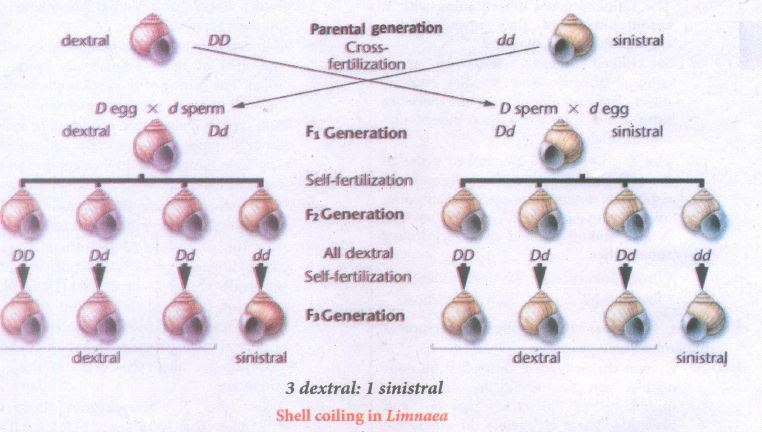
(v) In extra nuclear inheritance, male and female parents contribute equally their nuclear genes to the progeny but do not make equal contribution of' extra chromosomal genes hence, the crosses can yield different (or) non Mendelian results. Extra chromosomal inheritance in Limnaea peregra.
(vi) Limnaea peregra is a freshwater snail. The shell of these animals are spirally coiled. The coiling of the shell is clockwise (dextral) or anticlockwise (sinistral).
(vii) Both type of coilings are produced by two. different types of genetically controlled cleavages namely, dextral cleavage and sinistral cleavage.
(viii) In Limnaea, dextral coiling is normal and Sinistral coiling is a mutant character.
(ix) Direction of coiling is determined by a pair of nuclear genes, D( dextral) and d (sinistral). The gene for dextral (D) being dominant over sinistral coiling (d). In Fig. a dextral snail provides the eggs and a sinistral snail provides the sperm. The offsprings are all dextral (Dd), in the F1 generation.
(x) When the F1 heterozygous dextral individual (Dd) were self crossed the F2 generation showed dextral coiling with genotype of IDD, 2Dd and l dd.
(xi) When a reciprocal cross is made the F1 individuals have Dd genotype but are coiled sinistrally, as in the female parent. In both the crosses the Flare phenotypically similar to the female parent, though the offsprings in both crosses have the same genotype Dd. This is because the genotype of the maternal parent determines the phenotype of the offspring.
(xii) When the F1 sinistral individuals were self crossed, the shell coiling in the F2 generation, were all dextral. This is because the genes do not segregate in the F2 generation. Only in the F3 generation segregation occurs in the ratio of 3 dextral: 1 sinistral.
(xiii) Reasons: The type of cleavage depends on the organization of the egg which is established before the maturation division of the oocyte nucleus and by the influence of the maternal genotype.
(xiv) The direction of coiling of the shell depends upon the orientation of the mitotic spindle during the first cleavage.
(xv) Obviously, maternal control affects only one generation. In each generation the coiling is dependent on the maternal genotype.
14.
1. The sex determining mechanism of humans is XX-XY type.
2. In humans, out of 23 pairs of chromosomes present, 22 pairs are exactly same in both males and females known as autosomes (body).
3. The 23rd chromosome is the sex chromosome. (i.e) Pair of X-chromosome (XX) is present in females and males having one X and one Y chromosome (XY).
4. During, spermatogenesis, in case of males two types of gametes are produced (x and y).
5. The 50% total sperms produced carry X-chromosomes and the rest 50% carry Y - chromosomes besides autosomes. This condition is called male diagamety.
6. The Y containing sperms and X containing sperms are called androsperms and gynosperms respectively.
7. Female produces only one type of ovum with an X-chromosome. If an ovum fertilizes with a sperm carrying X chromosome the zygote develops into a female (XX) and if an ovum is fertilized with sperm carrying Y-chromosome, zygote thus, formed will be male (YY).
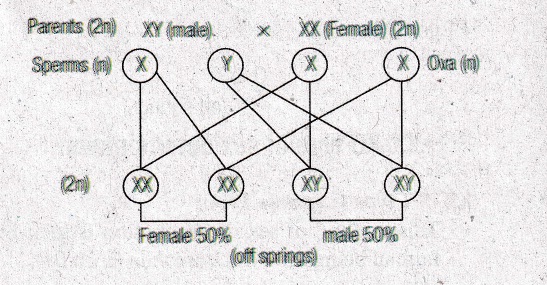
8. Hence, the genetic makeup of sperm, which fertilizes the ovum determines the sex of a child there are 50% chances of having either a male or female in each progeny.
9. Thus, it is by chance phenomenon, so women should not be blamed for giving birth to a girl child
15.
(i) The symptomatic treatment of genetic disease of man is called Euphenics or Medical engineering.
(ii) In 1960, Joshua Lederberg coined the term euphenics. It means normal appearing.
(iii) It deals with the control of several inherited human diseases especially the inborn errors of metabolism.
Eg. Phenylketonuria (PKU)
16.
i) The genes present in the non-homologous region of the Y chromosome are called Y - linked genes or holandric genes.
ii) The Y-linked genes have no corresponding allele in X - chromosome.
iii) These genes are transmitted directly from father to son, because males inherit the Y chromosome from the father.
Iv) Eg. Gene for Hypertrichosis (excessive development of hairs on pinna of the ear).
17.
In ABO blood group, each allele (IA and IB) produces a transferase enzyme. IA allele produces N-acetyl galactose transferase and can add N-acetyl galactosamine (NAG) and Ballele encodes for the enzyme galactose transferase that adds galactose to the precursor (i.e. H substances) In the case of Io/Io allele no terminal transferase enzyme is produced and therefore called "null" allele arid hence cannot add NAG or galactose to the precursor.
18.
(i) It helps in gender identification.
(ii) It is used to detect the chromosomal aberrations like deletion, duplication, translocation, invasion and nondisjunction of chromosomes.
(iii) It helps to identify the abnormalities of chromosomes like aneuploidy.
(iv) It is also used in predicting the evolutionary relationships between species.
(v) Genetic diseases in human beings can be detected by this technique.
19.
1. In this method of sex determination, the homogametic male possesses two 'X' chromosomes as in certain insects and certain vertebrates like fishes, reptiles and birds producing a single type of gamete.
2. The female sex consists of a single 'Y' chromosome. Thus the females are heterogametic and produce two types of eggs.
3. To avoid confusion with the XX-XO and XX-XY trues of sex determination, the alphabets 'Z' and 'W 'are used here instead of X and Y respectively.
4. Heterogametic females are of two types, ZO-ZZ type and ZW-ZZ type.

12th Standard Syllabus & Materials
12th Standard
TN 12th Computer Applications களப்பெயர் முறைமை (DNS) Sample Question Papers Study Material - QB365 Set A
NEW12th Standard
TN 12th Computer Applications வலையமைப்பு எடுத்துக்காட்டுகள் மற்றும் நெறிமுறைகள் Sample Question Papers Study Material - QB365 Set A
NEW12th Standard
TN 12th Computer Applications கணினி வலையமைப்பு ஓர் அறிமுகம் Sample Question Papers Study Material - QB365 Set A
NEW12th Standard
TN 12th Computer Applications PHP-உடன் MySQL-ஐ இணைத்தல் Sample Question Papers Study Material - QB365 Set A



Tamilnadu Stateboard 12th Standard Subjects

Maths

Chemistry

Physics
Biology

Computer Science

Business Maths and Statistics

Economics

Commerce

Accountancy

History

Computer Applications
Biology
Computer Technology
Computer Applications
Computer Science
Business Maths and Statistics
Commerce
Economics
Maths
Chemistry
Physics
Computer Technology
History
Accountancy

Tamil

English

French
Tamilnadu Stateboard Standards

