
 100% FREE ACCESS
12th Standard Syllabus & Materials
12th Standard
TN 12th Computer Applications மின்னணு தரவு பரிமாற்றம் Sample Question Papers Study Material - QB365 Set A
NEW12th Standard
TN 12th Computer Applications மின் - வணிக பாதுகாப்பு அமைப்புகள் Sample Question Papers Study Material - QB365 Set A
NEW12th Standard
TN 12th Computer Applications மின்னணு செலுத்தல் முறைகள் Sample Question Papers Study Material - QB365 Set A
NEW12th Standard
TN 12th Computer Applications மின் - வணிகம் Sample Question Papers Study Material - QB365 Set A
NEW12th Standard
TN 12th Computer Applications திறந்த மூல கருத்துருக்கள் Sample Question Papers Study Material - QB365 Set A
NEW12th Standard
TN 12th Computer Applications வலையமைப்பு வடமிடல் Sample Question Papers Study Material - QB365 Set A

Published on: 17/01/2020
Download Tamil Nadu 12th Standard Biology question papers, model tests, one-mark questions, important questions, and public exam papers in PDF format. Free study materials and answer keys for TN State Board students.
Questions + Answers key
Take MCQ Biology Test1.
Explain the mechanism of lac-operon of the E-coli.
2.
Describe incomplete dominance exhibited by Mirabilis jalapa.
3.
Point out any five morphological adaptations of epiphytes.
4.
Give a detailed account on anyone fibre yielding plant.
5.
6.
Draw a pyramid from following details and explain in brief.
Quantities of organisms are given-Hawks - 50, plants - 1000.rabbit and mouse - 250 + 250, pythons and lizard - 100 + 50 respectively.
7.
How are STDs transmitted?
8.
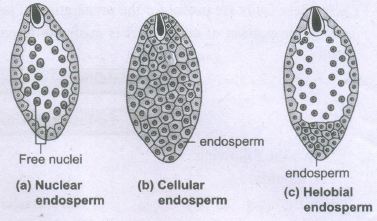
What is endosperm. Explain the types.
9.
Select the correct statement from the following
Primary treatment of sewage involves biological oxidation
Excreta of cattle is commonly called Gobur
Delta endotoxin of Bacillus thuringiensis is encoded by pen-genes
Trichoderma is a free-timing bacteria very common in root ecosystem
10.
Watson and Crick proposed their double helical DNA model based on the X-ray diffraction analysis of _________
Erwin Chargaff
Meselson and Stahl
Wilkins and Franklin
Griffith
11.
Statement 1: Pairing of homologous chromosome is called as syndesis.
Statement 2: Proterminal synapsis occurs from telomeres.
Statement 1 is correct and Statement 2 is incorrect
Statement 1 is incorrect and Statement 2 is correct
Both the statements are correct
Both the statements are incorrect
12.
Statement 1: Ephemerals are drought evaders.
Statement 2: They are not true xerophytes.
Statement 1 is correct. Statement 2 is incorrect.
Statement 1 is incorrect. Statement 2 is correct.
Both the statements are correct.
Both the statements are incorrect
13.
Statement 1: Primary sporogenous cell functions as megaspore mother cell.
Statement 2: Megaspore mother cell undergoes mitotic division producing megaspores.
Statement 1 is correct and statement 2 is incorrect.
Statement 1 is incorrect and statement 2 is correct.
Both the statements 1 and 2 are correct.
Both the statements 1 and 2 are incorrect.
14.
Identify the correct sequence of various zones from surface to depth in a pond ecosystem.
Profundal, limnetic, littoral and benthic
Benthic, littoral, profundal and limnetic
Limnetic, profundal, littoral and benthic
Littoral, limnetic, profundal and benthic
15.
Who is celebrated as Forest Man of India?
Anand Mohan Chakrabarthy
Dr. M.S. Swaminathan
Jadav Molai Payeng
Choudhary Ram Dhan
16.
1000 fish in the volume of water in the pond indicates _____________________
Relative abundance
Ecological density
Crude density
Population density
17.
Fusion of morphologically and physiologically similar gametes is called ______
anisogamy
hologamy
isogamy
merogamy
18.
Observe the following statements and pick out the right option from the following:
Statement I: The drug sources of Siddha include plants, animal parts, ores and minerals.
Statement II: Minerals are used for preparing drugs with long shelf-life.
Statement I is correct
Statement II is correct
Both statements are correct
Both statements are wrong
19.
Some organisms are able to maintain homeostasis by physical means _______
Conform
Regulate
Migrate
Suspend.
20.
Micro propagation involves _____.
vegetative multiplication of plants by using micro-organisms.
vegetative multiplication of plants by using small explants.
vegetative multiplication of plants by using microspores.
Non-vegetative multiplication of plants by using microspores and megaspores.
21.
Darwin’s finches are an excellent example of
connecting links
seasonal migration
adaptive radiation
parasitism
22.
Select the incorrect action of hormonal contraceptive pills from the following
Inhibition of spermatogenesis.
Inhibition of ovulation
Changes in cervical mucus impairing its ability to allow passage and transport of sperms
Alteration in uterine endometrium to make it unsuitable for implantation
23.
24.
A mRNA strand has a series of triplet codons of which the first three codons are given below
(a) AUG (b) UUU (c) UGC
(i) Name the amino acid encoded by these triplet codons.
(ii)Mention the DNA sequence from which these triplet codons would have transcribed?
25.
Write a note on Sacred Groves.
26.
Compare Mendelian factors with chromosome.
27.
What are the adverse effects of temperature on plant?
28.
In 1926, Vavilov initially proposed eight main geographic centres of crop origin. Mention any six of them.
29.
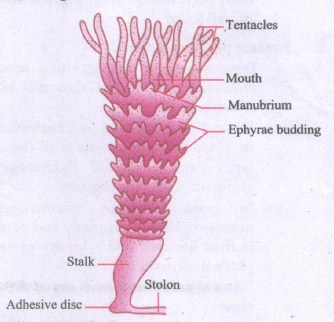
(i) Identify the animal
(ii) What is significant about the animal.
30.
31.
32.
Write the key features of organic farming.
33.
34.
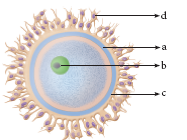
Identify the given image and label its parts marked as a, b, c and d
35.
What is colostrum? Write its significance.
36.
What makes the DNA and RNA as acidic molecules?
37.
Which is the primary lymphoid organs of birds? Mention its location and role.
38.
Complete the equation.
(a) Phenylalanine \(\underrightarrow { A } \) Tyrosine
(b) DOPA \(\underrightarrow { B } \) Melanin
39.
What does NCB stands for? Mention its role.
40.
Mention the different modes of asexual reproduction.
41.
What are interferons? Mention their role.
42.
How do forests help in maintaining the climate?
43.
What will happen if all producers are removed from ecosystem?
1.
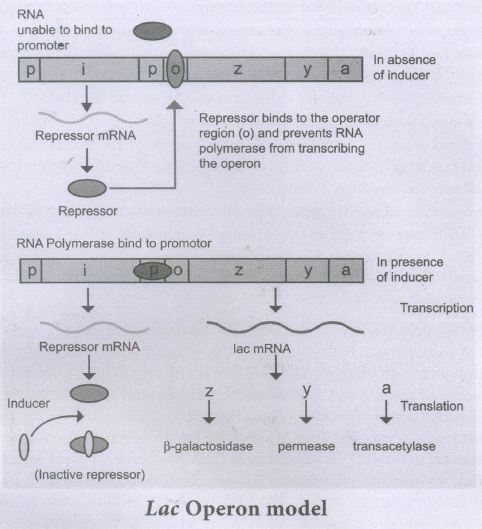
The Lac (Lactose) operon: The metabolism of lactose in E-coli requires three enzymes - permease, β-galactosidase (β-gal) and transacetylase. The enzyme permease is needed for entry of lactose into the cell, β-galactosidase brings about hydrolysis of lactose to glucose and galactose, while transacetylase transfers acetyl group from acetyl Co A to β-galactosidase. The lac operon consists of one regulator gene ('i' gene refers to inhibitor) promoter sites (P), and operator site (o). Besides these, it has three structural genes namely lac z, y and lac a. The lac 'z' gene codes for β-galactosidase, lac 'y' gene codes for permease and 'a' gene codes for transacetylase.
Jacob and Monod proposed the classical model of Lac operon to explain gene expression and regulation in E-coli. In lac operon, a polycistronic structural gene is regulated by a common promoter and regulatory gene. When the cell is using its normal energy source as glucose; the 'i' gene transcribes a repressor mRNA and after its translation, a repressor protein is produced. It binds to the operator region of the operon and prevents translation, as a result, β-galactosidase is not produced. In the absence of preferred carbon source such as glucose, if lactose is available as an energy source for the bacteria then lactose enters the cell as a result of permease enzyme. Lactose acts as an inducer and interacts with the repressor to inactivate it. The repressor protein binds to the operator of the operon and prevents RNA polymerase from transcribing the operon. In the presence of inducer, such as lactose or allolactose, the repressor is inactivated by interaction with the inducer. This allows RNA polymerase to bind to the promotor site and transcribe the operon to produce lac mRNA which enables formation of all the required enzymes needed for lactose metabolism. This regulation of lac operon by the repressor is an example of negative control of transcription initiation.
2.
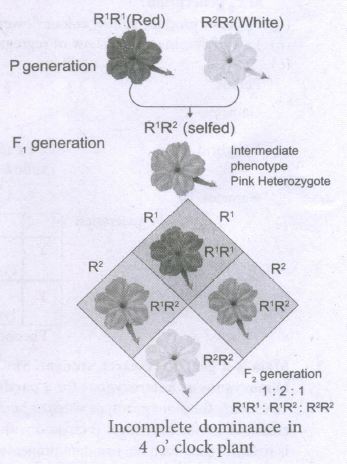
The German Botanist Carl Correns's (1905) Experiment - In 4 0' clock plant, Mirabilis jalapa when the pure breeding homozygous red (R1 R1) parent is crossed with homozygous white (R 2R2), the phenotype of the F1 hybrid is heterozygous pink (R1R2). The F1 heterozygous phenotype differs from both the parental homozygous phenotype. This cross did not exhibit the character of the dominant parent but an intermediate colour pink. When one allele is not completely dominant to another allele it shows incomplete dominance. Such allelic interaction is known as incomplete dominance. F1 generation produces intermediate phenotype pink coloured flower.
When pink coloured plants of F 1 generation were interbred in F2 both phenotypic and genotypic ratios were found to be identical as 1 : 2 : 1(1 red: 2 pink: 1 white). Genotypic ratio is 1 R1R1 : 2 R1R2 : 1 R2R2. From this we conclude that the alleles themselves remain discrete and unaltered proving the Mendel's Law of Segregation. The phenotypic and genotypic ratios are the same. There is no blending of genes. In the F2 generation R1 and R2 genes segregate and recombine to produce red, pink and white in the ratio of 1 : 2 : 1. R 1 allele codes for an enzyme responsible for the formation of red pigment. R2 allele codes for defective enzyme. R1 and R2 genotypes produce only enough red pigments to make the flower pink. Two R1R1 are needed for producing red flowers. Two R2R2 genes are needed for white flowers. If blending had taken place, the original pure traits would not have appeared and all F2 plants would have pink flowers. It is very clear that Mendel's particulate inheritance takes place in this cross which is confirmed by the reappearance of original phenotype in F2.
3.
Morphological adaptations:
Root system is extensively developed. These roots may be of two types. They are Clinging roots and Aerial roots.
Clinging roots fix the epiphytes firmly on the surface of the supporting objects.
Aerial roots are green coloured roots which may hang downwardly and absorb moisture from the atmosphere with the help of a spongy tissue called velamen.
1. Stem of some epiphytes are succulent and develop pseudo bulb or tuber.
2. Generally the leaves are lesser in number and may be fleshy and leathery.
3. Myrmecophily is a common occurrence in the epiphytic vegetation to prevent the predators
4. The fruits and seeds are very small and usually dispersed by wind, insects and birds.
4.
Jute
Botanical name : Corchorus spp.
Family: Malvaceae
Origin and Area of cultivation: Jute is derived from the two cultivated species (1) Core horns capsularis and (2) Colittorius is of African origin whereas C. Capsularis, is believed to Indo Burmaese origin. It is an important cultivated commercial crop in Gangetic plains of India and Bangladesh.
Uses: It is one of the largest exported fibre material of India. The jute industry occupies an important place in the national economy Of India. Jute is used for 'safe' packaging in view of being natural, renewable, bio-degradable and eco-friendly product. It is used in bagging and wrapping textile. About 75% of the jute produced is used for manufacturing sacks and bags. It is also used in manufacture of blankets, rags, curtains etc. It is also being used as a textile fibre in recent years.
5.
.jpg)
6.
Grassland ecosystem : There is a gradual decrease in the number of organisms in each trophic level from producers to primary consumers and then to secondary consumers, and finally to tertiary consumers. Therefore pyramids of number in grassland ecosystem are always upright.
7.
Sexually transmitted diseases (STD) or veneral diseases(VD) or Reproductive tract infections (RTI) are called as Sexually transmitted infections (STI).
Transmissions:
1. Normally STI are transmitted from person to person during intimate sexual contact with an infected partner.
2. Infections like Hepatitis-B and HIV are transmitted sexually as well as by sharing of infusion needles, surgical instruments, etc with infected people, blood transfusion (or) from infected mother to baby.
3. People in the age of 15 to 24years are prone to these infections.
4. The bacterial STI are gonorrhoea syphilis, chancroid, chlamydiasis and lymphogranuloma venereum.
5. The viral STI are genital herpes, genital warts Hepatitis-B and AIDS.
6. Trichomoniasis is a protozoan STI, and candidiasis is a fungal STI.
8.
(i) The primary endosperm nucleus divides immediately after fertilization and develops into an endosperm.
(ii) It is a nutritive tissue, and regulatory structure by undergoing repeated mitosis to form triploid (3n) endosperm that nourishes the developing embryo. Depending upon the mode of development three types of endosperm are recognized.
1) Nuclear endosperm:
(i) Primary endosperm, (PEN) nucleus undergoes several mitotic divisions. There is no cell wall formation So free nuclear condition exists in the endosperm.
Example:
Coccinia, Capsella, Arachis
2) Cellular endosperm:
(i) Primary endosperm nucleus divides into two nuclei There is cell wall formation.
(ii) Subsequent division also follows cell wall formation. It is said to be cellular endosperm
Example:
Adoxa, Helianthus, Scoparia.
3) Helobial endosperm:
(i) Primary Endosperm Nucleus moves towards the base of embryo sac.
(ii) Divides into two nuclei cell wall formation occurs forming a large micropylar chamber and a small chalazal chamber.
(iii) The nucleus of micropylar chamber further undergoes several free nuclear divisions. The nucleus of the chalazal chamber may or may not divide.
Example:
Hydrilla, Vallisneria.
9.
(a)
Primary treatment of sewage involves biological oxidation
10.
(c)
Wilkins and Franklin
11.
(a)
Statement 1 is correct and Statement 2 is incorrect
12.
(c)
Both the statements are correct.
13.
(a)
Statement 1 is correct and statement 2 is incorrect.
14.
(d)
Littoral, limnetic, profundal and benthic
15.
(c)
Jadav Molai Payeng
16.
(b)
Ecological density
17.
(c)
isogamy
18.
(b)
Statement II is correct
19.
(b)
Regulate
20.
(b)
vegetative multiplication of plants by using small explants.
21.
(c)
adaptive radiation
22.
(a)
Inhibition of spermatogenesis.
23.
(c)
24.
(i) AUG codes for Methionine
UUU codes for Phenylalanine
UGC codes for Cysteine
(ii) TAC sequence of DNA is transcribed to AUG
AAA sequence of DNA is transcribed to UUU
ACG sequence of DNA is transcribed to UGC
25.
A sacred grove or sacred woods are any grove of trees that are of special religious importance to a particular culture. Sacred groves feature in various cultures throughout the world.
26.
| S. No. | Mendelian factors | Chromosomes behaviour |
| 1. | Alleles of a factor occur in pair. | Chromosomes occur in pairs |
| 2. | Similar or dissimilar alleles of a factor separate during the gamete formation. | The homologous chromosomes separate during meiosis. |
| 3. | Mendelian factors can assort independently. | The paired chromosomes can separate independently during meiosis but the linked genes in the same chromosome normally do not assort independently. |
27.
1. Temperature affects the enzymatic action of all the bio-chemical reactions in a plant body.
2. Low temperature with high humidity can spread diseases to plants.
3. The varying temperature with moisture determines the distribution of the vegetation types.
28.
China, India, South America, Mediterranean, Mesoamerica and South East Asia.
29.
(i) Aurelia
(ii) The Significance is that Aurelia reproduces asexually by a special type of transverse fission called strobilation.
30.
31.
32.
(i) Protecting soil quality using organic materials and encouraging biological activity.
(ii) Indirect provision of crop nutrients using soil microorganisms.
(iii) Nitrogen fixation in soils using legumes.
(iv) Weed and pest control based on methods like crop rotation, biological diversity, natural predators, organic manures and suitable chemical, thermal and biological interventions.
33.
34.
Human Ovum
a - Vitelline membrane
b - Nucleus
c - Zona Pellucida
d - Corona radiata
35.
Colostrum is the yellowish fluid produced from the mother's mammary glands during initial few days of location, after parturition.
Significance:
1. It has less lactose than milk and almost no fat, but it contains more proteins, vitamin A and minerals.
2. Colostrum is also rich in IgA antibodies.
3. This helps to protect the infant's digestive tract against bacterial infection.
4. Breast milk is the ideal food for infants as it contains all the constituents in suitable concentration and is easily digestable.
5. It is fully sufficient till about 6 months of age and all infants must be breast fed by the mother to ensure the growth of a healthy baby.
36.
The phosphate functional group (PO4) gives DNA and RNA the property of an- acid at physiological pH, hence the name nucleic acid.
37.
Bursa of Fabricius is a primary lymphoid organ of birds. It is attached to the dorsal side of the cloaca. B lymphocytes mature in the bursa and bring about humoral immunity.
38.
(a) A = Phenylalanine hydroxylase
(b) B = Tyrosinase
39.
The Narcotics Control Bureau (NCB) is the nodal drug law enforcement and intelligence agency of India and is responsible for fighting drug trafficking and the abuse of illegal substances.
40.
The different modes of asexual reproduction seen in animals are fission, sporulation, budding, gemmule formation, fragmentation and regeneration.
41.
Interferons are a group of signalling proteins produced by virus infected cells. They interfere with viral replication and hence named interferons. A virus infected cell releases interferons which induce antiviral state in the uninfected cells. They are chemical mediators under physiological barriers offering Innate immunity.
42.
(a) Trees provide micro climate for crops and maintain O2 - CO2 balance atmospheric temperature & relative humidity
(b) Suitable for dry land where rainfall is minimum hence it is a good system for alternate land use pattern
43.
If all producers are removed from ecosystem We tend to face the following hurdles.
(i) The Ecosystem cannot be balanced
(ii) The interlocking pattern of food chain is broken
(iii) The movement of energy transfer among the food chain cannot be established
(iv) As the green plants occupying the first trophic level (T1) are producers - it affects majority of the food chain

12th Standard Syllabus & Materials
12th Standard
TN 12th Computer Applications களப்பெயர் முறைமை (DNS) Sample Question Papers Study Material - QB365 Set A
NEW12th Standard
TN 12th Computer Applications வலையமைப்பு எடுத்துக்காட்டுகள் மற்றும் நெறிமுறைகள் Sample Question Papers Study Material - QB365 Set A
NEW12th Standard
TN 12th Computer Applications கணினி வலையமைப்பு ஓர் அறிமுகம் Sample Question Papers Study Material - QB365 Set A
NEW12th Standard
TN 12th Computer Applications PHP-உடன் MySQL-ஐ இணைத்தல் Sample Question Papers Study Material - QB365 Set A



Tamilnadu Stateboard 12th Standard Subjects

Maths

Chemistry

Physics
Biology

Computer Science

Business Maths and Statistics

Economics

Commerce

Accountancy

History

Computer Applications
Biology
Computer Technology
Computer Applications
Computer Science
Business Maths and Statistics
Commerce
Economics
Maths
Chemistry
Physics
Computer Technology
History
Accountancy

Tamil

English

French
Tamilnadu Stateboard Standards

