
 100% FREE ACCESS
12th Standard Syllabus & Materials
12th Standard
TN 12th Computer Applications மின்னணு தரவு பரிமாற்றம் Sample Question Papers Study Material - QB365 Set A
NEW12th Standard
TN 12th Computer Applications மின் - வணிக பாதுகாப்பு அமைப்புகள் Sample Question Papers Study Material - QB365 Set A
NEW12th Standard
TN 12th Computer Applications மின்னணு செலுத்தல் முறைகள் Sample Question Papers Study Material - QB365 Set A
NEW12th Standard
TN 12th Computer Applications மின் - வணிகம் Sample Question Papers Study Material - QB365 Set A
NEW12th Standard
TN 12th Computer Applications திறந்த மூல கருத்துருக்கள் Sample Question Papers Study Material - QB365 Set A
NEW12th Standard
TN 12th Computer Applications வலையமைப்பு வடமிடல் Sample Question Papers Study Material - QB365 Set A

Published on: 13/09/2019
Download Tamil Nadu 12th Standard Biology question papers, model tests, one-mark questions, important questions, and public exam papers in PDF format. Free study materials and answer keys for TN State Board students.
Questions + Answers key
Take MCQ Biology Test1.
Assertion (A): Movement of organism from one place to another and back is called migration.
Reason (R): Eel is an example for anadromous migration.
Both A and R are correct R explain A
A is correct R is incorrect
R does not explain A
Both A and R are incorrect
2.
Assertion (A): Complete linkage is noticed in male species of Drosophila.
Reason (R): Completely linked genes show some crossing over.
A is true R is false
Both A and R are false
A is true, R is not correct explanation for A
R explains A
3.
What is the phenotypic ratio in case of incomplete dominance?
9: 7
3: 1
1: 2 : 1
1: 1 : 1 : 1
4.
Assertion (A) : Plains and valleys are rich in vegetation
Reason (R): Slow drain of surface water and better water retention is noticed.
A is true R is false
R explains A
A and R are false
A and R are true. But R does not explains A
5.
Autecology deals with the study of ___________.
Community
Population
Individual species
Niche of species
6.
Identify the plant tissue used for virus free germplasm
Apical meristem
Intercalary meristem
Lateral meristem
Plate meristem
7.
Which of the following are likely to be present in deep-sea water?
Archaebacteria
Eubacteria
Blue-green algae
Saprophytic fungi
8.
During favourable conditions ______ shows multiple fission.
Plasmodium
Amoeba
Planaria
Euglena
9.
Which of the following bacteria is used extensively as a bio-pesticide?
Bacillus thurigiensis
Bacillus subtilis
Lactobacillus acidophilus
Streptococcus lactis
10.
11.
A contraceptive pill prevents ovulation by ______.
blocking fallopian tube
inhibiting release of FSH and LH
stimulating release of FSH and LH
causing immediate degeneration of released ovum.
12.
An antibiotic gene in a vector usually helps in the selection of ______.
Competent cells
Transformed cells
Recombinant cells
None of the above
13.
The foetal membrane that forms the basis of the umbilical cord is _____.
Allantois
Amnion
Chorion
Yolk sac
14.
In which type of parthenogenesis are only males produced?
Arrhenotoky
Thelytoky
Amphitoky
Both a and b
15.
Which of the following phenotypes is not possible in the progeny of the parental genotypic combination IAIO x IAIB?
AB
O
A
B
16.
Choose the correct statement(s) about tenuinucellate ovule.
Sporogenous cell is hypodermal
Ovules have fairly large nucellus
Sporogenous cell is epidermal
ovules have single layer of nucellus tissue
17.
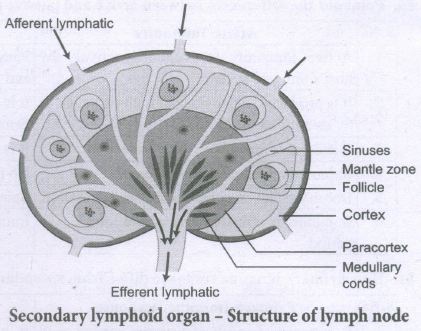
Describe the structure of lymph node with a labeled diagram
18.
Give an account of helminthic disease.
19.
Describe dispersal of fruit and seeds by animals.
20.
Highlight the milestones from the history of plant embryology.
21.
Differentiate between asexual and sexual reproduction
22.
How tongue grafting differs from wedge grafting?
23.
What are Coacervates?
24.
Explain the role of oxytocin and relaxin in parturition and lactation.
25.
26.
27.
Why does the zygote divides only after the division of Primary endosperm cell.
28.
Comment on Trisomy-21.
29.
Give any four unique characters exhibited by anemophilous flowers.
30.
Write a brief note on pneumatophores. Give an example.
31.
What is cell suspension culture?
32.
What is plasmotomy?
33.
Why do submerged plants receive weak illumination than exposed floating plants in a lake?
34.
Soil formation can be initiated by biological organisms. Explain how?
1.
(a)
Both A and R are correct R explain A
2.
(a)
A is true R is false
3.
(c)
1: 2 : 1
4.
(b)
R explains A
5.
(c)
Individual species
6.
(a)
Apical meristem
7.
(a)
Archaebacteria
8.
(b)
Amoeba
9.
(a)
Bacillus thurigiensis
10.
(d)
11.
(b)
inhibiting release of FSH and LH
12.
(b)
Transformed cells
13.
(a)
Allantois
14.
(a)
Arrhenotoky
15.
(b)
O
16.
(a)
Sporogenous cell is hypodermal
17.
Lymph node has three zones. They are the cortex, paracortex, and medulla. The outer most layer of the lymph node is called cortex, which consists of B-lymphocytes, macrophages, and follicular dendritic cells. The paracortex zone is beneath the cortex, which is richly populated by T lymphocytes and interdigitating dendritic cells. The innermost zone is called the medulla which is sparsely populated by lymphocytes, but many of them are plasma cells, which actively secrete antibody molecules. As the lymph enters, it slowly percolates through the cortex, paracortex, and medulla, giving sufficient chance for the phagocytic cells and dendritic cells to trap the antigen brought by the lymph. The lymph leaving a node carries enriched antibodies secreted by the medullary plasma cells against the antigens that enter the lymph node. Sometimes visible swelling of lymph nodes occurs due to active immune response and increased the concentration of lymphocytes. Thus swollen lymph nodes may signal an infection. There are several groups of lymph nodes. The most frequently enlarged lymph nodes are found in the neck, under the chin, in the armpits, and in the groin.
18.
Helminths are mostly endoparasitic in the gut and blood of human beings and cause diseases called helminthiasis. The two most prevalent helminthic diseases are Ascariasis and Filariasis. Ascaris is a monogenic parasite and exhibits sexual dimorphism. Ascariasis is a disease caused by the intestinal endoparasite Ascaris lumbricoides commonly called the roundworms. It is transmitted through ingestion of embryonated eggs through contaminated food and water. Children playing in contaminated soils are also prone to have a chance of transfer of eggs from hand to mouth. The symptoms of the disease are abdominal pain, vomiting, headache, anemia, irritability, and diarrhoea. A heavy infection can cause nutritional deficiency and severe abdominal pain and causes stunted growth in children. It may also cause enteritis, hepatitis, and bronchitis.
Filariasis is caused by Wuchereria bancrofti, commonly called filarial worm. It is found in the lymph vessels and lymph nodes of man. Wuchereria bancrofti is sexually dimorphic, viviparous and digenic. The life cycle is completed in two hosts, man and the female Culex mosquitoes. The female filarial worm gives rise to juveniles called microfilariae larvae. In the lymph glands, the juveniles develop into adults. The accumulation of the worms blocks the lymphatic system resulting in inflammation of the lymph nodes. In some cases, the obstruction of lymph vessels causes elephantiasis or filariasis of the limbs, scrotum and mammary glands
19.
Dispersal by Animals (Zoochory)
Birds and mammals, including human beings play an efficient and important role in the dispersal of fruit and seeds. They have the following devices.
i. Hooked fruit: The surface of the fruit or seeds have hooks (Xanthium), barbs (Andropogon), spines (Aristida) by means of which they adhere to the body of animals or clothes of human beings and get dispersed.
ii. Sticky fruits and seeds:
a. Some fruits have sticky glandular hairs by which they adhere to the fur of grazing animals. Example: Boerhaavia and Cleome.
b. Some fruits have viscid layer which adhere to the beak of the bird which eat them and when they rub them on to the branch of the tree, they disperse and germinate. Example: Cordia and Alangium.
iii. Fleshy fruits: Some fleshy fruits with conspicuous colours are dispersed by human beings to distant places after consumption.
Example: Mango and Diplocyclos
20.
1824 - G.B. Amici discovered the pollentube.
1848 - Hofmeister described the structure of pollen tetrad.
1870 - Hanstein described the development of embryo in Capsella and Alisma.
1878 - E. Strasburger reported poly embryony.
1884 - E. Strasburger discovered the process of syngamy.
1898 & 1899 - S.G. Nawaschin and L. Guignard independently, discovered double fertilizations.
21.
| Asexual Reproduction | Sexual Reproduction | |
|---|---|---|
| a | Involves only one parent | Involves two parents (male & female) |
| b | Only mitotic cell division takes place | Both mitosis & meiosis takes place |
| c | Offsprings are genetically identical to the parent. | Offsprings genetically differ from the parents. |
| d | Gametes are not produced | Gametes are produced |
22.
| Tongue grafting | Wedge grafting |
|---|---|
| In tongue grafting A scion and stock having the same thickness is cut obliquely and the scion is fit into the stock and bound with tape. | In wedge grafting a slit is made in the stock or the bark is cut A twig of the scion is inserted and tightly bound so that the cambium of the two is joined |
23.
Coacervates (large colloidal particles that precipitate out in aqueous medium) are the first pre-cells which gradually transformed into living cells, according to theory of chemical evolution.
24.
Relaxin
(i) It is a hormone secreted by the placenta and also by the corpus luteum during pregnancy.
(ii) It promotes parturition by relaxing the pelvic joints and by dilation of cervical ligaments with continued powerful contractions.
Oxytocin:
(i) It causes the "Let-Down" reflex.
(ii) The actual ejection of milk from the alveoli of the mammary glands.
(iii) During lactation, oxytocin also stimulates the recently emptied uterus to contract, helping it to return to pre-pregnancy size..
25.
26.
27.
The primary endosperm nucleus divides immediately after fertilization. It develops into an endosperm which is a nutritive tissue and a regulatory structure. The zygote divides only after that to form an embryo so that it can get nourishment from the endosperm that has formed earlier.
28.
Trisomic condition of chromosome - 21 results in Down's syndrome. It is characterized by severe mental retardation, defective development of the central nervous system, increased separation between the eyes, flattened nose, ears are malformed, mouth is constantly open and the tongue protrudes.
29.
(a) Flowers are small and inconspicuous
(b) Colorless
(c) Non-scented
(d) No nectar secretion
30.
Pneumatophores are the special type of negatively geotropic roots developed by halophytes. It possess pneumathodes to get sufficient aeration. They are also called breathing roots.
Example: Avicennia.
31.
The growing of cells including the culture of single cells or small aggregates of cells in vitro in liquid medium is known as cell suspension culture.
32.
(i) Plasmotomy is the division of multinucleated parent into many multinucleate daughter individuals, with the division of nuclei.
(ii) Nuclear division occurs later to maintain normal number of nuclei (e,g:) Opalina and Pelomyxa.
(iii) Plasmotomy occurs in Opalina and Pelomyxa.
(iv) It is a method of asexual reproduction
33.
Submerged plants are unable to obtain full illumination because a lot of sunlight is absorbed by overlying layers of water this is not the case for exposed floating plants that receive sunlight directly.
34.
Soil formation is initiated by the weathering process. Biological weathering takes place when organisms like bacteria, fungi, lichens & plants help in the breakdown of rocks through the production of acids & certain chemical substances.

12th Standard Syllabus & Materials
12th Standard
TN 12th Computer Applications களப்பெயர் முறைமை (DNS) Sample Question Papers Study Material - QB365 Set A
NEW12th Standard
TN 12th Computer Applications வலையமைப்பு எடுத்துக்காட்டுகள் மற்றும் நெறிமுறைகள் Sample Question Papers Study Material - QB365 Set A
NEW12th Standard
TN 12th Computer Applications கணினி வலையமைப்பு ஓர் அறிமுகம் Sample Question Papers Study Material - QB365 Set A
NEW12th Standard
TN 12th Computer Applications PHP-உடன் MySQL-ஐ இணைத்தல் Sample Question Papers Study Material - QB365 Set A



Tamilnadu Stateboard 12th Standard Subjects

Maths

Chemistry

Physics
Biology

Computer Science

Business Maths and Statistics

Economics

Commerce

Accountancy

History

Computer Applications
Biology
Computer Technology
Computer Applications
Computer Science
Business Maths and Statistics
Commerce
Economics
Maths
Chemistry
Physics
Computer Technology
History
Accountancy

Tamil

English

French
Tamilnadu Stateboard Standards

