
 100% FREE ACCESS
12th Standard Syllabus & Materials
12th Standard
TN 12th Computer Applications மின்னணு தரவு பரிமாற்றம் Sample Question Papers Study Material - QB365 Set A
NEW12th Standard
TN 12th Computer Applications மின் - வணிக பாதுகாப்பு அமைப்புகள் Sample Question Papers Study Material - QB365 Set A
NEW12th Standard
TN 12th Computer Applications மின்னணு செலுத்தல் முறைகள் Sample Question Papers Study Material - QB365 Set A
NEW12th Standard
TN 12th Computer Applications மின் - வணிகம் Sample Question Papers Study Material - QB365 Set A
NEW12th Standard
TN 12th Computer Applications திறந்த மூல கருத்துருக்கள் Sample Question Papers Study Material - QB365 Set A
NEW12th Standard
TN 12th Computer Applications வலையமைப்பு வடமிடல் Sample Question Papers Study Material - QB365 Set A

Published on: 21/11/2019
Reproduction in Organisms
Download Tamil Nadu 12th Standard Biology question papers, model tests, one-mark questions, important questions, and public exam papers in PDF format. Free study materials and answer keys for TN State Board students.
Questions + Answers key
Take MCQ Biology Test1.
Assertion and reasoning questions:
In each of the following questions there are two statements. One is assertion (A) and other is reasoning (R). Mark the correct answer as
Assertion: Viviparous animals give better protection to their off springs.
Reason: They lay their eggs in the safe places of the environment.
Codes:
A. If both A and R are true and R is correct explanation for A
B. If both A and R are true but R is not the correct explanation for A
C. If A is true but R is false
D. If both A and R are false.
If both A and R are true and R is correct explanation for A
If both A and R are true but R is not the correct explanation for A
If A is true but R is false
If both A and R are false
2.
In each of the following questions there are two statements. One is assertion (A) and other is reasoning (R). Mark the correct answer as
Assertion (A): Offsprings produced by asexual reproduction are genetically identical to the parent.
Reason(R): Asexual reproduction involves only mitosis and no meiosis.
Codes:
A. If both A and R are true and R is correct explanation for A
B. If both A and R are true but R is not the correct explanation for A
C. If A is true but R is false
D. If both A and R are false.
both A and R are true and R is correct explanation for A
If both A and R are true but R is not the correct explanation for A
If A is true but R is false
If both A and R are false.
3.
Mention the phases in the life cycle of an organism.
4.
What is plasmotomy?
5.
What is peculiar about the cell division of paramecium?
6.
How is juvenile phase different from reproductive phase?
7.
Why is the offspring formed by asexual reproduction referred as a clone?
8.
Name the phenomenon where the female gamete directly develops into a new organism with an avian example.
9.
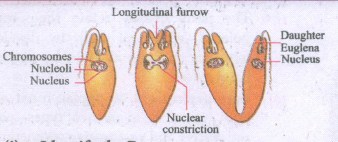
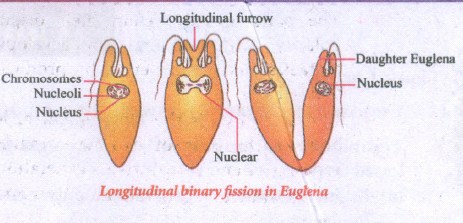
(i) Identify the Process
(ii) Name the Organism
10.
Explain encystment in amoeba.
11.
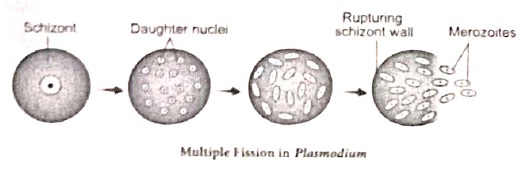
Explain multiple fission in plasmodium.
12.
Why are the offsprings of oviparous animal at a greater risk as compared to offsprings of viviparous organisms?
13.
Which type of reproduction is effective -Asexual or sexual and why?
14.
Write notes on binary fission in animals.
15.
16.
Differentiate between the following:
(a) Binary fission in amoeba and multiple fission in Plasmodium
(b) Budding in yeast and budding in Hydra
(c) Regeneration in lizard and Planaria
17.
Budding is seen in ______
Noctiluca
Amoeba
Nostoc
Planaria
18.
Giant Amoeba refers to ______
Opalina
Pelomyxa
Ceratium
Trichonympha
19.
Plasmotomy is observed in ________
Giant Amoeba
Hydra
Plasmodium
Ceratium
1.
D. If both A and R are false.
2.
A. If both A and R are true and R is correct explanation for A
3.
Juvenile phase I Vegetative phase, reproductive phasel maturity phase, Senescent phase.
4.
(i) Plasmotomy is the division of multinucleated parent into many multinucleate daughter individuals, with the division of nuclei.
(ii) Nuclear division occurs later to maintain normal number of nuclei (e,g:) Opalina and Pelomyxa.
(iii) Plasmotomy occurs in Opalina and Pelomyxa.
(iv) It is a method of asexual reproduction
5.
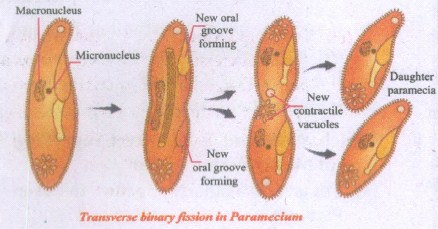
In paramecium, the macronucleus divides by amitosis and the micronucleus divides by mitosis.
6.
| juvenile phase | reproductive phase |
| lt is also known as young and Vegetative Phase | It is also known as Maturity adult Phase |
| lt is the period of growth between the birth of the individual upto reproductive maturitiy. | The organisms reproduce and their offsprings reach maturity period |
7.
Offsprings produced by asexual reproduction are called clones, because they are genetically as well as morphologically similar to the parent organism.
They are not only similar to one another, but are also exact copies of their parent (e,g): Amoeba, Spirogyra, Hydra, Yeast, etc.
8.
Parthenogenesis is the phenomenon in which female gamete directly develops into a new organism. (e,g:) Honeybee (male or drone).
9.
(i) Longitudinal binary fission
(ii) Euglena
10.
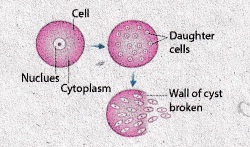
(i) During unfavorable conditions Amoeba withdraws its pseudopodia and secretes a three-layered, protective, chitinous cyst wall around it and becomes inactive. This phenomenon is called encystment.
(ii) When conditions become favourable, the encysted Amoeba divides by multiple fission and produces many minute amoebae called pseudopodiospore or amoebulae.
(iii) The cyst wall breaks off liberating the young pseudopodiospores.
11.
(i) In Plasmodium, multiple fission occurs in the schizont and in the oocyte stages. When multiple fission occurs in the schizont, the process is called schizogony and the daughter individuals are called merozoites.
(ii) When multiple fission occurs in the oocyte, it is called sporogony and the daughter individuals are called sporozoites.
12.
Oviparous animals lay eggs outside their body. These eggs are exposed to various environmental conditions and may be eaten by predators also. They face lot of risks until the young ones hatche. But the offsprings of viviparous animals are more safe and protected in the maternal womb until they are born.
13.
1. Sexual reproduction is considered to be a better mode of reproduction because it creates a hybrid that has more vigor than the parents.
2. It also creates the variation in off springs making its survival better.
3. The fact that most of the eukaryotes reproduce sexually in evidence of its evolutionary success.
4. In many animals, it is actually the only mode of reproduction.
14.
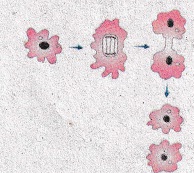
In binary fission, the parent organism divides into two halves and each half forms a daughter individual. The nucleus divides first amitotically or mitotically (karyokinesis), followed by the division of the cytoplasm (cytokinesis). The resultant offsprings are genetically identical to the parent. Depending on the plane of fission, binary fission is of the following types
(i) Simple irregular binary fission
(ii) Transverse binary fission
(iii) Longitudinal binary fission
(iv) Oblique binary fission
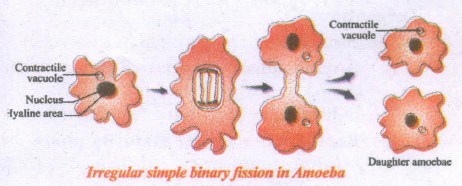
(i) Simple irregular binary fission is seen in Amoeba like irregular shaped organisms, where the plane of division is hard to observe. The contractile vacuoles cease to function and disappear. The nucleoli disintegrate and the nucleus divides mitotically. The cell then constricts in the middle, so the cytoplasm divides and forms two daughter cells.
(ii) In Transverse binary fission, the plane of the division runs along the transverse axis of the individual. E.g. Paramecium and Planaria. In Paramecium the macronucleus divides by amitosis and the micronucleus divides by mitosis.
(iii) In Longitudinal binary fission the nucleus and the cytoplasm divides in the longitudinal axis of the organism. In flagellates, the flagellum is retained usually by one daughter cell. The basal granule is divided into two and the new basal granule forms a flagellum in the other daughter individual. E.g. Vorticella and Euglena.
(iv) In Oblique binary fission the plane of division is oblique. It is seen in dinoflagellates. E.g. Ceratium.
15.
16.
(a)
| Binary Fission in Amoeba | Multiple fission in Plasmodium |
| lt results in the production of two individuals from a single parent. | It results in the production of several individuals |
| lt occurs under favourable conditions | It occurs both under favourable and unfavourable conditions |
| Nucleus of the parent cell divides only once to form two daughter nuclei | Nucleus of the parent cell undergoes repeated divisions to form a number of daughter nuclei |
| Cytoplasm divides after nuclear division | Cytoplasm does not divide after each nuclear division but divides during favourable condition |
| No part of parent body is left unused (e,g: Amoeba) | A part of the body (covering and residuai cytoplasm) is left unused. (e,g: Paramecium) |
 |
 |
(b) Budding in yeast and budding in hydra
| Budding in Yeast | Budding in Hydra |
| During budding the cell wall of the parent cell bulges out in the form of an out growth as bud | During budding the ectoderm cells increase and form a small elevation on the body surface as bud. |
| The parent nucleus divides into two daughter nuclei one of which migrates into bud. | Ectoderm and endoderm are pushed out to form the bud. The bud contains an interior lumen in continuation with parent's gastro vascular cavity (coelenteron) |
| As the bud enlarges and is fully formed, it is separated from the parentcell and grows into mature yeast. Sometimes a bud may produce another bud over it which is still attached to parent cell forming a false mycelium (or) pseudomycelium | The bud enlarges, develops a mouth and a circle of tentacles at its free end. When fully grown, the bud constricts at the base and finally separates from the parent body and leads an independent life |
(c) Regeneration is regrowth in the injured region
| Regeneration in Lizard | Regeneration in Planaria |
| This type of regeneration comes under epimorphosis type. | This type of regeneration comes under morphallaxis type |
| Several body parts can develop. | When the body is cut into several pieces, each piece can regenerate the lost parts and develops into a whole individual |
17.
(a)
Noctiluca
18.
(b)
Pelomyxa
19.
(a)
Giant Amoeba

12th Standard Syllabus & Materials
12th Standard
TN 12th Computer Applications களப்பெயர் முறைமை (DNS) Sample Question Papers Study Material - QB365 Set A
NEW12th Standard
TN 12th Computer Applications வலையமைப்பு எடுத்துக்காட்டுகள் மற்றும் நெறிமுறைகள் Sample Question Papers Study Material - QB365 Set A
NEW12th Standard
TN 12th Computer Applications கணினி வலையமைப்பு ஓர் அறிமுகம் Sample Question Papers Study Material - QB365 Set A
NEW12th Standard
TN 12th Computer Applications PHP-உடன் MySQL-ஐ இணைத்தல் Sample Question Papers Study Material - QB365 Set A



Tamilnadu Stateboard 12th Standard Subjects

Maths

Chemistry

Physics
Biology

Computer Science

Business Maths and Statistics

Economics

Commerce

Accountancy

History

Computer Applications
Biology
Computer Technology
Computer Applications
Computer Science
Business Maths and Statistics
Commerce
Economics
Maths
Chemistry
Physics
Computer Technology
History
Accountancy

Tamil

English

French
Tamilnadu Stateboard Standards

