
 100% FREE ACCESS
12th Standard Syllabus & Materials
12th Standard
TN 12th Computer Applications மின்னணு தரவு பரிமாற்றம் Sample Question Papers Study Material - QB365 Set A
NEW12th Standard
TN 12th Computer Applications மின் - வணிக பாதுகாப்பு அமைப்புகள் Sample Question Papers Study Material - QB365 Set A
NEW12th Standard
TN 12th Computer Applications மின்னணு செலுத்தல் முறைகள் Sample Question Papers Study Material - QB365 Set A
NEW12th Standard
TN 12th Computer Applications மின் - வணிகம் Sample Question Papers Study Material - QB365 Set A
NEW12th Standard
TN 12th Computer Applications திறந்த மூல கருத்துருக்கள் Sample Question Papers Study Material - QB365 Set A
NEW12th Standard
TN 12th Computer Applications வலையமைப்பு வடமிடல் Sample Question Papers Study Material - QB365 Set A

Published on: 03/01/2020
Zoology - Human Reproduction
Download Tamil Nadu 12th Standard Biology question papers, model tests, one-mark questions, important questions, and public exam papers in PDF format. Free study materials and answer keys for TN State Board students.
Questions + Answers key
Take MCQ Biology Test1.
The type of antibodies present in colostrum.
Ig E
Ig M
Ig A
Ig B
2.
_____ is the birth canal.
Cervix
Cervical canal
Uterus
Vagina
3.
The dividing embryo takes ______ days to move to the uterus from the fallopian tube.
10
15
4-5
2
4.
______ is popularly known as sperm lysin.
Inhibitin
Hyaluronidase
Androgen
Acrosome
5.
Spermatid \(\overset { A }{ \rightarrow }\) Spermatozoa what does 'A' stands for?
Spermatogenesis
Spermiation
Spermiogenesis
Gametogenesis
6.
The Androgen Binding Protein (ABP) is produced by ________.
Leydig cells
Hypothalamus
Sertoli cells
Pituitary gland
7.
The foetal membrane that forms the basis of the umbilical cord is _____.
Allantois
Amnion
Chorion
Yolk sac
8.
What is placenta?
9.
Enumerate the functions of reproductive system.
10.
Name the accessory ducts associated with male reproductive system.
11.
Define Gametogenesis.
12.
Name the hormones produced from the placenta during pregnancy.
13.
At what stage of development are the gametes formed in new born male and female?
14.
"Role of hormones in spermatogenesis" - comment on the statement.
15.
What is acrosome?
16.
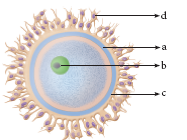
Identify the given image and label its parts marked as a, b, c and d
17.
(i) PPL helps in lactation
(ii) hCS helps in fertilization
(iii) Egg is the largest human cell
(iv) 14th day of menstrual cycle is the ovulatory phase
(a) i, iv
(b) ii and iii
(c) I, ii and iv
(d) i, iii, iv
18.
(i) For fertilization to occur, the egg must be transported earlier to the fallopian tube.
(ii) Twins are formed because fertilization membrane is formed later.
(iii) Binding of sperms to receptor molecules in zona. Pellucida is seen during fertilization
(iv) Morula is formed before blastocyst
(a) All the above
(b) i, iii and iv
(c) i and ii
(d) ii and iv
19.
Assertion: By 36th week, the baby is positioned into pelvis for parturition
Reason: The Braxter -Hick's contractions will begin for parturition.
Codes:
A. A and R are true, R is the correct explanation of A
B. A and R are true, R is not the correct explanation of A
C. A is true, R is false
D. Both A and R are false
20.
| (i) Amenorrhoea | Short cycle |
| (ii) Dysmenorrhoea | Uterine fibroids |
| (iii) Oligomenorrhoes | Pain |
| (iv) Polymenorrhoea | Psychological disturbances |
(a) i, ii and iv
(b) ii and iii
(c) ii and iv
(d) i, ii and iii
21.
| (i) Dizygotic twins | Two sperms |
| (ii) Epiblast | Gastrula |
| (iii) Amnion | Umbilical cord |
| (iv) Colostrum | I g A antibodies |
(a) i, ii and iv
(b) i and iv
(c) iii and iv
(d) ii and iii
22.
(a) Axoneme
(b) Mitochondria
(c) acrosome
(d) fertilization membrane
23.
Surgical removal of testis is called ______
24.
Release of ovum from follicle is called _____
25.
Write a note on embryonic membranes
1.
(c)
Ig A
2.
(d)
Vagina
3.
(a)
10
4.
(b)
Hyaluronidase
5.
(a)
Spermatogenesis
6.
(c)
Sertoli cells
7.
(a)
Allantois
8.
Placenta is a temporary endocrine organ formed during pregnancy and it connects the foetus to the uterine wall through the umbilical cord. It is the organ by which the nutritive, respiratory and excretory functions are fulfilled
9.
The reproductive system has four main functions namely,
(i) To produce the gametes namely sperms and ova
(ii) To transport and sustain these gametes
(iii) To nurture the developing offspring
(iv) To produce hormones
10.
The accessory ducts associated with the male reproductive system include rete testis, vasa efferentia, epididymis and vas deferens.
11.
Formation of gametes in males and females by spermatogenesis and oogenesis respectively
12.
Human Chorionic Gonadotropin (hCG), Human Chorionic Somatotropin (hCS) (or) Human Placental Lactogen (hPL), oestrogens and progesterone.
13.
Development of female gamete is called oogenesis. Oogenesis starts at the beginning of puberty.
Development of male gamete is called spermatogenesis. Spermatogenesis starts at puberty
14.
Spermatogenesis starts at the age of puberty and is initiated due to the increase in the release of Gonadotropin-Releasing Hormone (GnRH) by the hypothalamus. GnRH acts on the anterior pituitary gland and stimulates the secretion of two gonadotropins namely Follicle Stimulating Hormone (FSH) and Luteinizing Hormone (LH). FSH stimulates testicular growth and enhances the production of Androgen Binding Protein (ABP) by the Sertoli cells and helps in the process of spermiogenesis. LH acts on the Leydig cells and stimulates the synthesis of testosterone which in turn stimulates the process of spermatogenesis.
15.
(i) Acrosome is a small cap like pointed structure present at the tip of the nucleus and is formed mainly from the Golgi body of the spermatid.
(ii) It contains hyaluronidase, a proteolytic enzyme, popularly known as sperm lysin which helps to penetrate the ovum during fertilisation.
16.
Human Ovum
a - Vitelline membrane
b - Nucleus
c - Zona Pellucida
d - Corona radiata
17.
()
i, iii, iv
18.
i and ii
19.
C. A is true, R is false
20.
ii and iv
21.
ii and iii
22.
fertilization membrane
Reason: It is not a part of the sperm whereas the others are parts of sperm.
23.
Orchidectomy
24.
ovulation
25.
The extra embryonic membranes include amnion, yolk sac, allantois, and chorion. They protect the embryo from desiccation, mechanical shock, absorption of nutrients, gaseous exchange and placental formation.
| Embryonic membrane | Function | |
| a. | Amnion | Innermost two-layered membrane with amniotic fluid providing buoyancy to embryo from injury regulates temperature and acts as a medium for fetal movement. |
| b. | Chorion | Outermost layer covering and protecting the embryo. |
| c. | Allantois | Forms an outpocketing of embryonic tissue at the tail of yolk sac which forms umbilical cord that links embryo to placenta and finally becomes the part of urinary bladder |
| d. | Yolk sac | Forms a part of gut and acts a source of earliest blood cells and blood vessels |

12th Standard Syllabus & Materials
12th Standard
TN 12th Computer Applications களப்பெயர் முறைமை (DNS) Sample Question Papers Study Material - QB365 Set A
NEW12th Standard
TN 12th Computer Applications வலையமைப்பு எடுத்துக்காட்டுகள் மற்றும் நெறிமுறைகள் Sample Question Papers Study Material - QB365 Set A
NEW12th Standard
TN 12th Computer Applications கணினி வலையமைப்பு ஓர் அறிமுகம் Sample Question Papers Study Material - QB365 Set A
NEW12th Standard
TN 12th Computer Applications PHP-உடன் MySQL-ஐ இணைத்தல் Sample Question Papers Study Material - QB365 Set A



Tamilnadu Stateboard 12th Standard Subjects

Maths

Chemistry

Physics
Biology

Computer Science

Business Maths and Statistics

Economics

Commerce

Accountancy

History

Computer Applications
Biology
Computer Technology
Computer Applications
Computer Science
Business Maths and Statistics
Commerce
Economics
Maths
Chemistry
Physics
Computer Technology
History
Accountancy

Tamil

English

French
Tamilnadu Stateboard Standards

