
 100% FREE ACCESS
12th Standard Syllabus & Materials
12th Standard
TN 12th Computer Applications மின்னணு தரவு பரிமாற்றம் Sample Question Papers Study Material - QB365 Set A
NEW12th Standard
TN 12th Computer Applications மின் - வணிக பாதுகாப்பு அமைப்புகள் Sample Question Papers Study Material - QB365 Set A
NEW12th Standard
TN 12th Computer Applications மின்னணு செலுத்தல் முறைகள் Sample Question Papers Study Material - QB365 Set A
NEW12th Standard
TN 12th Computer Applications மின் - வணிகம் Sample Question Papers Study Material - QB365 Set A
NEW12th Standard
TN 12th Computer Applications திறந்த மூல கருத்துருக்கள் Sample Question Papers Study Material - QB365 Set A
NEW12th Standard
TN 12th Computer Applications வலையமைப்பு வடமிடல் Sample Question Papers Study Material - QB365 Set A

Published on: 03/01/2020
Zoology - Immunology
Download Tamil Nadu 12th Standard Biology question papers, model tests, one-mark questions, important questions, and public exam papers in PDF format. Free study materials and answer keys for TN State Board students.
Questions + Answers key
Take MCQ Biology Test1.
______ is the first one to encounter the antigen that enters tissue spaces.
Spleen
Lymph node
Bone marrow
GALT
2.
______ is a secondary lymphoid organ found in pharynx.
Adenoid
Tonsils
Thymus
Spleen
3.
______ is a second generation vaccine.
Polio
MMR
Hepatitis B
DPT
4.
Lymph nodes are seen in the ______
Toes
heart
Neck
Palm
5.
______ is not a feature of acquired immunity.
diversity
recognitionof self
non-specific
memory
6.
7.
All are peripheral lymphoid organs except
Lymph nodes
Spleen
Mucosa associated lymphoid tissue
Thymus
8.
Paratope is an
Antibody binding site on variable regions
Antibody binding site on heavy regions
Antigen binding site on variable regions
Antigen binding site on heavy regions
9.
Mention the functions of immunoglobulins?
10.
Define acquired immunity.
11.
How does immune system work?
12.
What is agglutination?
13.
Differentiate primary and secondary lymphoid organs with an example.
14.
Explain the structure of immunoglobulin with suitable diagram.
15.
Differentiate between:
Humoral and CMI immunity
16.
Write a note on different types of antigen antibody reactions.
17.
What is vaccine? What are its types?
18.
(i) When a cell undergoes malignant transformation it acquires a new surface antigen.
(ii) Allergy responses are medIated by IgA.
(iii) Western blot test deted~ the' viral core protein.
(iv) Passive immunity requires the body to produce antibodies
(a) ii and iv
(b) iii and iv
(c) i and iii
(d) i and iv
19.
Assertion: Opsonisation results in clumping of antigens.
Reason: It results in production of antitoxins.
(a) A and R are true, R is the correct explanation of A
(b) A and R are true, R is not the correct explanation of A
(c) A is true, R is false
(d) Both A and R are false
20.
| i. Agglutination | Particulate antigen |
| ii. Opsonin | Phagocytosis |
| iii. Precipitin | soluble antigen |
| iv. Neutralization | auto antigens |
(a) ii only
(b) iii and iv
(c) iv only
(d) i and ii
21.
(a) Dendritic cells
(b) Axon
(c) Macrophages
(d) Leucocytes
22.
(a) precipitation
(b) opsonisation
(c) diapedesis
(d) neutralization
23.
Another word for tumors _______
24.
Process of production of blood cells in bone marrow ______
25.
Ability of body to fight against a disease ______
1.
(b)
Lymph node
2.
(b)
Tonsils
3.
(c)
Hepatitis B
4.
(c)
Neck
5.
(c)
non-specific
6.
(d)
7.
(d)
Thymus
8.
(c)
Antigen binding site on variable regions
9.
They functions as antibodies. The functions of immunoglobulin are agglutination, precipitation, opsonisation, neutralization etc.,
10.
The immunity that an individual acquires after birth is known as acquired immunity. It is the body's resistance to a specific pathogen.
11.
The immune responses may be primary or secondary.
(i) The primary immune response occurs when a pathogen comes in contact with the immune system for the first time.
(ii) The secondary immune response occurs when a person is exposed to the same antigen again. During this time, immunological memory has been established and the immune system can start producing antibodies immediately. Within hours after recognition of the antigen, a new army of plasma cells are generated. Within 2 to 3 days, the antibody concentration in the blood rises steeply to reach much higher level than primary response. This is also called as "booster response".
12.
(i) Whenever a particulate antigen interacts with its antibody, it would result in clumping or agglutination of-the particulate antigen, which is called agglutination reaction.
(ii) The antibody involved in bringing about agglutination reaction is called agglutinin.
13.
Based on their functions, lymphoid organs are classified into primary or central lymphoid organs and secondary or peripheral lymphoid organs.
(i) The primary lymphoid organs provide appropriate environment for lymphocytic maturation. Eg. Thymus gland.
(ii) The secondary lymphoid organs trap antigens and make it available for mature lymphocytes, which can effectively fight against these antigens. Eg. Spleen.
14.
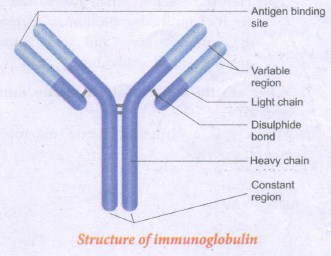
(i) In the 195"os,experiments by Porter and Edelman revealed the basic structure of the immunoglobulin.
(ii) An antibody molecule is Y shaped structu re that comprises of four polypeptide chains, two identical light chains (L) of molecular weight 25,000 Da (approximately 214 amino acids) and two identical heavy chains (H) of molecular weight 50,000 Da (approximately 450 amino acids).
(iii) The polypeptide chains are linked together by di-sulphide (S-S) bonds. One light chain is attached to each heavy chain and two heavy chains are attached to each other to form a Y shaped (Fig.) structure. Hence, an antibody is represented by H2L2.
(iv) Each chain (L and H) has two terminals. They are C - terminal (Carboxyl) and amino or N-terminal.
(v) Each chain (L and H) has two regions. They have variable (V) region at one end and a much larger constant (C) region at the other end.
(vi) Antibodies responding to different antigens have very different (V) regions but their (C) regions are the same in all antibodies.
(vii) In each arm of the monomer antibody, the (V) regions of the heavy and light chains combines to form an antigen - binding site shaped to 'fit' a specific antigenic determinant. Thus each antibody monomer has two such antigen - binding regions.
(viii) The (C) regions that forms the stem of the antibody monomer determine the antibody class and serve common functions in all antibodies.
15.
| S.No | Humoral Immunity | Cell mediated immunity |
| i. | When Pathogens are destroyed by the production of antibodies, it is known as antibody mediated or hurmoral immunity. |
When Pathogens are destroyed by cells without producing antibodies it is known as cell mediated immunity. |
| ii. | This is brought about by B cells with the aid of antigen presenting cells and T helper cells. |
This is brought about by T cells, macrophages and natural killer cells |
16.
The different types of antigen-antibody reaction are:
(i) Precipitin: The reaction between soluble antigen and antibody leads to visible precipitate formation, which is called precipitin reaction. Antibodies that bring about precipitate formation on reacting with antigens are called as precipitins.
(ii) Agglutinstion: Whenever a particulate antigen interacts with its antibody, it would result in clumping or agglutination of the particulate antigen, which is called agglutination reaction. The antibody involved in bringing about agglutination reaction is called agglutinin.
(iii) Opsonisation: Opsonisation or enhanced attachment is the process by which a pathogen is marked of ingestion and destruction by a phagocyte. Opsonisation involves the binding of an opsonin i.e., antibody, to a receptor on the pathogen's cell membrane. After opsonin binds to the membrane, phagocytesare attracted to the pathogen. So, opsonisation is a process in which pathogens are coated with a substance called an opsonin, marking the pathogen out for destruction by the immune system. This results in a much more efficient phagocytosis.
(iv) Neutralization: The neutralization reactions are the reactions or antigenantibody that involve the climinai ion of harmful effects of bacterial exotoxins or a virus by specific antibodies. These neutralizing substances i.e., antibodies are known as antitoxins. This specific antibody is produced by a host cell in response to a bacterial exotoxin or corresponding toxoid.
17.
A vaccine is a biological preparation that provides active acquired immunity to a particular disease and resembles a diseasecausing microorganism and is often made from weakened or atlenuated or killed forms of the microbes, their toxins, or one of its surface proteins. The vaccines are classified as first, second and third generation vaccines.
18.
()
i and iii
19.
Both A and R are false
20.
iv only
21.
Reason: It is not linked to immune system whereas the others are Iinked to Irnmune system.
22.
diapedesis
Reason: It is not a type of antigen-antibody reaction whereas others are types of antigenantibody reactions.
23.
neoplasm
24.
haematopoiesis
25.
immunity

12th Standard Syllabus & Materials
12th Standard
TN 12th Computer Applications களப்பெயர் முறைமை (DNS) Sample Question Papers Study Material - QB365 Set A
NEW12th Standard
TN 12th Computer Applications வலையமைப்பு எடுத்துக்காட்டுகள் மற்றும் நெறிமுறைகள் Sample Question Papers Study Material - QB365 Set A
NEW12th Standard
TN 12th Computer Applications கணினி வலையமைப்பு ஓர் அறிமுகம் Sample Question Papers Study Material - QB365 Set A
NEW12th Standard
TN 12th Computer Applications PHP-உடன் MySQL-ஐ இணைத்தல் Sample Question Papers Study Material - QB365 Set A



Tamilnadu Stateboard 12th Standard Subjects

Maths

Chemistry

Physics
Biology

Computer Science

Business Maths and Statistics

Economics

Commerce

Accountancy

History

Computer Applications
Biology
Computer Technology
Computer Applications
Computer Science
Business Maths and Statistics
Commerce
Economics
Maths
Chemistry
Physics
Computer Technology
History
Accountancy

Tamil

English

French
Tamilnadu Stateboard Standards

