
 100% FREE ACCESS
12th Standard Syllabus & Materials
12th Standard
TN 12th Maths Applications of Matrices and Determinants Sample Question Papers Study Material - QB365 Set A
NEW12th Standard
TN 12th Computer Applications மின்னணு தரவு பரிமாற்றம் Sample Question Papers Study Material - QB365 Set A
NEW12th Standard
TN 12th Computer Applications மின் - வணிக பாதுகாப்பு அமைப்புகள் Sample Question Papers Study Material - QB365 Set A
NEW12th Standard
TN 12th Computer Applications மின்னணு செலுத்தல் முறைகள் Sample Question Papers Study Material - QB365 Set A
NEW12th Standard
TN 12th Computer Applications மின் - வணிகம் Sample Question Papers Study Material - QB365 Set A
NEW12th Standard
TN 12th Computer Applications திறந்த மூல கருத்துருக்கள் Sample Question Papers Study Material - QB365 Set A

Published on: 03/01/2020
Zoology - Reproduction in Organisms
Download Tamil Nadu 12th Standard Biology question papers, model tests, one-mark questions, important questions, and public exam papers in PDF format. Free study materials and answer keys for TN State Board students.
Questions + Answers key
Take MCQ Biology Test1.
Pick out the organism whose fertilization occurs internally
reptiles
sponges
pisces
amphibians
2.
"Nothing lives forever, but life continues". What does it mean?
Older dies but new ones are produced by reproduction
Nothing can produce without death
Death has nothing to do with the continuation of life
Parthenogenesis is must for sexual reproduction
3.
Fusion of morphologically and physiologically similar gametes is called ______
anisogamy
hologamy
isogamy
merogamy
4.
Human beings exhibit ______
Hologamy
Exogamy
Isogamy
Paedogammy
5.
If the entire organism behaves as a gamete the Phenomenon is called _____
Autogamy
Syngamy
Morphallaxis
Hologamy
6.
During favourable conditions ______ shows multiple fission.
Plasmodium
Amoeba
Planaria
Euglena
7.
8.
Assertion: The embryos of ovoviviparous animals have no placental connection with their mothers.
Reason: Embryos receive nourishment from the egg yolk.
Codes:
A. If both A and R are true and R is correct explanation for A
B. If both A and R are true but R is not the correct explanation for A
C. If A is true but R is false
D. If both A and R are false
9.
Assertion and reasoning questions:
In each of the following questions there are two statements. One is assertion (A) and other is reasoning (R). Mark the correct answer as
Assertion: Viviparous animals give better protection to their off springs.
Reason: They lay their eggs in the safe places of the environment.
Codes:
A. If both A and R are true and R is correct explanation for A
B. If both A and R are true but R is not the correct explanation for A
C. If A is true but R is false
D. If both A and R are false.
If both A and R are true and R is correct explanation for A
If both A and R are true but R is not the correct explanation for A
If A is true but R is false
If both A and R are false
10.
Give the definition for (a) Arrhenotoky (b) Thelytoky (c) Amphitoky
11.
Differentiate exogenous and endogenous budding.
12.
13.
Write notes on binary fission in animals.
14.
Give reasons for the following:
(a) Some organisms like honey bees are called parthenogenetic animals
(b) A male honey bee has 16 chromosomes where as its female has 32 chromosomes
15.
Name the four types of fission seen in animals
16.
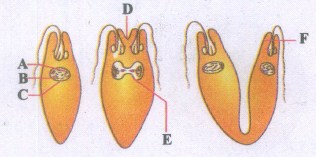
Identify the parts marked as A, B, C, D, E and F for the below diagram.
17.
With regard to asexual reproduction. mention two phenomena seen is Hydra.
18.
Define regeneration mention the types.
19.
How is juvenile phase different from reproductive phase?
20.
(i) Lizard is a continuous breeder.
(ii) Asexual reproduction is also known as somatogenic reproduction
(iii) In repeated fission, young ones do not separate till fission process is completed.
(iv) strobilation is a kind of longitudinal fission.
(a) i and iii
(b) i, ii and iv
(c) ii and iii
(d) ii and iv
21.
| i. Sporogony | Paramecium |
| ii. Bacteria | Uniparental inheritance |
| iii. Amoeba | Multiple fission |
| iv. Birds | External fertilization |
(a) i, ii and iv
(b) iii and iv
(c) ii and iv
(d) ii and iii
22.
| i. Planaria | Morphallaxis |
| ii. Conjugation | Amoeba |
| iii. Autogamy | Paramecium |
| iv. Apolysis | sea anemones |
(a) i and iii
(b) ii and iv
(c) ii and iii
(d) i, iii and iv
23.
(a) Conjugation
(b) Hologamy
(c) Paedogamy
(d) Regeneration
24.
During multiple fission Amoebae produce ______
25.
Exogenous buds are seen in ______
26.
The ploidy of males produced by arrhenotoky parthenogenesis is ________
1.
(a)
reptiles
2.
(a)
Older dies but new ones are produced by reproduction
3.
(c)
isogamy
4.
(b)
Exogamy
5.
(d)
Hologamy
6.
(b)
Amoeba
7.
(c)
8.
A. If both A and R are true and R is correct explanation for A
9.
D. If both A and R are false.
10.
(a) Arrhenotoky: In this type, only males are produced by parthenogenesis. eg: honey bees
(b) Thelytoky: In this type of parthenogenesis only females are produced by parthenogenesis. e.g: Solenobia
(c) Amphitoky: In this type parthenogenetic egg may develop into individuals of any sex. e.g: Aphis.
11.
| Exogenous budding | Endogenous Budding |
| Buds are formed on the outer surface of the parent body |
Buds are formed inside the cytoplasm within the body of the parent |
| E.g. Hydra | E.g. Noctiluca |
12.
13.
In binary fission, the parent organism divides into two halves and each half forms a daughter individual. The nucleus divides first amitotically or mitotically (karyokinesis), followed by the division of the cytoplasm (cytokinesis). The resultant offsprings are genetically identical to the parent. Depending on the plane of fission, binary fission is of the following types
(i) Simple irregular binary fission
(ii) Transverse binary fission
(iii) Longitudinal binary fission
(iv) Oblique binary fission
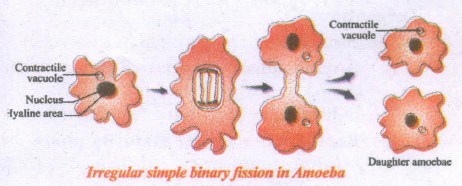
(i) Simple irregular binary fission is seen in Amoeba like irregular shaped organisms, where the plane of division is hard to observe. The contractile vacuoles cease to function and disappear. The nucleoli disintegrate and the nucleus divides mitotically. The cell then constricts in the middle, so the cytoplasm divides and forms two daughter cells.
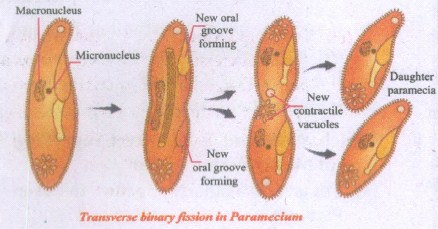
(ii) In Transverse binary fission, the plane of the division runs along the transverse axis of the individual. E.g. Paramecium and Planaria. In Paramecium the macronucleus divides by amitosis and the micronucleus divides by mitosis.
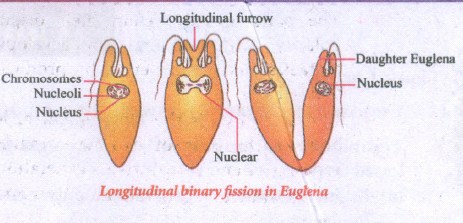
(iii) In Longitudinal binary fission the nucleus and the cytoplasm divides in the longitudinal axis of the organism. In flagellates, the flagellum is retained usually by one daughter cell. The basal granule is divided into two and the new basal granule forms a flagellum in the other daughter individual. E.g. Vorticella and Euglena.
(iv) In Oblique binary fission the plane of division is oblique. It is seen in dinoflagellates. E.g. Ceratium.
14.
(a) Some organisms like honeybees are called parthenogenetic animals.
1. In case of honeybees both haploid and diploid individuals formed, as a result of incomplete parthenogenesis.
2. Both sexual reproduction and parthenogenesis are inclusive.
3. Fertilized eggs (zygote) give rise to queen and workers (both are females) by the process of sexual reproduction.
4. Unfertilized eggs (ova) of females develop into drones (males) by the process of parthenogenesis.
(b) A male honeybee has 16 chromosomes where as its female has 32 chromosomes
1. It is because of haplodiploidy which is a sex determination system, in which males develop from unfertilized eggs (parthenogenesis) and are haploid (16n) and females develop frorn fertilized eggs and are diploid (32n) (sexual reproduction).
2. As unfertilized egg carries only half number of chromosome as compared to fertilized egg.
Therefore male honeybees have 16 chromosomes where as female has 32 chromosomes.
15.
Binary fission, Multiple fission, Sporulation and Strobilation
16.
A - Chromosomes
B - Nucleoli
C - Nucleus
D - Longitudinal furrow
E - Nuclear constriction
F - Daughter Euglena
17.
Budding and Regeneration.
18.
(i) Regeneration is regrowth in the injured region.
(ii) Regeneration is of two types
(a) morphallaxis
(b) epimorphosis.
19.
| juvenile phase | reproductive phase |
| lt is also known as young and Vegetative Phase | It is also known as Maturity adult Phase |
| lt is the period of growth between the birth of the individual upto reproductive maturitiy. | The organisms reproduce and their offsprings reach maturity period |
20.
()
ii and iii
21.
ii and iv
22.
ii and iv
23.
Regeneration
Reason: lt is associated with asexual reproduction whereas the others are associated with sexual reproduction.
24.
Amoobulae or Pseudopodiospores
25.
Hydra
26.
()
haploid

12th Standard Syllabus & Materials
12th Standard
TN 12th Computer Applications வலையமைப்பு வடமிடல் Sample Question Papers Study Material - QB365 Set A
NEW12th Standard
TN 12th Computer Applications களப்பெயர் முறைமை (DNS) Sample Question Papers Study Material - QB365 Set A
NEW12th Standard
TN 12th Computer Applications வலையமைப்பு எடுத்துக்காட்டுகள் மற்றும் நெறிமுறைகள் Sample Question Papers Study Material - QB365 Set A
NEW12th Standard
TN 12th Computer Applications கணினி வலையமைப்பு ஓர் அறிமுகம் Sample Question Papers Study Material - QB365 Set A



Tamilnadu Stateboard 12th Standard Subjects

Maths

Chemistry

Physics
Biology

Computer Science

Business Maths and Statistics

Economics

Commerce

Accountancy

History

Computer Applications
Biology
Computer Technology
Computer Applications
Computer Science
Business Maths and Statistics
Commerce
Economics
Maths
Chemistry
Physics
Computer Technology
History
Accountancy

Tamil

English

French
Tamilnadu Stateboard Standards

