
 100% FREE ACCESS
12th Standard Syllabus & Materials
12th Standard
TN 12th Computer Applications மின்னணு தரவு பரிமாற்றம் Sample Question Papers Study Material - QB365 Set A
NEW12th Standard
TN 12th Computer Applications மின் - வணிக பாதுகாப்பு அமைப்புகள் Sample Question Papers Study Material - QB365 Set A
NEW12th Standard
TN 12th Computer Applications மின்னணு செலுத்தல் முறைகள் Sample Question Papers Study Material - QB365 Set A
NEW12th Standard
TN 12th Computer Applications மின் - வணிகம் Sample Question Papers Study Material - QB365 Set A
NEW12th Standard
TN 12th Computer Applications திறந்த மூல கருத்துருக்கள் Sample Question Papers Study Material - QB365 Set A
NEW12th Standard
TN 12th Computer Applications வலையமைப்பு வடமிடல் Sample Question Papers Study Material - QB365 Set A

Published on: 12/10/2019
Botany - Chromosomal Basis of Inheritance
Download Tamil Nadu 12th Standard Biology question papers, model tests, one-mark questions, important questions, and public exam papers in PDF format. Free study materials and answer keys for TN State Board students.
Questions + Answers key
Take MCQ Biology Test1.

From the above figure identify the type of mutation and explain it.
2.
What are comutagens ?
3.
How temperature induces mutation?
4.
How and where chiasma is formed?
5.
What are the three types of synapsis? (or) Give the types of Synapsis.
6.
Compare Mendelian factors with chromosome.
7.
What are the salient features of the chromosomal theory of inheritance ?
8.
9.
Write the steps involved in molecular mechanism of DNA recombination with diagram.
10.
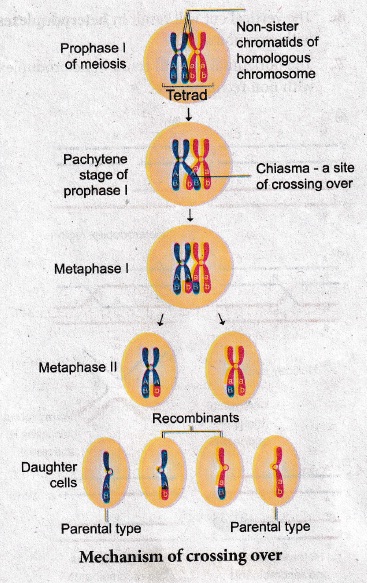
Explain the mechanism of crossing over.
1.
(i) A type of structural chromosomal abbrevation.
Reverse tandem duplication
(ii) The duplicated segment is located immediately after the normal segment but the gene sequence order will be reversed.
2.
Comutagens:
The compounds which are not having own mutagenic properties but can enhance the effects of known mutagens are called comutagens.
Example: Ascorbic acid increase the damage caused by hydrogen peroxide.
3.
(i) Increase in temperature increases the rate of mutation.
(ii) The rise in temperature, breaks the hydrogen bonds between two nucleotides which affects the process of replication and transcription.
4.
After tetrad formation, crossing over occurs in pachytene stage. The non-sister chromatids of homologous pair make a contact at one or more points. These points of contact between non-sister chromatids of homologous chromosomes are called Chiasmata (singular-Chiasma). At chiasma, cross-shaped or X-shaped structures are formed, where breaking and rejoining of two chromatids occur. This results in reciprocal exchange of equal and corresponding segments between them.
5.
Pairing of homologous chromosomes during zygotene stage of prophase I of meiosis I is called synapsis. Synapsis of three types:
1. Procentric synapsis: Pairing starts from middle of the chromosome.
2. Proterminal synapsis: Pairing starts from the telomeres.
3. Random synapsis: Pairing may start from anywhere.
6.
| S. No. | Mendelian factors | Chromosomes behaviour |
| 1. | Alleles of a factor occur in pair. | Chromosomes occur in pairs |
| 2. | Similar or dissimilar alleles of a factor separate during the gamete formation. | The homologous chromosomes separate during meiosis. |
| 3. | Mendelian factors can assort independently. | The paired chromosomes can separate independently during meiosis but the linked genes in the same chromosome normally do not assort independently. |
7.
(i) Somatic cells of organisms are derived from the zygote by repeated cell division (mitosis). these consist of two identical sets of chromosomes. One set is received from female parent (maternal) and the other from male parent (paternal). These two chromosomes constitute the homologous pair.
(ii) Chromosomes retain their structural uniqueness and individuality throughout the life cycle of an organism.
(iii) Each chromosome carries specific determiners or Mendelian factors which are now termed as genes.
(iv) The behaviour of chromosomes during the gamete formation (meiosis) provides evidence to the fact that genes or factors are located on chromosomes.
8.
9.
The widely accepted model of DNA recombination during crossing over is Holliday's hybrid DNA model.
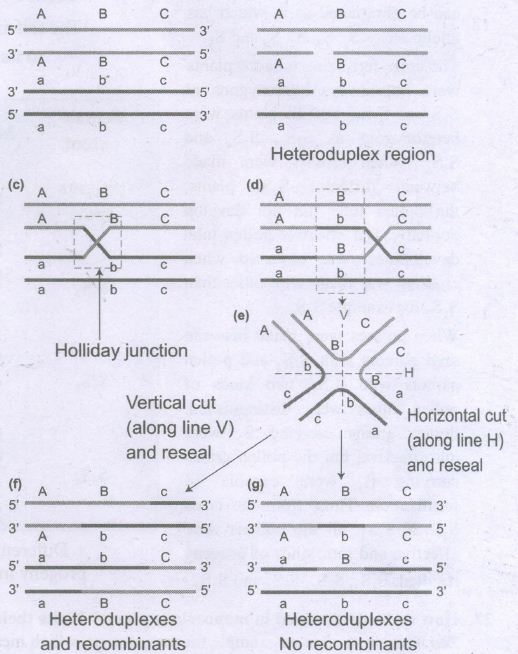
Steps involved are:
1. Homologous DNA molecules are paired side by side with their duplicated copies of DNAs
2. One strand of both DNAs cut in one place by the enzyme endonuclease.
3. The cut strands cross and join the homologous strands forming the Holliday structure or Holliday junction.
4. The Holliday junction migrates away from the original site, a process called branch migration, as a result heteroduplex region is formed.
5. DNA strands may cut along through the vertical (V) line or horizontal (H) line.
6. The vertical cut will result in heteroduplexes with recombinants.
7. The horizontal cut will result in heteroduplex with non recombinants.
10.
Crossing over is a process that includes four stages.
1. Synapsis
(i) Pairing between two homologous chromosomes is initiated during sub stage zygotene stage of prophase I of meiosis I
(ii) Homologous chromosomes are aligned side by side resulting in the formation of bivalents. It also occurs in zygotene sub-stage of prophase I of meiosis I tetrads.This pairing phenomenon is called synapsis.
2.Tetrad Formation
(i) Each homologous chromosome of a bivalent begin to form two identical sister chromatids.
(ii) They remain held together by a centromere at this stage each bivalent has four chromatids. This stage is called tetrad stage.
3. Cross Over
After tetrad formation, crossing over occurs in pachytene stage.
The non-sister chromatids of homologous pair make a contact at one or more points. These points of contact are called Chiasmata.
At chiasma, X-shaped structures are formed, where breaking and rejoining of two chromatids occur. This results in reciprocal exchange of equal and corresponding segments between them synapsis and chiasma formation are facilitated by protein filaments called synaptonemal complex.
4. Terminalisation
After crossing over, chiasma starts to move towards the terminal end of chromatids known as terminalisation. As a result, complete separation of homologous chromosomes occurs.

12th Standard Syllabus & Materials
12th Standard
TN 12th Computer Applications களப்பெயர் முறைமை (DNS) Sample Question Papers Study Material - QB365 Set A
NEW12th Standard
TN 12th Computer Applications வலையமைப்பு எடுத்துக்காட்டுகள் மற்றும் நெறிமுறைகள் Sample Question Papers Study Material - QB365 Set A
NEW12th Standard
TN 12th Computer Applications கணினி வலையமைப்பு ஓர் அறிமுகம் Sample Question Papers Study Material - QB365 Set A
NEW12th Standard
TN 12th Computer Applications PHP-உடன் MySQL-ஐ இணைத்தல் Sample Question Papers Study Material - QB365 Set A



Tamilnadu Stateboard 12th Standard Subjects

Maths

Chemistry

Physics
Biology

Computer Science

Business Maths and Statistics

Economics

Commerce

Accountancy

History

Computer Applications
Biology
Computer Technology
Computer Applications
Computer Science
Business Maths and Statistics
Commerce
Economics
Maths
Chemistry
Physics
Computer Technology
History
Accountancy

Tamil

English

French
Tamilnadu Stateboard Standards

