
 100% FREE ACCESS
12th Standard Syllabus & Materials
12th Standard
TN 12th Maths Applications of Matrices and Determinants Sample Question Papers Study Material - QB365 Set A
NEW12th Standard
TN 12th Computer Applications மின்னணு தரவு பரிமாற்றம் Sample Question Papers Study Material - QB365 Set A
NEW12th Standard
TN 12th Computer Applications மின் - வணிக பாதுகாப்பு அமைப்புகள் Sample Question Papers Study Material - QB365 Set A
NEW12th Standard
TN 12th Computer Applications மின்னணு செலுத்தல் முறைகள் Sample Question Papers Study Material - QB365 Set A
NEW12th Standard
TN 12th Computer Applications மின் - வணிகம் Sample Question Papers Study Material - QB365 Set A
NEW12th Standard
TN 12th Computer Applications திறந்த மூல கருத்துருக்கள் Sample Question Papers Study Material - QB365 Set A

Published on: 12/10/2019
Botany - Ecosystem
Download Tamil Nadu 12th Standard Biology question papers, model tests, one-mark questions, important questions, and public exam papers in PDF format. Free study materials and answer keys for TN State Board students.
Questions + Answers key
Take MCQ Biology Test1.
2.
According to ten percent law, how many Joules of energy does the individuals at the fourth tropic level will receive; if the individuals at first trophic level receives 1000 Joules of energy?
3.
Nutrients are retained in the ecosystem. Discuss how and name the process through which it is achieved?
4.
What is ecosystem services? Why it is of much importance?
5.
Discuss the three zones of a lentic ecosystem.
6.
Write a brief note on Detritus food chain.
7.
Explain Grazing food chain with example.
8.
Generally human activities are against to the ecosystem, where as a student how will you help to protect ecosystem?
9.
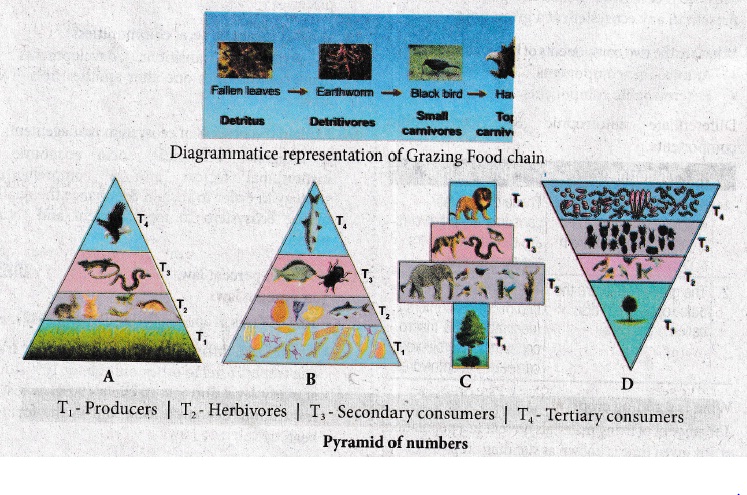
Shape of pyramid in a particular ecosystem is always different in shape. Explain with example.
10.
Name of the food chain which is generally present in all type of ecosystem. Explain and write their significance.
1.
2.
Organism at T4 level will receive 0.1 Joule of energy as per ten percent law.
3.
Nutrients will retain in the ecosystem through biogeochemical cycles. Various nutrients present in soil and atmosphere enter the organism at various trophic levels through food and other process and are cycled back to their origin. Thus the nutrients are not lost but retained in the ecosystem.
4.
Ecosystem services are defined as the benefits that people derive from nature. Study on ecosystem services acts as an effective tool for gaining knowledge on ecosystem benefits and their sustained use. Without such knowledge gain, the fate of any ecosystem will be at stake and the benefits they provide to us in future will become bleak.
5.
There are three zones, littoral, limnetic and profundal. The littoral zone, which is closest to the shore with shallow water region, allows easy penetration of light. It is warm and occupied by rooted plant species. The limnetic zone refers the open water of the pond with an effective penetration of light and domination of planktons. The deeper region of a pond below the limnetic zone is called profundal zone with no effective light penetration and predominance of heterotrophs. The bottom zone of a pond is termed benthic and is occupied by a community of organisms called benthos (usually decomposers).
6.
Detritus food chain is a type of food chain which begins with dead organic matter which is an important source of energy. A large amount of organic matter is derived from the dead plants, animals and their excreta. This- type of food chain is present in all ecosystems. The transfer of energy from the dead organic matter, is transferred through a series of organisms called detritus consumers (detritivores)- small carnivores -large (top) carnivores with repeated eating arid being eaten respectively. This is called the detritus food chain.
Fallen leaves ➝ Earth worm ➝ Black bird ➝ Hawk
Detritus Detritivores Small carnivores Top carnivores
7.
Main source of energy for the grazing food chain is the Sun. It begins with the first link, producers (plants). The second link in the food chain is primary consumers (mouse) which get their food from producers. The third link in the food chain is secondary consumers (snake) which get their food from primary consumers. Fourth link in the food chain is tertiary consumers (eagle) which get their food from secondary consumers.
Grass ➝ Mouse ➝ Snake ➝ Eagle
Producers Primary consumers Secondary Consumers Tertiary consumers
8.
(I) Buying and use only ecofriendly products and recycle them.
(II) Growing more trees.
(III) Choosing sustained farm products (vegetables, fruits and greens, etc.)
(IV) Reduce the use of natural resources.
(V) Recycle the waste and reduce the amount of waste you produce.
(VI) Reduce consumption of water and electricity.
(VII) Reduce or eliminate the use of house-hold chemicals and pesticides.
(VIII) Maintain your cars and vehicles properly. (In order to reduce carbon emission).
(IX) Create awareness and educate about ecosystem protection among your friends and family members and ask them to find out solution to minimise this problem.
9.
Pyramid of number
(i) In a forest ecosystem the pyramid of number is different in shape, it is because the base (T 1) of the pyramid occupies large sized trees (producer) which are lesser in number.
(ii) Herbivores (T2) occupying second trophic level, are more in number than the producers (T1).
(iii) In final trophic level (T4) tertiary consumers (lion) are lesser in number than the secondary consumers (T3).
(iv) Therefore, the pyramid of numbers in forest ecosystem looks spindle-shaped.
Pyramid of biomass
(i) In forest ecosystem, there is a gradual decrease in biomass of organisms at successive trophic levels from producers to top carnivores (Tertiary consumer). Therefore, the pyramid of biomass looks upright.
10.
Detritus food chain
(i) This type of food chain begins with dead organic matter which is an important source of energy.
(ii) A large amount of organic matter is derived from the dead plants, animals and their excreta.
(iii) This type of food chain is present in all ecosystems
(iv) The transfer of energy from the dead organic matter is transferred through a series of organisms called detritus consumers. (detrivores)-Small carnivores -large (top) carnivores with repeated eating and being eaten respectively.

12th Standard Syllabus & Materials
12th Standard
TN 12th Computer Applications வலையமைப்பு வடமிடல் Sample Question Papers Study Material - QB365 Set A
NEW12th Standard
TN 12th Computer Applications களப்பெயர் முறைமை (DNS) Sample Question Papers Study Material - QB365 Set A
NEW12th Standard
TN 12th Computer Applications வலையமைப்பு எடுத்துக்காட்டுகள் மற்றும் நெறிமுறைகள் Sample Question Papers Study Material - QB365 Set A
NEW12th Standard
TN 12th Computer Applications கணினி வலையமைப்பு ஓர் அறிமுகம் Sample Question Papers Study Material - QB365 Set A



Tamilnadu Stateboard 12th Standard Subjects

Maths

Chemistry

Physics
Biology

Computer Science

Business Maths and Statistics

Economics

Commerce

Accountancy

History

Computer Applications
Biology
Computer Technology
Computer Applications
Computer Science
Business Maths and Statistics
Commerce
Economics
Maths
Chemistry
Physics
Computer Technology
History
Accountancy

Tamil

English

French
Tamilnadu Stateboard Standards

