
 100% FREE ACCESS
12th Standard Syllabus & Materials
12th Standard
TN 12th Maths Applications of Matrices and Determinants Sample Question Papers Study Material - QB365 Set A
NEW12th Standard
TN 12th Computer Applications மின்னணு தரவு பரிமாற்றம் Sample Question Papers Study Material - QB365 Set A
NEW12th Standard
TN 12th Computer Applications மின் - வணிக பாதுகாப்பு அமைப்புகள் Sample Question Papers Study Material - QB365 Set A
NEW12th Standard
TN 12th Computer Applications மின்னணு செலுத்தல் முறைகள் Sample Question Papers Study Material - QB365 Set A
NEW12th Standard
TN 12th Computer Applications மின் - வணிகம் Sample Question Papers Study Material - QB365 Set A
NEW12th Standard
TN 12th Computer Applications திறந்த மூல கருத்துருக்கள் Sample Question Papers Study Material - QB365 Set A

Published on: 12/10/2019
Botany - Plant Tissue Culture
Download Tamil Nadu 12th Standard Biology question papers, model tests, one-mark questions, important questions, and public exam papers in PDF format. Free study materials and answer keys for TN State Board students.
Questions + Answers key
Take MCQ Biology Test1.
Give the examples for micro propagation performed plants .
2.
Based on the material used, how will you classify the culture technology? Explain it.
3.
Explain the basic concepts involved in plant tissue culture
4.
Write any three points that you know about Genetic Engineering Appraisal Committee (GEAC).
5.
Comment on Biosafety.
6.
Name any three secondary metabolites obtained from plants and mention their medicinal aspects.
7.
What are Secondary metabolites? Give example.
8.
How cell suspension is prepared?
9.
What are the optimal conditions that favours the induction of callus from nutrient medium?
10.
Mention any three macronutrients and micro nutrients used in MS medium.
1.
Pineapple, banana, strawberry and potato.
2.
Types of Plant tissue cultures
Based on the explants some other plant tissue culture types are
(a) Organ culture
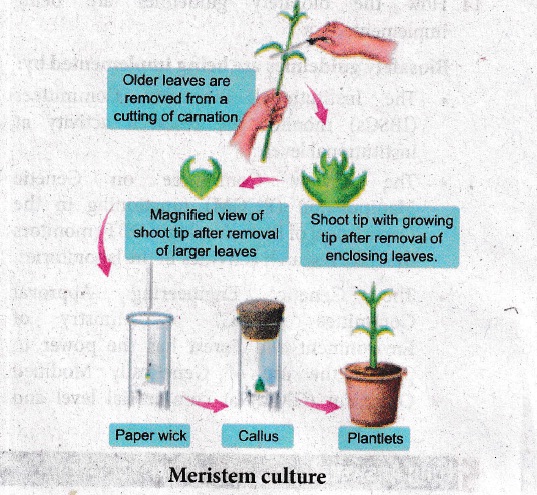
(b) Meristem culture
(c) Protoplast culture
(d) Cell culture
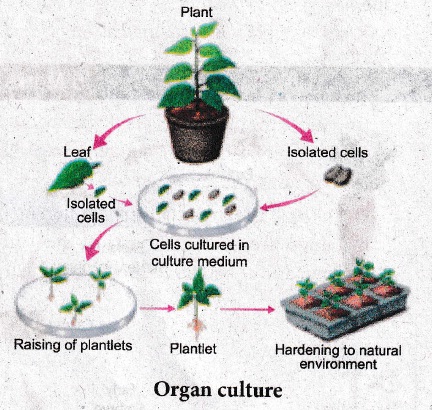
(a) Organ culture
The culture of embryos, anthers, ovaries roots, shoots or other organs of plants on culture media.
(b) Meristem Culture:
The culture of any plant meristematic tissue on culture media.
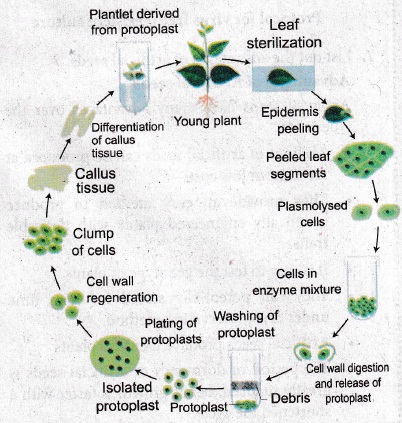
(c) Protoplast Culture:
1. Protoplasts are cells without a cell wall, but bounded by a cell membrane or plasma membrane.
2. Using protoplasts, it is possible to regenerate whole plants from single cells and also develop somatic hybrids.
The steps involved in protoplast culture
(i) Isolation of protoplast:
1. Small bits of plant tissue like leaf tissue are used for isolation of protoplast.
2. The leaf tissue is immersed in 0.5% Macrozyme and 2% Onozuka cellulase enzymes dissolved in 13% sorbitol or mannitol at pH 5.4.
3. It is then incubated over-night at 25oC.
4. After a gentle teasing of cells, protoplasts are obtained, and these are then transferred to 20% sucrose solution to retain their viability.
They are then centrifuged to get pure protoplasts as different from debris of cell walls.
(ii) Fusion of Protoplast
1. It is done through the use of a suitable fusogen. This is normally PEG (Polyethylene Glycol).
2. The isolated protoplast are incubated in 25 to 30% concentration of PEG with Ca++ ions and the Protoplast shows agglutination (the formation of clumps of cells) and fusion.
(iii) Culture of Protoplast:
MS liquid medium is used with some modification in droplet, plating or micro drop array techniques. Protoplast viability is tested with fluorescein diacetate before the culture. The cultures are incubated in continuous light 1000-2000 lux at 25oC. The cell wall formation occurs within 24-48 hours and the first division of new cells occurs between 2-7 days of culture.
(iv) Selection of somatic hybrid cells:
The fusion product of protoplasts without nucleus of different cells is called a cybrid. Following this nuclear fusion happen. This process is called somatic hybridization.
(d) Cell Suspension Culture
The growing of cells including the culture of single cells or small aggregates of cells in vitro in liquid medium is known as cell suspension culture. The cell suspension is prepared by transferring a portion of callus to the liquid medium and agitated using rotary shaker instrument. The cells are separated from the callus tissue and used for cell suspension culture.
3.
Basic concepts of Tissue Culture
Basic concepts of plant tissue culture are totipotency, differentiation, dedifferentiation and redifferentiation.
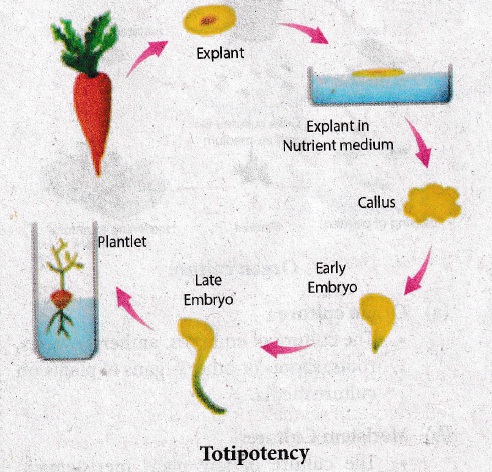
Totipotency
The property of live plant cells that they have the genetic potential when cultured in nutrient medium to give rise to a complete individual plant.
Differentiation
The process of biochemical and structural changes by which cells become specialized in form and function.
Redifferentiation
The further differentiation of already differentiated cell into another type of cell. For example, when the component cells of callus have the ability to form a whole plant in a nutrient medium, the phenomenon is called redifferentiation.
Dedifferentiation
The phenomenon of the reversion of mature cells to the meristematic state leading to the formation of callus is called dedifferentiation. These two phenomena of redifferentiation and dedifferentiation are the inherent capacities of living plant cells or tissue. This is described as totipotency.
4.
GEAC is an apex body under Ministry of Environment, Forests and Climate change for regulating manufacturing, use, import, export and storage of hazardous microbes or genetically modified organisms (GMOs) and cells in the country. It was established as an apex body to accord approval of activities involving large scale use of hazardous microorganisms and recombinants in research and industrial production. The GEAC is also responsible for approval of proposals relating to release of genetically engineered organisms and products into the environment including experimental field trials (Biosafety Research Level trial-I and II known as BRL-I and BRL-II).
5.
Biosafety is the prevention of large-scale loss of biological integrity, focusing both on ecology and human health. These prevention mechanisms include conduction of regular reviews of the biosafety in laboratory settings, as well as strict guidelines to follow. Biosafety is used to protect from harmful incidents. Many laboratories handling biohazards employ an ongoing risk management assessment and enforcement process for biosafety. Failures to follow such protocols can lead to increased risk of exposure to biohazards or pathogens. Human error and poor techniques contribute to unnecessary exposure to hazards arid compromise the best safeguards set into place for protection.
6.
| Secondary Metabolites | Medicinal use |
| Capsaicin | Rheumatic pain treatment |
| Vincristine | Anti-carcinogenic |
| Quinine | Anti-malarial |
7.
Secondary metabolites are chemical compounds that are not required by the plant for normal growth and development but are produced in the plant as 'byproducts' of cell metabolism. For Example: Biosynthesis and isolation of indole alkaloids from Catharanthus roseus plant cell culture.
8.
The cell suspension is prepared by transferring a portion of callus to the liquid medium and agitated using rotary shaker instrument. The cells are separated from the callus tissue and used for cell suspension culture.
9.
After the inoculation of explant in the nutrient medium supplemented with auxins and incubated at 25°C ± 2°C in an alternate light and dark period of 12 hours with light intensity of 1000 lux, induces cell division leading to the development of callus from the surface of explant.
10.
Macronutrients:
(a) Ammonium nitrate
(b) Potassium nitrate
(c) Calcium chloride
Micronutrients:
(a) Manganese sulphate
(b) Zinc sulphate
(c) Potassium iodide

12th Standard Syllabus & Materials
12th Standard
TN 12th Computer Applications வலையமைப்பு வடமிடல் Sample Question Papers Study Material - QB365 Set A
NEW12th Standard
TN 12th Computer Applications களப்பெயர் முறைமை (DNS) Sample Question Papers Study Material - QB365 Set A
NEW12th Standard
TN 12th Computer Applications வலையமைப்பு எடுத்துக்காட்டுகள் மற்றும் நெறிமுறைகள் Sample Question Papers Study Material - QB365 Set A
NEW12th Standard
TN 12th Computer Applications கணினி வலையமைப்பு ஓர் அறிமுகம் Sample Question Papers Study Material - QB365 Set A



Tamilnadu Stateboard 12th Standard Subjects

Maths

Chemistry

Physics
Biology

Computer Science

Business Maths and Statistics

Economics

Commerce

Accountancy

History

Computer Applications
Biology
Computer Technology
Computer Applications
Computer Science
Business Maths and Statistics
Commerce
Economics
Maths
Chemistry
Physics
Computer Technology
History
Accountancy

Tamil

English

French
Tamilnadu Stateboard Standards

