
 100% FREE ACCESS
12th Standard Syllabus & Materials
12th Standard
TN 12th Computer Applications மின்னணு தரவு பரிமாற்றம் Sample Question Papers Study Material - QB365 Set A
NEW12th Standard
TN 12th Computer Applications மின் - வணிக பாதுகாப்பு அமைப்புகள் Sample Question Papers Study Material - QB365 Set A
NEW12th Standard
TN 12th Computer Applications மின்னணு செலுத்தல் முறைகள் Sample Question Papers Study Material - QB365 Set A
NEW12th Standard
TN 12th Computer Applications மின் - வணிகம் Sample Question Papers Study Material - QB365 Set A
NEW12th Standard
TN 12th Computer Applications திறந்த மூல கருத்துருக்கள் Sample Question Papers Study Material - QB365 Set A
NEW12th Standard
TN 12th Computer Applications வலையமைப்பு வடமிடல் Sample Question Papers Study Material - QB365 Set A

Published on: 20/08/2019
Botany - Principles and Processes of Biotechnology
Download Tamil Nadu 12th Standard Biology question papers, model tests, one-mark questions, important questions, and public exam papers in PDF format. Free study materials and answer keys for TN State Board students.
Questions + Answers key
Take MCQ Biology Test1.
Tetracycline is obtained from_________
S.nodosus
S.aureofacins
S.grises
P. chryosogenum
2.
Assertion (A) : Pseudomonas putida is utilized in the production of Biological hydrogen.
Reason (R): During photosynthesis, it releases oxygen.
Both A and R are wrong.
A is right R is wrong.
R explains A.
A and R are right, R does not explain A.
3.
pUC 19 is an example for_______
Shuttle vector
Expression vector
Cosmid
Phagemid vector
4.
The bacteria responsible for causing Crown Gall:
Escherichia coli
Bacillus subtilis
Bacillus thuringiensis
Agrobacterium tumefaciens
5.
Which of the following person coined the term biotechnology?
Ernst Hoppe
Stanley Cohen
Ian Wilmet
Karl Ereky
6.
An analysis of chromosomal DNA using the southern hybridisation technique does not use _____.
Electrophoresis
Blotting
Autoradiography
Polymerase Chain Reaction
7.
Which one of the following is not correct statement
Ti plasmid causes the bunchy top disease
Multiple cloning site is known as Polylinker
Non viral method transfection of Nucleic acid in cell
Polylactic acid is a kind of biodegradable and bioactive thermoplastic.
8.
pBR 322, BR stands for ______.
Plasmid Bacterial Recombination
Plasmid Bacterial Replication
Plasmid Bolivar and Rodriguez
Plasmid Baltimore and Rodriguez
9.
Plasmids are ______.
circular protein molecules
required by bacteria
tiny bacteria
confer resistance to antibiotics
10.
11.
Explain in detail about various types of direct gene transfer method.
12.
Explain the steps involved in recombinant DNA technology
13.
14.
Mention the application of Biotechnology.
15.
How do you use the biotechnology in modern practice?
16.
Define Biopiracy.
17.
Expand (i) PEG (ii) PHB
18.
What is a palindrome sequence?
19.
What are the materials used to grow microorganism like Spirulina?
20.
Mention any three algal species used for SCP production.
21.
What is SCP? Mention its nutritional value.
22.
What are restriction enzyme. Mention their type with role in Biotechnology.
23.
What do you know about the word pBR332?
1.
(b)
S.aureofacins
2.
(a)
Both A and R are wrong.
3.
(b)
Expression vector
4.
(d)
Agrobacterium tumefaciens
5.
(d)
Karl Ereky
6.
(d)
Polymerase Chain Reaction
7.
(a)
Ti plasmid causes the bunchy top disease
8.
(c)
Plasmid Bolivar and Rodriguez
9.
(d)
confer resistance to antibiotics
10.
(d)
11.
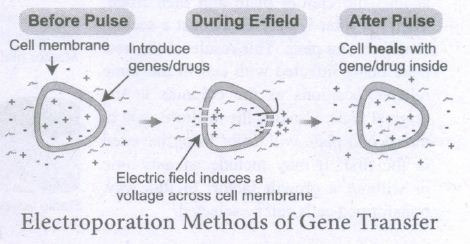
a. Chemical mediated gene transfer: Certain chemicals like polyethylene glycol (PEG) and dextran sulphate induce DNA uptake into plant + protoplasts.
b. Microinjection: The DNA ""+ is directly injected into the nucleus using fine tipped glass needle or micro pipette to transform plant cells. The protoplasts are immobilised on a solid support (agarose on a microscopic slide) or held with a holding pipette under suction.
c. Electroporation Methods of Gene Transfer: A pulse of high voltage is applied to protoplasts, cells or tissues which makes transient pores in the plasma membrane through which uptake of foreign DNA occurs.
d. Liposome mediated method of Gene Transfer: Liposomes the artificial phospholipid vesicles are useful in gene transfer. The gene or DNA is transferred from liposome into vacuole of plant cells. It is carried out by encapsulated DNA into the vacuole. This technique is advantageous because the liposome protects the introduced DNA from being damaged by the acidic pH and protease enzymes present in the vacuole. Liposome and tonoplast of vacuole fusion resulted in gene transfer. This process is called lipofection.
e. Biolistics: The foreign DNA is coated onto the surface of minute gold or tungsten particles (I-311m) and bombarded onto the target tissue or cells using a particle gun (also called as gene gun/micro projectile gun/shotgun). Then the bombarded cells or tissues are cultured on selected medium to regenerate plants from the transformed cells.
12.
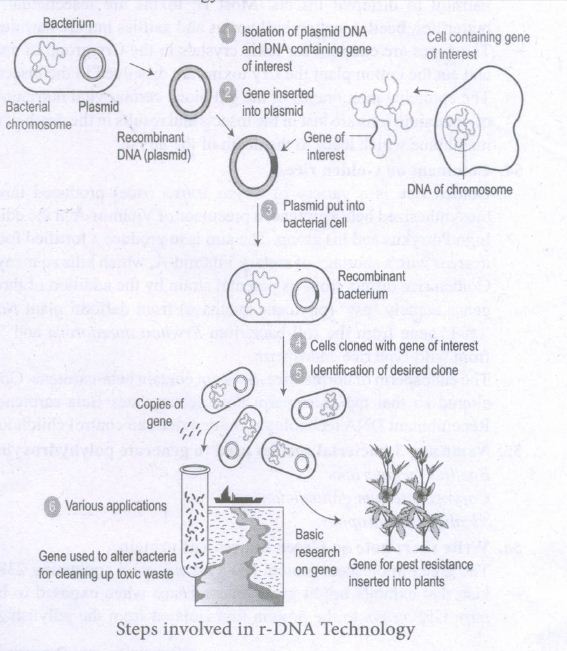
The steps involved in recombinant DNA technology are:
(i) Isolation of a DNA fragment containing a gene of interest that needs to be cloned. This is called an insert.
(ii) Generation of recombinant DNA (rDNA) molecule by insertion of the DNA fragment into a carrier molecule called a vector that can self-replicate within the host cell.
(iii) Selection of the transformed host cells that is carrying the rDNA and allowing them to multiply thereby multiplying the rDNA molecule.
(iv) The entire process thus generates either a large amount of rDNA or a large amount of protein expressed by the insert.
(v) Wherever vectors are not involved the desired gene is multiplied by PCR technique. The multiple copies are injected into the host cell protoplast or it is shot into the host cell protoplast by shot gun method.
13.
14.
Applications of Biotechnology
1. Biotechnology is one of the most important applied interdisciplinary sciences of the 21st century. It is the trusted area that enables us to find the beneficial way of life.
2. Biotechnology has wide applications in various sectors like agriculture, medicine, environment and commercial industries.
3. This science has an invaluable outcome like transgenic varieties of plants e.g. transgenic cotton (Bt-cotton), rice, tomato, tobacco, cauliflower, potato and banana.
4. The development of transgenics as pesticide resistant, stress resistant and disease resistant varieties of agricultural crops is the immense outcome of biotechnology.
5. The synthesis of human insulin and blood protein in E.coli and utilized for insulin deficiency disorder in human is a breakthrough in biotech industries in medicine.
6. The synthesis of vaccines, enzymes, antibiotics, dairy products and beverages are the products of biotech industries.
7. Biochip based biological computer is one of the successes of biotechnology.
8. Genetic engineering involves genetic manipulation, tissue culture involves aseptic cultivation of totipotent plant cell into plant clones under controlled atmospheric conditions.
9. Single cell protein from Spirulina is utilized in food industries.
10. Production of secondary metabolites, biofertilizers, biopesticides and enzymes.
11. Biomass energy, biofuel, bioremediation and phytoremediation for environmental biotechnology.
15.
Modern biotechnology
(i) There are two main features of this technology, that differentiated it from the conventional technology are its
i) ability to change the genetic material for getting new products with specific requirements through recombinant DNA technology
ii) ownership of the newly developed technology and its social impact.
(ii) Modern biotechnology embraces all methods of genetic modification by recombinant DNA and cell fusion technology.
The major focus of biotechnology are
(i) Fermentation for production of acids, enzymes, alcohols, antibiotics, fine chemicals, vitamins and toxins
(ii) Biomass for bulk production of single cell protein , alcohol, and biofuel
(iii) Enzymes as biosensors, in processing industry
(iv) Biofuels for production of hydrogen, alcohol, methane
(v) Microbial inoculants as biofertilizer, and nitrogen fixers
(vi) Plant and animal cell culture for production of secondary metabolites, monoclonal antibodies
(vii) Recombinant DNA technology for production of fine chemicals, enzymes, vaccines, growth hormones, antibiotics, and interferon.
(viii) Process engineering - tools of biotechnology is used for effluent treatment , water recycling.
16.
Biopiracy can be defined as the manipulation of intellectual property rights laws by corporations to gain exclusive control over national genetic resources, without giving adequate recognition or remuneration to the original possessors of those resources.
17.
(i) PEG - Poly Ethylene Glycol
(ii) PHB - Poly Hydroxy Butyrate
18.
Palindrome is a sequence of nucleotide in DNA strands at the site which reads the same in 5'- 3' direction and in the 3'-5' direction.
19.
Spirulina can be grown easily on materials like waste water from potato processing plants (containing starch), straw, molasses, animal manure and even sewage, to produce large quantities.
20.
Spirulina, Chlorella and Chlamydomonas.
21.
Single Cell Protein (SCP) are dried cells of microorganisms that are used as protein supplement in human foods or animal feeds. SCP are rich in proteins, aminoacids, vitamins, carbohydrates, fats and minerals. It is used as food source by Astronauts and Antarctica expedition scientists.
22.
A restriction enzyme or restriction endonuclease is an enzyme that cleaves DNA into fragments at or near specific recognition sites within the molecule known as restriction sites.
Types
(i) Exonucleases - which remove nucleotides one at a time from the end of a DNA molecule. e.g. Bal 31, Exonuclease III.
(ii) Endonucleases - which break the internal phosphodiester bonds within a DNA molecule. e.g. Hind II, EcoRI, PvulI, BamHI, TaqI.
(iii) The restriction enzymes are called as molecular scissors
(iv) They are used in recombinant DNA technology as they recognize & cut DNA within a specific sequence.
23.
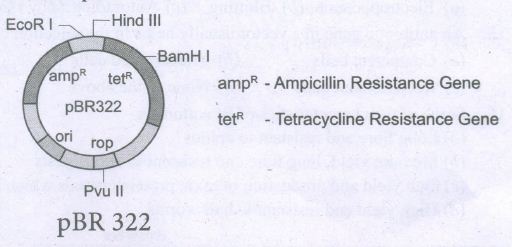
(i) pBR 322 plasmid is a reconstructed plasmid and most widely used as cloning vector;
(ii) It contains 4361 base pairs. In pBR, p denotes plasmid, Band R respectively the names of scientist Boliver and Rodriguez who developed this plasmid.
(iii) The number 322 is the number of plasmid developed from their laboratory.
(iv) It contains ampR and tetR two different antibiotic resistance genes and recognition sites for several restriction enzymes.
(v) ori and antibiotic resistance genes. Rop codes for the proteins involved in the replication of the plasmid.

12th Standard Syllabus & Materials
12th Standard
TN 12th Computer Applications களப்பெயர் முறைமை (DNS) Sample Question Papers Study Material - QB365 Set A
NEW12th Standard
TN 12th Computer Applications வலையமைப்பு எடுத்துக்காட்டுகள் மற்றும் நெறிமுறைகள் Sample Question Papers Study Material - QB365 Set A
NEW12th Standard
TN 12th Computer Applications கணினி வலையமைப்பு ஓர் அறிமுகம் Sample Question Papers Study Material - QB365 Set A
NEW12th Standard
TN 12th Computer Applications PHP-உடன் MySQL-ஐ இணைத்தல் Sample Question Papers Study Material - QB365 Set A



Tamilnadu Stateboard 12th Standard Subjects

Maths

Chemistry

Physics
Biology

Computer Science

Business Maths and Statistics

Economics

Commerce

Accountancy

History

Computer Applications
Biology
Computer Technology
Computer Applications
Computer Science
Business Maths and Statistics
Commerce
Economics
Maths
Chemistry
Physics
Computer Technology
History
Accountancy

Tamil

English

French
Tamilnadu Stateboard Standards

