
 100% FREE ACCESS
12th Standard Syllabus & Materials
12th Standard
TN 12th Computer Applications மின்னணு தரவு பரிமாற்றம் Sample Question Papers Study Material - QB365 Set A
NEW12th Standard
TN 12th Computer Applications மின் - வணிக பாதுகாப்பு அமைப்புகள் Sample Question Papers Study Material - QB365 Set A
NEW12th Standard
TN 12th Computer Applications மின்னணு செலுத்தல் முறைகள் Sample Question Papers Study Material - QB365 Set A
NEW12th Standard
TN 12th Computer Applications மின் - வணிகம் Sample Question Papers Study Material - QB365 Set A
NEW12th Standard
TN 12th Computer Applications திறந்த மூல கருத்துருக்கள் Sample Question Papers Study Material - QB365 Set A
NEW12th Standard
TN 12th Computer Applications வலையமைப்பு வடமிடல் Sample Question Papers Study Material - QB365 Set A

Published on: 22/01/2020
Botany - Principles of Ecology
Download Tamil Nadu 12th Standard Biology question papers, model tests, one-mark questions, important questions, and public exam papers in PDF format. Free study materials and answer keys for TN State Board students.
Questions + Answers key
Take MCQ Biology Test1.
Name the study that deals with soil factors. Also mention the optimal soil pH for crop cultivation.
2.
What does the term 'Timber line' refers to?
3.
Based on temperature prevalence, Raunkiaer classified world's vegetation into four types. Name them.
4.
Sandy soil is not suitable for cultivation. Explain why?
5.
Soil formation can be initiated by biological organisms. Explain how?
6.
The organic horizon is generally absent from agricultural soils because tilling, e.g., plowing, buries organic matter. Why is an organic horizon generally absent in desert soils ?
7.
What is Phytoremediation ?
8.
‘Green algae are not likely to be found in the deepest strata of the ocean’. Give at least one reason.
9.
Why are some organisms called as eurythermals and some others as stenohaline ?
10.
What are ecological equivalents? Give one example
11.
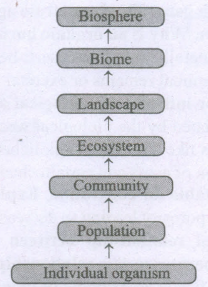
What is ecological hierarchy? Name the levels of ecological hierarchy.
12.
Define ecology.
13.
14.
Distinguish habitat and niche
15.
Describe the mutual relationship between the fig and wasp and comment on the phenomenon that operates in this relationship.
1.
The study of soil is called pedology. The best pH of soil for crop cultivation is 5.5 to 6.8.
2.
Timber line is an imaginary line in a mountain or higher areas of land that marks the level above which trees do not grow. The altitudinal limit of normal tree growth is about 3000 to 4000 m.
3.
Raunkiaer classified the world's vegetation into the following four types. They are megatherms, mesotherms, microtherms and hekistotherms.
4.
Sandy soil loses water at high rate, These characters along with other parameters such as pH, mineral composition is also important.
5.
Soil formation is initiated by the weathering process. Biological weathering takes place when organisms like bacteria, fungi, lichens & plants help in the breakdown of rocks through the production of acids & certain chemical substances.
6.
A desert has little or no plant life without plants, there is no organic horizon in the soil leading to a low level of water retention that is unsuitable for plant growth.
7.
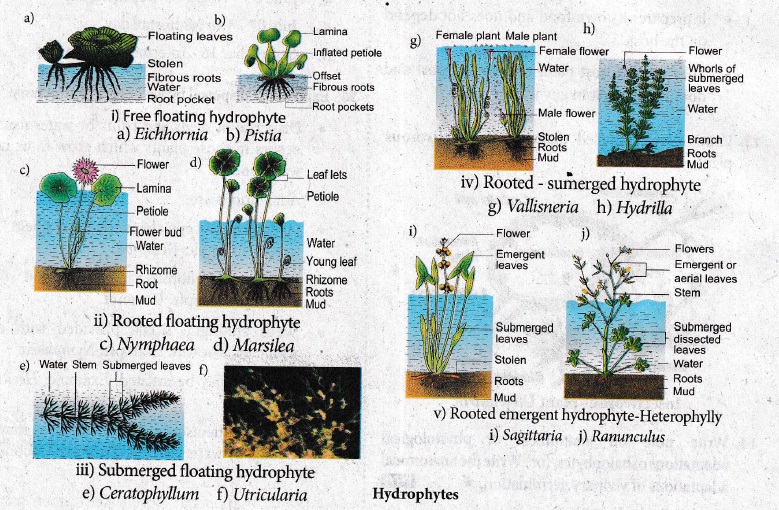
Certain plants can also be used to remove cadmium from contaminated soil, this is known as phytoremediation.
Example: Eichhornia
8.
The blue green light have short wavelength & penetrates into the water. Green algae is unable to use that component of light. Blue light can penetrate up to 500 ft depth therefore algae are unlikely to survive below that depth.
9.
1. Eurythermal: Organisms which can tolerate a wide range of temperature fluctuations.
2. Stenohaline: Organisms which can withstand only small range of salinity.
3. These variations the organisms also grow in different environment.
10.
Taxonomically different species occupying similar habitats (Niches) in different geographical regions are called Ecological equivalents.
E.g: Certain species of epiphytic orchids of Western Ghats of India differ from the epiphytic orchids of South America. But they are epiphytes.
11.
The interaction of organisms with their environment results in the establishment of grouping of organisms
Levels of ecological hierarchy
12.
1. It deals with the study of environment in relation to organisms.
2. It can be studied by considering individual organisms, population, community, biome or biosphere and their environment.
13.
14.
The differences between habitat and niche are as follows.
| S. No | Habitat | Niche |
| 1 | A specific physical space occupied by an organism (species). | A functional space occupied by an organism in the same eco-system |
| 2 | Same habitat may be shared by many organisms (species). | A single niche is occupied by a single species. |
| 3 | Habitat specificity is exhibited by organism. | Organisms may change their niche with time and season |
15.
1. In many species of fig trees, there is a one-to one relationship with the pollinator species of wasp. It means that a given fig species can be pollinated only by its 'partner' wasp species & no other species.
2. The female wasp uses the fruit not only as an oviposition (egg, laying) site but uses the developing seeds within the fruit for nourishing its larvae.
3. The wasp pollinates the fig inflorescence while searching for suitable egg-laying sites.
4. In return for the favour of pollination the fig offers the wasp, some of its developing seeds, as food for the developing wasp larvae.
5. The relationship that operates here is co-evolution.

12th Standard Syllabus & Materials
12th Standard
TN 12th Computer Applications களப்பெயர் முறைமை (DNS) Sample Question Papers Study Material - QB365 Set A
NEW12th Standard
TN 12th Computer Applications வலையமைப்பு எடுத்துக்காட்டுகள் மற்றும் நெறிமுறைகள் Sample Question Papers Study Material - QB365 Set A
NEW12th Standard
TN 12th Computer Applications கணினி வலையமைப்பு ஓர் அறிமுகம் Sample Question Papers Study Material - QB365 Set A
NEW12th Standard
TN 12th Computer Applications PHP-உடன் MySQL-ஐ இணைத்தல் Sample Question Papers Study Material - QB365 Set A



Tamilnadu Stateboard 12th Standard Subjects

Maths

Chemistry

Physics
Biology

Computer Science

Business Maths and Statistics

Economics

Commerce

Accountancy

History

Computer Applications
Biology
Computer Technology
Computer Applications
Computer Science
Business Maths and Statistics
Commerce
Economics
Maths
Chemistry
Physics
Computer Technology
History
Accountancy

Tamil

English

French
Tamilnadu Stateboard Standards

