
 100% FREE ACCESS
12th Standard Syllabus & Materials
12th Standard
TN 12th Computer Applications மின்னணு தரவு பரிமாற்றம் Sample Question Papers Study Material - QB365 Set A
NEW12th Standard
TN 12th Computer Applications மின் - வணிக பாதுகாப்பு அமைப்புகள் Sample Question Papers Study Material - QB365 Set A
NEW12th Standard
TN 12th Computer Applications மின்னணு செலுத்தல் முறைகள் Sample Question Papers Study Material - QB365 Set A
NEW12th Standard
TN 12th Computer Applications மின் - வணிகம் Sample Question Papers Study Material - QB365 Set A
NEW12th Standard
TN 12th Computer Applications திறந்த மூல கருத்துருக்கள் Sample Question Papers Study Material - QB365 Set A
NEW12th Standard
TN 12th Computer Applications வலையமைப்பு வடமிடல் Sample Question Papers Study Material - QB365 Set A

Published on: 21/11/2019
Applications of Matrices and Determinants
Download Tamil Nadu 12th Standard Business Maths and Statistics question papers, model tests, one-mark questions, important questions, and public exam papers in PDF format. Free study materials and answer keys for TN State Board students.
Questions + Answers key
Take MCQ Business Maths and Statistics Test
1.
Solve: 2x + 3y = 5, 6x + 5y = 11
2.
Show that the equations x- 3y + 4z = 3, 2x - 5y + 7z = 6, 3x - 8y + 11z = 1 are inconsistent
3.
Show that the equations x + 2y = 3, y - z = 2, x + y + z = 1 are consistent and have infinite sets of solution.
4.
Solve the equations 2x + 3y = 7, 3x + 5y = 9 by Cramer’s rule.
5.
If A=\(\left( \begin{matrix} 1 & 1 & -1 \\ 2 & -3 & 4 \\ 3 & -2 & 3 \end{matrix} \right) \) and B=\(\left( \begin{matrix} 1 & -2 & 3 \\ -2 & 4 & -6 \\ 5 & 1 & -1 \end{matrix} \right) \), then find the rank of AB and the rank of BA.
6.
Find the rank of the matrix \(\left( \begin{matrix} 1 & 2 & -1 \\ 2 & 4 & 1 \\ 3 & 6 & 3 \end{matrix}\begin{matrix} 3 \\ -2 \\ -7 \end{matrix} \right) \)
7.
Find the rank of the matrix \(\left( \begin{matrix} 5 & 3 & 0 \\ 1 & 2 & -4 \\ -2 & -4 & 8 \end{matrix} \right) \)
8.
Using determinants, find the quadratic defined by f(x) = ax2 + bx + c if
f(1) = 0,
f(2) = - 2 and
f(3) = -6.
9.
Solve the equations x + 2y + z = 7, 2x − y + 2z = 4, x + y − 2z = −1 by using Cramer’s rule
10.
Two types of soaps A and B are in the market. Their present market shares are 15% for A and 85% for B. Of those who bought A the previous year, 65% continue to buy it again while 35% switch over to B. Of those who bought B the previous year, 55% buy it again and 45% switch over to A. Find their market shares after one year and when is the equilibrium reached?
11.
For what values of the parameter λ, will the following equations fail to have unique solution: 3x − y+λz = 1, 2x + y + z = 2, x + 2y − λz = −1 by rank method.
12.
If A, B are two n x n non-singular matrices, then ___________
AB is non-singular
AB is singular
(AB)-1 = A-1 B-1
(AB)-1 does not exit
13.
The rank of an n x n matrix each of whose elements is 2 is __________
1
2
n
n2
14.
If \(T=\begin{array}{l} A \\ B \end{array}\left(\begin{array}{ll} 0.7 & 0.3 \\ 0.6 & x \end{array}\right)\) is a transition probability matrix, then the value of x is ________.
0.2
0.3
0.4
0.7
15.
If \(\rho (A)\) = r then which of the following is correct?
all the minors of order r which does not vanish
A has at least one minor of order r which does not vanish
A has at least one (r+1) order minor which vanishes
all (r+1) and higher order minors should not vanish
16.
The rank of the matrix \(\left( \begin{matrix} 1 & 1 & 1 \\ 1 & 2 & 3 \\ 1 & 4 & 9 \end{matrix} \right) \) is ________.
0
1
2
3
17.
If A and B are non-singular matrices, prove that AB is non-singular.
1.
Given non-homogeneous equations are
2x + 3y = 5 6X + 5y = 11
\(\Delta =\left| \begin{matrix} 2 & 3 \\ 6 & 5 \end{matrix} \right| =10-18=-8\)
Since \(\Delta \neq 0\) Cramer's rule can be applied and the system is consistent with unique solution
\(\Delta x=\left| \begin{matrix} 5 & 3 \\ 11 & 5 \end{matrix} \right| =25-33=-8\)
\(\Delta y=\left| \begin{matrix} 2 & 5 \\ 6 & 11 \end{matrix} \right| =22-30=-8\)
\(\therefore x=\cfrac { \Delta x }{ \Delta } =\cfrac { -8 }{ -8 } =1\)
\(y=\cfrac { \Delta y }{ \Delta } =\cfrac { -8 }{ -8 } =1\)
\(\therefore \) Solution set is {1, 1}
2.
Given non-homogeneous equations are
x- 3y + 4z = 3, 2x - 5y + 7z = 6, 3x - 8y + 11z = 1
| Augmented matrix [A, B] |
Elementary Transformation |
|---|---|
| \(\left( \begin{matrix} 1 & -3 & 4 \\ 2 & -5 & 7 \\ 3 & -8 & 11 \end{matrix}\begin{matrix} 3 \\ 6 \\ 1 \end{matrix} \right) \) | |
| \(\sim \left( \begin{matrix} 1 & -3 & 4 \\ 0 & 1 & -1 \\ 0 & 1 & -1 \end{matrix}\begin{matrix} 3 \\ 0 \\ -8 \end{matrix} \right) \) | \({ R }_{ 2 }\rightarrow { R }_{ 2 }-2{ R }_{ 1 }\) \({ R }_{ 3 }\rightarrow { R }_{ 3 }-{ 3R }_{ 1 }\) |
| \(\sim \left( \begin{matrix} 1 & -3 & 4 \\ 0 & 1 & -1 \\ 0 & 0 & -0 \end{matrix}\begin{matrix} 3 \\ 0 \\ -8 \end{matrix} \right) \) | \({ R }_{ 3 }\rightarrow { R }_{ 3 }-R_{ 2 }\) |
Clearly \(\rho (A)=2\) and \(\rho (A,B)=3\)
\(\rho (A,B)\neq \rho (A)\)
Hence, the given system is inconsistent and has no solution.
3.
Given non-homogeneous equations are
x + 2y = 3,y - z = 2,x + Y + z = 1
| Augmented matrix [A, B] |
Elementary Transformation |
|---|---|
| \(\left( \begin{matrix} 1 & 2 & 0 \\ 0 & 1 & -1 \\ 1 & 1 & 1 \end{matrix}\begin{matrix} 3 \\ 2 \\ 1 \end{matrix} \right) \) | |
| \(\sim \left( \begin{matrix} 1 & 2 & 0 \\ 0 & 1 & -1 \\ 0 & -1 & 1 \end{matrix}\begin{matrix} 3 \\ 2 \\ -2 \end{matrix} \right) \) | \({ R }_{ 3 }\rightarrow { R }_{ 3 }+{ R }_{ 2 }\) |
| \(\sim \left( \begin{matrix} 1 & 2 & 0 \\ 0 & 1 & -1 \\ 0 & 0 & 0 \end{matrix}\begin{matrix} 3 \\ 2 \\ 0 \end{matrix} \right) \) | \({ R }_{ 3 }\rightarrow { R }_{ 3 }+{ R }_{ 2 }\) |
Obviously,\(\rho (A)=2\) and \(\rho (A,B)\)
Hence \(\rho (A)=2\quad \rho\) (A, B) = 2
\(\therefore\) The system is consistent and has infinite number of solutions.
4.
The equations are
2x + 3y = 7
3x + 5y = 9
Here \(\triangle =\left| \begin{matrix} 2 & 3 \\ 3 & 5 \end{matrix} \right| =1\)
\(\neq 0\)
\(\therefore \) we can apply Cramer’s Rule
Now \({ \triangle }_{ x }=\left| \begin{matrix} 7 & 3 \\ 9 & 5 \end{matrix} \right| =8\) \({ \triangle }_{ y }=\left| \begin{matrix} 2 & 7 \\ 3 & 9 \end{matrix} \right| =-3\)
\(\therefore \) By Cramer’s rule
\(x=\frac { { \triangle }_{ X } }{ \triangle } =\frac { 8 }{ 1 } =8\) \(y=\frac { { \triangle }_{ y } }{ \triangle } =\frac { -3 }{ 1 } =-3\)
\(\therefore \) Solution is x = 8, y = −3
5.
Given
A = \(\left( \begin{matrix} 1 & 1 & -1 \\ 2 & -3 & 4 \\ 3 & -2 & 3 \end{matrix} \right) \) and B = \(\left( \begin{matrix} 1 & -2 & 3 \\ -2 & 4 & -6 \\ 5 & 1 & -1 \end{matrix} \right) \)
\(AB=\left( \begin{matrix} 1 & 1 & -1 \\ 2 & -3 & 4 \\ 3 & -2 & 3 \end{matrix} \right) \left( \begin{matrix} 1 & -2 & 3 \\ -2 & 4 & -6 \\ 5 & 1 & -1 \end{matrix} \right) \)
= \(\left( \begin{matrix} 1-2+5 & -2+4-1 & 3-6+1 \\ 2+6+20 & -4-12+45 & 6+18-4 \\ 3+4+15 & -6-8+3 & 9+12-3 \end{matrix} \right) \)
= \(\left( \begin{matrix} -6 & 1 & -2 \\ 28 & -12 & 20 \\ 22 & -11 & 18 \end{matrix} \right) =\left( \begin{matrix} -6 & 1 & -2 \\ 28 & -12 & 20 \\ 22 & -11 & 18 \end{matrix} \right) \)
| Matrix (AB) | Elementary Transformation |
|---|---|
| \(AB=\left( \begin{matrix} -6 & 1 & -2 \\ 28 & -12 & 20 \\ 22 & -11 & 18 \end{matrix} \right) \) | |
| \(\sim \left( \begin{matrix} 1 & -6 & -2 \\ -12 & 28 & 20 \\ -11 & 22 & 18 \end{matrix} \right) \) | \({ C }_{ 1 }\leftrightarrow { C }_{ 2 }\) |
| \(\sim \left( \begin{matrix} 1 & -6 & -2 \\ -12 & 28 & 20 \\ -11 & 22 & 18 \end{matrix} \right) \) | \({ R }_{ 2 }\rightarrow { R }_{ 2 }+12{ R }_{ 1 }\) |
| \(\sim \left( \begin{matrix} 1 & -6 & -2 \\ 0 & -44 & -4 \\ 0 & -44 & -4 \end{matrix} \right) \) | \({ R }_{ 3 }\rightarrow { R }_{ 3 }+11{ R }_{ 1 }\) |
| \(\sim \left( \begin{matrix} 1 & -6 & -2 \\ 0 & -44 & -4 \\ 0 & 0 & 0 \end{matrix} \right) \) | \({ R }_{ 3 }\rightarrow { R }_{ 3 }-{ R }_{ 2 }\) |
The matrix is in echelon form and the number of non-zero rows is 2.
\(\therefore \rho (AB)=2\)
Now \(BA=\left( \begin{matrix} 1 & -2 & 3 \\ -2 & 4 & -6 \\ 5 & 1 & -1 \end{matrix} \right) \left( \begin{matrix} 1 & 1 & -1 \\ 2 & -3 & 4 \\ 3 & -2 & 3 \end{matrix} \right) \)
= \(\left( \begin{matrix} 1-4+9 & 1+6-6 & -1-8+9 \\ -2+8-18 & -2-12+12 & 2+16-18 \\ 5+2-3 & 5-3+2 & -5+4-3 \end{matrix} \right) \)
= \(\left( \begin{matrix} 6 & 1 & 0 \\ -12 & -2 & 0 \\ 4 & 4 & -4 \end{matrix} \right) \)
| Matrix (BA) | Elementary Transformation |
|---|---|
| \(BA=\left( \begin{matrix} 6 & 1 & 0 \\ -12 & -2 & 0 \\ 4 & 4 & -4 \end{matrix} \right) \) | |
| \(\sim \left( \begin{matrix} 1 & 6 & 0 \\ -2 & -12 & 0 \\ 4 & 4 & -4 \end{matrix} \right) \) | \({ C }_{ 1 }\leftrightarrow { C }_{ 2 }\) |
| \(\sim \left( \begin{matrix} 1 & 6 & 0 \\ 0 & 0 & 0 \\ 4 & 4 & -4 \end{matrix} \right) \) | \({ R }_{ 2 }\rightarrow { R }_{ 2 }+2{ R }_{ 1 }\) |
| \(\sim \left( \begin{matrix} 1 & 6 & 0 \\ 0 & 0 & 0 \\ 0 & -20 & -4 \end{matrix} \right) \) | \({ R }_{ 3 }\rightarrow { R }_{ 3 }-4R_{ 1 }\) |
The number of non-zero rows is 2.
\(\therefore \rho (BA)=2\)
6.
Let A = \(\left( \begin{matrix} 1 & 2 & -1 \\ 2 & 4 & 1 \\ 3 & 6 & 3 \end{matrix}\begin{matrix} 3 \\ -2 \\ -7 \end{matrix} \right) \)
Order of A is 3 \(\times\) 4
∴\(\rho \)(A)\(\le \)3
Consider the third order minors
\(\left| \begin{matrix} 1 & 2 & -1 \\ 2 & 4 & 1 \\ 3 & 6 & 3 \end{matrix} \right| =\) 0, \(\left| \begin{matrix} 1 & -1 & 3 \\ 2 & 1 & -2 \\ 3 & 3 & -7 \end{matrix} \right| =0\)
\(\left| \begin{matrix} 1 & 2 & 3 \\ 2 & 4 & -2 \\ 3 & 6 & -7 \end{matrix} \right| =0,\) \(\left| \begin{matrix} 2 & -1 & 3 \\ 4 & 1 & -2 \\ 6 & 3 & -7 \end{matrix} \right| =0\)
Since all third order minors vanishes, \(\rho (A)\neq 3\)
Now, let us consider the second order minors,
Consider one of the second order minors \(\\ \\ \left| \begin{matrix} 2 & -1 \\ 4 & 1 \end{matrix} \right| =6\neq 0\)
There is a minor of order 2 which is not zero.
\(\therefore \rho (A)=2\)
7.
Let A= \(\left( \begin{matrix} 5 & 3 & 0 \\ 1 & 2 & -4 \\ -2 & -4 & 8 \end{matrix} \right) \)
Order of A is 3 \(\times\) 3.
∴\(\rho \)(A)\(\le \)3
Consider the third order minor \(\left| \begin{matrix} 5 & 3 & 0 \\ 1 & 2 & -4 \\ -2 & -4 & 8 \end{matrix} \right| =0\)
Since the third order minor vanishes, therefore \(\rho (A)\neq 3\)
Consider a second order minor \(\left| \begin{matrix} 5 & 3 \\ 1 & 2 \end{matrix} \right| =7\neq 0\)
There is a minor of order 2, which is not zero.
\(\therefore \rho (A)=2\)
8.
fix) = ax2 + bx + c
\(f(1)=0\Rightarrow a\left( 1 \right) ^{ 2 }+b(1)+c=0\Rightarrow a+b+c=0\) ...(1)
\(f(2)=-2\Rightarrow a\left( { 2 }^{ 2 } \right) +b(2)+c=-2\Rightarrow 4a+2b+c=2\)..(2)
\(f(3)-6\Rightarrow a(3^{ 2 })+b(3)+c=-6\Rightarrow 9a+3b+c=-6\)
Now \(\Delta =\left| \begin{matrix} 1 & 1 & 1 \\ 4 & 2 & 1 \\ 9 & 3 & 1 \end{matrix} \right| \)
= 1(2 - 3) - 1(4 - 9) + 1(12 - 18)
= \(-1+5-6=-2\neq 0\)
Since \(\Delta \neq 0\) Cramer's rule can be applied and the system has unique solution
\(\Delta a=\left| \begin{matrix} 0 & 1 & 1 \\ -2 & 2 & 1 \\ -6 & 3 & 1 \end{matrix} \right| \)
= 0-1(-2+6)+ 1(-6+ 12)
= -4 + 6 = 2
\(\Delta b=\left| \begin{matrix} 1 & 0 & 1 \\ 4 & -2 & 1 \\ 9 & -6 & 1 \end{matrix} \right| \)
= 1(-2+6)+0+1(-24+ 18)
= 4 - 6 = -2
\(\Delta c=\left| \begin{matrix} 1 & 1 & 0 \\ 4 & 2 & -2 \\ 9 & 3 & -6 \end{matrix} \right| \)
= 1 (-12 + 6) - 1( - 24 + 18) + 0
= -6 + 6 = 0
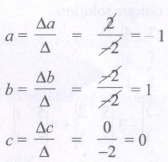
f(n) = (-1)x2 + 1(x) + 0
f(x) = x2+ x.
9.
\(\Delta =\left| \begin{matrix} 1 & 2 & 1 \\ 2 & -1 & 2 \\ 1 & 1 & -2 \end{matrix} \right| \)
= \(1\left| \begin{matrix} -1 & 2 \\ 1 & -2 \end{matrix} \right| -2\left| \begin{matrix} 2 & 2 \\ 1 & -2 \end{matrix} \right| +1\left| \begin{matrix} 2 & -1 \\ 1 & 1 \end{matrix} \right| \)
= 1(2 -2) - 2(-4 -2) + 1(2 + 1)
= 1(0)-2(-6)+1(3)
= 12 + 3 = 15\(\neq \)0.
Since \(\Delta \neq 0\) Cramer's rule can be applied and thesystem is consistent with unique solution.
\({ \Delta }x=\left| \begin{matrix} 7 & 2 & 1 \\ 4 & -1 & 2 \\ -1 & 1 & -2 \end{matrix} \right| \)
= \(7\left| \begin{matrix} -1 & 2 \\ 1 & -2 \end{matrix} \right| -2\left| \begin{matrix} 4 & 2 \\ -1 & -2 \end{matrix} \right| +1\left| \begin{matrix} 4 & -1 \\ -1 & 1 \end{matrix} \right| \)
= 7 (2 -2) -2 (-8 + 2) + 1 (4 - 1)
= 7 (0) - 2(-6) + 1(3)
= 12 + 3 = 15
\(\Delta y=\left| \begin{matrix} 1 & 7 & 1 \\ 2 & 4 & 2 \\ 1 & -1 & -2 \end{matrix} \right| \)
= \(1\left| \begin{matrix} 4 & 2 \\ -1 & -2 \end{matrix} \right| -7\left| \begin{matrix} 2 & 2 \\ 1 & -2 \end{matrix} \right| +1\left| \begin{matrix} 2 & 4 \\ 1 & -1 \end{matrix} \right| \)
= 1 (- 8 + 2) -7(-4 -2) + 1(-2 -4)
= 1 (-6) -7 (-6) + 1 (-6)
= - 6 + 42 - 6 = 30
\(\Delta z=\left| \begin{matrix} 1 & 2 & 7 \\ 2 & -1 & 4 \\ 1 & 1 & -1 \end{matrix} \right| \)
= \(1\left| \begin{matrix} -1 & 4 \\ 1 & -1 \end{matrix} \right| -2\left| \begin{matrix} 2 & 4 \\ 1 & -1 \end{matrix} \right| +7\left| \begin{matrix} 2 & -1 \\ 1 & 1 \end{matrix} \right| \)
= 1 (1 - 4) - 2(- 2 - 4) + 7(2 + 1)
= 1(-3)-2(-6)+7(3)
= - 3 + 12 + 21 = 30
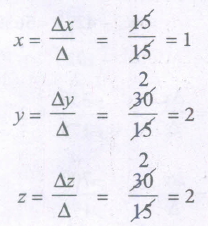
\(\therefore\) Solution set is {1, 2, 2}
10.
Transition probability matrix
(A B) T = (A B)
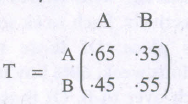
Where A represents the percent of people those who bought soap A and B represents the percent of people those who bought soap B.
By the given data
A = 15% = ·15
and B = 85% = ·85
Percentage after one year is
\(\left( \cdot 15\quad \cdot 85 \right) \left( \begin{matrix} \cdot 65 & \cdot 35 \\ \cdot 45 & \cdot 55 \end{matrix} \right) \)
= ((.15)(·65) + (·85)(-45) ·15(-35)+ ·85(-55))
= (-0975 + ·3825 ·0525 + -4675)
= (-48 ·52)
Hence, market share after one year is 48% and 52% At equilibrium,
\(\left( A\quad B \right) \left( \begin{matrix} \cdot 65 & \cdot 35 \\ \cdot 45 & \cdot 55 \end{matrix} \right) =(A\quad B)\)
(-65A + A5B ·35A +·55B) = (A B)
Equating the corresponding entries on both sides we get
\(\Rightarrow \cdot 65A+\cdot 45B=A\)
\(\Rightarrow \cdot 65A+\cdot 45(1-A)=A\)
[Since A+B = 1 B = 1-A]
\(\Rightarrow \cdot 65A+\cdot 45-\cdot 45A=A\)
\(\Rightarrow \cdot 45=A-\cdot 65A+\cdot 45A\)
\(\Rightarrow \cdot 45=A\left( \cdot 35+45 \right) \)
\(\Rightarrow \cdot 45=A(\cdot 35+45)\)
\(\Rightarrow \cdot 45=A(-8)\)
\(\Rightarrow A=\cfrac { \cdot 45 }{ \cdot 8 } =\cdot 5625=56.25\)
\(\therefore B=1-A=1-\cdot 5625=\cdot 4375\)
= 43.75%
\(\therefore\) Equilibrium is reached when A = 56.25% and B = 43.75%
11.
Given non-homogeneous equations are
\(3x-y+\lambda z=1\)
\(2x+y+z=2\)
\(x+2y-\lambda z=-1\)
The matrix equation corresponding to the given system is
| Augmented matrix [A,B] | Elementary Transformation |
|---|---|
| \(\left( \begin{matrix} 3 & -1 & \lambda \\ 2 & 1 & 1 \\ 1 & 2 & - \end{matrix}\begin{matrix} 1 \\ 2 \\ -1 \end{matrix} \right) \) | |
| \(\sim \left( \begin{matrix} 1 & 2 & -\lambda \\ 2 & 1 & 1 \\ 3 & -1 & \lambda \end{matrix}\begin{matrix} -1 \\ 2 \\ 1 \end{matrix} \right) \) | \({ R }_{ 1 }\leftrightarrow { R }_{ 3 }\) |
| \(\sim \left( \begin{matrix} 1 & 2 & -\lambda \\ 0 & -3 & 1+2\lambda \\ 3 & -1 & \lambda \end{matrix}\begin{matrix} -1 \\ 4 \\ 1 \end{matrix} \right) \) | \({ R }_{ 2 }\rightarrow { R }_{ 2 }-2{ R }_{ 1 }\) |
| \(\left( \begin{matrix} 1 & 2 & -\lambda \\ 0 & -3 & 1+2\lambda \\ 0 & -7 & 4\lambda \end{matrix}\begin{matrix} -1 \\ 4 \\ 4 \end{matrix} \right) \) | \({ R }_{ 3 }\rightarrow { R }_{ 3 }-3{ R }_{ 1 }\) |
| \(\sim \left( \begin{matrix} 1 & 2 & -\lambda \\ 0 & -1 & \frac { 1+2\lambda }{ 3 } \\ 0 & - & \frac { 4\lambda }{ 7 } \end{matrix}\begin{matrix} -1 \\ \frac { 4 }{ 3 } \\ \frac { 4 }{ 7 } \end{matrix} \right) \) | \({ R }_{ 2 }\rightarrow { R }_{ 2 }\div 3\) \({ R }_{ 3 }\rightarrow { R }_{ 3 }\div 7\) |
| \(\left( \begin{matrix} 1 & 2 & -\lambda \\ 0 & -1 & \frac { 1+2 }{ 3 } \\ 0 & 0 & \frac { -7-2\lambda }{ 21 } \end{matrix}\begin{matrix} -1 \\ \frac { 4 }{ 3 } \\ \frac { -16 }{ 21 } \end{matrix} \right) \) | \({ R }_{ 3 }\rightarrow { R }_{ 3 }-{ R }_{ 2 }\) |
Since
\(\cfrac { 4\lambda }{ 7 } -\cfrac { 1+2\lambda }{ 3 } \)
= \(\cfrac { 12\lambda -7-14\lambda }{ 21 } =\cfrac { -7-2\lambda }{ 21 } \)
and \(\cfrac { 4 }{ 7 } -\cfrac { 4 }{ 3 } =\cfrac { 12-28 }{ 21 } \)
= \(\cfrac { -16 }{ 21 } \)
\(\therefore\) Since the system is fail to have unique solution either it can have infinitely many solution or it may be inconsistent.
This can happen only when \(\cfrac { -7-2\lambda }{ 21 } =0\)
\(\Rightarrow -7-2\lambda =0\)
\(\Rightarrow -7=2\lambda \)
\(\Rightarrow \lambda =\cfrac { -7 }{ 2 } \)
12.
The non-homogeneous equation are
2x - y + z = 7, 3x + y - 5z = 13, x + y + z = 5
| Augmented matrix [A,B] |
Elementary Transformation |
|---|---|
| \(\left( \begin{matrix} 2 & -1 & 1 \\ 3 & 1 & -5 \\ 1 & 1 & 1 \end{matrix}\begin{matrix} 7 \\ 13 \\ 5 \end{matrix} \right) \) | |
| \(-\left( \begin{matrix} 1 & 1 & 1 \\ 3 & 1 & -5 \\ 2 & -1 & 1 \end{matrix}\begin{matrix} 5 \\ 13 \\ 7 \end{matrix} \right) \) | \({ R }_{ 1 }\leftrightarrow { R }_{ 3 }\) |
| \(\sim \left( \begin{matrix} 1 & 1 & 1 \\ 0 & -2 & -8 \\ 0 & -3 & -1 \end{matrix}\begin{matrix} 5 \\ -2 \\ -3 \end{matrix} \right) \) | \({ R }_{ 2 }\rightarrow { R }_{ 2 }-3{ R }_{ 1 }\) \({ R }_{ 3 }\rightarrow { R }_{ 3 }-2{ R }_{ 1 }\) |
| \(\sim \left( \begin{matrix} 1 & 1 & 1 \\ 0 & -2 & -8 \\ 0 & 0 & 11 \end{matrix}\begin{matrix} 5 \\ -2 \\ 0 \end{matrix} \right) \) | \({ R }_{ 3 }\rightarrow { R }_{ 3 }-\cfrac { 3 }{ 2 } { R }_{ 2 }\) |
Clearly \(\rho (A)=3\) and \(\rho (A,B)\) = 3 = Number of unknowns
\(\therefore\) The given system is consistent and has unique solution.
13.
(a)
1
14.
(c)
0.4
15.
(b)
A has at least one minor of order r which does not vanish
16.
(d)
3
17.
Since A and B are non-singular,
|A| \(\neq \) 0, |B|\(\neq \) 0
Consider |AB| |A|·|B|
\(\neq \) 0 since |A|\(\neq \) 0 and |B|\(\neq \) 0.=? |AB| \(\neq \) 0
\(\therefore\) AB is non-singular.

12th Standard Syllabus & Materials
12th Standard
TN 12th Computer Applications களப்பெயர் முறைமை (DNS) Sample Question Papers Study Material - QB365 Set A
NEW12th Standard
TN 12th Computer Applications வலையமைப்பு எடுத்துக்காட்டுகள் மற்றும் நெறிமுறைகள் Sample Question Papers Study Material - QB365 Set A
NEW12th Standard
TN 12th Computer Applications கணினி வலையமைப்பு ஓர் அறிமுகம் Sample Question Papers Study Material - QB365 Set A
NEW12th Standard
TN 12th Computer Applications PHP-உடன் MySQL-ஐ இணைத்தல் Sample Question Papers Study Material - QB365 Set A



Tamilnadu Stateboard 12th Standard Subjects

Maths

Chemistry

Physics

Biology

Computer Science
Business Maths and Statistics

Economics

Commerce

Accountancy

History

Computer Applications
Biology
Computer Technology
Computer Applications
Computer Science
Business Maths and Statistics
Commerce
Economics
Maths
Chemistry
Physics
Computer Technology
History
Accountancy

Tamil

English

French
Tamilnadu Stateboard Standards
