
 100% FREE ACCESS
12th Standard Syllabus & Materials
12th Standard
TN 12th Computer Applications மின்னணு தரவு பரிமாற்றம் Sample Question Papers Study Material - QB365 Set A
NEW12th Standard
TN 12th Computer Applications மின் - வணிக பாதுகாப்பு அமைப்புகள் Sample Question Papers Study Material - QB365 Set A
NEW12th Standard
TN 12th Computer Applications மின்னணு செலுத்தல் முறைகள் Sample Question Papers Study Material - QB365 Set A
NEW12th Standard
TN 12th Computer Applications மின் - வணிகம் Sample Question Papers Study Material - QB365 Set A
NEW12th Standard
TN 12th Computer Applications திறந்த மூல கருத்துருக்கள் Sample Question Papers Study Material - QB365 Set A
NEW12th Standard
TN 12th Computer Applications வலையமைப்பு வடமிடல் Sample Question Papers Study Material - QB365 Set A

Published on: 27/09/2019
Applications of Matrices and Determinants
Download Tamil Nadu 12th Standard Business Maths and Statistics question papers, model tests, one-mark questions, important questions, and public exam papers in PDF format. Free study materials and answer keys for TN State Board students.
Questions + Answers key
Take MCQ Business Maths and Statistics Test
1.
Find the rank of each of the following matrices.
\(\left( \begin{matrix} 5 & 6 \\ 7 & 8 \end{matrix} \right) \)
2.
Find the rank of the matrix \(\begin{pmatrix} 1 & 5 \\ 3 & 9 \end{pmatrix}\)
3.
If \(A=\left( \begin{matrix} 2 & 4 \\ 4 & 3 \end{matrix} \right) ,X=\left( \begin{matrix} n \\ 1 \end{matrix} \right) B=\left( \begin{matrix} 8 \\ 11 \end{matrix} \right) \) and AX = B then find n.
4.
Find the rank of the matrix A =\(\left( \begin{matrix} -2 & 1 & 3 \\ 0 & 1 & 1 \\ 1 & 3 & 4 \end{matrix}\begin{matrix} 4 \\ 2 \\ 7 \end{matrix} \right) \)
5.
Consider the matrix of transition probabilities of a product available in the market in two brands A and B.
\(_{ B }^{ A }\left( \begin{matrix} \overset { A }{ 0.9 } & \overset { B }{ 0.1 } \\ 0.3 & 0.7 \end{matrix} \right) \)
Determine the market share of each brand in equilibrium position.
6.
Solve the following equations by using Cramer’s rule
2x + 3y = 7; 3x + 5y = 9
7.
Solve the equations 2x + 3y = 7, 3x + 5y = 9 by Cramer’s rule.
8.
Show that the equations 3x − 2y = 6, 6x − 4y = 10 are inconsistent
9.
Find the rank of the matrix \(\left( \begin{matrix} 1 & 2 & -1 \\ 2 & 4 & 1 \\ 3 & 6 & 3 \end{matrix}\begin{matrix} 3 \\ -2 \\ -7 \end{matrix} \right) \)
10.
A total of Rs. 8,500 was invested in three interest earning accounts. The interest rates were 2%, 3% and 6% if the total simple interest for one year was Rs. 380 and the amount, invested at 6% was equal to the sum of the amounts in the other two accounts, then how much was invested in each account? (use Cramer’s rule).
11.
In a market survey three commodities A, B and C were considered. In finding out the index number some fixed weights were assigned to the three varieties in each of the commodities. The table below provides the information regarding the consumption of three commodities according to the three varieties and also the total weight received by the commodity
| Commodity Variety | Variety | Total weight | ||
| I | II | III | ||
| A | 1 | 2 | 3 | 11 |
| B | 2 | 4 | 5 | 21 |
| C | 3 | 5 | 6 | 27 |
Find the weights assigned to the three varieties by using Cramer’s Rule.
12.
Solve by Cramer’s rule x + y + z = 4, 2x − y + 3z = 1, 3x + 2y − z = 1
13.
Show that the equations 5x + 3y + 7z = 4, 3x + 26y + 2z = 9, 7x + 2y + 10z = 5 are consistent and solve them by rank method.
14.
Investigate for what values of ‘a’ and ‘b’ the following system of equations x + y + z = 6,x + 2y + 3z = 10, x + 2y + az = b have
(i) no solution
(ii) a unique solution
(iii) an infinite number of solutions.
15.
The system of linear equations x + y + z = 2, 2x + y − z = 3, 3x + 2y + k = 4 has unique solution, if k is not equal to _______.
4
0
-4
1
16.
Which of the following is not an elementary transformation?
\({ R }_{ i }\leftrightarrow { R }_{ j }\)
\({ R }_{ i }\rightarrow { 2R }_{ i }+{ 2C }_{ j }\)
\({ R }_{ i }\rightarrow { 2R }_{ i }-{ 4R }_{ j}\)
\({ C }_{ i }\rightarrow { C }_{ i }+{ 5C }_{ j }\)
17.
18.
The rank of the unit matrix of order n is ________.
n −1
n
n +1
n2
19.
If A = (1 2 3), then the rank of AAT is ________.
0
2
3
1
20.
A set of values of the variable x1,x2,...xn satisfying all the equations simultaneously is called__________ of the system
21.
The system of linear equations x + y + Z = 2, 2x + Y - z = 3, 3x + 2y + kz = 4 has a unique solution if k is_______
22.
The system of equation x + y + z = 2, 3x - y + 2z = 6 and 3x + y - z = -18 has________solution
23.
If A is a matrix of order 3 and IAI = 8 then |adj AI|=_______
24.
For any 2 x 2 matrix, if A (adj A = \(\left| \begin{matrix} 10 & 0 \\ 0 & 10 \end{matrix} \right| \) then IAI is _______
1.
Let \(A=\left( \begin{matrix} 5 & 6 \\ 7 & 8 \end{matrix} \right) \)
Order of A is 2 \(\times\) 2
\(\therefore \rho (A)\le 2\) [Since minimum of (2, 2) is 2]
Consider the second order minor
\(\left| \begin{matrix} 5 & 6 \\ 7 & 8 \end{matrix} \right| =40-42\)
= \(-2\neq 0\)
There is a minor of order 2, which is not zero
\(\therefore \rho (A)=2\)
2.
Let A =\(\begin{pmatrix} 1 & 5 \\ 3 & 9 \end{pmatrix}\)
Order of A is 2 \(\times\) 2
∴ \(\rho \) (A) \(\le \) 2
Consider the second order minor
\(\begin{vmatrix} 1 & 5 \\ 3 & 9 \end{vmatrix}=-6\neq 0\)
There is a minor of order 2, which is not zero.
∴ \(\rho \) (A) \(\le \) 2
3.
GivenAX B
\(\left( \begin{matrix} 2 & 4 \\ 4 & 3 \end{matrix} \right) ,\left( \begin{matrix} n \\ 1 \end{matrix} \right) \left( \begin{matrix} 8 \\ 11 \end{matrix} \right) \)
\(\Rightarrow \left( \begin{matrix} 2n+4 \\ 4n+3 \end{matrix} \right) =\left( \begin{matrix} 8 \\ 11 \end{matrix} \right) \)
Equating the corresponding entries on both sides, we get
2n +4 = 8
2n = 8-4
2n=4
\(n=\cfrac { 4 }{ 2 } \)
2 = 2
4.
Given A =\(\left( \begin{matrix} -2 & 1 & 3 \\ 0 & 1 & 1 \\ 1 & 3 & 4 \end{matrix}\begin{matrix} 4 \\ 2 \\ 7 \end{matrix} \right) \)
\(\sim \left( \begin{matrix} 1 & 3 & 4 \\ 0 & 1 & 1 \\ -2 & 1 & 3 \end{matrix}\begin{matrix} 7 \\ 2 \\ 4 \end{matrix} \right) { R }_{ 1 }\rightarrow { R }_{ 3 }\)
\(\sim \left( \begin{matrix} 1 & 3 & 4 \\ 0 & 1 & 1 \\ 0 & 7 & 11 \end{matrix}\begin{matrix} 7 \\ 2 \\ 18 \end{matrix} \right) { R }_{ 2 }\rightarrow { { R_{ 2 }+2{ R }_{ 1 } } }\)
\(\sim \left( \begin{matrix} 1 & 3 & 4 \\ 0 & 1 & 1 \\ 0 & 0 & 4 \end{matrix}\begin{matrix} 7 \\ 2 \\ 4 \end{matrix} \right) { R }_{ 3 }\rightarrow { R_{ 3 }-{ 7R }_{ 2 } }\)
The last equivalent matrix is in echelon form and there are 3 non - zero rows.
\(\therefore \rho (A)=3\)
5.
Transition probability matrix
T = \(_{ B }^{ A }\left( \begin{matrix} \overset { A }{ 0.9 } & \overset { B }{ 0.1 } \\ 0.3 & 0.7 \end{matrix} \right) \)
At equilibrium, (A B) T = (AB) where A + B = 1
(A B) \(\left( \begin{matrix} 0.9 & 0.1 \\ 0.3 & 0.7 \end{matrix} \right) \) = (A B)
0.9A + 0.3B = A
0.9A + 0.3(1−A) = A
0.9A−0.3A + 0.3 = A
0.6A + 0.3 = A
0.4A = 0.3
A = \(\frac { 0.3 }{ 0.4 } =\frac { 3 }{ 4 } \)
B = 1-\(\frac { 3 }{ 4 } =\frac { 1 }{ 4 } \)
Hence the market share of brand A is 75% and the market share of brand B is 25%
6.
\(\Delta =\left| \begin{matrix} 2 & 3 \\ 3 & 5 \end{matrix} \right| =10-9=1\neq 0\)
Since \(\Delta \neq 0\)
we can apply Cramer's rule and the system is consistent with unique solution.
\(\Delta x=\left| \begin{matrix} 7 & 3 \\ 9 & 5 \end{matrix} \right| =7(5)-9(3)\)
= 35 - 27 = 8
\(\Delta y=\left| \begin{matrix} 2 & 7 \\ 3 & 9 \end{matrix} \right| =2(9)-3(7)\)
= 18 - 21 = -3
\(\therefore\) \(x=\cfrac { \Delta x }{ \Delta } =\cfrac { 8 }{ 1 } =8\)
\(y=\cfrac { \Delta y }{ \Delta } =\cfrac { -3 }{ 1 } =3\)
\(\therefore\) Solution set is (8, -3)
7.
The equations are
2x + 3y = 7
3x + 5y = 9
Here \(\triangle =\left| \begin{matrix} 2 & 3 \\ 3 & 5 \end{matrix} \right| =1\)
\(\neq 0\)
\(\therefore \) we can apply Cramer’s Rule
Now \({ \triangle }_{ x }=\left| \begin{matrix} 7 & 3 \\ 9 & 5 \end{matrix} \right| =8\) \({ \triangle }_{ y }=\left| \begin{matrix} 2 & 7 \\ 3 & 9 \end{matrix} \right| =-3\)
\(\therefore \) By Cramer’s rule
\(x=\frac { { \triangle }_{ X } }{ \triangle } =\frac { 8 }{ 1 } =8\) \(y=\frac { { \triangle }_{ y } }{ \triangle } =\frac { -3 }{ 1 } =-3\)
\(\therefore \) Solution is x = 8, y = −3
8.
The matrix equation corresponding to the given system is
\(\left( \begin{matrix} 3 & -2 \\ 6 & -4 \end{matrix} \right) \left( \begin{matrix} x \\ y \end{matrix} \right) =\left( \begin{matrix} 6 \\ 10 \end{matrix} \right) \)
AX = B
| Matrix A | Augmented matrix [A,B] | Elementary Transformation |
| \(\left( \begin{matrix} 3 & -2 \\ 6 & -4 \end{matrix} \right) \) \(\sim \left( \begin{matrix} 3 & -2 \\ 0 & 0 \end{matrix} \right) \) |
\(\left( \begin{matrix} 3 & -2 & 6 \\ 6 & -4 & 10 \end{matrix} \right) \) \(\sim \left( \begin{matrix} 3 & -2 & 6 \\ 0 & 0 & -2 \end{matrix} \right) \) |
\({ R }_{ 2 }\rightarrow { R }_{ 2 }-{ 2R }_{ 1 }\) |
| \(\rho (A)=1\) | \(\rho ([A,B])=2\) |
\(\therefore \)\(\rho ([A,B])=2\), \(\rho (A)=1\)
\(\rho (A)\neq \rho \left( [A,B] \right) \)
\(\therefore \) The given system is inconsistent and has no solution.
9.
Let A = \(\left( \begin{matrix} 1 & 2 & -1 \\ 2 & 4 & 1 \\ 3 & 6 & 3 \end{matrix}\begin{matrix} 3 \\ -2 \\ -7 \end{matrix} \right) \)
Order of A is 3 \(\times\) 4
∴\(\rho \)(A)\(\le \)3
Consider the third order minors
\(\left| \begin{matrix} 1 & 2 & -1 \\ 2 & 4 & 1 \\ 3 & 6 & 3 \end{matrix} \right| =\) 0, \(\left| \begin{matrix} 1 & -1 & 3 \\ 2 & 1 & -2 \\ 3 & 3 & -7 \end{matrix} \right| =0\)
\(\left| \begin{matrix} 1 & 2 & 3 \\ 2 & 4 & -2 \\ 3 & 6 & -7 \end{matrix} \right| =0,\) \(\left| \begin{matrix} 2 & -1 & 3 \\ 4 & 1 & -2 \\ 6 & 3 & -7 \end{matrix} \right| =0\)
Since all third order minors vanishes, \(\rho (A)\neq 3\)
Now, let us consider the second order minors,
Consider one of the second order minors \(\\ \\ \left| \begin{matrix} 2 & -1 \\ 4 & 1 \end{matrix} \right| =6\neq 0\)
There is a minor of order 2 which is not zero.
\(\therefore \rho (A)=2\)
10.
Let the amount invested in the rate of 2%, 3% and 6% be Rs. x, Rs. y and Rs. z respectively
By the given data,
x+ y+z = 8500
\(\cfrac { 2x }{ 100 } +\cfrac { 3y }{ 100 } +\cfrac { 6z }{ 100 } =380\)
\(\Rightarrow \cfrac { 2x+3y+6z }{ 100 } =380\)
\(\because Interest=\cfrac { PNR }{ 100 } =\cfrac { x\times 1\times 2 }{ 100 } =\cfrac { 2x }{ 100 } \)
\(\Rightarrow 2x+3y+6z=38000\)
Also,z = x+y
x+y-z =0
\(\Delta =\left| \begin{matrix} 1 & 1 & 1 \\ 2 & 3 & 6 \\ 1 & 1 & -1 \end{matrix} \right| \)
\(1\left| \begin{matrix} 3 & 6 \\ 1 & -1 \end{matrix} \right| -1\left| \begin{matrix} 2 & 6 \\ 1 & -1 \end{matrix} \right| +1\left| \begin{matrix} 2 & 3 \\ 1 & 1 \end{matrix} \right| \)
= 1(-3 - 6) - 1(-2 -6) + 1 (2 - 3)
= 1(-9) - 1 (-8) + 1(-1)
= -9 + 8 - 1 = 2 \(\neq \) 0
Since \(\Delta \neq 0\),Cramer's rule can be applied and the system is consistent with unique solution
\({ \Delta x }=\left| \begin{matrix} 8500 & 1 & 1 \\ 38000 & 3 & 6 \\ 0 & 1 & -1 \end{matrix} \right| \)
= \(8500\left| \begin{matrix} 3 & 6 \\ 1 & -1 \end{matrix} \right| -1\left| \begin{matrix} 38000 & 6 \\ 1 & -1 \end{matrix} \right| +1\left| \begin{matrix} 38000 & 3 \\ 0 & 1 \end{matrix} \right| \)
= 8500 (- 3 - 6) - 1(-38000 -0) + 1(38000 - 0)
= 8500(-9) - 1(-38000) + 1(38000)
= - 76500 + 38000 + 38000
= -500
\(\Delta y=\left| \begin{matrix} 1 & 8500 & 1 \\ 2 & 38000 & 6 \\ 1 & 0 & -1 \end{matrix} \right| \)
= \(1\left| \begin{matrix} 38000 & 6 \\ 0 & -1 \end{matrix} \right| -8500\left| \begin{matrix} 2 & 6 \\ 1 & -1 \end{matrix} \right| +1\left| \begin{matrix} 2 & 38000 \\ 1 & 0 \end{matrix} \right| \)
= 1 (-38000 - 0) - 8500 (-2 -6) + 1(0 - 38000)
= - 38000 - 8500 (-8) - 38000
= - 38000 + 68000 - 38000
= - 8000
\(\Delta z=\left| \begin{matrix} 1 & 1 & 8500 \\ 2 & 3 & 38000 \\ 1 & 1 & 0 \end{matrix} \right| \)
= \(1\left| \begin{matrix} 38000 & 6 \\ 0 & -1 \end{matrix} \right| -1\left| \begin{matrix} 2 & 38000 \\ 1 & 0 \end{matrix} \right| +8500\left| \begin{matrix} 2 & 3 \\ 1 & 1 \end{matrix} \right| \)
= 1 (0 - 38000) - 1(0 -38000) +85000 (2 - 3)
= - 38000 + 38000 + 8500 (-1)
= - 8500
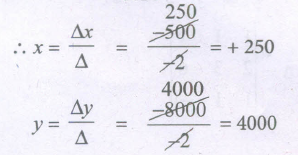
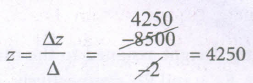
Hence, the amount invested in the three accounts are Rs. 250, Rs. 4000 and Rs. 4250 respectively.
11.
Let the weight assigned to the three varieties be Rs. x, Rs. y and Rs. z respectively By the given data,
x + 2y + 3z = 11
2x + 4y + 5z = 21
3x + 5y + 6z = 27
\(\Delta =\left| \begin{matrix} 1 & 2 & 3 \\ 2 & 4 & 5 \\ 3 & 5 & 6 \end{matrix} \right| =1\left| \begin{matrix} 4 & 5 \\ 5 & 6 \end{matrix} \right| -2\left| \begin{matrix} 2 & 5 \\ 3 & 6 \end{matrix} \right| +3\left| \begin{matrix} 2 & 4 \\ 3 & 5 \end{matrix} \right| \)
= 1(24 - 25) -2(12 - 15) + 3(10 - 12)
= 1(-1) -2 (-3) + 3(-2)
= -1+6 - 6 = -1\(\neq \) 0.
Since \(\Delta \neq 0\) the system is consistent with unique solution and Cramer's rule can be applied.
\(\Delta x=\left| \begin{matrix} 11 & 2 & 3 \\ 21 & 4 & 5 \\ 27 & 5 & 6 \end{matrix} \right| \)
\(=11\left| \begin{matrix} 4 & 5 \\ 5 & 6 \end{matrix} \right| -2\left| \begin{matrix} 21 & 5 \\ 27 & 6 \end{matrix} \right| +3\left| \begin{matrix} 21 & 4 \\ 27 & 5 \end{matrix} \right| \)
= 11(24 - 25) - 2(126 - 135) + 3(105 - 108)
= 11(-1) - 2(-9) + 3 (-3)
= 11+18-9
= -2
\(\Delta y=\left| \begin{matrix} 1 & 11 & 3 \\ 2 & 21 & 5 \\ 3 & 27 & 6 \end{matrix} \right| \)
= \(\left| \begin{matrix} 21 & 5 \\ 27 & 6 \end{matrix} \right| -11\left| \begin{matrix} 2 & 5 \\ 3 & 6 \end{matrix} \right| +3\left| \begin{matrix} 2 & 21 \\ 3 & 27 \end{matrix} \right| \)
= 1(126 - 135) - 11(12 -15) + 3(54 - 63)
= - 9 - 11(-3) + 3(-9)
= - 9 + 33 - 27
= 3
\(\Delta z=\left| \begin{matrix} 1 & 2 & 11 \\ 2 & 4 & 21 \\ 3 & 5 & 27 \end{matrix} \right| =1\left| \begin{matrix} 4 & 21 \\ 5 & 27 \end{matrix} \right| -2\left| \begin{matrix} 2 & 21 \\ 3 & 27 \end{matrix} \right| +11\left| \begin{matrix} 2 & 4 \\ 3 & 5 \end{matrix} \right| \)
= 1(108 - 105) - 2(54 - 63) + 11(10 - 12)
= 1(3) - 2(-9) + 11(-2)
= 3 + 18 - 22
= -1
\(x=\cfrac { \Delta x }{ \Delta } =\cfrac { -2 }{ -1 } =2\)
\(y=\cfrac { \Delta y }{ \Delta } =\cfrac { -3 }{ 1 } =3\)
and \(z=\cfrac { \Delta z }{ \Delta } =\cfrac { -1 }{ -1 } =1\)
Hence, the weights assigned to the three varieties are 2, 3 and 1 respectively
12.
Here \(\triangle =\left| \begin{matrix} 1 & 1 & 1 \\ 2 & -1 & 3 \\ 3 & 2 & -1 \end{matrix} \right| =13\neq 0\)
\(\therefore \) We can apply Cramer’s Rule and the system is consistent and it has unique solution.
\({ \triangle }_{ x }=\left| \begin{matrix} 1 & 1 & 1 \\ 2 & -1 & 3 \\ 3 & 2 & -1 \end{matrix} \right| =-13\)
\( { \triangle }_{ y }=\left| \begin{matrix} 1 & 4 & 1 \\ 2 & 1 & 3 \\ 3 & 1 & -1 \end{matrix} \right| =39\)
\( { \triangle }_{ z }=\left| \begin{matrix} 1 & 1 & 4 \\ 2 & -1 & 1 \\ 3 & 2 & 1 \end{matrix} \right| =26\)
\(\therefore \) By Cramer’s rule
\(x=\frac { { \triangle }x }{ { \triangle } } =\frac { -13 }{ 13 } =-1\)
\( y=\frac { { \triangle }y }{ { \triangle } } =\frac { 39 }{ 13 } =3\)
\( z=\frac { { \triangle }z }{ { \triangle } } =\frac { 26 }{ 13 } =2\)
\(\therefore \) The solution is (x, y, z) = (−1, 3, 2)
13.
Given non-homogeneous equations are
5x+ 3y + 7z = 4
3x + 26y + 2z = 9
7x + 2y + 10z = 5
The matrix equation corresponding to the given system is
\(\left( \begin{matrix} 5 & 3 & 7 \\ 3 & 26 & 2 \\ 7 & 2 & 10 \end{matrix} \right) \left( \begin{matrix} x \\ y \\ z \end{matrix} \right) =\left( \begin{matrix} 4 \\ 9 \\ 5 \end{matrix} \right) \)
| Augmented matrix [A, B] | Elementary Transformation |
|---|---|
| \(\left( \begin{matrix} 5 & 3 & 7 \\ 3 & 26 & 2 \\ 7 & 2 & 10 \end{matrix}\begin{matrix} 4 \\ 9 \\ 5 \end{matrix} \right) \) | |
| \(\sim \left( \begin{matrix} 3 & 26 & 2 \\ 5 & 3 & 7 \\ 7 & 2 & 10 \end{matrix}\begin{matrix} 9 \\ 4 \\ 5 \end{matrix} \right) \) | \({ R }_{ 1 }\leftrightarrow { R }_{ 2 }\) |
| \(\left( \begin{matrix} 1 & \frac { 26 }{ 3 } & \frac { 2 }{ 3 } \\ 5 & 3 & 7 \\ 7 & 2 & 10 \end{matrix}\begin{matrix} 3 \\ 4 \\ 5 \end{matrix} \right) \) | \({ R }_{ 1 }\rightarrow { R }_{ 1 }\div 3\) |
| \(\left( \begin{matrix} 1 & \frac { 26 }{ 3 } & \frac { 2 }{ 3 } \\ 0 & \frac { -121 }{ 3 } & \frac { 11 }{ 3 } \\ 7 & 2 & 5 \end{matrix}\begin{matrix} 3 \\ -11 \\ 5 \end{matrix} \right) \) | \({ R }_{ 2 }\rightarrow { R }_{ 2 }-5{ R }_{ 1 }\) |
| \(\left( \begin{matrix} 1 & \frac { 26 }{ 3 } & \frac { 2 }{ 3 } \\ 0 & \frac { -121 }{ 3 } & \frac { 11 }{ 3 } \\ 0 & \frac { -176 }{ 3 } & \frac { 16 }{ 3 } \end{matrix}\begin{matrix} 3 \\ -11 \\ -16 \end{matrix} \right) \) | \({ R }_{ 3 }\rightarrow { R }_{ 3 }-7{ R }_{ 1 }\) |
| \(\sim \left( \begin{matrix} 1 & \frac { 26 }{ 3 } & \frac { 2 }{ 3 } \\ 0 & \frac { -11 }{ 3 } & \frac { 1 }{ 3 } \\ 0 & \frac { -11 }{ 3 } & \frac { 1 }{ 3 } \end{matrix}\begin{matrix} 3 \\ -1 \\ -1 \end{matrix} \right) \) | \({ R }_{ 2 }\rightarrow { R }_{ 2 }\div 11\) \({ R }_{ 3 }\rightarrow { R }_{ 3 }\div 16\) |
| \(\left( \begin{matrix} 1 & \frac { 26 }{ 3 } & \frac { 2 }{ 3 } \\ 0 & \frac { -11 }{ 3 } & \frac { 1 }{ 3 } \\ 0 & 0 & 0 \end{matrix}\begin{matrix} 3 \\ -1 \\ 0 \end{matrix} \right) \) | \({ R }_{ 3 }\rightarrow { R }_{ 3 }-{ R }_{ 2 }\) |
\(\therefore\) The system is consistent with infinitely many solutions let us rewrite the above echelon form into matrix form
\(\left( \begin{matrix} 1 & \frac { 26 }{ 3 } & \frac { 2 }{ 3 } \\ 0 & \frac { -11 }{ 3 } & \frac { 1 }{ 3 } \\ 0 & 0 & 0 \end{matrix} \right) \left( \begin{matrix} x \\ y \\ z \end{matrix} \right) =\left( \begin{matrix} 3 \\ -1 \\ 0 \end{matrix} \right) \)
\(x+\cfrac { 26 }{ 3 } y+\cfrac { 2 }{ 3 } z=3\)
\(x+\cfrac { 26 }{ 3 } y+\cfrac { 2 }{ 3 } z=3\)
let z = k where k\(\in\) R
\((2)\Rightarrow \cfrac { -11 }{ 3 } y+\cfrac { k }{ 3 } =-1\)
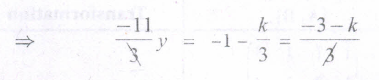
\(\Rightarrow \ -11y=-3-k\)
11y = 3 + k
\(\Rightarrow \quad y=\cfrac { 1 }{ 11 } \left( 3+k \right) \)
Substituting \(y=\cfrac { 1 }{ 11 } \left( 3+k \right) \) and z = k in (1) we get,
\(x+\cfrac { 26 }{ 3 } \left( \cfrac { 3+k }{ 11 } \right) +\cfrac { 2 }{ 3 } k=3\)
\(=\cfrac { 26 }{ 3 } \left( \cfrac { 3+k }{ 11 } \right) -\cfrac { 2k }{ 3 } +3\)
\(\cfrac { 78-26k }{ 33 } -\cfrac { 2k }{ 3 } +3\)
\(\cfrac { 78-26k-22k+99 }{ 33 } \)
\(\cfrac { 78-26k-22k+99 }{ 33 } \)
\(\cfrac { 21-48k }{ 33 } =\cfrac { 3(7-16k) }{ 33 } \)
= \(\cfrac { 1 }{ 11 } (7-6k)\)
\(\therefore\) Solution set is \(\left\{ \cfrac { 1 }{ 11 } \left( 7-16k \right), \cfrac { 1 }{ 11 } (3+k),k \right\} \)K \(\in\) R
Hence, for different values of k, we get infinitely many solutions.
14.
The matrix equation corresponding to the given system is
\(\left( \begin{matrix} 1 & 1 & 1 \\ 1 & 2 & 3 \\ 1 & 2 & a \end{matrix} \right) \left( \begin{matrix} X \\ Y \\ Z \end{matrix} \right) =\left( \begin{matrix} 6 \\ 10 \\ b \end{matrix} \right) \)
AX = B
| Augmented matrix [A,B] | Elementary Transformation |
| \(\left( \begin{matrix} 1 & 1 & 1 \\ 1 & 2 & 3 \\ 1 & 2 & a \end{matrix}\begin{matrix} 6 \\ 10 \\ b \end{matrix} \right) \) \(\sim \left( \begin{matrix} 1 & 1 & 1 \\ 0 & 1 & 2 \\ 0 & 1 & a-1 \end{matrix}\begin{matrix} 6 \\ 4 \\ b-6 \end{matrix} \right) \) \(\sim \left( \begin{matrix} 1 & 1 & 1 \\ 0 & 1 & 2 \\ 0 & 0 & a-3 \end{matrix}\begin{matrix} 6 \\ 4 \\ b-10 \end{matrix} \right) \) |
\({ R }_{ 2 }\rightarrow { R }_{ 2 }-{ R }_{ 1 }\) \({ R }_{ 3 }\rightarrow { R }_{ 3 }-{ R }_{ 1 }\) |
Case (i) For no solution:
The system possesses no solution only when \(\rho (A)\neq ([A,B])\) which is possible only when a−3 = 0 and b −10 \(\neq \) 0.
Hence for a = 3, b \(\neq \) 10, the system possesses no solution.
Case (ii) For a unique solution:
The system possesses a unique solution only when \(\rho (A)= ([A,B])\)=number of unknowns.
i.e when \(\rho (A)=\rho ([A,B])\) = 3
Which is possible only when a−3 \(\neq \) 0 and b may be any real number as we can observe .
Hence for a \(\neq \) and b \(\in \) R, the system possesses a unique solution.
Case (iii) For an infinite number of solutions:
The system possesses an infinite number of solutions only when
\(\rho (A)=\rho ([A,B])\)
Hence for a = 3, b = 10, the system possesses infinite number of solutions.
15.
(b)
0
16.
(b)
\({ R }_{ i }\rightarrow { 2R }_{ i }+{ 2C }_{ j }\)
17.
(b)
18.
(b)
n
19.
(d)
1
20.
()
Solution
21.
()
Not equal to 0
22.
()
unique
23.
()
64
24.
()
10

12th Standard Syllabus & Materials
12th Standard
TN 12th Computer Applications களப்பெயர் முறைமை (DNS) Sample Question Papers Study Material - QB365 Set A
NEW12th Standard
TN 12th Computer Applications வலையமைப்பு எடுத்துக்காட்டுகள் மற்றும் நெறிமுறைகள் Sample Question Papers Study Material - QB365 Set A
NEW12th Standard
TN 12th Computer Applications கணினி வலையமைப்பு ஓர் அறிமுகம் Sample Question Papers Study Material - QB365 Set A
NEW12th Standard
TN 12th Computer Applications PHP-உடன் MySQL-ஐ இணைத்தல் Sample Question Papers Study Material - QB365 Set A



Tamilnadu Stateboard 12th Standard Subjects

Maths

Chemistry

Physics

Biology

Computer Science
Business Maths and Statistics

Economics

Commerce

Accountancy

History

Computer Applications
Biology
Computer Technology
Computer Applications
Computer Science
Business Maths and Statistics
Commerce
Economics
Maths
Chemistry
Physics
Computer Technology
History
Accountancy

Tamil

English

French
Tamilnadu Stateboard Standards
