
 100% FREE ACCESS
12th Standard Syllabus & Materials
12th Standard
TN 12th Maths Applications of Matrices and Determinants Sample Question Papers Study Material - QB365 Set A
NEW12th Standard
TN 12th Computer Applications மின்னணு தரவு பரிமாற்றம் Sample Question Papers Study Material - QB365 Set A
NEW12th Standard
TN 12th Computer Applications மின் - வணிக பாதுகாப்பு அமைப்புகள் Sample Question Papers Study Material - QB365 Set A
NEW12th Standard
TN 12th Computer Applications மின்னணு செலுத்தல் முறைகள் Sample Question Papers Study Material - QB365 Set A
NEW12th Standard
TN 12th Computer Applications மின் - வணிகம் Sample Question Papers Study Material - QB365 Set A
NEW12th Standard
TN 12th Computer Applications திறந்த மூல கருத்துருக்கள் Sample Question Papers Study Material - QB365 Set A

Published on: 20/01/2020
Download Tamil Nadu 12th Standard Business Maths and Statistics question papers, model tests, one-mark questions, important questions, and public exam papers in PDF format. Free study materials and answer keys for TN State Board students.
Questions + Answers key
Take MCQ Business Maths and Statistics Test
1.
Compute
(i) Laspeyre's
(ii) Paasche's
(iii) Fisher's price index number for 2000 from the following data.
| Commodity | Price | Quantity | ||
| 1990 | 2000 | 1990 | 2000 | |
| A | 2 | 4 | 8 | 6 |
| B | 5 | 6 | 10 | 5 |
| C | 4 | 5 | 14 | 10 |
| D | 2 | 2 | 19 | 13 |
2.
Evaluate ഽx. log (1 + x) dx
3.
The net profit p and quantity x satisfy the differential equation \(\frac { dp }{ dx } =\frac { 2{ p }^{ 3 }-{ x }^{ 3 } }{ 3x{ p }^{ 2 } } \). Find the relationship between the net profit and demand given that p = 20, when x = 10.
4.
The marginal revenue function (in thousands of rupees) of a commodity is 7+e-0.05x where x is the number of units sold. Find the total revenue from the sale of 100 units (e-5 = 0.0067)
5.
For what values of k, the system of equations kx+ y+z = 1, x+ ky+z= 1, x+ y+kz = 1 have
(I) Unique solution
(ii) More than one solution
(iii) no solution
6.
Solve the following equation by using Cramer’s rule
2x + y −z = 3, x + y + z =1, x− 2y− 3z = 4
7.
Using the following data, construct Fisher’s Ideal Index Number and Show that it satisfies Factor Reversal Test and Time Reversal Test?
| Commodities | Price | Quantity | ||
| Base Year | Current year | Base Year | Current year | |
| Wheat | 6 | 10 | 50 | 56 |
| Ghee | 2 | 2 | 100 | 120 |
| Firewood | 4 | 6 | 60 | 60 |
| Sugar | 10 | 12 | 30 | 24 |
| Cloth | 8 | 12 | 40 | 36 |
8.
9.
Find the particular solution of the differential equation x2 dy + y(x + y)dx = 0 given that x = 1, y = 1
10.
Derive the mean and variance of binomial distribution.
11.
The price of a machine is Rs. 5,00,000 with an estimated life of 12 years. The estimated salvage value is Rs. 30,000. The machine can be rented at Rs. 72,000 per year. The present value of the rental payment is calculated at 9% interest rate. Find out whether it is advisable to rent the machine.(e−1.08 = 0.3396).
12.
Evaluate \(\int { { \left( \log x \right) }^{ 2 } } dx\)
13.
Two types of soaps A and B are in the market. Their present market shares are 15% for A and 85% for B. Of those who bought A the previous year, 65% continue to buy it again while 35% switch over to B. Of those who bought B the previous year, 55% buy it again and 45% switch over to A. Find their market shares after one year and when is the equilibrium reached?
14.
In a market survey three commodities A, B and C were considered. In finding out the index number some fixed weights were assigned to the three varieties in each of the commodities. The table below provides the information regarding the consumption of three commodities according to the three varieties and also the total weight received by the commodity
| Commodity Variety | Variety | Total weight | ||
| I | II | III | ||
| A | 1 | 2 | 3 | 11 |
| B | 2 | 4 | 5 | 21 |
| C | 3 | 5 | 6 | 27 |
Find the weights assigned to the three varieties by using Cramer’s Rule.
15.
The price of 3 Business Mathematics books, 2 Accountancy books and one Commerce book is Rs. 840. The price of 2 Business Mathematics books, one Accountancy book and one Commerce book is Rs. 570. The price of one Business Mathematics book, one Accountancy book and 2 Commerce books is Rs. 630. Find the cost of each book by using Cramer’s rule.
16.
Show that the equations 5x + 3y + 7z = 4, 3x + 26y + 2z = 9, 7x + 2y + 10z = 5 are consistent and solve them by rank method.
17.
Find k, if the equations x + 2y − 3z = −2, 3x − y − 2z = 1, 2x + 3y − 5z = k are consistent.
18.
Explain in detail about non-sampling error.
19.
Evaluate \(\int _{ 0 }^{ 1 }{ [{ e }^{ a \log x }+{ e }^{ x \log a }] } dx\)
20.
In year 2000 world gold production was 2547 metric tons and it was growing exponentially at the rate of 0.6% per year. If the growth continues at this rate, how many tons of gold will be produced from 2000 to 2013? [e0.078 = 1.0811)
1.
| Commodity | Price | Quantity | ||
| Base year p0 | Current year p1 | Base year q0 | Current year q1 | |
| A | 2 | 4 | 8 | 6 |
| B | 5 | 6 | 10 | 5 |
| C | 4 | 5 | 14 | 10 |
| D | 2 | 2 | 19 | 13 |
| p0q0 | p1q0 | p0q1 | p1q1 |
| 16 | 32 | 12 | 24 |
| 50 | 60 | 25 | 30 |
| 56 | 70 | 40 | 50 |
| 38 | 38 | 26 | 26 |
| 160 | 200 | 103 | 130 |
(i) Laspeyre's index number
\(P_{01}^{L} = \frac{\Sigma p_1q_0}{\Sigma p_0q_0}\times100\)
\(=\frac{200}{160}\times100=125\)
(ii) Paasche's Price index number
\(P_{01}^{P} = \frac{\Sigma p_1q_1}{\Sigma p_0q_1}\times100\)
\(=\frac{130}{103}\times100=126.21\)
(iii) Fisher's price index number
\(P_{01}^{F} =\sqrt {{P_{01}^{L}}\times{P_{01}^{P}}}=125.6\)
2.
Let I = ഽx. log (1 + x) dx
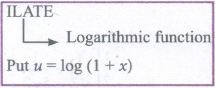
u = log (1 + x); dv = x dx
\(du=\frac { 1 }{ 1+x } dx;\quad v=\frac { { x }^{ 2 } }{ 2 } \)
Using integration by parts we get,
I = ഽu dv = uv - ഽv du
= ഽ x log (1 + x) dx
= \(\frac { { x }^{ 2 } }{ 2 } log(1+x)-\int { \frac { { x }^{ 2 } }{ 2 } .\frac { 1 }{ 1+x } } dx\)
= \(\frac { { x }^{ 2 } }{ 2 } log(1+x)-\frac { 1 }{ 2 } \int { \frac { { x }^{ 2 } }{ 1+x } } dx\)
= \(\frac { { x }^{ 2 } }{ 2 } log(1+x)-\frac { 1 }{ 2 } \int { \frac { { x }^{ 2 }-1+1 }{ 1+x } } dx\)
[Adding & subtracting 1 in the numerator]
= \(\frac { { x }^{ 2 } }{ 2 } log(1+x)-\frac { 1 }{ 2 } \)
.JPG)
= \(\frac { { x }^{ 2 } }{ 2 } log(1+x)-\frac { 1 }{ 2 } \left[ \int { \left( x-1 \right) dx+log\left| 1+x \right| } \right] +c\)
= \(\frac { { x }^{ 2 } }{ 2 } log(x+1)-\frac { 1 }{ 2 } \left[ \frac { { x }^{ 2 } }{ 2 } -x+log\left| 1+x \right| \right] +c\)
3.
Given \(\frac { dp }{ dx } =\frac { 2{ p }^{ 3 }-{ x }^{ 3 } }{ 3x{ p }^{ 2 } } \)
The numerator and denominator are homogeneous functions of 3,
∴ Put p=vx and \(\frac { dp }{ dx } =v+x\frac { dv }{ dx } \)
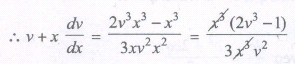
= \(\frac { 2{ v }^{ 3 }-1 }{ 3{ v }^{ 2 } } \)
⇒ \(\frac { dv }{ dx } =\frac { 2{ v }^{ 3 }-1 }{ 3{ v }^{ 2 } } -v=\frac { 2{ v }^{ 3 }-1-3{ v }^{ 3 } }{ 3{ v }^{ 2 } } \)
= \(\frac { -1-{ v }^{ 3 } }{ 3{ v }^{ 2 } } \)
⇒ \(\left( \frac { 3{ v }^{ 2 } }{ 1+{ v }^{ 3 } } \right) dv=-\frac { dx }{ x } \)
Integrating, \(\int { \frac { 3{ v }^{ 2 } }{ 1+{ v }^{ 3 } } } dv=-\int { \frac { dx }{ x } } \)
⇒ log(1+v3) = -log x + log c
⇒ 1+v3 = \(\frac { c }{ x } \)
Replacing v by \(\frac { p }{ x } \) we get
\(1+\frac { { p }^{ 3 } }{ { x }^{ 3 } } =\frac { c }{ x } \Rightarrow \frac { { x }^{ 3 }+{ p }^{ 3 } }{ { x }^{ 3 } } =\frac { c }{ x } \)
⇒ \(\frac { { x }^{ 3 }+{ p }^{ 3 } }{ { x }^{ 2 } } \)= c ⇒ x3+p3 = cx2...(1)
When x = 10, p = 20
⇒ 103 + 203 = c(10)2 ⇒ 1000 + 8000 = 100 c
⇒ 9000 = 100 c
⇒ c = 90
∴ (1) becomes,
x3+p3 = 90x2
⇒ p3 = 90x2-x3
⇒ p3 = x2(90-x) which is the required relationship.
4.
Given' R'(x) = 7 + e-0.05x
Total revenue from sale of 100 units is
\(R=\int _{ 0 }^{ 100 }{ (7+{ e }^{ -0.05x })dx } \)
\(={ \left[ 7x+\frac { { e }^{ -0.05x } }{ -0.05 } \right] }_{ 0 }^{ 100 }\)
\(=700-\frac { 100 }{ 5 } ({ e }^{ -5 }-{ e }^{ 0 })\left[ 0.05=\frac { 5 }{ 100 } \right] \)
= 700-20(0.0067-1)[∵e0=1]
= 700-0.134
= 719.866
Since the revenue is given in thousands,
Total revenue = 719.866 x 1000
= Rs. 7,19,866
5.
The given non-homogeneous equations can be written as
\(\left( \begin{matrix} k & 1 & 1 \\ 1 & k & 1 \\ 1 & 1 & k \end{matrix} \right) \left( \begin{matrix} x \\ y \\ z \end{matrix} \right) =\left( \begin{matrix} 1 \\ 1 \\ 1 \end{matrix} \right) \)
| Augmented matrix [A, B] |
Elementary Transformation |
|---|---|
| \(\left( \begin{matrix} k & 1 & 1 \\ 1 & k & 1 \\ 1 & 1 & k \end{matrix}\begin{matrix} 1 \\ 1 \\ 1 \end{matrix} \right) \) | |
| \(\sim \left( \begin{matrix} 1 & 1 & k \\ 1 & k & 1 \\ k & 1 & 1 \end{matrix}\begin{matrix} 1 \\ 1 \\ 1 \end{matrix} \right) \) | \({ R }_{ 1 }\leftrightarrow { R }_{ 3 }\) |
| \(\sim \left( \begin{matrix} 1 & 1 & k \\ 0 & k-1 & 1-k \\ 0 & 1-k & 1-{ k }^{ 2 } \end{matrix}\begin{matrix} 1 \\ 0 \\ 1-k \end{matrix} \right) \) | \({ R }_{ 2 }\rightarrow { R }_{ 2 }-R_{ 1 }\) \({ R }_{ 3 }\rightarrow { R }_{ 3 }-k{ R }_{ 1 }\) |
| \(\sim \left( \begin{matrix} 1 & 1 & k \\ 0 & k-1 & 1-k \\ 0 & 0 & 2-k-{ k }^{ 2 } \end{matrix}\begin{matrix} 1 \\ 0 \\ 1-k \end{matrix} \right) \) | \({ R }_{ 3 }\rightarrow { R }_{ 3 }{ +R_{ 2 } }\) |
Case (i):
When \(k\neq 1\) and \(k\neq 2\)
\(\rho (A)=\rho (A,B)=3=\) Number of unknowns
\(\therefore \) The system has unique solution
Case (ii):
When k = 1
\(\left[ A,B \right] \sim \left( \begin{matrix} 1 & 1 & 1 \\ 0 & 0 & 0 \\ 0 & 0 & 0 \end{matrix}\begin{matrix} 1 \\ 0 \\ 0 \end{matrix} \right) \)
\(\rho (A)=\rho\) (A, B) = 1
\(\therefore \) The system is consistent and has infinitely many solutions.
Case (iii):
When k = - 2
\(\left[ A,B \right] \sim \left( \begin{matrix} 1 & 1 & -2 \\ 0 & -3 & 3 \\ 0 & 0 & 0 \end{matrix}\begin{matrix} 1 \\ 0 \\ -3 \end{matrix} \right) \)
\(\rho (A)=2\rho (A,B)\)= 3
\(\Rightarrow \rho (A)\neq 2\rho (A,B)\)
\(\therefore\) The system is inconsistent and has no solution.
6.
\(\Delta =\left| \begin{matrix} 2 & 1 & -1 \\ 1 & 1 & 1 \\ 1 & -2 & 3 \end{matrix} \right| =2\)
\(\left| \begin{matrix} 1 & 1 \\ -2 & -3 \end{matrix} \right| -1\left| \begin{matrix} 1 & 1 \\ 1 & -3 \end{matrix} \right| -1\left| \begin{matrix} 1 & 1 \\ 1 & -2 \end{matrix} \right| \)
= 2 (-3+2) - 1 (-3 -1) -1 (-2-1)
= 2(-1) -1 (-4) -1 (-3)
= -2 + 4 + 3 = 5.
Since\(\Delta \neq 0\),
we can apply Cramer's rule and the system is consistent with unique solution.
\(x=\left| \begin{matrix} 3 & 1 & -1 \\ 1 & 1 & 1 \\ 4 & -2 & 3 \end{matrix} \right| =3\left| \begin{matrix} 1 & 1 \\ -2 & -3 \end{matrix} \right| -1\left| \begin{matrix} 1 & 1 \\ 4 & -3 \end{matrix} \right| -1\left| \begin{matrix} 1 & 1 \\ 4 & -2 \end{matrix} \right| \)
= 3(-3 + 2) -1(-3 -4) -1(-2 -4)
= 3 (-1) -1 (-7) -1 (-6)
= -3 + 7 + 6 = 10.
\(\Delta y=\left| \begin{matrix} 2 & 3 & -1 \\ 1 & 1 & 1 \\ 1 & 4 & -3 \end{matrix} \right| =2\left| \begin{matrix} 1 & 1 \\ 4 & -3 \end{matrix} \right| -3\left| \begin{matrix} 1 & 1 \\ 1 & -3 \end{matrix} \right| -1\left| \begin{matrix} 1 & 1 \\ 1 & 4 \end{matrix} \right| \)
= 2(-3 -4) -3 (-3 -1) -1 (4-1)
= 2 (-7) -3 (-4) -1(3)
= 14 + 12 - 3 = -5
\(\Delta z=\left| \begin{matrix} 2 & 1 & 3 \\ 1 & 1 & 1 \\ 1 & -2 & 4 \end{matrix} \right| \)
= \(2\left| \begin{matrix} 1 & 1 \\ -2 & 4 \end{matrix} \right| -1\left| \begin{matrix} 1 & 1 \\ 1 & 4 \end{matrix} \right| +3\left| \begin{matrix} 1 & 1 \\ 1 & -2 \end{matrix} \right| \)
= 2(4 + 2) -1(4 -1) + 3(-2 -1)
= 2(6) -1(3) + 3(-3)
= 12 - 3 - 9
= 0
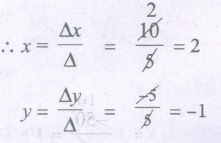
\(z=\cfrac { \Delta z }{ \Delta } =\cfrac { 0 }{ 5 } =0\)
\(\therefore\)Solution set is (2, -1, 0)
7.
| Commodities | Price | Quantity | ||
| Base year (p0) | Current year (p1) | q0 | q1 | |
| Wheat | 6 | 10 | 50 | 56 |
| Ghee | 2 | 2 | 60 | 60 |
| Firewood | 4 | 6 | 60 | 60 |
| Sugar | 10 | 12 | 30 | 24 |
| Cloth | 8 | 12 | 40 | 36 |
| p0q0 | p1q1 | p0q1 | p1q0 |
| 300 | 560 | 336 | 500 |
| 200 | 240 | 240 | 200 |
| 240 | 360 | 240 | 360 |
| 300 | 288 | 240 | 360 |
| 320 | 432 | 288 | 480 |
| 1360 | 1880 | 1344 | 1900 |
Fisher's price index number
\(P^{F}_{01}\) = \(\sqrt{ \frac {\sum p_{1}q_{0}}{\sum p_{0}q_{0}} \times \frac{ {\sum p_{1}q_{1}} }{{\sum p_{0}q_{1}}}{}}\times 100\)
= \(\sqrt\frac {1900 \times 1880}{1360 \times 1344} \times 100\)
= \(\sqrt\frac {3572000}{1827840} \times 100\)
= \(\sqrt {1.954} \times 100\)
\(P^{F}_{01}\) = 139.8
Time reversal test:
\(P _{01} \times P_{10}\) = \(\sqrt{ \frac {\sum p_{1}q_{0}\times \sum p_{1}q_{1}\times \sum p_{0}q_{1}\times \sum p_{0}q_{0}}{\sum p_{0}q_{0}\times \sum p_{0}q_{1}\times \sum p_{1}q_{1} \times \sum p_{1}q_{0}} }\)
= 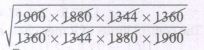
= \(\sqrt {1}\) = 1
∴ \(P _{01} \times P_{10}\) = 1
Factor reversal test:
\(P _{01} \times Q_{01}\) = \(\sqrt{ \frac {\sum p_{1}q_{0}\times \sum p_{1}q_{1}\times \sum q_{1}p_{0}\times \sum q_{1}p_{1}}{\sum p_{0}q_{0}\times \sum p_{0}q_{1}\times \sum q_{0}p_{0} \times \sum q_{0}p_{1}} }\)
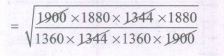
= \(\frac {1880}{1360} = \frac {\sum p_{1}q_{1}}{\sum p_{0}q_{0}}\)
Hence, it satisfies time reversal test and factor reversal test.
8.
9.
x2dy + y(x + y) dx = 0
x2dy = −y( x+y) dx
\(\frac { dy }{ dx } =\frac { -(xy+{ y }^{ 2 }) }{ { x }^{ 2 } } \)
Put y = vx and \(\frac { dy }{ dx } =v+x\frac { dv }{ dx } \) in (1)
\(v+x\frac { dv }{ dx } =\frac { (xvx+{ v }^{ 2 }{ x }^{ 2 }) }{ { x }^{ 2 } } \)
= −(v + v2)
\(x\frac { dv }{ dx } \) = −v2−v− v
= −(v2 + 2v)
On separating the variables
\(\frac { dv }{ { v }^{ 2 }+2v } =-\frac { dx }{ x } \)
\(\frac { dv }{ v(v+2) } =\frac { -dx }{ x } \)
\(\frac { 1 }{ 2 } \left[ \frac { (v+2)-v }{ v(v+2) } \right] dv=\frac { -dx }{ x } \)
\(\frac { 1 }{ 2 } ഽ\left[ \frac { 1 }{ v } -\frac { 1 }{ v+2 } \right] dv=-ഽ\frac { dx }{ x } \)
\(\frac12\) [log v - log (v + 2)] = - log x + log c
\(\frac { 1 }{ 2 } log\frac { v }{ v+2 } =log\frac { c }{ x } \)
We have
\(\frac { v }{ v+2 } =\frac { { c }^{ 2 } }{ { x }^{ 2 } } \)
Replace v = \(\frac{y}{x}\), we get
\(\frac { y }{ x\left( \frac { y }{ x } +2 \right) } =\frac { k }{ { x }^{ 2 } } \) where c2 =k
\(\frac { y{ x }^{ 2 } }{ y+2x } =k\)
When x = 1, y = 1
∴ (2) ⇒ k = \(\frac { 1 }{ 1+2 } \)
k = \(\frac { 1 }{ 3 } \)
∴ The solution is 3x2 y = 2x + y
10.
The mean of the binomial distribution
Ex = \(\overset { n }{ \underset { x=0 }{ \Sigma } } x.p(x)=\overset { n }{ \underset { x=0 }{ \Sigma } } \left( \begin{matrix} n \\ x \end{matrix} \right) { p }^{ x }q^{ n-x }\)
= \(p.\overset { n }{ \underset { x=0 }{ \Sigma } } x.\left( \begin{matrix} n \\ x \end{matrix} \right) { p }^{ x-1 }q^{ n-x }\)
[Take p common]
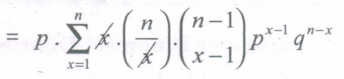
= \(np.\overset { n }{ \underset { x=1 }{ \Sigma } } \left( \begin{matrix} n-1 \\ x-1 \end{matrix} \right) { p }^{ x-1 }q^{ n-x }\)
= np (q +p)n-1 [using binomial theorem]
(x+a)n = \({ x }^{ n }+{ n }_{ { C }_{ 1 } }{ x }^{ n-1 }{ a }^{ 1 }+...+{ a }^{ n }\)
= np(1)n-1 [∵ p+q=1]
= np
∴ Mean = E(x) = np..(1)
Now, E(X2) =\(\overset { n }{ \underset { x=0 }{ \Sigma } } { x }^{ 2 }.\left( \begin{matrix} n \\ x \end{matrix} \right) { p }^{ x }q^{ n-x }\)
=\(\overset { n }{ \underset { x=0 }{ \Sigma } } \{ x(x-1)+x\} \left( \begin{matrix} n \\ x \end{matrix} \right) { p }^{ x }q^{ n-x }\)
=\(\overset { n }{ \underset { x=0 }{ \Sigma } } x(x-1).\left( \begin{matrix} n \\ x \end{matrix} \right) { p }^{ x }q^{ n-x }+{ \Sigma }_{ x }.\left( \begin{matrix} n \\ x \end{matrix} \right) { p }^{ x }q^{ n-x }\)
=\(\overset { n }{ \underset { x=2 }{ \Sigma } } x(x-1)\frac { n(n-1) }{ x(x-1) } \left( \begin{matrix} n-2 \\ n-2 \end{matrix} \right) { p }^{ x-2 }{ q }^{ n-x }\)+\(\Sigma x\left( \begin{matrix} n \\ x \end{matrix} \right) { p }^{ x }q^{ n-x }\)
= \(n(n-1){ p }^{ 2 }\left\{ \Sigma \left( \begin{matrix} n-2 \\ n-2 \end{matrix} \right) { p }^{ x-2 }{ q }^{ n-x } \right\} \) +np (using (1))
= n(n-1)p2 (q+p)n-2 + np
[using binomial theory]
= n(n-1)p2 (1) + np ∴ p+ q = 1
= n(n-1)p2+ np .... (2)
Variance = E(X2) - [E(X)]2
= n(n-1)p2+np-(np)2
[From (1) & (2)]

= np (1-p) = npq [ ∵ p+q = 1⇒ q = 1-p]
∴ Mean = np and variance = npq
11.
The present value of payment for t year = \(\int _{ 0 }^{ t }{ { 72000e }^{ -0.09t } } dt\)
Present value of 12 years = \(\int _{ 0 }^{ t }{ { 72000e }^{ -0.09t } } dt\)
= 72000\({ \left[ \frac { { e }^{ -0.09t } }{ { -0.09 } } \right] }_{ 0 }^{ \\ 12 }\)
= \(\frac { 72000 }{ -0.09 } \left[ { e }^{ -0.09(12) }-{ e }^{ 0 } \right] \)
= \(-8,00,000[{ e }^{ -1.08 }-{ e }^{ 0 }]\)
= −8,00,000 [0.3396 −1]
= 5,28,320
Cost of the machine = 5,00,000 − 30,000
= 4,70,000
Hence it not advisable to rent the machine
It is better to buy the machine.
12.
\(\int { { \left( \log x \right) }^{ 2 } } dx= \int { udv } \)
= uv − \(\int { } \)vdu
= x (log x)2 − 2\(\int { } \) logxdx...(*)
\(=x(\log x)^{ 2 }-2\int { udv } \)
\(=x(\log x)^{ 2 }-2[uv-\int { udv } ]\)
\(=x(\log x)^{ 2 }-2[x \log x-\int { dx] } \)
\(=x(\log x)^{ 2 }-2x \log x+x+c\)
\(=x[(\log{ ) }^{ 2 }-\log{ x }^{ 2 }+2]+c\)
| For \(\int { } \)log x dx in (*) | |
| Take u = (log x) Differentiate \(du=\frac { 1 }{ x } dx\) | and dv = dx Integrate v = x |
13.
Transition probability matrix
(A B) T = (A B)
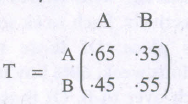
Where A represents the percent of people those who bought soap A and B represents the percent of people those who bought soap B.
By the given data
A = 15% = ·15
and B = 85% = ·85
Percentage after one year is
\(\left( \cdot 15\quad \cdot 85 \right) \left( \begin{matrix} \cdot 65 & \cdot 35 \\ \cdot 45 & \cdot 55 \end{matrix} \right) \)
= ((.15)(·65) + (·85)(-45) ·15(-35)+ ·85(-55))
= (-0975 + ·3825 ·0525 + -4675)
= (-48 ·52)
Hence, market share after one year is 48% and 52% At equilibrium,
\(\left( A\quad B \right) \left( \begin{matrix} \cdot 65 & \cdot 35 \\ \cdot 45 & \cdot 55 \end{matrix} \right) =(A\quad B)\)
(-65A + A5B ·35A +·55B) = (A B)
Equating the corresponding entries on both sides we get
\(\Rightarrow \cdot 65A+\cdot 45B=A\)
\(\Rightarrow \cdot 65A+\cdot 45(1-A)=A\)
[Since A+B = 1 B = 1-A]
\(\Rightarrow \cdot 65A+\cdot 45-\cdot 45A=A\)
\(\Rightarrow \cdot 45=A-\cdot 65A+\cdot 45A\)
\(\Rightarrow \cdot 45=A\left( \cdot 35+45 \right) \)
\(\Rightarrow \cdot 45=A(\cdot 35+45)\)
\(\Rightarrow \cdot 45=A(-8)\)
\(\Rightarrow A=\cfrac { \cdot 45 }{ \cdot 8 } =\cdot 5625=56.25\)
\(\therefore B=1-A=1-\cdot 5625=\cdot 4375\)
= 43.75%
\(\therefore\) Equilibrium is reached when A = 56.25% and B = 43.75%
14.
Let the weight assigned to the three varieties be Rs. x, Rs. y and Rs. z respectively By the given data,
x + 2y + 3z = 11
2x + 4y + 5z = 21
3x + 5y + 6z = 27
\(\Delta =\left| \begin{matrix} 1 & 2 & 3 \\ 2 & 4 & 5 \\ 3 & 5 & 6 \end{matrix} \right| =1\left| \begin{matrix} 4 & 5 \\ 5 & 6 \end{matrix} \right| -2\left| \begin{matrix} 2 & 5 \\ 3 & 6 \end{matrix} \right| +3\left| \begin{matrix} 2 & 4 \\ 3 & 5 \end{matrix} \right| \)
= 1(24 - 25) -2(12 - 15) + 3(10 - 12)
= 1(-1) -2 (-3) + 3(-2)
= -1+6 - 6 = -1\(\neq \) 0.
Since \(\Delta \neq 0\) the system is consistent with unique solution and Cramer's rule can be applied.
\(\Delta x=\left| \begin{matrix} 11 & 2 & 3 \\ 21 & 4 & 5 \\ 27 & 5 & 6 \end{matrix} \right| \)
\(=11\left| \begin{matrix} 4 & 5 \\ 5 & 6 \end{matrix} \right| -2\left| \begin{matrix} 21 & 5 \\ 27 & 6 \end{matrix} \right| +3\left| \begin{matrix} 21 & 4 \\ 27 & 5 \end{matrix} \right| \)
= 11(24 - 25) - 2(126 - 135) + 3(105 - 108)
= 11(-1) - 2(-9) + 3 (-3)
= 11+18-9
= -2
\(\Delta y=\left| \begin{matrix} 1 & 11 & 3 \\ 2 & 21 & 5 \\ 3 & 27 & 6 \end{matrix} \right| \)
= \(\left| \begin{matrix} 21 & 5 \\ 27 & 6 \end{matrix} \right| -11\left| \begin{matrix} 2 & 5 \\ 3 & 6 \end{matrix} \right| +3\left| \begin{matrix} 2 & 21 \\ 3 & 27 \end{matrix} \right| \)
= 1(126 - 135) - 11(12 -15) + 3(54 - 63)
= - 9 - 11(-3) + 3(-9)
= - 9 + 33 - 27
= 3
\(\Delta z=\left| \begin{matrix} 1 & 2 & 11 \\ 2 & 4 & 21 \\ 3 & 5 & 27 \end{matrix} \right| =1\left| \begin{matrix} 4 & 21 \\ 5 & 27 \end{matrix} \right| -2\left| \begin{matrix} 2 & 21 \\ 3 & 27 \end{matrix} \right| +11\left| \begin{matrix} 2 & 4 \\ 3 & 5 \end{matrix} \right| \)
= 1(108 - 105) - 2(54 - 63) + 11(10 - 12)
= 1(3) - 2(-9) + 11(-2)
= 3 + 18 - 22
= -1
\(x=\cfrac { \Delta x }{ \Delta } =\cfrac { -2 }{ -1 } =2\)
\(y=\cfrac { \Delta y }{ \Delta } =\cfrac { -3 }{ 1 } =3\)
and \(z=\cfrac { \Delta z }{ \Delta } =\cfrac { -1 }{ -1 } =1\)
Hence, the weights assigned to the three varieties are 2, 3 and 1 respectively
15.
Let ‘x’ be the cost of a Business Mathematics book
Let ‘y’ be the cost of a Accountancy book.
Let ‘z’ be the cost of a Commerce book.
\(\therefore \) 3x + 2y + z = 840
2x + y + z = 570
x + y + 2z = 630
Here \({ \triangle }=\left| \begin{matrix} 3 & 2 & 1 \\ 2 & 1 & 1 \\ 1 & 1 & 2 \end{matrix} \right| =-2\neq 0\)
\({ \triangle }_{ x }=\left| \begin{matrix} 840 & 2 & 1 \\ 570 & 1 & 1 \\ 630 & 1 & 2 \end{matrix}\begin{matrix} 1 \\ 1 \\ 2 \end{matrix} \right| =-240 \)
\({ \triangle }_{ y }=\left| \begin{matrix} 3 & 840 & 1 \\ 2 & 570 & 1 \\ 1 & 630 & 2 \end{matrix} \right| =-300 \)
\({ \triangle }_{ z }=\left| \begin{matrix} 3 & 2 & 840 \\ 2 & 1 & 570 \\ 1 & 1 & 630 \end{matrix} \right| =-360\)
\(\therefore \) By Cramer’s rule
\(x=\frac { { \triangle }x }{ { \triangle } } =\frac { -240 }{ -2 } =120 \)
\(y=\frac { { \triangle }y }{ { \triangle } } =\frac { 300 }{ -2 } =150 \)
\(z=\frac { { \triangle }z }{ { \triangle } } =\frac { 360 }{ -2 } =180\)
\(\therefore \) The cost of a Business Mathematics book is Rs. 120,
the cost of a Accountancy book is Rs. 150 and
the cost of a Commerce book is Rs. 180.
16.
Given non-homogeneous equations are
5x+ 3y + 7z = 4
3x + 26y + 2z = 9
7x + 2y + 10z = 5
The matrix equation corresponding to the given system is
\(\left( \begin{matrix} 5 & 3 & 7 \\ 3 & 26 & 2 \\ 7 & 2 & 10 \end{matrix} \right) \left( \begin{matrix} x \\ y \\ z \end{matrix} \right) =\left( \begin{matrix} 4 \\ 9 \\ 5 \end{matrix} \right) \)
| Augmented matrix [A, B] | Elementary Transformation |
|---|---|
| \(\left( \begin{matrix} 5 & 3 & 7 \\ 3 & 26 & 2 \\ 7 & 2 & 10 \end{matrix}\begin{matrix} 4 \\ 9 \\ 5 \end{matrix} \right) \) | |
| \(\sim \left( \begin{matrix} 3 & 26 & 2 \\ 5 & 3 & 7 \\ 7 & 2 & 10 \end{matrix}\begin{matrix} 9 \\ 4 \\ 5 \end{matrix} \right) \) | \({ R }_{ 1 }\leftrightarrow { R }_{ 2 }\) |
| \(\left( \begin{matrix} 1 & \frac { 26 }{ 3 } & \frac { 2 }{ 3 } \\ 5 & 3 & 7 \\ 7 & 2 & 10 \end{matrix}\begin{matrix} 3 \\ 4 \\ 5 \end{matrix} \right) \) | \({ R }_{ 1 }\rightarrow { R }_{ 1 }\div 3\) |
| \(\left( \begin{matrix} 1 & \frac { 26 }{ 3 } & \frac { 2 }{ 3 } \\ 0 & \frac { -121 }{ 3 } & \frac { 11 }{ 3 } \\ 7 & 2 & 5 \end{matrix}\begin{matrix} 3 \\ -11 \\ 5 \end{matrix} \right) \) | \({ R }_{ 2 }\rightarrow { R }_{ 2 }-5{ R }_{ 1 }\) |
| \(\left( \begin{matrix} 1 & \frac { 26 }{ 3 } & \frac { 2 }{ 3 } \\ 0 & \frac { -121 }{ 3 } & \frac { 11 }{ 3 } \\ 0 & \frac { -176 }{ 3 } & \frac { 16 }{ 3 } \end{matrix}\begin{matrix} 3 \\ -11 \\ -16 \end{matrix} \right) \) | \({ R }_{ 3 }\rightarrow { R }_{ 3 }-7{ R }_{ 1 }\) |
| \(\sim \left( \begin{matrix} 1 & \frac { 26 }{ 3 } & \frac { 2 }{ 3 } \\ 0 & \frac { -11 }{ 3 } & \frac { 1 }{ 3 } \\ 0 & \frac { -11 }{ 3 } & \frac { 1 }{ 3 } \end{matrix}\begin{matrix} 3 \\ -1 \\ -1 \end{matrix} \right) \) | \({ R }_{ 2 }\rightarrow { R }_{ 2 }\div 11\) \({ R }_{ 3 }\rightarrow { R }_{ 3 }\div 16\) |
| \(\left( \begin{matrix} 1 & \frac { 26 }{ 3 } & \frac { 2 }{ 3 } \\ 0 & \frac { -11 }{ 3 } & \frac { 1 }{ 3 } \\ 0 & 0 & 0 \end{matrix}\begin{matrix} 3 \\ -1 \\ 0 \end{matrix} \right) \) | \({ R }_{ 3 }\rightarrow { R }_{ 3 }-{ R }_{ 2 }\) |
\(\therefore\) The system is consistent with infinitely many solutions let us rewrite the above echelon form into matrix form
\(\left( \begin{matrix} 1 & \frac { 26 }{ 3 } & \frac { 2 }{ 3 } \\ 0 & \frac { -11 }{ 3 } & \frac { 1 }{ 3 } \\ 0 & 0 & 0 \end{matrix} \right) \left( \begin{matrix} x \\ y \\ z \end{matrix} \right) =\left( \begin{matrix} 3 \\ -1 \\ 0 \end{matrix} \right) \)
\(x+\cfrac { 26 }{ 3 } y+\cfrac { 2 }{ 3 } z=3\)
\(x+\cfrac { 26 }{ 3 } y+\cfrac { 2 }{ 3 } z=3\)
let z = k where k\(\in\) R
\((2)\Rightarrow \cfrac { -11 }{ 3 } y+\cfrac { k }{ 3 } =-1\)
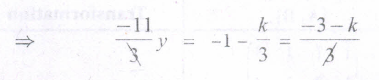
\(\Rightarrow \ -11y=-3-k\)
11y = 3 + k
\(\Rightarrow \quad y=\cfrac { 1 }{ 11 } \left( 3+k \right) \)
Substituting \(y=\cfrac { 1 }{ 11 } \left( 3+k \right) \) and z = k in (1) we get,
\(x+\cfrac { 26 }{ 3 } \left( \cfrac { 3+k }{ 11 } \right) +\cfrac { 2 }{ 3 } k=3\)
\(=\cfrac { 26 }{ 3 } \left( \cfrac { 3+k }{ 11 } \right) -\cfrac { 2k }{ 3 } +3\)
\(\cfrac { 78-26k }{ 33 } -\cfrac { 2k }{ 3 } +3\)
\(\cfrac { 78-26k-22k+99 }{ 33 } \)
\(\cfrac { 78-26k-22k+99 }{ 33 } \)
\(\cfrac { 21-48k }{ 33 } =\cfrac { 3(7-16k) }{ 33 } \)
= \(\cfrac { 1 }{ 11 } (7-6k)\)
\(\therefore\) Solution set is \(\left\{ \cfrac { 1 }{ 11 } \left( 7-16k \right), \cfrac { 1 }{ 11 } (3+k),k \right\} \)K \(\in\) R
Hence, for different values of k, we get infinitely many solutions.
17.
The matrix equation corresponding to the given system is
\(\left( \begin{matrix} 1 & 2 & -3 \\ 3 & -1 & -2 \\ 2 & 3 & -5 \end{matrix} \right) \left( \begin{matrix} X \\ Y \\ Z \end{matrix} \right) =\left( \begin{matrix} -2 \\ 1 \\ k \end{matrix} \right) \)
AX = B
| Augmented matrix [A,B] | Elementary Transformation |
| \(\left( \begin{matrix} 1 & 2 & -3 \\ 3 & -1 & -2 \\ 2 & 3 & -5 \end{matrix}\begin{matrix} -2 \\ 1 \\ k \end{matrix} \right) \) \(\sim \left( \begin{matrix} 1 & 2 & -3 \\ 0 & -7 & 7 \\ 0 & -1 & 1 \end{matrix}\begin{matrix} -2 \\ 7 \\ 4+k \end{matrix} \right) \) \(\sim \left( \begin{matrix} 1 & 2 & -3 \\ 0 & -7 & 7 \\ 0 & 0 & 0 \end{matrix}\begin{matrix} -2 \\ 7 \\ 21+7k \end{matrix} \right) \) |
\({ R }_{ 2 }\rightarrow { R }_{ 2 }-{ 3R }_{ 1 }\) \({ R }_{ 3 }\rightarrow { R }_{ 3 }-2{ R }_{ 1 }\) \({ R }_{ 3 }\rightarrow 7{ R }_{ 3 }-{ R }_{ 2 }\) |
| \(\rho (A)=2,\rho ([A,B])=2\quad or\quad 3\) |
For the equations to be consistent, \(\rho ([A,B])=\)\(\rho (A)=2\)
\(\therefore \) 21 + 7k = 0
7k = -21
k = -3
18.
The errors that arise due to human factors which always vary from one investigator to another in selecting, estimating or using measuring instruments are called Non-Sampling errors.
It may arise in the following ways:
a) Due to negligence and carelessness of the part of either investigator or respondents.
b) Due to lack of trained and qualified investigators.
c) Due to framing of a wrong questionnaire.
d) Due to applying wrong statistical measure.
e) Due to incomplete investigation and sample survey.
19.
\(\int _{ 0 }^{ 1 }{ [{ e }^{ a \log x }+{ e }^{ x \log a }] } dx=\int _{ 0 }^{ 1 }{ ({ x }^{ a }+{ a }^{ x }) } dx\)
\(={ \left[ \frac { { x }^{ a+1 } }{ a+1 } +\frac { { a }^{ x } }{ \log a } \right] }_{ 0 }^{ 1 }\)
\(=\left( \frac { 1 }{ a+1 } +\frac { a }{ \log a } \right) -\left( 0+\frac { 1 }{ \log a } \right) \)
\(=\frac { 1 }{ a+1 } +\frac { a }{ \log a } -\frac { 1 }{ \log a } \)
\(=\frac { 1 }{ a+1 } +\frac { (a-1) }{ \log a } \)
20.
Annual consumption at timet = 0 (In the year 2000) = p0 = 2547 metric ton.
Total production of Gold from 2000 to 2013 = \(\int _{ 0 }^{ 13 }{ 2547e^{ 0.006t } } dt\)
= \(\frac { 2547 }{ 0.006 } \left[ e^{ 0.006t } \right] _{ 0 }^{ 13 }\)
= 424500 (e0.078 −1)
= 34,426.95 metric tons approximately.

12th Standard Syllabus & Materials
12th Standard
TN 12th Computer Applications வலையமைப்பு வடமிடல் Sample Question Papers Study Material - QB365 Set A
NEW12th Standard
TN 12th Computer Applications களப்பெயர் முறைமை (DNS) Sample Question Papers Study Material - QB365 Set A
NEW12th Standard
TN 12th Computer Applications வலையமைப்பு எடுத்துக்காட்டுகள் மற்றும் நெறிமுறைகள் Sample Question Papers Study Material - QB365 Set A
NEW12th Standard
TN 12th Computer Applications கணினி வலையமைப்பு ஓர் அறிமுகம் Sample Question Papers Study Material - QB365 Set A



Tamilnadu Stateboard 12th Standard Subjects

Maths

Chemistry

Physics

Biology

Computer Science
Business Maths and Statistics

Economics

Commerce

Accountancy

History

Computer Applications
Biology
Computer Technology
Computer Applications
Computer Science
Business Maths and Statistics
Commerce
Economics
Maths
Chemistry
Physics
Computer Technology
History
Accountancy

Tamil

English

French
Tamilnadu Stateboard Standards
