
 100% FREE ACCESS
12th Standard Syllabus & Materials
12th Standard
TN 12th Computer Applications மின்னணு தரவு பரிமாற்றம் Sample Question Papers Study Material - QB365 Set A
NEW12th Standard
TN 12th Computer Applications மின் - வணிக பாதுகாப்பு அமைப்புகள் Sample Question Papers Study Material - QB365 Set A
NEW12th Standard
TN 12th Computer Applications மின்னணு செலுத்தல் முறைகள் Sample Question Papers Study Material - QB365 Set A
NEW12th Standard
TN 12th Computer Applications மின் - வணிகம் Sample Question Papers Study Material - QB365 Set A
NEW12th Standard
TN 12th Computer Applications திறந்த மூல கருத்துருக்கள் Sample Question Papers Study Material - QB365 Set A
NEW12th Standard
TN 12th Computer Applications வலையமைப்பு வடமிடல் Sample Question Papers Study Material - QB365 Set A

Published on: 20/01/2020
Download Tamil Nadu 12th Standard Business Maths and Statistics question papers, model tests, one-mark questions, important questions, and public exam papers in PDF format. Free study materials and answer keys for TN State Board students.
Questions + Answers key
Take MCQ Business Maths and Statistics Test
1.
A random sample of marks in mathematics secured by 50 students out of 200 students showed a mean of 75 and a standard deviation of 10. Find the 95% confidence limits for the estimate of their mean marks.
2.
Obtain K, μ and σ2 of of the normal distribution whose probability distribution function is f(x) = \(K{ e }^{ -2x^{ 2 }+4x-2 }\), -∞
3.
A player tosses two unbiased coins. He wins Rs. 5 if two heads appear, Rs. 2 if one head appear and Rs.1 if no head appear. Find the expected amount to win.
4.
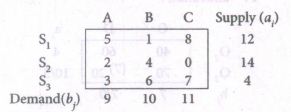
Find the initial basic feasible solution for the following transportation problem by Vogel's approximation method.
5.
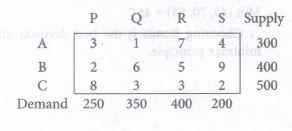
Determine an initial basic feasible solution to the following transportation problem using North West corner rule.
6.
If f' (x) = 3x2 - \(\frac { 2 }{ { x }^{ 3 } } \) and f(1) = 0, find f(x)
7.
Solve: (x2-yx2)dy + (y2+xy2)dx = 0
8.
Find y when x = 0.2 given that
| x | 0 | 1 | 2 | 3 | 4 |
| y | 176 | 185 | 194 | 202 | 212 |
9.
Find the area bounded by one arc of the curve y = sin ax and the x-axis.
10.
If \(A=\left( \begin{matrix} 2 & 4 \\ 4 & 3 \end{matrix} \right) ,X=\left( \begin{matrix} n \\ 1 \end{matrix} \right) B=\left( \begin{matrix} 8 \\ 11 \end{matrix} \right) \) and AX = B then find n.
11.
Show that the equations x + 2y = 3, y - z = 2, x + y + z = 1 are consistent and have infinite sets of solution.
12.
Find the rank of each of the following matrices.
\(\left( \begin{matrix} -1 & 2 & -2 \\ 4 & -3 & 4 \\ -2 & 4 & -4 \end{matrix} \right) \)
13.
Compute the consumer price index for 2015 on the basis of 2014 from the following data.
| Commodities | Quantities | Prices in 2015 | Prices in 2016 |
| A | 6 | 5.75 | 6.00 |
| B | 6 | 5.00 | 8.00 |
| C | 1 | 6.00 | 9.00 |
| D | 6 | 8.00 | 10.00 |
| E | 4 | 2.00 | 1.50 |
| F | 1 | 20.00 | 15.00 |
14.
Write a brief note on seasonal variations
15.
Using second fundamental theorem, evaluate the following:
\(\int _{ 1 }^{ e }{ \frac { dx }{ x(1{ +logx) }^{ 3 } } } \)
16.
Find the rank of the matrix A =\(\left( \begin{matrix} -2 & 1 & 3 \\ 0 & 1 & 1 \\ 1 & 3 & 4 \end{matrix}\begin{matrix} 4 \\ 2 \\ 7 \end{matrix} \right) \)
17.
A total of Rs. 8,600 was invested in two accounts. One account earned \(4\frac { 3 }{ 4 } %\)% annual interest and the other earned \(6\frac { 1 }{ 2 } %\)% annual interest. If the total interest for one year was Rs. 431.25, how much was invested in each account? (Use determinant method).
18.
Show that the equations x + y = 5, 2x + y = 8 are consistent and solve them.
19.
The demand and supply function of a commodity are pd = 18− 2x − x2 and ps = 2x − 3 . Find the consumer’s surplus and producer’s surplus at equilibrium price.
20.
If the probability of success is 0.09, how many trials are needed to have a probability of atleast one success as 1/3 or more ?
1.
Sample size n = 50
Sample mean \(\bar { x } \) = 75
Sample S.D. s = 10
Standard error (S.E) = \(\frac { s }{ \sqrt { n } } =\frac { 10 }{ \sqrt { 50 } } =\frac { 10 }{ 7.07 } \)
= 1.414
As the significance level is α = 0.005, \(Z_{ \frac { \alpha }{ 2 } }\) = 1.96
∴ 95% confidence limits for the population mean is \(\bar { X } -Z_{ \frac { \alpha }{ 2 } }(S.E)\le \bar { X } -Z_{ \frac { \alpha }{ 2 } }(S.E)\)
⇒ 75 - (1.96)(1.414) ≤ μ ≤ 75 + (1.96)(1.414)
⇒ 75-2.771 ≤ μ ≤ 75 + 2.771
⇒ 72.23 ≤ μ ≤ 77.77
Hence, the 95% confidence interval of the population mean is (72.23, 77.77)
2.
Consider -2x2 + 4x - 2 = -2(x2-2x+1)
= -2(x-1)2
∴ \({ e }^{ -2x^{ 2 }+4x-2 }=e^{ -2(x-1)^{ 2 } }\)
\({ e }^{ -\frac { 1 }{ 2 } \frac { (x-1)^{ 2 } }{ \frac { 1 }{ 4 } } }=e^{ -\frac { 1 }{ 2 } \left( \frac { x-1 }{ \frac { 1 }{ 2 } } \right) ^{ 2 } }\)
i.e \(K{ e }^{ -2x^{ 2 }+4x-2 }=\frac { 1 }{ \sigma \sqrt { 2\pi } } .e^{ -\frac { 1 }{ 2 } \left( \frac { x-\mu }{ \sigma } \right) }\)
⇒ \(Ke^{ -\frac { 1 }{ 2 } \left( \frac { x-1 }{ \frac { 1 }{ 2 } } \right) ^{ 2 } }=\frac { 1 }{ \sigma \sqrt { 2\pi } } .e^{ -\frac { 1 }{ 2 } \left( \frac { x-\mu }{ \sigma } \right) }\)
⇒ σ = \(\frac{1}{2}\), μ = 1 and K = \(\frac { 1 }{ \sigma \sqrt { 2\pi } } \)
⇒ K = \(\frac { 1 }{ \frac { 1 }{ 2 } .\sqrt { 2\pi } } \Rightarrow K=\sqrt { \frac { 2 }{ \pi } } \).
3.
When 2 coins are tossed, sample space S={HH, HT, TH, TT} ⇒ n(s) = 4
∴P(X = 5) = p(getting 2 heads) =\(\frac{1}{4}\)
P(X = 2) = p(getting 1 head) = \(\frac{2}{4}=\frac{1}{2}\)
P(X = 1) = p(getting no head) = \(\frac{1}{4}\)
Hence the probability distribution function is
| X | 1 | 2 | 5 |
| P(X=x) | \(\frac{1}{4}\) | \(\frac{1}{2}\) | \(\frac{1}{4}\) |
\(\therefore E(x)=\sum { { x }_{ i }{ p }_{ i }=1(\frac { 1 }{ 4 } ) } +2(\frac { 1 }{ 2 } )+5(\frac { 1 }{ 4 } )\)
\(=\frac { 1 }{ 4 } +1+\frac { 5 }{ 4 } =\frac { 1+4+5 }{ 4 } \)
\(=\frac { 10 }{ 4 } =2.50\)
Hence the expected money to win is Rs. 2.50
4.
Σai = 12 + 14 + 4 = 30
Σbj = 9 + 10 + 11 = 30
Σai = Σbj
∴ The given problem is a balanced transportation problem.
Hence, there exists a feasible solution to the given problem.
I - allocation :
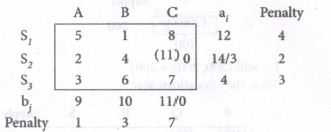
[∵ the highest penalty is 7, In C, least cost is 0 & min (11, 14) = 11]
II - allocation :
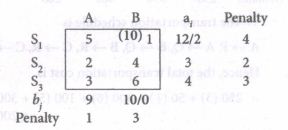
[∵ the highest penalty is 4, In S1'least cost is 1& min (10, 12) = 10]
III - allocation :
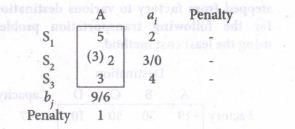
[∵ In A, least cost is 2 & min (9, 3) = 3]
IV - allocation :
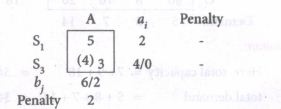
[∵ In A, least cost is 3 & min (6,4) = 4]
V - allocation :
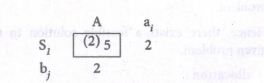
[∵ min (2, 2) = 2]
Thus, the allocations are
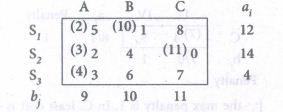
∴ The transportation schedule is
S1 → A, S1 → B, S2 → A, S2 → C S3 → A
Hence, the total transportation cost is
= 2(5) + 10(1) + 3(2) + 11(0) + 4(3)
= 10 + 10 + 6 + 0 + 12 = Rs. 38
5.
Here total supply = 300 + 400 + 500 = 1200
Total demand = 250 + 350 + 400 + 200 =1200
∴ Total supply = total demand
The given problem is a balanced transportation problem.
Hence, there exists a feasible solution to the given problem
I-allocation:
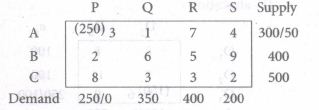
[∵ Min (250, 300) = 250]
II-allocation:
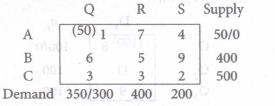
[∵ Min (50,350) = 50]
III-allocation:
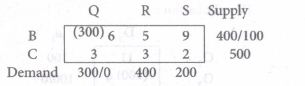
[∵ Min (300,400) = 300]
IV-allocation:
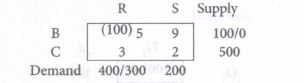
[∵ Min (400,100) = 100]
V-allocation:
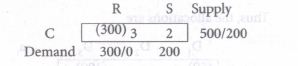
[∵ Min (300, 500) = 300]
VI-allocation:
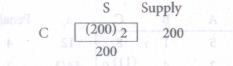
[∵ Min (200, 200) = 200]
Thus, the allocations are
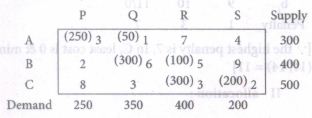
∴ The transportation schedule is
A → P, A → Q, B → Q, B → R, C → R, C → S
Hence, the total transportation cost is
= 250 (3) + 50 (1) + 300 (6) + 100 (5) + 300 (3) + 200 (2)
= 750 + 50 + 1800 + 500 + 900 + 400
= Rs. 4400
6.
Given
f' (x) = 3x2 - \(\frac { 2 }{ { x }^{ 3 } } \)
We know f(x) = ∫ f'(x) dx
= \(\int { \left( { 3x }^{ 2 }-\frac { 2 }{ { x }^{ 3 } } \right) } \)
\(f\left( x \right) =3\left( \frac { { x }^{ 3 } }{ 3 } \right) -2\left( \frac { { -x }^{ -2 } }{ -2 } \right) +c\)
\(f\left( x \right) ={ x }^{ 3 }+\frac { 1 }{ { x }^{ 2 } } +c....(1)\)
Also, f(1) = 0
\(0={ 1 }^{ 3 }+\frac { 1 }{ { 1 }^{ 2 } } +c\)
= 1 + 1 + c
c = -2
\(\therefore f\left( x \right) ={ x }^{ 3 }+\frac { 1 }{ { x }^{ 2 } } -2\)
7.
Given (x2-yx2)dy + (y2+xy2)dx = 0
⇒ x2(1-y)dy+y2(1+x)dx = 0
⇒ x2(1-y)dy = -y2(1+x)dx
Separating the variables we get,
\(\frac { (1-y) }{ y^{ 2 } } dy=-\frac { (1+x) }{ x^{ 2 } } \)dx
⇒ \(\frac { 1 }{ { y }^{ 2 } } dy-\frac { 1 }{ y } dy=-\frac { 1 }{ x^{ 2 } } dx-\frac { 1 }{ x } dx\)
Integrating, \(\int { { y }^{ -2 } } dy-\int { \frac { 1 }{ y } } dy=-\int { \frac { 1 }{ x^{ 2 } } } dx-\int { \frac { 1 }{ x } } \)
\(-\frac { 1 }{ y } -logy=\frac { 1 }{ x } \) -log x + C
⇒ log x - log y = \(\frac { 1 }{ x } +\frac { 1 }{ y } \)+C
⇒ log \(log\left( \frac { x }{ y } \right) =\frac { x+y }{ xy } \)+C
⇒ \(\frac { x }{ y } =e^{ \frac { x+y }{ xy } +C }\)
⇒ \(\frac { x }{ y } =K.e^{ \frac { x+y }{ xy } }\) [where eC = K]
8.
Since x = 0.2 lies at the beginning of the table, use Newton's foward interpolation formula
\(\Rightarrow { y }_{ o }+\frac { n }{ n! } \triangle { y }_{ o }+\frac { n(n+1) }{ 2! } { \triangle }^{ 2 }{ y }_{ o }+\frac { n(n+1)(n-2) }{ 3! } { \triangle }^{ 3 }{ (y }_{ o })\)
Here h = 1, xo = 0, x = 0.2
⇒ x0 + nh = 0.2 ⇒ 0 + n(1) = 0.2 ⇒ n = 0.2
The forward difference table is
| x | y | Δy | ∆2y | Δ3y | Δ4y |
| 0 | 176 | ||||
| 1 | 185 | 9 | |||
| 2 | 194 | 9 | 0 | ||
| 3 | 202 | 8 | -1 | -1 | |
| 4 | 212 | 10 | 2 | 3 | 4 |
∴ y = 176 +\(\frac { 0.2 }{ 1! } (9)+\frac { (0.2)(0.2-1) }{ 2! } (0)+\frac { (0.2)(0.2-1)(0.2-2) }{ 3! } (-1)+\frac { (0.2)(0.2-1)(0.2-2)(0.3-3) }{ 4! } (4)\)
= 176 + 1.8 - 0.048 - 0.1344 = 177.6176
ஃ Hence when x = 0.2, y = 177.6176.
9.
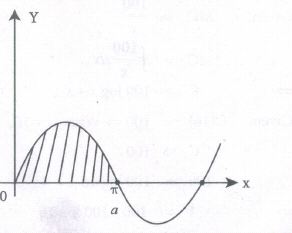
The limits for one arch of the curve y = sin ax When y = 0 ⇒Sin ax = 0
⇒ sin ax = sin 0, sin \(\pi\)
⇒ ax = 0 or ax = \(\pi\)
⇒ x = 0, x = \(\frac{\pi}{a}\)
∴ The limits are from x = 0 to x = \(\frac{\pi}{a}\)
∴ Area =\(\int _{ a }^{ b }{ ydx } \)
\(=\int _{ 0 }^{ a }{ sin\quad ax\quad dx } \)
\(={ \left[ -\frac { cos\quad ax }{ a } \right] }_{ 0 }^{ \frac { \pi }{ a } }\)
\(=-\frac { 1 }{ a } \left[ cos\quad a\times \frac { \pi }{ a } -cos(a)(0) \right] \)
\(=-\frac { 1 }{ a } \left[ cos\quad \pi -cos0 \right] \)
\(=-\frac { 1 }{ a } (-1-1)[\because cos0=1\ cos\pi =-1]\)
\(A=\frac { 2 }{ a } \) sq.units.
10.
GivenAX B
\(\left( \begin{matrix} 2 & 4 \\ 4 & 3 \end{matrix} \right) ,\left( \begin{matrix} n \\ 1 \end{matrix} \right) \left( \begin{matrix} 8 \\ 11 \end{matrix} \right) \)
\(\Rightarrow \left( \begin{matrix} 2n+4 \\ 4n+3 \end{matrix} \right) =\left( \begin{matrix} 8 \\ 11 \end{matrix} \right) \)
Equating the corresponding entries on both sides, we get
2n +4 = 8
2n = 8-4
2n=4
\(n=\cfrac { 4 }{ 2 } \)
2 = 2
11.
Given non-homogeneous equations are
x + 2y = 3,y - z = 2,x + Y + z = 1
| Augmented matrix [A, B] |
Elementary Transformation |
|---|---|
| \(\left( \begin{matrix} 1 & 2 & 0 \\ 0 & 1 & -1 \\ 1 & 1 & 1 \end{matrix}\begin{matrix} 3 \\ 2 \\ 1 \end{matrix} \right) \) | |
| \(\sim \left( \begin{matrix} 1 & 2 & 0 \\ 0 & 1 & -1 \\ 0 & -1 & 1 \end{matrix}\begin{matrix} 3 \\ 2 \\ -2 \end{matrix} \right) \) | \({ R }_{ 3 }\rightarrow { R }_{ 3 }+{ R }_{ 2 }\) |
| \(\sim \left( \begin{matrix} 1 & 2 & 0 \\ 0 & 1 & -1 \\ 0 & 0 & 0 \end{matrix}\begin{matrix} 3 \\ 2 \\ 0 \end{matrix} \right) \) | \({ R }_{ 3 }\rightarrow { R }_{ 3 }+{ R }_{ 2 }\) |
Obviously,\(\rho (A)=2\) and \(\rho (A,B)\)
Hence \(\rho (A)=2\quad \rho\) (A, B) = 2
\(\therefore\) The system is consistent and has infinite number of solutions.
12.
Let A = \(\left( \begin{matrix} -1 & 2 & -2 \\ 4 & -3 & 4 \\ -2 & 4 & -4 \end{matrix} \right) \)
The order of A is 3 x 3
\(\therefore \rho (A)\le 3\) [Since minimum of (3,3) is 3]
Let us transform the matrix to an echelon form
| Matrix A | Elementary Transformation |
|---|---|
| \(A=\left( \begin{matrix} -1 & 2 & -2 \\ 4 & -3 & 4 \\ -2 & 4 & -4 \end{matrix} \right) \) | |
| \(\sim \left( \begin{matrix} 1 & -2 & 2 \\ 4 & -3 & 4 \\ -4 & 4 & -4 \end{matrix} \right) \) | \(R_{ 1 }\rightarrow { R }_{ 1 }\left( -1 \right) \) |
| \(\sim \left( \begin{matrix} 1 & -2 & 2 \\ 0 & 5 & -4 \\ -2 & 4 & -4 \end{matrix} \right) \) | \({ R }_{ 2 }\rightarrow { R }_{ 2 }-4{ R }_{ 1 }\) |
| \(\sim \left( \begin{matrix} 1 & -2 & 2 \\ 0 & 5 & -4 \\ 0 & 0 & 0 \end{matrix} \right) \) | \({ R }_{ 3 }\rightarrow { R }_{ 32 }+2R_{ 1 }\) |
The matrix is in echelon form and the number of non-zero rows is 2.
\(\therefore \rho (A)=2\)
13.
| Commodities | Quantities (q0) | p0 | p1 | p1q0 | p0q0 |
| A | 6 | 5.75 | 6.00 | 36 | 34.5 |
| B | 6 | 5.00 | 8.00 | 48 | 30 |
| C | 1 | 6:00 | 9:00 | 9 | 6 |
| D | 6 | 8:00 | 10:00 | 60 | 48 |
| E | 4 | 2:00 | 1:50 | 6 | 8 |
| F | 1 | 20:00 | 15:00 | 15 | 20 |
| 24 | 174 | 146.5 |
Cost of living index number = \({ \frac {\sum p_{1}q_{0}}{\sum p_{0}q_{0}}} \times100\)
C.L.I = \(\frac {174}{146.5} \times 100\) = 118.77
14.
Tendency movements are due to nature, which repeat themselves periodically in every seasons. These variations repeat themselves in less than one year time. It is measured in an interval of time.
Seasonal variations may be influenced by natural force, social customs and traditions.
15.
Let I = \(\int _{ 1 }^{ e }{ \frac { dx }{ x{ \left( 1+\log { x } \right) }^{ 3 } } } \)
Let t = 1+log x
\(\Rightarrow dt=\frac { 1 }{ x } dx\)
When x = 1, t = 1 + log 1 = 1 + 0 = 1
When x = e, t =1 + log e = 1 + 1 = 2
\(\therefore I=\int _{ 1 }^{ 2 }{ \frac { dt }{ { t }^{ 3 } } } =\int _{ 1 }^{ 2 }{ { t }^{ -3 } } dt\)
\(={ { \left[ \frac { { t }^{ -3+1 } }{ -3+1 } \right] }_{ 1 } }^{ 2 }\)
\(={ { \left[ \frac { { t }^{ -2 } }{ -2 } \right] }_{ 1 } }^{ 2 }={ { \left[ -\frac { 1 }{ { 2t }^{ 2 } } \right] }_{ 1 } }^{ 2 }\)
\(=-\frac { 1 }{ 2 } \left[ \frac { 1 }{ { 2 }^{ 2 } } -\frac { 1 }{ { 1 }^{ 2 } } \right] \)
\(=-\frac { 1 }{ 2 } \left[ \frac { 1 }{ 4 } -1 \right] =-\frac { 1 }{ 2 } \left( \frac { -3 }{ 4 } \right) =\frac { 3 }{ 8 } \)
16.
Given A =\(\left( \begin{matrix} -2 & 1 & 3 \\ 0 & 1 & 1 \\ 1 & 3 & 4 \end{matrix}\begin{matrix} 4 \\ 2 \\ 7 \end{matrix} \right) \)
\(\sim \left( \begin{matrix} 1 & 3 & 4 \\ 0 & 1 & 1 \\ -2 & 1 & 3 \end{matrix}\begin{matrix} 7 \\ 2 \\ 4 \end{matrix} \right) { R }_{ 1 }\rightarrow { R }_{ 3 }\)
\(\sim \left( \begin{matrix} 1 & 3 & 4 \\ 0 & 1 & 1 \\ 0 & 7 & 11 \end{matrix}\begin{matrix} 7 \\ 2 \\ 18 \end{matrix} \right) { R }_{ 2 }\rightarrow { { R_{ 2 }+2{ R }_{ 1 } } }\)
\(\sim \left( \begin{matrix} 1 & 3 & 4 \\ 0 & 1 & 1 \\ 0 & 0 & 4 \end{matrix}\begin{matrix} 7 \\ 2 \\ 4 \end{matrix} \right) { R }_{ 3 }\rightarrow { R_{ 3 }-{ 7R }_{ 2 } }\)
The last equivalent matrix is in echelon form and there are 3 non - zero rows.
\(\therefore \rho (A)=3\)
17.
Let the amount invested in the two accounts be Rs. x and Rs. y respectively
By the given data, x + y = 8600 ..(1)
\(4\cfrac { 3 }{ 4 } \times \cfrac { x }{ 100 } +6\cfrac { 1 }{ 2 } \times \cfrac { y }{ 100 } =431.25\) \(\left[ \therefore interest=\cfrac { PNR }{ 100 } \right] \)
\(\Rightarrow \cfrac { 19x }{ 400 } +\cfrac { 13y }{ 3200 } =431.25\)
\(\Rightarrow \cfrac { 19x+26y }{ 400 } =431.25\)
19x + 26y = 172500 ...(2)
\(\Delta =\left| \begin{matrix} 1 & 1 \\ 19 & 26 \end{matrix} \right| =1(26)-1(19)\)
= 26-19 =7
\({ \Delta }x=\left| \begin{matrix} 8600 & 1 \\ 172500 & 26 \end{matrix} \right| =8600(26)-1(172500)\)
= 223600 - 172500 = 51100
\(\Delta y=\left| \begin{matrix} 1 & 8600 \\ 19 & 172500 \end{matrix} \right| =1(172500)-19(8600)\)
= 172500 - 163400 = 9100
\(x=\cfrac { \Delta x }{ \Delta } -\cfrac { 51100 }{ 7 } =7300\)
\(y=\cfrac { \Delta y }{ \Delta } =\cfrac { 9100 }{ 7 } =1300\)
\(\therefore\) Investment in the interest of \(4\frac { 3 }{ 4 } \) % account is Rs. 7300 and investment in the rate of \(6\frac { 1 }{ 2 } \) account is Rs.1300.
18.
The matrix equation corresponding to the given system is
\(\begin{pmatrix} 1 & 1 \\ 2 & 1 \end{pmatrix}\left( \begin{matrix} x \\ y \end{matrix} \right) =\left( \begin{matrix} 5 \\ 8 \end{matrix} \right) \)
A X = B
| Matrix A | Augmented matrix [A,B] | Elementary Transformation |
| \(\begin{pmatrix} 1 & 1 \\ 2 & 1 \end{pmatrix}\) \(\sim \begin{pmatrix} 1 & 1 \\ 0 & -1 \end{pmatrix}\) |
\(\left( \begin{matrix} 1 & 1 & 5 \\ 2 & 1 & 8 \end{matrix} \right) \) \(\sim \left( \begin{matrix} 1 & 1 & 5 \\ 0 & -1 & -2 \end{matrix} \right) \) |
\({ R }_{ 2 }\rightarrow { R }_{ 2 }-{ 2R }_{ 1 }\) |
| \(\rho (A)=2\) | \(\rho ([A,B])=2\) |
Number of non-zero rows is 2.
\(\rho (A)=\rho ([A,B])=2=\) Number of unknowns.
The given system is consistent and has unique solution.
Now, the given system is transformed into
\(\left( \begin{matrix} 0 & 1 \\ 0 & -1 \end{matrix} \right) \left( \begin{matrix} x \\ y \end{matrix} \right) =\left( \begin{matrix} 5 \\ -2 \end{matrix} \right) \)
x + y = 5
y = 2
\(\therefore (1)\Rightarrow x+2=5\)
x = 3
Solution is x = 3, y = 2
19.
Given Pd = 18− 2x − x2 ; Ps = 2x − 3
We know that at equilibrium prices pd = ps
18− 2x − x2 = 2x – 3
x2 + 4x −21 = 0
(x − 3) (x + 7) = 0
x = –7 or 3
The value of x cannot be negative, x = 3
When x0 = 3
ஃ p0 = 18 − 2(3) − (3)2 = 3
CS = \(\int _{ 0 }^{ { x }_{ o } }{ f(x) } \) dx - x0p0
= \(\int _{ 0 }^{ 3 }{ (18-2x-{ x }^{ 2 }) } \)dx - 3 x 3
= \({ \left[ 18x-{ x }^{ 2 }-\frac { { x }^{ 3 } }{ 3 } \right] }_{ 0 }^{ 3 }\)- 9
= 18(3) - (3)2 - \(\left( \frac { { 3 }^{ 3 } }{ 3 } \right) \) - 9
CS = 27 units
PS = x0P0 - \(\int _{ 0 }^{ { x }_{ o } }{ g(x) } \)
= (3 \(\times\) 3) - \(\int _{ 0 }^{ 3 }{ (2x-3) } \)
= 9 - \(({ { { x }^{ 2 }-3x) } }_{ 0 }^{ 3 }\)
= 9 units
Hence at equilibrium price,
(i) the consumer’s surplus is 27 units
(ii) the producer’s surplus is 9 units.
20.
Given probability of success p = 0.09
∴ q = 1 - p = 1 - 0.09 = 0.91
n = 1
Also P(atleast one success) = \(\frac { 1 }{ 3 } \) or more
∴ P(X≥1) = \(\frac { 1 }{ 3 } \)
⇒ 1-P(X < 1) = \(\frac { 1 }{ 3 } \)
⇒ P(X<1) =\(1-\frac { 1 }{ 3 } =\frac { 2 }{ 3 } \)
⇒ P(X = 0) =\(\frac { 2 }{ 3 } \)
⇒ nCx pxqn-x = \(\frac { 2 }{ 3 } \)
Putting x = 0,
nC0 (0.09)0 (0.91)n-0 = \(\frac { 2 }{ 3 } \)
⇒ (0.91)n = \(\frac { 2 }{ 3 } \) =0.6666
when (0.91) is Jultiplied 5 times we are getting 0.6240
∴ n = 5 or more
Here number of trails are 5 or more.

12th Standard Syllabus & Materials
12th Standard
TN 12th Computer Applications களப்பெயர் முறைமை (DNS) Sample Question Papers Study Material - QB365 Set A
NEW12th Standard
TN 12th Computer Applications வலையமைப்பு எடுத்துக்காட்டுகள் மற்றும் நெறிமுறைகள் Sample Question Papers Study Material - QB365 Set A
NEW12th Standard
TN 12th Computer Applications கணினி வலையமைப்பு ஓர் அறிமுகம் Sample Question Papers Study Material - QB365 Set A
NEW12th Standard
TN 12th Computer Applications PHP-உடன் MySQL-ஐ இணைத்தல் Sample Question Papers Study Material - QB365 Set A



Tamilnadu Stateboard 12th Standard Subjects

Maths

Chemistry

Physics

Biology

Computer Science
Business Maths and Statistics

Economics

Commerce

Accountancy

History

Computer Applications
Biology
Computer Technology
Computer Applications
Computer Science
Business Maths and Statistics
Commerce
Economics
Maths
Chemistry
Physics
Computer Technology
History
Accountancy

Tamil

English

French
Tamilnadu Stateboard Standards
