
 100% FREE ACCESS
12th Standard Syllabus & Materials
12th Standard
TN 12th Computer Applications மின்னணு தரவு பரிமாற்றம் Sample Question Papers Study Material - QB365 Set A
NEW12th Standard
TN 12th Computer Applications மின் - வணிக பாதுகாப்பு அமைப்புகள் Sample Question Papers Study Material - QB365 Set A
NEW12th Standard
TN 12th Computer Applications மின்னணு செலுத்தல் முறைகள் Sample Question Papers Study Material - QB365 Set A
NEW12th Standard
TN 12th Computer Applications மின் - வணிகம் Sample Question Papers Study Material - QB365 Set A
NEW12th Standard
TN 12th Computer Applications திறந்த மூல கருத்துருக்கள் Sample Question Papers Study Material - QB365 Set A
NEW12th Standard
TN 12th Computer Applications வலையமைப்பு வடமிடல் Sample Question Papers Study Material - QB365 Set A

Published on: 20/01/2020
Download Tamil Nadu 12th Standard Business Maths and Statistics question papers, model tests, one-mark questions, important questions, and public exam papers in PDF format. Free study materials and answer keys for TN State Board students.
Questions + Answers key
Take MCQ Business Maths and Statistics Test
1.
Evaluate the following integrals:
ഽ\(\frac { dx }{ { e }^{ x }+6+{ 5e }^{ -x } } \)
2.
Mention the properties of binomial distribution.
3.
Evaluate \(\int { \frac { 1 }{ \sqrt { x+2 } -\sqrt { x-2 } } } dx\)
4.
Show that the equations 3x − 2y = 6, 6x − 4y = 10 are inconsistent
5.
Calculate the seasonal indices by the method of simple average for the following data.
| Year | I quarter | II quarter | III quarter | IV quarter |
| 1985 | 68 | 62 | 61 | 63 |
| 1986 | 65 | 58 | 66 | 61 |
| 1987 | 68 | 63 | 63 | 67 |
6.
In an entrance examination a student has to answer all the 120 questions. Each question has four options and only one option is correct. A student gets 1 mark for a correct answer and loses \(\frac{1}{2}\) mark for a wrong answer. What is the expectation of the mark scored by a student if he chooses the answer to each question at random?
7.
Determine whether the following is a probability distribution of a random variable X.
| X | 0 | 1 | 2 |
| P(X) | 0.6 | 0.1 | 0.2 |
8.
For the given pay-off matrix, find the optimal decision under the minimax principle.
9.
If f'(x) = 8x3 -2x2, f(2) = 1, find f(x)
10.
Solve: 3\(\frac { { d }^{ 2 }y }{ dx^{ 2 } } -5\frac { dy }{ dx } \)+ 2y = 0
11.
Write down the order and degree of the following differential equations.
\(\left( \frac { dy }{ dx } \right) ^{ 2 }-7\frac { d^{ 3 }y }{ { dx }^{ 3 } } +y\frac { { d }^{ 2 }y }{ dx^{ 2 } } +4\frac { dy }{ dx } \)- log x = 0
12.
The marginal cost function of manufacturing x units of a commodity is 3x2 - 2x + 8. If there is no fixed cost, find the total cost function?
13.
Show that the equations x + y + z = 6, x + 2y + 3z = 14 and x + 4y + 7z = 30 are consistent
14.
Find the differential equation of the following
xy = c2
15.
What is the Assignment problem?
16.
What do you mean by process control?
17.
Write note on Fisher’s price index number.
18.
What is an estimator?
19.
Evaluate \(\int _{ \frac { \pi }{ 6 } }^{ \frac { \pi }{ 3 } }{ \sin x } \) dx
20.
What do you understand by Mathematical expectation?
21.
Define random variable.
22.
Using Integration, find the area of the region bounded the line 2y + x = 8, the x axis and the lines x = 2, x = 4.
23.
Evaluate ∫(2sin x − 5cos x)dx
24.
Using Lagrange’s interpolation formula find a polynomial which passes through the points (0, –12), (1, 0), (3, 6) and (4,12).
25.
The average score on a nationally administered aptitude test was 76 and the corresponding standard deviation was 8. In order to evaluate a state’s education system, the scores of 100 of the state’s students were randomly selected. These students had an average score of 72. Test at a significance level of 0.05 if there is a significant difference between the state scores and the national scores.
1.
\(I=\int { \cfrac { dx }{ { e }^{ x }+6+\frac { 5 }{ { e }^{ x } } } } \)
= \(\int { \cfrac { { e }^{ x }dx }{ { e }^{ 2x }+6{ e }^{ x }+5 } } \)
Put \({ e }^{ x }=t\Rightarrow { e }^{ x }dx=dt\)
\(\Rightarrow I=\int { \cfrac { dt }{ { t }^{ 2 }+6t+5 } } \)
\(I=\int { \cfrac { dt }{ \left( t+5 \right) \left( t+1 \right) } } \)
= \(\int { \cfrac { A }{ t+5 } dt+\int { \cfrac { B }{ t+1 } dt } } \)
\(\cfrac { 1 }{ \left( t+5 \right) \left( t+1 \right) } =\cfrac { A }{ t+5 } +\cfrac { B }{ t+1 } \)
\(\Rightarrow I=A(t+1)+b(t+5)\)
Put t = - 1
\(\Rightarrow 1=B(-1+5)\)
\(\Rightarrow 1=B(4)\)
\(\Rightarrow B=\cfrac { 1 }{ 4 } \)
Put t = - 5
\(\Rightarrow 1=A(-5+1)\)
I=A(-4)
\(\Rightarrow A=-\cfrac { 1 }{ 4 } \)
From (1),\(I=\int { \cfrac { -\frac { 1 }{ 4 } dt }{ t+5 } } +\int { \cfrac { \frac { 1 }{ 4 } dt }{ t+1 } } \)
= \(-\cfrac { 1 }{ 4 } \log\left| t+5 \right| +\cfrac { 1 }{ 4 } \log|t+1|+c\)
= \(\cfrac { 1 }{ 4 } \left[ \log|t+1|-\log t+5| \right] +c\)
= \(\cfrac { 1 }{ 4 } \log\left| \cfrac { t+1 }{ t+5 } \right| +c\)
= \(\cfrac { 1 }{ 4 } \log\left| \cfrac { { e }^{ x }+1 }{ { e }^{ x }+5 } \right| +c\)
\(\left[ \because t={ e }^{ x } \right] \)
2.
(i) Binomial distribution is symmetrical if p = q = 0.5. It is skew symmetric if p≠q. It is positively skewed if p < 0.5 and it is negatively skewed if p > 0.5.
(ii) For binomial distribution, variance is less than mean.
Variance = npq = (np)q < np < mean.
3.
\(\int { \frac { 1 }{ \sqrt { x+2 } -\sqrt { x-2 } } } dx\)
=\(\int { \frac { \sqrt { x+2 } +\sqrt { x-2 } }{ 4 } } dx\)
\(=\frac { 1 }{ 6 } \left\{ { \left( x+2 \right) }^{ \frac { 3 }{ 2 } }+{ \left( x-2 \right) }^{ \frac { 3 }{ 2 } } \right\} +c\)
| By rationalisation, \(\frac { 1 }{ \sqrt { x+2 } -\sqrt { x-2 } } =\frac { 1 }{ \sqrt { x+2 } -\sqrt { x-2 } } \times \frac { \sqrt { x+2 } -\sqrt { x-2 } }{ \sqrt { x+2 } -\sqrt { x-2 } } =\frac { \sqrt { x+2 } -\sqrt { x-2 } }{ 4 } \) |
4.
The matrix equation corresponding to the given system is
\(\left( \begin{matrix} 3 & -2 \\ 6 & -4 \end{matrix} \right) \left( \begin{matrix} x \\ y \end{matrix} \right) =\left( \begin{matrix} 6 \\ 10 \end{matrix} \right) \)
AX = B
| Matrix A | Augmented matrix [A,B] | Elementary Transformation |
| \(\left( \begin{matrix} 3 & -2 \\ 6 & -4 \end{matrix} \right) \) \(\sim \left( \begin{matrix} 3 & -2 \\ 0 & 0 \end{matrix} \right) \) |
\(\left( \begin{matrix} 3 & -2 & 6 \\ 6 & -4 & 10 \end{matrix} \right) \) \(\sim \left( \begin{matrix} 3 & -2 & 6 \\ 0 & 0 & -2 \end{matrix} \right) \) |
\({ R }_{ 2 }\rightarrow { R }_{ 2 }-{ 2R }_{ 1 }\) |
| \(\rho (A)=1\) | \(\rho ([A,B])=2\) |
\(\therefore \)\(\rho ([A,B])=2\), \(\rho (A)=1\)
\(\rho (A)\neq \rho \left( [A,B] \right) \)
\(\therefore \) The given system is inconsistent and has no solution.
5.
| Year | I quarter | II quarter | III quarter | IV quarter |
| 1985 | 68 | 62 | 61 | 63 |
| 1986 | 65 | 58 | 66 | 61 |
| 1987 | 68 | 63 | 63 | 67 |
| Total | 201 | 183 | 190 | 191 |
| Average | 67 | 61 | 63.33 | 63.67 |
Grand average = \(\frac{67 + 61 + 63.33 + 63.37}{4}\)
= \(\frac{255}{4}=63.75\)
Seasonal index (S.I) = \(\frac{Quarterly average}{Grand average}\times100\)
Hence, S.I for I quarter = \(\frac{67}{63.75}\times100\) = 105.01
S.I for II quarter = \(\frac{61}{63.75}\times100\) = 95.68
S.I for III quarter = \(\frac{63.33}{63.75}\times100\) = 99.35
S.I for IV quarter = \(\frac{63.67}{63.75}\times100\) = 99.87
6.
Let X be a random variable. That denote the mark obtained by a student for answering a question.
∴ X can take values 1 and -\(\frac{1}{2}\)
∴ P(X = 1) = P (answering a question correctly)
= \(\frac{1}{4}\)
P(X = -\(\frac{1}{2}\)) = P(answering a question wrongly)
=\(1-\frac{1}{4}=\frac{3}{4}\)
∴ Probability distribution function is
| X | 1 | -\(\frac{1}{2}\) |
| P(X) | \(\frac{1}{4}\) | \(\frac{3}{4}\) |
\(\therefore E(x)=\sum { xp(x)=1(\frac { 1 }{ 4 } )-\frac { 1 }{ 2 } \left( \frac { 3 }{ 4 } \right) =\frac { 1 }{ 4 } -\frac { 3 }{ 8 } } \)
\(=\frac { 2-3 }{ 8 } =-\frac { 1 }{ 8 } \)
∴ Expectation of mark for answering a single question is -\(\frac{1}{8}\)
∴ Expectation of mark for answering 120 questions = 120(-\(\frac{1}{8}\)) = -15.
7.
P(X = 0) + P(X = 1) + P(X = 2)
= 0.6 + 0.1 + 0.2 = 0.9 ≠ 1
Hence the given distribution of probabilities is not a probability distribution.
8.
| Alternative | Economy | Maximum | ||
| Growing | Stable | Declining | ||
| Bonds | 40 | 45 | 5 | 45 |
| Stocks | 70 | 30 | -13 | 70 |
| Mutual Funds | 53 | 45 | -5 | 53 |
Min (45, 70, 53) = 45
∴ Choosing Bonds is the best decision under minimax principle.
9.
Given f'(x) = 8x3 -2x2
∴ ∫ f'(x) dx = ∫ (8x3 - 2x2) dx
⇒ f(x) = \(\frac { { 8x }^{ 4 } }{ 4 } -\frac { { { 2x }^{ 3 } } }{ 3 } +c\)
⇒ f (x) = 2x4 - \(\frac { { { 2x }^{ 3 } } }{ 3 } +c\) ...(1)
Also, f(2) = 1
⇒ 1 = 2(24) - \(\frac { { 2\left( { { 2 }^{ 3 } } \right) } }{ 3 } +c\)
⇒ 1 = 32 - \(\frac { { 16 } }{ 3 } +c\)
⇒ 1 - 32 + \(\frac { { 16 } }{ 3 } \) = c ⇒ -31 + \(\frac { { 16 } }{ 3 } \) =c
⇒ \(\frac { { -93+16 } }{ 3 } =c\)
⇒ c = \(\frac { { -77 } }{ 3 } \)
∴ (1) ⟶ f(x) = 2x4 - \(\frac { { 2x }^{ 3 } }{ 3 } -\frac { { -77 } }{ 3 } \)
10.
The auxiliary equation is 3m2 - 5m + 2 = 0
⇒ (m - 1)(3m - 2) = 0
⇒ m = 1, \(\frac { 2 }{ 3 } \)
The roots are real and different
∴ Complementary function CF is Aex + \({ Be }^{ \frac { 2 }{ 3 } x }\)
∴ The general solution is y = Aex + \({ Be }^{ \frac { 2 }{ 3 } x }\).
11.
The highest derivative if of order 3 and its power is 1
∴ order is 3 and degree is 1.
12.
Given MC = 3x2 - 2x + 8
⇒ ഽMC = ഽ(3x2 - 2x + 8)dx
\(\Rightarrow C=\frac { { 3x }^{ 3 } }{ 3 } -\frac { { 2x }^{ 2 } }{ 2 } +8x+k\)
⇒ C = x3 - x2 + 8x + k
Since there is no fixed cost,
when x = 0, C = 0 ⇒ k = 0
∴ C = x3 - x2 + 8x
13.
Given non-homogeneous equations are x + y + z = 6, x + 2y + 3z = 14, x + 4y + 7z = 30
| Augmented matrix | Elementary Transformation |
|---|---|
| \(\left( \begin{matrix} 1 & 2 & \begin{matrix} 1 & 6 \end{matrix} \\ 1 & 2 & \begin{matrix} 3 & 14 \end{matrix} \\ 1 & 4 & \begin{matrix} 7 & 30 \end{matrix} \end{matrix} \right) \) | |
| \(\left( \begin{matrix} 1 & 1 & 1 \\ 0 & 1 & 2 \\ 0 & 3 & 6 \end{matrix}\begin{matrix} 6 \\ 8 \\ 24 \end{matrix} \right) \) | \({ R }_{ 2 }\rightarrow { R }_{ 2 }-{ R }_{ 1 }\) \({ R }_{ 3 }\rightarrow { R }_{ 3 }-{ R }_{ 1 }\) |
| \(-\left( \begin{matrix} 1 & 1 & 1 \\ 0 & 1 & 2 \\ 0 & 0 & 0 \end{matrix}\begin{matrix} 6 \\ 8 \\ 0 \end{matrix} \right) \) | \({ R }_{ 3 }\rightarrow { R }_{ 3 }-{ R }_{ 1 }\) |
Here \(\rho (A)=\rho (A,B) = 2\)
\(\therefore\) The given system is consistent
14.
Differentiating w.r.t 'x' we get,
x.\(\frac { dy }{ dx } \) + y(1) = 0 [Product rule]
⇒ x\(\frac { dy }{ dx } \) + y = 0 which is the required differentiated equation.
15.
To assign the different jobs to the different machines (one job per machine) to minimize the overall cost is known as assignment problem.
16.
The main objective in any product process is to control and maintain a satisfactory quality level of the manufactured product. This is done by Process Control. In process control the proportion of defective items in the production process is to be minimized and it is achieved through the technique of control charts.
17.
Fisher's price index number is the geometric mean of Laspeyre's and Paasche's price index number. Hence it is weighted index number.
Fisher's price index number = \(\sqrt {\frac {\sum p_{1}q_{0}}{\sum p_{0}q_{0} }}{\times}{\frac {\sum p_{1}q_{1}}{\sum p_{0}q_{1}} \times {100}}\)
18.
Any sample statistic which is used to estimate an unknown population parameter is called an estimator (i.e.,). an estimator is a sample statistic used to estimate a population parameter.
19.
\(\int _{ \frac { \pi }{ 6 } }^{ \frac { \pi }{ 3 } }{ \sin x } dx={ \left[ -\cos x \right] }_{ \frac { \pi }{ 6 } }^{ \frac { \pi }{ 3 } }\)
\(=-\left( \cos\frac { \pi }{ 3 } -\cos\frac { \pi }{ 6 } \right) \)
\(=\frac { 1 }{ 2 } (\sqrt { 3 } -1)\)
20.
Mathematical expectation E(X) is an average of the values, that the random variable takes on, where each value is weighted by the probability that the random variable is equal to that value. Values that are most probable receive more weight. Each value x is multiplied by the approximate probability that X equals the valuex.
21.
A random variable is a real valued function defined on a sample space S and taking values in (-∞, ∞) or whose possible values are numerical outcomes of a random experiment.
22.
2y + x = 8
| x | 0 | 8 |
| y | 4 | 0 |
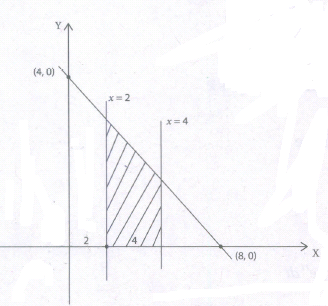
Given 2y + x = 8
2y = 8-x
y = \(\frac{1}{2}\) (8-x)
Given limits are x = 2 and x = 4
Area of the shaded region between the given limits
\(A=\int _{ a }^{ b }{ y\quad dx } =\int _{ 2 }^{ 4 }{ \frac { 1 }{ 2 } (8-x)dx } \)
\(\frac { 1 }{ 2 } \int _{ 2 }^{ 4 }{ (8-x)dx } =\frac { 1 }{ 2 } { \left[ 8x-\frac { { x }^{ 2 } }{ x } \right] }_{ 2 }^{ 4 }\)
\(=\frac { 1 }{ 2 } \left[ \left( 8(4)-\frac { { 4 }^{ 2 } }{ 2 } \right) \left( 8(2)-\frac { { 2 }^{ 2 } }{ 2 } \right) \right] \)
\(=\frac { 1 }{ 2 } [(32-8)-(16-21)]\)
\(=\frac { 1 }{ 2 } [24-14]\)
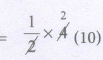
A = 5 sq. units.
23.
∫(2sin x − 5cos x )dx = 2∫sin x dx − 5∫cos x dx
= −2cos x −5sin x + c
24.
Given
| x | 0 | 1 | 3 | 4 |
| y | -12 | 0 | 6 | 12 |
Here the intervals are unequal
∴ By Lagranges interpolation formula, we have
x0 = 0, x1 = 1, x2 = 3, x3 = 4
y0 = -12, y1 = 0, y2 = 6, y3 = 12 and x = x.
∴ y = f(x) = \(\frac { (x-{ x }_{ 1 })(x-{ x }_{ 2 })(x-{ x }_{ 3 }) }{ ({ x }_{ 0 }-{ x }_{ 1 })({ x }_{ 0 }-{ x }_{ 2 })({ x }_{ 0 }-{ x }_{ 3 }) } \times { y }_{ 0 }+\frac { (x-{ x }_{ 0 })(x-{ x }_{ 2 })(x-{ x }_{ 3 }) }{ ({ x }_{ 1 }-{ x }_{ 0 })({ x }_{ 1 }-{ x }_{ 2 })(x_{ 1 }-{ x }_{ 3 }) } \times { y }_{ 1 }+\frac { (x-{ x }_{ 0 })(x-{ x }_{ 1 })(x-{ x }_{ 3 }) }{ ({ x }_{ 2 }-{ x }_{ 0 })({ x }_{ 2 }-{ x }_{ 1 })({ x }_{ 2 }-{ x }_{ 3 }) } \times { y }_{ 2 }+\frac { (x-{ x }_{ 0 })(x-{ x }_{ 1 })(x-{ x }_{ 2 }) }{ ({ x }_{ 3 }-{ x }_{ 0 })({ x }_{ 3 }-{ x }_{ 1 })({ x }_{ 3 }-{ x }_{ 2 }) } \times { y }_{ 3 }\)
= \(\frac { (x-1)(x-3)(x-4) }{ (0-1)(0-3)(0-4) } (-12)+\frac { (x-0)(x-3)(x-4) }{ (1-0)(1-3)(1-4) } (0)+\frac { (x-0)(x-1)(x-4) }{ (3-0)(3-1)(3-4) } (6)+\frac { (x-1)(x-3)(x-4) }{ (4-0)(4-1)(4-3) } (12)\)
= \(\frac { (x-1)(x-3)(x-4) }{ (-1)(-3)(-4) } (-12)+0+\frac { x(x-1)(x-4) }{ (3)(2)(-1) } (6)+\frac { x(x-1)(x-3) }{ (4)(3)(1) } (12)\)
= +[(x - 1)(x - 3)(x - 4)] - x (x - 1)(x - 4) + x(x - 1)(x - 3)
= +[(x3-4x+3)(x-4)] -x(x2-5x+4) + x(x2-4x + 3)
= - (x3 - 8x2+ 19x - 12) - 4x2 + 3x
= (x - 4)(x2 - 4x + 3) - x (x2 - 5x + 4) + x(x2 - 4x + 3)

= x3 - 7x2 + 19x - 12.
25.
Sample size n = 100
Sample mean \(\bar { X } \)= 72
Population mean μ = 76
Population standard deviation σ = 8
Null Hypotheses H0:
μ = 76(i.e., There is no Significant difference between the state scores and the national scores)
\(Z=\frac { \bar { X } -\mu }{ \frac { \sigma }{ \sqrt { n } } } \)
\(\Rightarrow Z=\frac { 72-76 }{ \frac { 8 }{ \sqrt { 100 } } } =\frac { -4 }{ \frac { 8 }{ 10 } } =\frac { -4 }{ 8 } =-5\)
\(\Rightarrow |Z|=5\)
\({ Z }_{ \frac { \alpha }{ 2 } }=1.96\)
\(Z>{ Z }_{ \frac { \alpha }{ 2 } }i.e.,\ 5>1.96\)
Inference : Since \(Z>{ Z }_{ \frac { \alpha }{ 2 } }\) at 5% level of significance, the null hypothesis H0 is rejected.
Hence, we conclude that there is significant difference between the state scores and the national scores.

12th Standard Syllabus & Materials
12th Standard
TN 12th Computer Applications களப்பெயர் முறைமை (DNS) Sample Question Papers Study Material - QB365 Set A
NEW12th Standard
TN 12th Computer Applications வலையமைப்பு எடுத்துக்காட்டுகள் மற்றும் நெறிமுறைகள் Sample Question Papers Study Material - QB365 Set A
NEW12th Standard
TN 12th Computer Applications கணினி வலையமைப்பு ஓர் அறிமுகம் Sample Question Papers Study Material - QB365 Set A
NEW12th Standard
TN 12th Computer Applications PHP-உடன் MySQL-ஐ இணைத்தல் Sample Question Papers Study Material - QB365 Set A



Tamilnadu Stateboard 12th Standard Subjects

Maths

Chemistry

Physics

Biology

Computer Science
Business Maths and Statistics

Economics

Commerce

Accountancy

History

Computer Applications
Biology
Computer Technology
Computer Applications
Computer Science
Business Maths and Statistics
Commerce
Economics
Maths
Chemistry
Physics
Computer Technology
History
Accountancy

Tamil

English

French
Tamilnadu Stateboard Standards
