
 100% FREE ACCESS
12th Standard Syllabus & Materials
12th Standard
TN 12th Computer Applications மின்னணு தரவு பரிமாற்றம் Sample Question Papers Study Material - QB365 Set A
NEW12th Standard
TN 12th Computer Applications மின் - வணிக பாதுகாப்பு அமைப்புகள் Sample Question Papers Study Material - QB365 Set A
NEW12th Standard
TN 12th Computer Applications மின்னணு செலுத்தல் முறைகள் Sample Question Papers Study Material - QB365 Set A
NEW12th Standard
TN 12th Computer Applications மின் - வணிகம் Sample Question Papers Study Material - QB365 Set A
NEW12th Standard
TN 12th Computer Applications திறந்த மூல கருத்துருக்கள் Sample Question Papers Study Material - QB365 Set A
NEW12th Standard
TN 12th Computer Applications வலையமைப்பு வடமிடல் Sample Question Papers Study Material - QB365 Set A

Published on: 12/11/2019
Download Tamil Nadu 12th Standard Business Maths and Statistics question papers, model tests, one-mark questions, important questions, and public exam papers in PDF format. Free study materials and answer keys for TN State Board students.
Questions + Answers key
Take MCQ Business Maths and Statistics Test
1.
Variation due to assignable causes in the product occur due to, _____
faulty process
carelessness of operators
poor quality of raw material
all the above.
2.
Cyclic variations in a time series are caused by __________
Lock out in a factor
war
floods
none of above
3.
Any hypothesis which is complementary to the null hypothesis is _______ hypothesis.
Null
Alternative
Statistical
testing
4.
The point estimate mean of the following data is __________.
21.1, 25.0, 20.0, 16.0, 12.0, 10.0, 17.0, 18.0, 13.0,11.0
16.3
13.6
21.21
212:10
5.
If F(x) is the probability distribution function, then F(- ∞) is_______.
1
2
∞
0
6.
If the p.d.f of a continuous random variable. X is \(f(x)=\left\{\begin{array}{l} \frac{x}{2}, 0
\(\frac{2}{3}\)
\(\frac{4}{3}\)
\(\frac{10}{3}\)
\(\frac{7}{3}\)
7.
The methods of funding feasible solution to a transportation problem ___________
North West Corner Rule
Least Cost Method
Hungarian Method
Vogel's Approximation Method
8.
The solution of \(\frac { dy }{ dx } \) = ex-y is _____________
eyex = c
y=log cex
y=log(ex+c)
ex+y = c
9.
If \(\int { \frac { 1 }{ \left( x+2 \right) \left( { x }^{ 2 }+1 \right) } } \) dx = a log \(\left| 1+{ x }^{ 2 } \right| \) +b tan-1 x + \(\frac { 1 }{ 5 } log\left| x+2 \right| \) +c then ___________
\(a=-\frac { 1 }{ 10 } ,b=\frac { -2 }{ 5 } \)
\(a=\frac { 1 }{ 10 } ,b=\frac { -2 }{ 5 } \)
\(a=-\frac { 1 }{ 10 } ,b=\frac { 2 }{ 5 } \)
\(a=\frac { 1 }{ 10 } ,b=\frac { 2 }{ 5 } \)
10.
For what value of k, the matrix \(A=\left( \begin{matrix} 2 & k \\ 3 & 5 \end{matrix} \right) \) has no inverse?
\(\frac { 3 }{ 10 } \)
\(\frac { 10 }{ 3 } \)
3
10
11.
Newton's forward interpolation formula is used when the value of y is required near the ______ of the table
end
beginning
left
right
12.
The area lying above the X-axis and under the parabola y = 4x - x2 is ______ sq. units
\(\frac{16}{3}\)
\(\frac{8}{3}\)
\(\frac{32}{3}\)
\(\frac{64}{3}\)
13.
Lagrange’s interpolation formula can be used for _______.
equal intervals only
unequal intervals only
both equal and unequal intervals
none of these.
14.
Δ2y0 = _______.
y2 −2y1 + y0
y2 + 2y1 − y0
y2 + 2y1 + y0
y2 + y1 + 2y0
15.
Least square method of fitting a trend is ________.
Most exact
Least exact
Full of subjectivity
Mathematically unsolved
16.
\(\int _{ 0 }^{ \infty }{ { x }^{ 4 }{ e }^{ -x } } \)dx is _______.
12
4
4!
64
17.
If \(\int _{ 0 }^{ 1 }{ f(x) } dx=1,\int _{ 0 }^{ 1 }{ xf(x) } dx=a\) and \(\int _{ 0 }^{ 1 }{ { x }^{ 2 }f(x) } dx={ a }^{ 2 }\), then \(\int _{ 0 }^{ 1 }{ { (a-x) }^{ 2 } } f(x)\) dx is _______.
4a2
0
2a2
1
18.
If X ~ N(μ, σ2), the maximum probability at the point of inflexion of normal distribution is ________.
\({ \left( \frac { 1 }{ \sqrt { 2\pi } } \right) }^{ { e }^{ \frac { 1 }{ 2 } } }\)
\({ \left( \frac { 1 }{ \sqrt { 2\pi } } \right) }^{ { e }^{ \left( -\frac { 1 }{ 2 } \right) } }\)
\({ \left( \frac { 1 }{ \sigma \sqrt { 2\pi } } \right) }^{ { e }^{ \left( \frac { 1 }{ 2 } \right) } }\)
\({ \left( \frac { 1 }{ \sqrt { 2\pi } } \right) }\)
19.
If X is a discrete random variable and p(x) is the probability of X, then the expected value of this random variable is equal to ________.
\(\sum { f(x) } \)
\(\sum[x+f(x)]\)
\(\sum { f(x)+x } \)
\(\sum { xp(x) } \)
20.
\(\left| { A }_{ n\times n } \right| \) = 3 \(\left| adjA \right| \) = 243 then the value n is _______.
4
5
6
7
21.
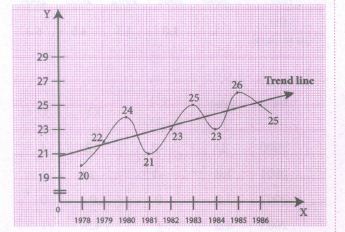
Fit a trend line to the following data by graphic method.
| Year | 1978 | 1979 | 1980 | 1981 | 1982 | 1983 | 1984 | 1985 | 1986 |
| Production of steel | 20 | 22 | 24 | 21 | 23 | 25 | 23 | 26 | 25 |
22.
The standard deviation of a binomial distribution (q +p)16 is 2. Find its mean.
23.
An urn contains 4 white and 6 red balls. Four balls are drawn at random from the urn. Find the probability distribution of the number of white balls.
24.
For the given pay-off matrix, choose the best alternative for the given states of nature under
(i) Maximin (ii) Minimax princple
| Alternative | States of Nature | ||
| Good | Fair | Bad | |
| A | 100 | 60 | +50 |
| B | 80 | 50 | +10 |
| C | 40 | 20 | +5 |
25.
Form the differential equation for y = (A + Bx)e3x where A and B are constants.
26.
If y75 = 2459, y50 = 2018, y85 = 1180, and y90 =402, find y82
| x | 75 | 80 | 85 | 90 |
| y | 2459 | 2018 | 1180 | 402 |
27.
Find the area under the demand curve xy = 1 bounded by the ordinates x = 3, x = 9 and x-axis
28.
Solve: 2x - 3y - 1 = 0, 5x + 2y - 12 = 0 by Cramer's rule.
29.
Assuming one in 80 births is a case of twins, calculate the probability of 2 or more sets of twins on a day when 30 births occur.
30.
Calculate the producer’s surplus at x = 5 for the supply function p = 7 + x.
31.
If you toss a fair coin three times, the outcome of an experiment consider as random variable which counts the number of heads on the upturned faces. Find out the probability mass function and check the properties of the probability mass function.
32.
Calculate the 3-yearlymoving averages of the production figures (in tonnes) for the following data.
| Year | 1973 | 1974 | 1975 | 1976 | 1977 | 1978 | 1979 | 1980 | 1981 | 1982 | 1983 | 1984 | 1985 | 1986 | 1987 |
| Production | 15 | 21 | 30 | 36 | 42 | 46 | 50 | 56 | 63 | 70 | 74 | 82 | 90 | 95 | 102 |
33.
A sample of 400 students is found to have mean height of 171.38 cms, Can it reasonable be regarded as a sample from a large population with mean height of 171.17 cms and standard deviation of 3.3 cms (Test at 5% level)
34.
Find the mean for the probability density function \(f(x)=\begin{cases} \frac { 1 }{ 24 } ,-12\le x\le 12 \\ 0,\quad otherwise \end{cases}\)
35.
For the given pay-off matrix, find the optimal decision under the minimax principle.
36.
Solve: x dy +y dx = 0
37.
When h = 1, find Δ (x3).
38.
Find the area of the region bounded by the parabola x2 = 4y, y = 2, y = 4 and the y-axis.
39.
Solve: 2x + 3y = 4 and 4x + 6y = 8 using Cramer's rule.
40.
A sample of 100 students is chosen from a large group of students. The average height of these students is 162 cm and standard deviation (S.D) is 8 cm. Obtain the standard error for the average height of large group of students of 160 cm?
41.
Evaluate \(\int _{ 0 }^{ \infty }{ { e }^{ -\frac { x }{ 2 } } } dx\)
42.
The following information is the probability distribution of successes.
| No. of Successes | 0 | 1 | 2 |
| Probability | \(\frac{6}{11}\) | \(\frac{9}{22}\) | \(\frac{1}{22}\) |
Determine the expected number of success.
43.
Measurements of the weights of a random sample of 200 ball bearings made by certain machine during one week showed a mean of 0.824 newtons and a S.D. of 0.042 newton's. Find
a) 95% and
b) 99% confidence limits for the mean weight of all the ball bearings.
44.
Marks in an aptitude test given to 800 students of a school was found to be normally distributed 10% of the students scored below 40 marks and 10% of the students scored above 90 marks. Find the number of students scored between 40 and 90?
45.
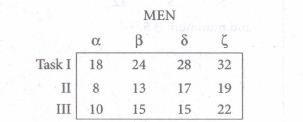
Solve the following assignment problem.
46.
The probability distribution of a random variation X is given below.
| X | 0 | 1 | 2 | 3 | 4 |
| P(X) | 0.1 | 0.25 | 0.3 | 0.2 | 0.15 |
Find
(i) V(X)
ii) V\((\frac{X}{2})\)
47.
Evaluate ഽ x3 sin (x4) dx
48.
The net profit p and quantity x satisfy the differential equation \(\frac { dp }{ dx } =\frac { 2{ p }^{ 3 }-{ x }^{ 3 } }{ 3x{ p }^{ 2 } } \). Find the relationship between the net profit and demand given that p = 20, when x = 10.
49.
From the following data, calculate the value of e1.75
| x | 1.7 | 1.8 | 1.9 | 2.0 | 2.1 |
| ex | 5.474 | 6.050 | 6.686 | 7.386 | 8.166 |
50.
A new transit system has just gone into operation in a city. Of those who use the transit system this year, 10% will switch over to using their own car next year and 90% will continue to use the transit system. Of those who use their cars this year, 80% will continue to use their cars next year and 20% will switch over to the transit system. Suppose the population of the city remains constant and that 50% of the commuters use the transit system and 50% of the commuters use their own car this year,
(i) What percent of commuters will be using the transit system after one year?
(ii) What percent of commuters will be using the transit system in the long run?
51.
Solve (x2 + 1)\(\frac { dy }{ dx } \) + 2xy = 4x2
52.
Calculate Fisher’s price index number and show that it satisfies both Time Reversal Test and Factor Reversal Test for data given below.
| Commodities | Base Year | Current Year | ||
| Price | Quantity | Price | Quantity | |
| Rice | 10 | 5 | 11 | 6 |
| Wheat | 12 | 6 | 13 | 4 |
| Rent | 14 | 8 | 15 | 7 |
| Fuel | 16 | 9 | 17 | 8 |
| Transport | 18 | 7 | 19 | 5 |
| Miscellaneous | 20 | 4 | 21 | 3 |
53.
A manufacturer of ball pens claims that a certain pen he manufactures has a mean writing life of 400 pages with a standard deviation of 20 pages. A purchasing agent selects a sample of 100 pens and puts them for test. The mean writing life for the sample was 390 pages. Should the purchasing agent reject the manufactures claim at 1% level?
54.
A car hiring firm has two cars. The demand for cars on each day is distributed as a Poisson variate, with mean 1.5. Calculate the proportion of days on which
(i) Neither car is used
(ii) Some demand is refused
1.
(d)
all the above.
2.
(d)
none of above
3.
(b)
Alternative
4.
(a)
16.3
5.
(d)
0
6.
(c)
\(\frac{10}{3}\)
7.
(c)
Hungarian Method
8.
(c)
y=log(ex+c)
9.
(c)
\(a=-\frac { 1 }{ 10 } ,b=\frac { 2 }{ 5 } \)
10.
(b)
\(\frac { 10 }{ 3 } \)
11.
(b)
beginning
12.
(c)
\(\frac{32}{3}\)
13.
(c)
both equal and unequal intervals
14.
(a)
y2 −2y1 + y0
15.
(a)
Most exact
16.
(c)
4!
17.
(b)
0
18.
(c)
\({ \left( \frac { 1 }{ \sigma \sqrt { 2\pi } } \right) }^{ { e }^{ \left( \frac { 1 }{ 2 } \right) } }\)
19.
(d)
\(\sum { xp(x) } \)
20.
(c)
6
21.
22.
Given n = 16, S.D = 2 ⇒ \(\sqrt { npq } \) =2
⇒ npq = 4
∴ 16(pq) = 4 ⇒ pq =\(\frac { 4 }{ 16 } =\frac { 1 }{ 4 } \)
⇒ q = \(\frac { 1 }{ 4p } \)...(1)
Since p + q = 1 ⇒ p+\(\frac { 1 }{ 4p } \)=1
⇒ \(\frac { 4{ p }^{ 2 }+1 }{ 4p } \) = 1
⇒ 4p2+1 = 4p ⇒ 4p2 -4p+1 = 0
⇒ (2p-1)2 = 0 ⇒ 2p-1 = 0
⇒ 2p = 1 ⇒ p = \(\frac { 1 }{ 2 } \)
∴ q = 1-p = \(1-\frac { 1 }{ 2 } =\frac { 1 }{ 2 } \)
Mean = np = 16 x \(\frac { 1 }{ 2 } \) = 8
23.
Let X denote the number of white balls drawn from the urn.
Since there are 4 white balls, X can take values 0,1,2,3,4.
P(X = 0)=p(gettmg no white balls)\(=\frac { { 6C }_{ 4 } }{ 10{ C }_{ 4 } } \)
\(\frac{1}{14}\)
P(X = 1) = P(getting one white ball and 3 red balls) \(\frac { { 4C }_{ 4 }\times { 6C }_{ 3 } }{ { 10 }C_{ 4 } } =\frac { 8 }{ 21 } \)
P(X = 2) = P(getting two white balls and 2 red balls) \(\frac { { 4C }_{ 2 }\times { 6C }_{ 2 } }{ { 10 }C_{ 4 } } =\frac { 8 }{ 21 } \)
P(X = 3) = P(getting 3 white balls and 1 red ball) \(\frac { { 4C }_{ 3 }\times { 6C }l }{ { 10 }C_{ 4 } } =\frac { 4 }{ 35 } \)
P(X = 4) = P(getting 4 white balls) =\(\frac { 4{ C }_{ 4 } }{ 10{ C }_{ 4 } } \)
=\(\frac{1}{210}\)
Thus the probability distribution of X is
| X | 0 | 1 | 2 | 3 | 4 |
| P(X) | \(\frac{1}{14}\) | \(\frac{8}{21}\) | \(\frac{6}{14}\) | \(\frac{4}{35}\) | \(\frac{1}{210}\) |
24.
| Alternative | States of Nature | Minimum | Maximum | ||
| Good | Fair | Bad | |||
| A | 100 | 60 | +50 | +50 | 100 |
| B | 80 | 50 | +10 | 10 | 80 |
| C | 40 | 20 | +5 | 5 | 40 |
(i) Max (50, 10, 5) = 50
∴ A is the best alternative under maximin principle
(ii) Min (100, 80,40) = 40
∴ C is the best alternative under minimax principle
25.
Given y = (A + Bx)e3x ....(1)
Differentiating w.r.t 'x' we get,
\(\frac { dy }{ dx } \)= (A+Bx)e3x(3)+e3x(B)
⇒ \(\frac { dy }{ dx } \) = 3y + Be3x [Using (1)]
⇒ Be3x = \(\frac { dy }{ dx } \)-3y
Differentiating again w.r.t 'x' we get,
\(\frac { d^{ 2 }y }{ { dx }^{ 2 } } =3\left( \frac { dy }{ dx } \right) \)+ Be3x(3)
⇒ \(\frac { d^{ 2 }y }{ { dx }^{ 2 } } =3\left( \frac { dy }{ dx } \right) +3\left[ \frac { dy }{ dx } -3y \right] \) [Using (2)]
⇒ \(\frac { d^{ 2 }y }{ { dx }^{ 2 } } =3\left( \frac { dy }{ dx } \right) +3\left( \frac { dy }{ dx } \right) \)-9y
⇒ \(\frac { d^{ 2 }y }{ { dx }^{ 2 } } =6\left( \frac { dy }{ dx } \right) \)-9y which is the required differential equation.
26.
Since 82 lies at the beginning of the table, we can use Newton's forward interpolation formula
\(\Rightarrow { y }_{ o }+\frac { n }{ n! } \triangle { y }_{ o }+\frac { n(n+1) }{ 2! } { \triangle }^{ 2 }{ y }_{ o }+\frac { n(n+1)(n-2) }{ 3! } { \triangle }^{ 3 }{ (y }_{ o })\)
Also x0 + nh = 82 ⇒ 75 + n(5) = 82 ⇒ 5n = 82 - 75 = 7
⇒ n = \(\frac75\) = 1.4
The difference table is
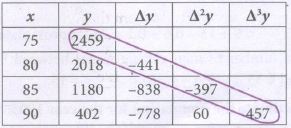
\(y=2459+\frac { 1.4 }{ 1! } (-441)+\frac { (1.4)(1.4-1) }{ 2! } (-397)+\frac { (1.4)(1.4-1)(1.4-2) }{ 3! } (457)\)
= 2459 - 617.4 - 111.6 - 25.592
y = 1704. 408 when x = 82.
27.
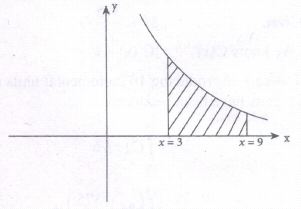
Area \(=\int _{ a }^{ b }{ ydx } \)
\(=\int _{ 3 }^{ 9 }{ \frac { 1 }{ x } dx } \)
\(={ [log\quad x] }_{ 3 }^{ 9 }\)
= log9-log3
\(=log\left( \frac { 9 }{ 3 } \right) \)
A = log 3 sq.units.
28.
The non-homogeneous equations are
2x - 3y - 1 = 0, 5x + 2y - 12 = 0
\(\Delta =\left| \begin{matrix} 2 & -3 \\ 5 & 2 \end{matrix} \right| =4+15=19\neq 0\)
Since \(\Delta \neq 0\) Cramer's rule can be applied and the system is consistent with unique solution.
\(\Delta x=\left| \begin{matrix} 1 & -3 \\ 12 & 2 \end{matrix} \right| =2+36=38\)
\(\Delta y=\left| \begin{matrix} 2 & 1 \\ 5 & 12 \end{matrix} \right| =24-5=19\)
\(x=\cfrac { \Delta x }{ \Delta } =\cfrac { 38 }{ 19 } =1\)
\(y=\cfrac { \Delta y }{ \Delta } =\cfrac { 19 }{ 19 } =1\)
\(\therefore \) Solution set is {2, 1}
29.
Let x devotes the set of twins on a day
P(twin birth) = p = 1/80 = 0.0125 and n = 30
The value of mean λ = np = 30 × 0.0125 = 0.375
Hence, X follows poisson distribution with p(x)\(\frac { { e }^{ -\lambda }{ \lambda }^{ x } }{ x! } \)
The probability is
P(2 or more) = 1 – [p (x = 0) + p (x = )] \(=1-\left[ \frac { { e }^{ -0.375 }{ (0.375) }^{ 0 } }{ 0! } +\frac { { e }^{ -0.375 }{ (0.375) }^{ 1 } }{ 1! } \right] \)
\(=1-{ e }^{ -0.375 }[1+0.375]\)
\(=1-(0.6873\times 1.375)\)
= 0.055
30.
Given supply function p = 7 + x and x = 5
When x0 = 5, p0 = 7 + 5 = 12
∴ p0x0 = x12 = 60
Producer's Surplus
\(={ p }_{ 0 }{ x }_{ 0 }-\int _{ g }^{ x }{ (x)dx } \)
\(=60-\int _{ 0 }^{ 5 }{ (7+x)dx } \)
\(=60-{ \left[ 7x+\frac { { x }^{ 2 } }{ 2 } \right] }_{ 0 }^{ 5 }\)
\(=60-\left[ 7(5)+\frac { { 5 }^{ 2 } }{ 2 } \right] \)
\(=60-\left[ 35+\frac { 25 }{ 2 } \right] \)
= 60-(35+12.5)
= 60-47.5
P.S = 12.5 = \(\frac{25}{2}\) units.
31.
Let X is the random variable which counts the number of heads on the upturned faces. The outcomes are stated below
| Outcomes | (HHH) | (HHT) | (HTH) | (THH) | (THT) | (TTH) | (HTT) | (TTT) |
| Values of X | 3 | 2 | 2 | 2 | 1 | 1 | 1 | 0 |
These values are summarized in the following probability table.
| Value of X | 0 | 1 | 2 | 3 | Total |
| P(xi) | \(\frac{1}{8}\) | \(\frac{3}{8}\) | \(\frac{3}{8}\) | \(\frac{1}{8}\) | \(\sum _{ i=0 }^{ 3 }{ p({ x }_{ i })=1 } \) |
(i) p(xi) \(\ge\)0\(\forall \) i and
(ii) \(\sum _{ i=0 }^{ 3 }{ p({ x }_{ i })=1 } \)
Hence, p(xi) is a probability mass function.
32.
| Year | Production | 3-yearly moving total | 3-yearly moving average |
| 1973 | 15 | - | - |
| 1974 | 21 | 22.00 | |
| 1975 | 30 | 66 | 29.00 |
| 1976 | 36 | 87 | 36.00 |
| 1977 | 42 | 108 | 41.33 |
| 1978 | 46 | 124 | 46.00 |
| 1979 | 50 | 138 | 50.67 |
| 1980 | 56 | 152 | 56.33 |
| 1981 | 63 | 169 | 63.00 |
| 1982 | 70 | 189 | 69.00 |
| 1983 | 74 | 207 | 75.33 |
| 1984 | 82 | 226 | 82.00 |
| 1985 | 90 | 246 | 89.00 |
| 1986 | 95 | 267 | 95.67 |
| 1987 | 102 | 287 | - |
33.
Given sample size n = 400
Sample mean \(\bar { x } \) = 171.38
Population mean μ = 171.17
Population Standard deviation σ = 3.3
Null hypotheses: H0 : μ = 171.17
Alternative hypotheses: H1 : μ ≠ 171.17
The test statistic, z = \(\frac { \bar { x } -\mu }{ \frac { \sigma }{ \sqrt { n } } } =\frac { 171.38-171.17 }{ \frac { 3.3 }{ \sqrt { 400 } } } \)
=\(\frac { 0.21 }{ 0.165 } \) = 1.273
As the level of significance is α = 0.005, \(Z_{ \frac { \alpha }{ 2 } }\) = 1.96
Here z < \(Z_{ \frac { \alpha }{ 2 } }\) as 1.273 < 1.96
Inference: since z < \(Z_{ \frac { \alpha }{ 2 } }\), we accept the null hypotheses at 5% level of significance.
Hence, we can conclude that the sample of 400 has taken from the population with mean height of 171.17 cm.
34.
Mean = E(X)=\(\int _{ -\infty }^{ \infty }{ x.f(x)dx=\int _{ -12 }^{ 12 }{ x.\left( \frac { 1 }{ 24 } \right) } dx } \)
\(=\frac { 1 }{ 24 } \int _{ -12 }^{ 12 }{ x.dx } \)
\(=0[\because \int _{ -a }^{ a }{ f(x)dx=0 } when\ f(x)\ is\ an\ odd\ function]\)
\(\therefore E(X)=0\)
35.
| Alternative | Economy | Maximum | ||
| Growing | Stable | Declining | ||
| Bonds | 40 | 45 | 5 | 45 |
| Stocks | 70 | 30 | -13 | 70 |
| Mutual Funds | 53 | 45 | -5 | 53 |
Min (45, 70, 53) = 45
∴ Choosing Bonds is the best decision under minimax principle.
36.
x dy = -y dx
Separating the variables we get
\(\frac { dy }{ y } =-\frac { dx }{ x } \)
Integrating, \(\int { \frac { dy }{ y } } =-\int { \frac { dx }{ x } } \)
⇒ log y = -log x + log C
⇒ log y = log\(\left( \frac { C }{ x } \right) \Rightarrow y=\frac { C }{ x } \) ⇒ xy = C.
37.
We know Δ (f(x)) = f(x + h) -f(x)
Since h = 1, ∆ (f)) = f(x + 1) - f(x)
[∵ (x + 1)3 = x3 + 3x2 + 3x + 1]
⇒ Δ (x3) = (x + 1)3 - x3

⇒ Δ (x3) = 3x2 + 3x + 1
38.
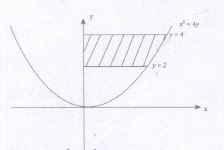
Area under the curve is
\(A=\int _{ c }^{ d }{ xdy } =\int _{ 2 }^{ 4 }{ \sqrt { 4y } dy } \)
\(=2\int _{ 2 }^{ 4 }{ { y }^{ \frac { 1 }{ 2 } }dy } =2{ \left( \frac { { y }^{ \frac { 3 }{ 2 } } }{ \frac { 3 }{ 2 } } \right) }_{ 2 }^{ 4 }\)
\(=\frac { 4 }{ 3 } \left( { y }^{ \frac { 3 }{ 2 } } \right) \)
\(=\frac { 4 }{ 3 } \left( { 4 }^{ \frac { 3 }{ 2 } }-{ 2 }^{ \frac { 3 }{ 2 } } \right) \)
\(=\frac { 4 }{ 3 } \left( 4\sqrt { 4 } -2\sqrt { 2 } \right) \)
\(=\frac { 4 }{ 3 } (8-2\sqrt { 2 } )\)sq.units
39.
\(\Delta =\left| \begin{matrix} 2 & 3 \\ 4 & 6 \end{matrix} \right| =12-12=0\)
\(\Delta x=\left| \begin{matrix} 4 & 3 \\ 8 & 6 \end{matrix} \right| =24-24=0\)
\(\Delta x=\left| \begin{matrix} 4 & 3 \\ 8 & 6 \end{matrix} \right| =24-24=0\)
\(\therefore \Delta =\Delta x=\Delta y=0\)
\(\therefore \) The system is consistent with infinite number of solutions
let y = k, \(k\epsilon R\)
\(\therefore 2x+3k=4\Rightarrow 2x=4-3k\)
\(\Rightarrow x=\cfrac { 1 }{ 2 } \left( 4-3k \right) ,k\epsilon R\)
\(\therefore \) Solution set is \(\left\{ \cfrac { 4-3k }{ 2 } ,k \right\} ,k\epsilon R\)
40.
Give n = 100, \(\bar x\) =162 cm, s = 8 cm is known in this problem
since σ is unknown , so we consider \(\hat{\sigma}\) = s and \(\varphi\) = 160 cm
\(S.E = \frac { \hat{\sigma} }{ \sqrt { n } } =\frac { s }{ \sqrt { n } } =\frac { 8 }{ \sqrt { 100 } } =0.8\)
Therefore the standard error for the average height of large group of students of 160 cm is 0.8.
41.
\(\int _{ 0 }^{ \infty }{ { e }^{ -\frac { x }{ 2 } } } dx=-2{ \left[ { e }^{ -\frac { x }{ 2 } } \right] }_{ 0 }^{ \infty }\)
= − 2[0 −1] = 2
42.
Expected number of success is
E(X)\(E(X)=\sum _{ x }^{ }{ x } { P }_{ X }(x)\)
\(=\left( 0\times \frac { 6 }{ 11 } \right) +\left( 1\times \frac { 9 }{ 22 } \right) +\left( 2\times \frac { 1 }{ 22 } \right) \)
\(=\frac { 11 }{ 22 } \)
= 0.5
Therefore, the expected number of success is 0.5. Approximately one success.
43.
Given sample size n = 200
Sample mean \(\bar { x } \) = 0.824
Sample S.D. s = 0.042
Standard error = \(\frac { s }{ \sqrt { n } } =\frac { 0.042 }{ \sqrt { 200 } } \)
= \(\frac { 0.042 }{ 14.14 } \) = 0.00270
(a) As the level of significance is α = 0.05, \(Z_{ \frac { \alpha }{ 2 } }\) = 1.96
∴ 95% confidence limits for μ are given by \(\bar { x } -Z_{ \frac { \alpha }{ 2 } }(S.E)\le \mu \le \bar { x } +Z_{ \frac { \alpha }{ 2 } }(S.E)\)
⇒ 0.824 - (1.96) (0.00270) ≤ μ ≤ 0.824 + (1.96) (0.00270)
⇒ 0.824 - 0.00582 ≤ μ ≤ 0.824 + 0.00582
⇒ 0.818 ≤ μ ≤ 0.832
Hence, the 95% confidence limits for μ is (0.818,0.832)
(b) As the level of significance is α =0.001, \(Z_{ \frac { \alpha }{ 2 } }\) = 2.58
∴ 99% confidence limits for μ are given by \(\bar { x } -Z_{ \frac { \alpha }{ 2 } }(S.E)\le \mu \le \bar { x } +Z_{ \frac { \alpha }{ 2 } }(S.E)\)
⇒ 0.824 - (2.58) (0.00270) ≤ μ ≤ 0.824 + (2.58) (0.00270)
⇒ 0.824 - 0.00582 ≤ μ ≤ 0.824 + 0.005825
⇒ 0.816 ≤ μ ≤ 0.832
Hence, the 99% confidence limits for μ is (0.816, 0.832)
44.
Let X denote the height of the student
Given P (X < 40) = 10% = \(\frac { 10 }{ 100 } \) =0.1
P(X> 90) = 10% = \(\frac { 10 }{ 100 } \) =0.1
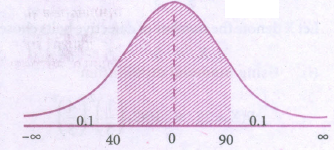
∴ P(40 < X < 90) = P(-∞ < X < ∞) - [P(X < 40) + P(X < 90)]
= 1 - (0.1 + 0.1)
= 1 - 0.2 = 0.8
∴ out of 800 students, number of students scored between 40 and 90 = 800 x 0.8
= 640 students.
45.
Since the number of rows is less then the number of columns, given assignment problem is unbalanced one.
To balance it, introduce a dummy row with all the entries zero.
The revised assignment problem is
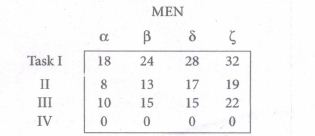
Here only 3 tasks can be assigned to 3 men.
Step 1 :
Select the smallest element in each row and subtract it will all the elements in its row.
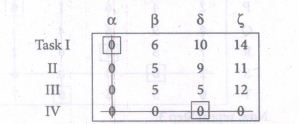
Here each row and column has atleast one zero.
Step 2:
Examine the row with only one zero, mark that zero by \(\Box\) and draw a vertical line.
After examining all the rows, examine the column with single zero, mark that zero by \(\Box\) and draw a horizontal line.
Step 3:
Only two assignment have been made.
The elements not lying on the line are
\(\begin{matrix} 6 & 10 & 14 \\ 5 & 9 & 11 \\ 5 & 5 & 12 \end{matrix}\)
and minimum is 5.
Subtract 5 from all these numbers. Other numbers remains the same.
A new cost matrix will be found .and repeat step 2.
∴ The new cost matrix is
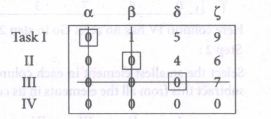
Thus, 3 assignments have been made.
The optical assignment schedule and total cost is
| Task | MEN | Cost |
| I | α | 18 |
| II | β | 13 |
| III | δ | 15 |
| Total Cost | Rs. 46 | |
46.
i) E(X) = Σxipi
= 0(0.1)+1(0.25)+2(0.3)+3(0.2)+4.(0.15)
= 2.05
E(X2) = ∑xi2pi
= 0(0.1)+1(0.25)+4(0.3)+9(0.2)+16(0.15)
= 5.65
Now, V(X) = E(X2)-[E(X)]2
= 5.65 - (2.05)2 = 1.4475
ii) \(V\left( \frac { X }{ 2 } \right) =\frac { 1 }{ 4 } v(X)\quad [\because V(aX)={ a }^{ 2 }V(X)]\)
\(=\frac { 1 }{ 4 } (1.4475)\)
\(V\left( \frac { X }{ 2 } \right) =0.361875\)
47.
Let I = ഽ x3 sin (x4) dx
Put t = x4
⇒ dt = 4x3 dfx
\(\Rightarrow \frac { dt }{ 4 } ={ x }^{ 3 }dx\)
\(\therefore I=\int { sin } t.\frac { dt }{ 4 } =\frac { 1 }{ 4 } sint\quad dt\)
= \(-\frac { 1 }{ 4 } cos\quad t+c\)
= \(-\frac { 1 }{ 4 } cos\left( { x }^{ 4 } \right) +c\) \(\left[ \because t={ x }^{ 4 } \right] \)
48.
Given \(\frac { dp }{ dx } =\frac { 2{ p }^{ 3 }-{ x }^{ 3 } }{ 3x{ p }^{ 2 } } \)
The numerator and denominator are homogeneous functions of 3,
∴ Put p=vx and \(\frac { dp }{ dx } =v+x\frac { dv }{ dx } \)
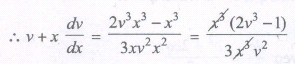
= \(\frac { 2{ v }^{ 3 }-1 }{ 3{ v }^{ 2 } } \)
⇒ \(\frac { dv }{ dx } =\frac { 2{ v }^{ 3 }-1 }{ 3{ v }^{ 2 } } -v=\frac { 2{ v }^{ 3 }-1-3{ v }^{ 3 } }{ 3{ v }^{ 2 } } \)
= \(\frac { -1-{ v }^{ 3 } }{ 3{ v }^{ 2 } } \)
⇒ \(\left( \frac { 3{ v }^{ 2 } }{ 1+{ v }^{ 3 } } \right) dv=-\frac { dx }{ x } \)
Integrating, \(\int { \frac { 3{ v }^{ 2 } }{ 1+{ v }^{ 3 } } } dv=-\int { \frac { dx }{ x } } \)
⇒ log(1+v3) = -log x + log c
⇒ 1+v3 = \(\frac { c }{ x } \)
Replacing v by \(\frac { p }{ x } \) we get
\(1+\frac { { p }^{ 3 } }{ { x }^{ 3 } } =\frac { c }{ x } \Rightarrow \frac { { x }^{ 3 }+{ p }^{ 3 } }{ { x }^{ 3 } } =\frac { c }{ x } \)
⇒ \(\frac { { x }^{ 3 }+{ p }^{ 3 } }{ { x }^{ 2 } } \)= c ⇒ x3+p3 = cx2...(1)
When x = 10, p = 20
⇒ 103 + 203 = c(10)2 ⇒ 1000 + 8000 = 100 c
⇒ 9000 = 100 c
⇒ c = 90
∴ (1) becomes,
x3+p3 = 90x2
⇒ p3 = 90x2-x3
⇒ p3 = x2(90-x) which is the required relationship.
49.
Since e1.75 lies at the beginning of the table, we can use Newton's forward interpolation formula
∴ xo + nh = x ⇒ 1.7 + n(0.1) = 1.75
⇒ n(0.1) = 1.75 - 1.7 = 0.05
⇒ n = \(\frac{0.05}{0.1}\) = 0.5
\({ y }_{ x }={ y }_{ o }+\frac { n }{ n! } \triangle { y }_{ o }+\frac { n(n+1) }{ 2! } { \triangle }^{ 2 }{ y }_{ o }+\frac { n(n+1)(n-2) }{ 3! } { \triangle }^{ 3 }{ (y }_{ o })+.......\)
The difference table is
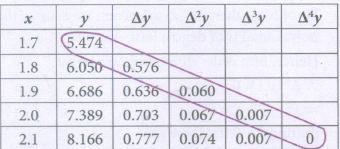
∴ \(y\left( { e }^{ 1.75 } \right) =5.74+\frac { 0.5 }{ 1! } (0.576)+\frac { (0.5)(0.5-1) }{ 2! } (0.06)+\frac { (0.5)(0.5-1)(0.5-2) }{ 3! } (0.007)\)
y(e1.75) = 5.474 + 0.288 - 0.0075 + 0.0004375
= 5.7549375
50.
Let A represents the percent of commuters who use the transit system and B represents the percent of commuters who use their own car. Transition probability matrix
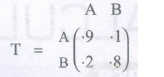
Given 50% of commuters use the transit system and 50% of the commuters use their own car this year.
(i) Percentage of commuters after one year
\(\left( \cdot 5\cdot 5 \right) \left( \begin{matrix} \cdot 9 & \cdot 1 \\ \cdot 2 & \cdot 8 \end{matrix} \right) \)
= (-5\(\times\)·9+·5\(\times\).2 ·5\(\times\)·1+·5\(\times\)·8)
= (-45 + ·10 ·05 +.40)
= (-55 - 45)
A = 55% and B = 45%
(ii) Equilibrium will be reached in the long run at equilibrium, we must have
(A B)T = (A B) wher A+B = 1
\(\Rightarrow \left( \begin{matrix} A & B \end{matrix} \right) \left( \begin{matrix} \cdot 9 & \cdot 1 \\ \cdot 2 & \cdot 8 \end{matrix} \right) =\left( \begin{matrix} A & B \end{matrix} \right) \)
\(\left( \begin{matrix} \cdot 9A+\cdot 2B & \cdot 1A+8B \end{matrix} \right) =\left( \begin{matrix} A & B \end{matrix} \right) \)
Equating the corresponding entries on both sides we get,
\(\cdot 9A+\cdot 2B=A\Rightarrow \cdot 9A+\cdot 2(1-A)=A\)
[Since A + B = 1, B = 1 -A]
\(\Rightarrow \cdot 9A+\cdot 2-\cdot 2A=A\)
\(\Rightarrow \cdot 2=A-\cdot 9A+\cdot 2A\)
\(\Rightarrow \cdot 2=A(1-\cdot 9+\cdot 2)\)
\(\Rightarrow \cdot 2=A=(\cdot 3)\)
\(\therefore\) 67% of the commuters will be using the transit system in the long run.
51.
The given equation can be reduced to
\(\frac { dy }{ dx } +\frac { 2x }{ { x }^{ 2 }+1 } y=\frac { 4{ x }^{ 2 } }{ { x }^{ 2 }+1 } \)
It is of the form \(\frac { dy }{ dx } \) + Py = Q
Here P \(=\frac { 2x }{ { x }^{ 2 }+1 } ,Q=\frac { 4{ x }^{ 2 } }{ { x }^{ 2 }+1 } \)
ഽPdx = ഽ\(\frac { 2x }{ { x }^{ 2 }+1 } \)dx = log(x2 +1)
I.F = eഽpdx = elog(x2+1) = x2 + 1
The required solution is y(IF) = ഽQ(I.F)dx + c
y(x2 +1) = ഽ\(\frac { 4{ x }^{ 2 } }{ { x }^{ 2 }+1 } \)(x2 + 1)dx + c
y(x2 +1) = \(\frac { 4{ x }^{ 3 } }{ 3 } \) + c
52.
| Commodities | Base Year | Current Year | p0q0 | p0q1 | p1q0 | p1q1 | ||
| Price (p0) |
Quantity (q1) |
Price ((p0)) |
Quantity (q1) |
|||||
| Rice | 10 | 5 | 11 | 6 | 50 | 60 | 55 | 66 |
| Wheat | 12 | 6 | 13 | 4 | 72 | 48 | 78 | 52 |
| Rent | 14 | 8 | 15 | 7 | 112 | 98 | 120 | 105 |
| Fuel | 16 | 9 | 17 | 8 | 144 | 128 | 153 | 136 |
| Transport | 18 | 7 | 19 | 5 | 126 | 90 | 133 | 95 |
| Miscellaneous | 20 | 4 | 21 | 3 | 80 | 60 | 84 | 63 |
| Total | 584 | 484 | 623 | 517 | ||||
Fisher’s price index number
\({ P }_{ 01 }^{ F }=\left( \sqrt { \frac { \sum { { p }_{ 1 }{ q }_{ 10 } } \times \sum { { p }_{ 1 }{ q }_{ 1 } } }{ \sum { { p }_{ 0 }{ q }_{ 0 } } \times \sum { { p }_{ 0 }{ q }_{ 1 } } } } \right) \times 100=\left( \sqrt { \frac { 623\times 517 }{ 584\times 484 } } \right) \times 100=106.74\)
Time Reversal Test: P01 × P10 = 1
\({ P }_{ 01 }\times { P }_{ 10 }=\sqrt { \left( \frac { \sum { { p }_{ 1 }{ q }_{ 0 } } \times \sum { { p }_{ 1 }{ q }_{ 1 } } \times \sum { { p }_{ 0 }{ q }_{ 1 } } \times \sum { { p }_{ 0 }{ q }_{ 0 } } }{ \sum { { p }_{ 0 }{ q }_{ 0 } } \times \sum { { p }_{ 0 }{ q }_{ 1 } } \times \sum { { p }_{ 1 }{ q }_{ 1 } } \times \sum { { p }_{ 1 }{ q }_{ 0 } } } \right) } \)
\({ P }_{ 01 }\times { P }_{ 10 }=\sqrt { \left( \frac { 623\times 517\times 484\times 584 }{ 584\times 487\times 517\times 623 } \right) } \)
P01 x P10 = 1
Factor Reversal Test
\({ P }_{ 01 }\times { Q }_{ 01 }=\frac { \sum { { p }_{ 1 }{ q }_{ 1 } } }{ \sum { { p }_{ 0 }{ q }_{ 0 } } } \)
\({ P }_{ 01 }\times { P }_{ 01 }=\sqrt { \left( \frac { \sum { { p }_{ 1 }{ q }_{ 0 } } \times \sum { { p }_{ 1 }{ q }_{ 1 } } \times \sum { { p }_{ 1 }{ q }_{ 0 } } \times \sum { { p }_{ 1 }{ q }_{ 1 } } }{ \sum { { p }_{ 0 }{ q }_{ 0 } } \times \sum { { p }_{ 0 }{ q }_{ 1 } } \times \sum { { p }_{ 0 }{ q }_{ 0 } } \times \sum { { p }_{ 0 }{ q }_{ 1 } } } \right) } \)
\({ P }_{ 01 }\times { P }_{ 10 }=\sqrt { \left( \frac { 623\times 517\times 484\times 517 }{ 584\times 484\times 584\times 623 } \right) } \)
\({ P }_{ 01 }\times { P }_{ 01 }=\sqrt { \left( \frac { 517\times 517 }{ 585\times 584 } \right) } =\frac { 517 }{ 584 } \)
\({ P }_{ 01 }\times { P }_{ 01 }=\frac { \sum { { p }_{ 1 }{ q }_{ 1 } } }{ \sum { { p }_{ 0 }{ q }_{ 0 } } } \)
53.
Sample size n =100, Sample mean \(\bar x\) = 390 pages, Population mean \(\mu\) = 400 pages
Population SD \(\sigma\) = 20 pages
The sample is a large sample and so we apply Z -test
Null Hypothesis:
There is no significant difference between the sample mean and the population mean of writing life of pen he manufactures, i.e., H0 : \(\mu\) = 400
Alternative Hypothesis:
There is significant difference between the sample mean and the population mean of writing life of pen he manufactures, i.e., H1:\(\mu\neq\) 400 (two tailed test)
The level of significance \(\alpha\) = 1% = 0.01
Applying the test statistic
\(Z=\frac{\bar{x}-\mu}{\frac{\sigma}{\sqrt{n}}} \sim N(0,1) ; \)
\(Z=\frac{390-400}{\frac{20}{\sqrt{100}}}=\frac{-10}{2}=-5, \therefore|Z|=5\)
Thus the calculated value |Z| = 5 and the significant value or table value \({ Z }_{ \frac { \sigma }{ 2 } }=2.58\)
Comparing the calculated and table values, we found Z > \({ Z }_{ \frac { \sigma }{ 2 } }\) i.e., 5 > 2.58
Inference: Since the calculated value is greater than table value i.e., \(Z>{ Z }_{ \frac { \sigma }{ 2 } }\) at 1% level of significance, the null hypothesis is rejected and Therefore we concluded that \(\mu \neq400\) and the manufacturer’s claim is rejected at 1% level of significance.
54.
Given mean = λ = 1.5
X follows poisson distribution with
p(x,λ) = \(\frac { e^{ -\lambda }.{ \lambda }^{ x } }{ x! } \)
(i) ∴ P(neither car is used)
= P(X = 0) = \(\frac { e^{ -1.5 }.(1.5)^{ 0 } }{ 0! } \) =e-1.5
= 0.2231 [∵ e-1.5 =0.2231]
(ii) P (Some demand is refused)
The demand may be either 0 car, 1 car or 2 cars
∴ P (Some demand is refused) = 1 - P(X ≤ 2)
= 1 - [P(X = 0) + P (X = 1) + P(X = 2)]
= 1-\(\left[ \frac { e^{ -\lambda }.{ \lambda }^{ 0 } }{ 0! } +\frac { e^{ -\lambda }.{ \lambda }^{ 1 } }{ 1! } +\frac { e^{ -\lambda }.{ \lambda }^{ 2 } }{ 2! } \right] \)
= 1-e-λ (1+λ+\(\frac { { \lambda }^{ 2 } }{ 2 } \))
= 1-e-1.5 (1+1.5+\(\frac { (1.5)^{ 2 } }{ 2 } \))
= 1 - 0.2231 (3.625) = 1 - 0.8087 = 0.1912
∴ Probability of some demand is refused = 0.1912.

12th Standard Syllabus & Materials
12th Standard
TN 12th Computer Applications களப்பெயர் முறைமை (DNS) Sample Question Papers Study Material - QB365 Set A
NEW12th Standard
TN 12th Computer Applications வலையமைப்பு எடுத்துக்காட்டுகள் மற்றும் நெறிமுறைகள் Sample Question Papers Study Material - QB365 Set A
NEW12th Standard
TN 12th Computer Applications கணினி வலையமைப்பு ஓர் அறிமுகம் Sample Question Papers Study Material - QB365 Set A
NEW12th Standard
TN 12th Computer Applications PHP-உடன் MySQL-ஐ இணைத்தல் Sample Question Papers Study Material - QB365 Set A



Tamilnadu Stateboard 12th Standard Subjects

Maths

Chemistry

Physics

Biology

Computer Science
Business Maths and Statistics

Economics

Commerce

Accountancy

History

Computer Applications
Biology
Computer Technology
Computer Applications
Computer Science
Business Maths and Statistics
Commerce
Economics
Maths
Chemistry
Physics
Computer Technology
History
Accountancy

Tamil

English

French
Tamilnadu Stateboard Standards
