
 100% FREE ACCESS
12th Standard Syllabus & Materials
12th Standard
TN 12th Computer Applications மின்னணு தரவு பரிமாற்றம் Sample Question Papers Study Material - QB365 Set A
NEW12th Standard
TN 12th Computer Applications மின் - வணிக பாதுகாப்பு அமைப்புகள் Sample Question Papers Study Material - QB365 Set A
NEW12th Standard
TN 12th Computer Applications மின்னணு செலுத்தல் முறைகள் Sample Question Papers Study Material - QB365 Set A
NEW12th Standard
TN 12th Computer Applications மின் - வணிகம் Sample Question Papers Study Material - QB365 Set A
NEW12th Standard
TN 12th Computer Applications திறந்த மூல கருத்துருக்கள் Sample Question Papers Study Material - QB365 Set A
NEW12th Standard
TN 12th Computer Applications வலையமைப்பு வடமிடல் Sample Question Papers Study Material - QB365 Set A

Published on: 22/01/2020
Integral Calculus II
Download Tamil Nadu 12th Standard Business Maths and Statistics question papers, model tests, one-mark questions, important questions, and public exam papers in PDF format. Free study materials and answer keys for TN State Board students.
Questions + Answers key
Take MCQ Business Maths and Statistics Test
1.
Find the producer's surplus for the supply function p = x2 + x + 3 when xo = 4
2.
Find the consumer's surplus for the demand function p = 25 - x -x2 when Po = 19
3.
Find the demand function for which the elasticity of demand is 1
4.
The marginal cost function is MC = \(\frac{100}{x}\). Find the cost function C(x) if C(16) = 100.
5.
The marginal cost at a production level of x units is given by C '(x) = 85 +\(\frac{375}{x^2}\). Find the cost of producing 10 in elemental units after 15 units have been produced?
6.
If the marginal revenue for a commodity is MR = 9 - 6x2 + 2x, find the total revenue function.
7.
The marginal cost function of manufacturing x units of a commodity is 3x2 - 2x + 8. If there is no fixed cost, find the total cost function?
8.
Find the area under the curve y = 4x - x2 included between x = 0, x = 3 and the X-axis.
9.
Find the area under the curve y = 4x2 - 8x + 6 bounded by the Y-axis, X-axis and the ordinate at x = 2.
10.
Find the area of the region bounded by the parabola x2 = 4y, y = 2, y = 4 and the y-axis.
11.
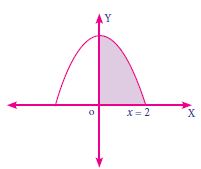
Find the area of the region bounded by the parabola \(y=4{ - }x^{ 2 }\) , x −axis and the lines x = 0, x = 2.
12.
For the marginal revenue function MR = 6 − 3x2 − x3, Find the revenue function and demand function.
13.
Calculate consumer’s surplus if the demand function p = 122 − 5x − 2x2 and x = 6
14.
The marginal cost function of a commodity is given by MC = \(\frac { 14000 }{ \sqrt { 7x+4 } } \) and the fixed cost is Rs. 18,000. Find the total cost and average cost.
15.
1.
Given supply function is P = x + x + 3 and Xo = 4
∴ Po = 42 + 4 + 3
= 16+ 4 + 3 = 23
∴ p0x0 = 23(4) = 92
Producer's surplus
\(PS={ p }_{ 0 }{ x }_{ 0 }-\int _{ 0 }^{ x0 }{ g(x)dx } \)
\(=92-\int _{ 0 }^{ 4 }{ \left( { x }^{ 2 }+x+3 \right) dx } \)
\(=92-{ \left( \frac { { x }^{ 3 } }{ 3 } +\frac { { x }^{ 2 } }{ 2 } +3x \right) }_{ 0 }^{ 4 }\)
\(=92-\left( \frac { { 4 }^{ 3 } }{ 3 } +\frac { { 4 }^{ 2 } }{ 2 } +3(4) \right) \)
\(=92-\left( \frac { 64 }{ 3 } +8+12 \right) \)
\(=92-\frac { 64 }{ 3 } -20=72-\frac { 64 }{ 3 } \)
\(=\frac { 216-64 }{ 3 } \)
\(PS=\frac { 152 }{ 3 } \) units
2.
Given demand function is p = 25 - x - X2
and p0 = 19
⇒ 19 = 25-x-x2
⇒ x2 + x - 6 = 0
⇒ (x + 3) (x - 2) = 0
⇒ x = -3 or x = 2
Since x cannot be negative xo = 2
po xo = 19(2) = 38
\(CS=\int _{ 0 }^{ 2 }{ f(x)dx-{ p }_{ 0 }{ x }_{ 0 } } \)
\(=\int _{ 0 }^{ 2 }{ \left( 25-x-{ x }^{ 2 } \right) dx-38 } \)
\(={ \left( 25x-\frac { { x }^{ 2 } }{ 2 } -\frac { { x }^{ 3 } }{ 3 } \right) }_{ 0 }^{ 2 }-38\)
\(=25(2)-\frac { 4 }{ 2 } -\frac { 8 }{ 3 } -38\)
\(=50-2-\frac { 8 }{ 3 } -38\)
\(=10-\frac { 8 }{ 3 } =\frac { 30-8 }{ 3 } \)
\(CS=\frac { 22 }{ 3 } \) units
3.
Given ηd = 1
\(\Rightarrow \frac { -p }{ x } .\frac { dx }{ dp } =1\)
\(\Rightarrow \frac { dx }{ x } =\frac { -dp }{ p } \)
⇒ log x = log p + log k
⇒log x+ log p = log k
⇒ log px = log k
⇒ px = k
Demand function P = \(\frac{k}{x}\)
4.
Given \(MC=\frac { 100 }{ x } \)
\(\\ \int { MC } =\int { \frac { 100 }{ x } } \)
⇒ C = 100 log x + k
Given C(16) =100 ⇒ When x = 16,
C = 100
∴ 100 = 100 log 16 + k
⇒ k = 100-100 log 16
C = 100 log x + 100 - 100 log 16
= 100 (log x - log16 + 1)
\(C=100(log\left( \frac { x }{ 16 } \right) +1)\)
5.
Given C'(x) = 85 + \(\frac{375}{x^2}\).
We know C(x) ഽC'(x) + k
The cost of producing 10 incremental units after 15 units have been produced
\(C'(x)=85+\frac { 375 }{ { x }^{ 2 } } \)
\(C(x)=\int { C'(x) } dx\)
\(\int _{ 15 }^{ 25 }{ C'(x) } dx\)
\(\int _{ 15 }^{ 25 }{ \left( 85+\frac { 375 }{ { x }^{ 2 } } \right) } dx\)
\({ \left[ 85+\frac { 375 }{ { x } } \right] }_{ 15 }^{ 25 }\)
\(\left( 85(25)-\frac { 375 }{ 25 } \right) -\left( 85(15)-\frac { 375 }{ 15 } \right) \)
= (2125 - 15) - (1275 - 25)
= 2110 - 1250 = Rs. 860
6.
Given MR = 9 - 6x2 + 2x
⇒ഽMR=ഽ(9 - 6x2 + 2x)sx
\(\Rightarrow R=9x-\frac { { 6x }^{ 3 } }{ 3 } +\frac { { 2x }^{ 2 } }{ 2 } +k\)
⇒ R = 9x - 2x3 + x2 + k
When x = 0, R = 0 ⇒ k = 0
∴ R = 9x - 2x3 + x2
7.
Given MC = 3x2 - 2x + 8
⇒ ഽMC = ഽ(3x2 - 2x + 8)dx
\(\Rightarrow C=\frac { { 3x }^{ 3 } }{ 3 } -\frac { { 2x }^{ 2 } }{ 2 } +8x+k\)
⇒ C = x3 - x2 + 8x + k
Since there is no fixed cost,
when x = 0, C = 0 ⇒ k = 0
∴ C = x3 - x2 + 8x
8.
Given curve is y = 4x - X2
The limits are from x = 0 to x = 3
∴ Area \(\int _{ 0 }^{ 3 }{ y } dx=\int _{ 0 }^{ 3 }{ (4x-{ x }^{ 2 }) } dx\)
\({ \left[ \frac { 4{ x }^{ 2 } }{ 2 } -\frac { { x }^{ 3 } }{ 3 } \right] }_{ 0 }^{ 3 }=2(9)-\frac { 27 }{ 3 } \)
=18 - 9
Area = 9 sq.units
9.
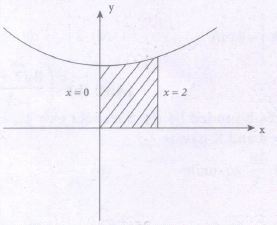
The Y-axis is the ordinate at x = 0.
The area bounded by the ordinates at x = 0, x = 2 and the given curve is
\(A=\int _{ a }^{ b }{ y } dx\)
\(=\int _{ 0 }^{ 2 }{ ({ 4x }^{ 2 }-8x+6)dx } \)
\(={ \left[ \frac { { 4x }^{ 3 } }{ 3 } -\frac { 8{ x }^{ 2 } }{ 2 } +6x \right] }_{ 0 }^{ 2 }\)
\(=4\left( \frac { 8 }{ 3 } \right) -4(4)+6(2)\)
\(\frac { 32 }{ 3 } -6+12=\frac { 32 }{ 3 } -4\)
\(=\frac { 32-12 }{ 3 } =\frac { 20 }{ 3 } \)
∴ Area \(=\frac { 20 }{ 3 } \)sq.units
10.
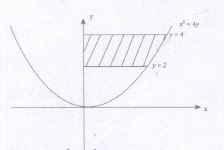
Area under the curve is
\(A=\int _{ c }^{ d }{ xdy } =\int _{ 2 }^{ 4 }{ \sqrt { 4y } dy } \)
\(=2\int _{ 2 }^{ 4 }{ { y }^{ \frac { 1 }{ 2 } }dy } =2{ \left( \frac { { y }^{ \frac { 3 }{ 2 } } }{ \frac { 3 }{ 2 } } \right) }_{ 2 }^{ 4 }\)
\(=\frac { 4 }{ 3 } \left( { y }^{ \frac { 3 }{ 2 } } \right) \)
\(=\frac { 4 }{ 3 } \left( { 4 }^{ \frac { 3 }{ 2 } }-{ 2 }^{ \frac { 3 }{ 2 } } \right) \)
\(=\frac { 4 }{ 3 } \left( 4\sqrt { 4 } -2\sqrt { 2 } \right) \)
\(=\frac { 4 }{ 3 } (8-2\sqrt { 2 } )\)sq.units
11.
\(y=4{ - }x^{ 2 }\)
Required area = \(\int _{ 0 }^{ 2 }{ ydx } =\int _{ 0 }^{ 2 }{ (4- } { x }^{ 2 })dx\)
= \({ \left[ 4x-\frac { { x }^{ 2 } }{ 3 } \right] }_{ 0 }^{ 2 }=8-\frac { 8 }{ 3 } \)
= \(\frac { 16 }{ 3 } \) sq.units
12.
Given MR = 6 − 3x2 − x3
⇒ ഽMR =ഽ(6 − 3x2 − x3)dx
\(\Rightarrow \mathrm{R}=6 x-\frac{\not{3} x^{3}}{\not3}-\frac{x^{4}}{4}+k\)
\(\Rightarrow 6x-{ x }^{ 3 }-\frac { { x }^{ 4 } }{ 4 } +k\)
When x = 0, R = 0 ⇒ k = 0
\(\Rightarrow R=6x-{ x }^{ 3 }-\frac { { x }^{ 4 } }{ 4 } \)
Demand function \(P=\frac { R }{ x } =6-{ x }^{ 2 }-\frac { { x }^{ 3 } }{ 4 } \)
13.
Given demand functionp = 122 - 5x - 2x2 and x = 6
When x0 = 6, p0 = 122-5(6)-2(6)2
= 122-30-72
= 122-102
P0 = 20
p0x0 = 20 \(\times\) 6 = 120
Consumer's Surplus
CS \(=\int _{ 0 }^{ x }{ f(x) } dx-{ p }_{ 0 }{ x }_{ 0 }\)
\(=\int _{ 0 }^{ 6 }{ (122-5x-2{ x }^{ 2 })dx-120 } \)
\(={ \left[ 122x-\frac { 5{ x }^{ 2 } }{ 2 } -\frac { { 2x }^{ 3 } }{ 3 } \right] }_{ 0 }^{ 6 }-120\)
\(=122(6)-5\frac { \left( { 6 }^{ 2 } \right) }{ 2 } -2\frac { \left( { 6 }^{ 3 } \right) }{ 3 } -120\)
\(=732-\frac { 180 }{ 2 } -\frac { 432 }{ 3 } -120\)
= 732-90-144-120
= 732-354
C.S = 378 units
14.
Given \(MC=\frac { 14000 }{ \sqrt { 7x+4 } } \)
\(\Rightarrow \frac { dc }{ dx } =\frac { 14000 }{ \sqrt { 7x+4 } } \)
\(\Rightarrow dC=\frac { 14000 }{ \sqrt { 7x+4 } } dx\)
\(\Rightarrow \int { dC } =14000\int { \frac { dx }{ \sqrt { 7x+4 } } } \)
\(\Rightarrow 14000\int { (7x+4)^{ -\frac { 1 }{ 2 } }dx } \)
\(\Rightarrow C=14000\frac { { (7x+4) }^{ -\frac { 1 }{ 2 } +1 } }{ \left( -\frac { 1 }{ 2 } +1 \right) 7 } +k\)
\(\Rightarrow C=14000\frac { { (7x+4) }^{ \frac { 1 }{ 2 } } }{ \frac { 7 }{ 2 } } +k\)
\(C={\not14000} \times \frac{2}{\not 7} \sqrt{7 x+4}+k\)
\(\Rightarrow C=4000\sqrt { 7x+4 } +k\) ...(1)
Given fixed cost is 18,000
When x = 0, C = 18000
⇒ 18000 = 4000√4 + k
⇒ 18000 = 4000(2) + k
⇒ k = 18000-8000
⇒ k = 10000
∴(1) becomes,
C = 4000\(\sqrt { 7x+4 } +10000\),
Average Cost (AC) \(=\frac{C}{x}\)
= \(\frac { 4000 }{ x } \sqrt { 7x+4 } +\frac { 10000 }{ x } \)
15.

12th Standard Syllabus & Materials
12th Standard
TN 12th Computer Applications களப்பெயர் முறைமை (DNS) Sample Question Papers Study Material - QB365 Set A
NEW12th Standard
TN 12th Computer Applications வலையமைப்பு எடுத்துக்காட்டுகள் மற்றும் நெறிமுறைகள் Sample Question Papers Study Material - QB365 Set A
NEW12th Standard
TN 12th Computer Applications கணினி வலையமைப்பு ஓர் அறிமுகம் Sample Question Papers Study Material - QB365 Set A
NEW12th Standard
TN 12th Computer Applications PHP-உடன் MySQL-ஐ இணைத்தல் Sample Question Papers Study Material - QB365 Set A



Tamilnadu Stateboard 12th Standard Subjects

Maths

Chemistry

Physics

Biology

Computer Science
Business Maths and Statistics

Economics

Commerce

Accountancy

History

Computer Applications
Biology
Computer Technology
Computer Applications
Computer Science
Business Maths and Statistics
Commerce
Economics
Maths
Chemistry
Physics
Computer Technology
History
Accountancy

Tamil

English

French
Tamilnadu Stateboard Standards
