
 100% FREE ACCESS
12th Standard Syllabus & Materials
12th Standard
TN 12th Computer Applications மின்னணு தரவு பரிமாற்றம் Sample Question Papers Study Material - QB365 Set A
NEW12th Standard
TN 12th Computer Applications மின் - வணிக பாதுகாப்பு அமைப்புகள் Sample Question Papers Study Material - QB365 Set A
NEW12th Standard
TN 12th Computer Applications மின்னணு செலுத்தல் முறைகள் Sample Question Papers Study Material - QB365 Set A
NEW12th Standard
TN 12th Computer Applications மின் - வணிகம் Sample Question Papers Study Material - QB365 Set A
NEW12th Standard
TN 12th Computer Applications திறந்த மூல கருத்துருக்கள் Sample Question Papers Study Material - QB365 Set A
NEW12th Standard
TN 12th Computer Applications வலையமைப்பு வடமிடல் Sample Question Papers Study Material - QB365 Set A

Published on: 22/01/2020
Numerical Methods
Download Tamil Nadu 12th Standard Business Maths and Statistics question papers, model tests, one-mark questions, important questions, and public exam papers in PDF format. Free study materials and answer keys for TN State Board students.
Questions + Answers key
Take MCQ Business Maths and Statistics Test
1.
Construct a forward difference table for y = f(x) = x3+2x+1 for x = 1,2,3,4,5
2.
Construct a forward difference table for the following data
| x | 0 | 10 | 20 | 30 |
| y | 0 | 0.174 | 0.347 | 0.518 |
3.
The area A of circle of diameter ‘d’ is given for the following values
| D | 80 | 85 | 90 | 95 | 100 |
| A | 5026 | 5674 | 6362 | 7088 | 7854 |
Find the approximate values for the areas of circles of diameter 82 and 91 respectively
4.
From the following data find y at x = 43 and x = 84
| x | 40 | 50 | 60 | 70 | 80 | 90 |
| y | 184 | 204 | 226 | 250 | 276 | 304 |
5.
From the following table obtain a polynomial of degree y in x
| x | 1 | 2 | 3 | 4 | 5 |
| y | 1 | -1 | 1 | -1 | 1 |
6.
Using Lagrange’s interpolation formula find a polynomial which passes through the points (0, –12), (1, 0), (3, 6) and (4,12).
7.
Find f(0.5) if f(−1) = 202, f (0)= 175, f(1) = 82 and f(2) = 55
8.
Find the missing figures in the following table
| x | 0 | 5 | 10 | 15 | 20 | 25 |
| y | 7 | 11 | - | 18 | - | 32 |
9.
Using interpolation, find the value of f(x) when x = 15
| x | 3 | 7 | 11 | 19 |
| f(x) | 42 | 43 | 47 | 60 |
10.
Using interpolation estimate the business done in 1985 from the following data
| Year | 1982 | 1983 | 1984 | 1986 |
| Business done (in lakhs) | 150 | 235 | 365 | 525 |
11.
Find the second order backward differences of f(x).
12.
When h = 1, find Δ (x3).
13.
Find the missing term from the following data
| x | 1 | 2 | 3 | 4 |
| f(x) | 100 | - | 126 | 157 |
14.
If f(0) = 5, f(1) = 6, f(3) = 50, find f(2) by using Lagrange's formula.
15.
Find the missing term from the following data.
| x | 20 | 30 | 40 |
| y | 51 | - | 34 |
1.
y = f(x) = x3+2x+1 for x = 1,2,3,4,5
| x | y | Δy | Δ2y | Δ3y | Δ4y |
|---|---|---|---|---|---|
| 1 | 4 | ||||
| 9 | |||||
| 2 | 13 | 12 | |||
| 21 | 6 | ||||
| 3 | 34 | 18 | 0 | ||
| 39 | 6 | ||||
| 4 | 73 | 24 | |||
| 63 | |||||
| 5 | 136 | ||||
2.
The Forward difference table is given below
| x | y | Δy | Δ2y | Δ3y |
| 0 | 0 | |||
| 0.174 | ||||
| 10 | 0.174 | -0.001 | ||
| 0.173 | -0.001 | |||
| 20 | 0.347 | -0.002 | ||
| 0.171 | ||||
| 30 | 0.518 |
3.
Let the diameter be x and area be y.
To find y when x = 82, use Newton's forward interpolation form
∴ x0 + nh = 82 ⇒ 80 + n(5) ⇒ 82 - 80 = 2
⇒ n = \(\frac{2}{5}\) = 0.4
The difference table is
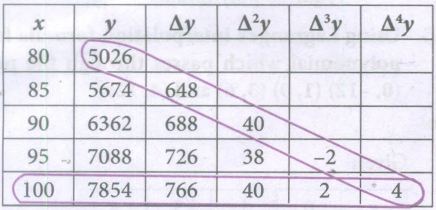
∴ y(82) = y0 + \(\frac { n }{ 1! } { \triangle y }_{ 0 }+\frac { n(n+1) }{ 2! } { \triangle }^{ 2 }{ y }_{ 0 }+\frac { n(n+1)(n+2) }{ 3! } { \triangle }^{ 3 }{ y }_{ 0 }\)+ \(\frac { n(n+1)(n+2)(n-3) }{ 4! } { \triangle }^{ 4 }{ y }_{ 0 }\)
.JPG)
+ \(\frac{(0.4)(0.4-1)(0.4-2)}{6}\)(-2)
.JPG)
= 5026 + 259.2 + (0.4) (-0.6) (20) + \(\frac{(0.4)(-0.6)(-1.6)(-1)}{3}\) + \(\frac{(0.4)(-0.6)(-1.6)(-2.6)}{3}\)
= 5026 + 259.2 - 4.8 - 0.128 - 0.1664
= 5280.10
∴ When the diameter is 82, area of circle is 5280.1 (≅ 5281)
To find y when x = 91, use Newton's backward interpolation formula.
∴ xn + nh = 91 ⇒ 100 + n(5) = 91
⇒ 5n = 91 - 100
⇒ 5n = -9 ⇒ n = \(\frac{-9}{5}\) = 1.8
Newton's backward interpolation formula is
y(x=xn+nh) = yn + \(\frac { n }{ 1! } \triangledown { y }_{ n }+\frac { n(n+1) }{ 2! } { \triangledown }^{ 2 }{ y }_{ n }+\frac { n(n+1)(n+2) }{ 3! } { \triangledown }^{ 3 }{ y }_{ n }\)
y(x = 91) = 7854 - 1.8 (766) +
.JPG)
\(+\frac{(-1.8)(-1.8+1)(-1.8+2)(-1.8+3)}{3!}\)(4)
⇒ y(x = 91) = 7854 - 1378.8 + (-1.8) (-0.8) (20) + (-1.8) (-0.8) (0.2) + \(\frac{(-1.8)(-0.8)(0.2)(1.2)}{6}\) (4)
⇒ y(x = 91) = 7854 - 1378.8 + 28.8 + 0.288 + 0.2304
⇒ y(x = 91) = 6504.5
Hence when the diameter is 91, area is 6504.5 ≅ 6504
4.
| x | 40 | 50 | 60 | 70 | 80 | 90 |
| y | 184 | 204 | 226 | 250 | 276 | 304 |
Since x = 43 lies in the beginning of the table, use.
Newton's forward interpolation formula.
∴ x0+ nh = 43 ⇒ 40 + n(10) = 43 ⇒ 10n
=43 - 40 = 3
⇒ n = \(\frac{3}{10}\) = 0.3
Newton's forward interpolation formula is
y(x=x0+nh) = y0\(\frac { n }{ 1! } { \triangle y }_{ 0 }+\frac { n(n+1) }{ 2! } { \triangle }^{ 2 }{ y }_{ 0 }+\frac { n(n+1)(n+2) }{ 3! } { \triangle }^{ 3 }{ y }_{ 0 }\)
The difference table is
| x | y | Δy | Δ2y | Δ3y | Δ4y | Δ5y |
|---|---|---|---|---|---|---|
| 40 | 184 | |||||
| 50 | 204 | 20 | ||||
| 60 | 226 | 22 | 2 | |||
| 70 | 250 | 24 | 2 | 0 | ||
| 80 | 276 | 2 | 2 | 0 | 0 | |
| 90 | 304 | 28 | 2 | 0 | 0 | 0 |
.JPG)
= 184 + 6 + (0.3)(-0.7)
= 184 + 6 - 0.21
= 189.79
∴ when x = 43, y = 189.79.
To find y when x = 84, use Newton's backward interpolation formula
∴ xn + nh = 84
90 + n(10) = 84 ⇒ 10n = 84 - 90 = -6
⇒ n = \(\frac{-6}{10}\) = -6
Newton's backward interpolation formula is
∴ y(x=xn+nh)= yn + \(\frac { n }{ 1! } \triangledown { y }_{ n }+\frac { n(n+1) }{ 2! } { \triangledown }^{ 2 }{ y }_{ n }+\frac { n(n+1)(n+2) }{ 3! } { \triangledown }^{ 3 }{ y }_{ n }\)
.JPG)
= 304 - 16.8 + (-0.6) (0.4)
= 304 - 16.8 - 0.24
= 304 - 17.04 = 286.96
∴ when x = 84, y = 286.96
5.
Given
The difference table is
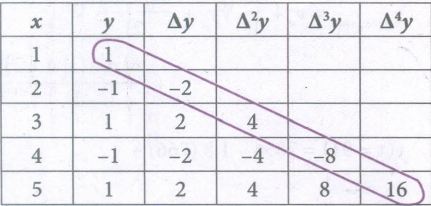
To findy when x = x ⇒ x0+ nh = x ⇒ 1 + n (1) = x ⇒ n = x-1
Newton's forward interpolation formula is
y(x=x) = \(\frac { n }{ 1! } { \triangle y }_{ 0 }+\frac { n(n+1) }{ 2! } { \triangle }^{ 2 }{ y }_{ 0 }+\frac { n(n+1)(n+2) }{ 3! } { \triangle }^{ 3 }{ y }_{ 0 }\)+ .....
y(x=x) = 1 + (x-1)(-2) + \(\frac { (x-1)(x-2) }{ 2 } (4)+\frac { (x-1)(x-2)(x-3) }{ 6 } (-8)+\frac { (x-1)(x-2)(x-3)(x-4) }{ 24 } (16)\)
⇒ y = 1 - 2x + 2(x2 - 3x + 2) - \(\frac{4}{3}\) (x - 1) (x - 2) (x - 3) + \(\frac{2}{3}\) (x - 1) (x - 2) (x - 3) (x -4)
⇒ y = 3 - 2x + 2x2 - 6x + 4 - \(\frac{4}{3}\) [(x2 - 3x + 2) (x- 3)] + \(\frac{2}{3}\) [(x2 - 3x + 2)(x2 - 7x + 12)]
⇒ y = 2x2 - 8x+ 7- \(\frac{4}{3}\) [x3- 3x2+ 2x- 3x2 + 9x- 6] + \(\frac{2}{3}\) [x4 - 3x3 + 2x2 - 7x3 + 21x2 - 14x + 12x2 - 36x + 24]
⇒ y = 2x2-8x+7- \(\frac{4}{3}\) x3 + 4x2 - \(\frac{8}{3}\) x + 4x2 - 12x + 8 + \(\frac { { 12x }^{ 4 } }{ 3 } -\frac { 20 }{ 3 } { x }^{ 3 }+\frac { 70 }{ 3 } { x }^{ 2 }-\frac { 100x }{ 3 } +\frac { 48 }{ 3 } \)
⇒ y = \(\frac{2}{3}\) x4 + x3 \(\left( \frac { -4 }{ 3 } \frac { -20 }{ 3 } \right) \) + x2\(\left( 2+4+4+\frac { 70 }{ 3 } \right) \) + x \(\left( -8-\frac { 8 }{ 3 } -12-\frac { 100 }{ 3 } \right) \) + 31
⇒ y = \(\frac{2}{3}\) x4 - 8x3 + \(\frac{100}{3}\) x2 - 56x + 31 which is the required polynomial.
6.
Given
| x | 0 | 1 | 3 | 4 |
| y | -12 | 0 | 6 | 12 |
Here the intervals are unequal
∴ By Lagranges interpolation formula, we have
x0 = 0, x1 = 1, x2 = 3, x3 = 4
y0 = -12, y1 = 0, y2 = 6, y3 = 12 and x = x.
∴ y = f(x) = \(\frac { (x-{ x }_{ 1 })(x-{ x }_{ 2 })(x-{ x }_{ 3 }) }{ ({ x }_{ 0 }-{ x }_{ 1 })({ x }_{ 0 }-{ x }_{ 2 })({ x }_{ 0 }-{ x }_{ 3 }) } \times { y }_{ 0 }+\frac { (x-{ x }_{ 0 })(x-{ x }_{ 2 })(x-{ x }_{ 3 }) }{ ({ x }_{ 1 }-{ x }_{ 0 })({ x }_{ 1 }-{ x }_{ 2 })(x_{ 1 }-{ x }_{ 3 }) } \times { y }_{ 1 }+\frac { (x-{ x }_{ 0 })(x-{ x }_{ 1 })(x-{ x }_{ 3 }) }{ ({ x }_{ 2 }-{ x }_{ 0 })({ x }_{ 2 }-{ x }_{ 1 })({ x }_{ 2 }-{ x }_{ 3 }) } \times { y }_{ 2 }+\frac { (x-{ x }_{ 0 })(x-{ x }_{ 1 })(x-{ x }_{ 2 }) }{ ({ x }_{ 3 }-{ x }_{ 0 })({ x }_{ 3 }-{ x }_{ 1 })({ x }_{ 3 }-{ x }_{ 2 }) } \times { y }_{ 3 }\)
= \(\frac { (x-1)(x-3)(x-4) }{ (0-1)(0-3)(0-4) } (-12)+\frac { (x-0)(x-3)(x-4) }{ (1-0)(1-3)(1-4) } (0)+\frac { (x-0)(x-1)(x-4) }{ (3-0)(3-1)(3-4) } (6)+\frac { (x-1)(x-3)(x-4) }{ (4-0)(4-1)(4-3) } (12)\)
= \(\frac { (x-1)(x-3)(x-4) }{ (-1)(-3)(-4) } (-12)+0+\frac { x(x-1)(x-4) }{ (3)(2)(-1) } (6)+\frac { x(x-1)(x-3) }{ (4)(3)(1) } (12)\)
= +[(x - 1)(x - 3)(x - 4)] - x (x - 1)(x - 4) + x(x - 1)(x - 3)
= +[(x3-4x+3)(x-4)] -x(x2-5x+4) + x(x2-4x + 3)
= - (x3 - 8x2+ 19x - 12) - 4x2 + 3x
= (x - 4)(x2 - 4x + 3) - x (x2 - 5x + 4) + x(x2 - 4x + 3)

= x3 - 7x2 + 19x - 12.
7.
Given
| x | -1 | 0 | 1 | 2 |
| y | 202 | 175 | 82 | 55 |
Since we have to find f(0.5) which is at the beginning of the table, use Newton's forward interpolation formula.
xn + nh = 0.5 ⇒ -1 + n(1) = 0.5
⇒ n = 0.5 + 1 = 1.5
∴ y(0.5) = \(\frac { n }{ 1! } { \triangle y }_{ 0 }+\frac { n(n+1) }{ 2! } { \triangle }^{ 2 }{ y }_{ 0 }+\frac { n(n+1)(n+2) }{ 3! } { \triangle }^{ 3 }{ y }_{ 0 }\)
The difference table is
| x | y | Δy | Δ2y | Δ3y |
|---|---|---|---|---|
| -1 | 202 | |||
| 0 | 175 | |||
| 1 | 82 | -93 | -66 | |
| 2 | 55 | -27 | 66 | 132 |
∴ y(0.5) = 202+\(\frac { 1.5 }{ 1! } (-27)+\frac { (1.5)(1.5-1) }{ 2! } (-66)+\frac { (1.5)(1.5-1)(1.5-2) }{ 3! } (132)\)
= 202 - 40.5 + (1.5) (.5) (-33) + \(\frac { (1.5)(.5)(-0.5) }{ 6(132) } \) (132)
= 202 - 40.5 - 24.75 - 8.25
= 202 -73.5
= 128.5
Hence f(0.5) = 128.5
8.
Let the missing entries be y2 and y4
Since only four values of f(x) are given, the polynomial which fits the data is of degree 3.
Hence fourth differences are zero
⇒ (E - 1)4yk = 0
⇒ (E4- 4E3 + 6E2 - 4E + 1) yk = 0 (1)
Put k = 0 in (1) we get,
y4 - 4y3 + 6y2 - 4y1 + y0 = 0
y4 - 4(18) + 6y2 - 4(11) + 7 = 0
⇒ y4 - 72 + 6y2 - 44 + 7 = 0
⇒ y4 + 6y2 = 109 (2)
Put k = 1 in (1) we get,
(E4- 4E3 + 6E2 - 4E + 1) y1 = 0
⇒ y5 - 4y4 + 6y3 - 4y2 +y1 = 0
⇒ 32 - 4 (y4) + 6 (18) - 4y2 + 11 = 0
32 - 4y4 + 108 - 4y2 + 11 = 0
⇒ -4y4 - 4y2 + 151 = 0
| -4y4 - 4y2 | = | -151 | |
| (2) \(\times\) 4 ➝ | 4y4 + 24y2 | = | 436 |
| Adding, | 20y2 | = | 285 |
Adding,
⇒ y2 = 14.25
Substituting y2 = 14.25 in (2) we get,
y4 + 6 (14.25) = 109
⇒ y4 + 85.5 = 109
⇒ y4 = 109 - 58.5
⇒ y4 = 23.5
9.
Using interpolation, find the value of f(x) when x =1
Here the intervals are unequal. By Lagrange's interpolation formula, we have
x0=3, x1 = 7, x2 = 11, x3 = 19
y0 = 42, y1 = 43, y2 = 47, y3 = 60 and x = 15
∴ Y =f(x) = \(\frac { (x-{ x }_{ 1 })(x-{ x }_{ 2 })(x-{ x }_{ 3 }) }{ ({ x }_{ 0 }-{ x }_{ 1 })({ x }_{ 0 }-{ x }_{ 2 })({ x }_{ 0 }-{ x }_{ 3 }) } \times { y }_{ 0 }+\frac { (x-{ x }_{ 0 })(x-{ x }_{ 2 })(x-{ x }_{ 3 }) }{ ({ x }_{ 1 }-{ x }_{ 0 })({ x }_{ 1 }-{ x }_{ 2 })(x_{ 1 }-{ x }_{ 3 }) } \times { y }_{ 1 }+\frac { (x-{ x }_{ 0 })(x-{ x }_{ 1 })(x-{ x }_{ 3 }) }{ ({ x }_{ 2 }-{ x }_{ 0 })({ x }_{ 2 }-{ x }_{ 1 })({ x }_{ 2 }-{ x }_{ 3 }) } \times { y }_{ 2 }+\frac { (x-{ x }_{ 0 })(x-{ x }_{ 1 })(x-{ x }_{ 2 }) }{ ({ x }_{ 3 }-{ x }_{ 0 })({ x }_{ 3 }-{ x }_{ 1 })({ x }_{ 3 }-{ x }_{ 2 }) } \times { y }_{ 3 }\)
= \(\frac { (15-7)(15-11)(15-19) }{ (3-7)(3-11)(3-19) } \times 42+\frac { (15-3)(15-7)(15-19) }{ (11-3)(11-7)(11-19) } \times 43+\frac { (15-3)(15-7)(15-19) }{ (11-3)(11-7)(11-19) } \times 47+\frac { (15-3)(15-7)(15-11) }{ (19-3)(19-7)(19-11) } \times 60\)
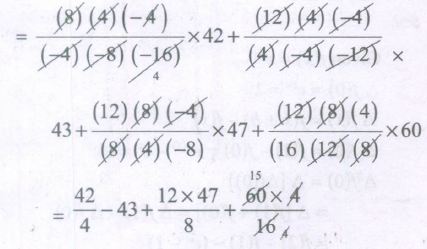
= \(\frac{21}{2}-43+70.5+15\)
= 10.5 - 43 + 70.5 + 15
y= 53
Hence when x = 15, f(x) = 53.
10.
Given:
| Year | 1982 | 1983 | 1984 | 1986 |
| Business done (in lakhs) | 150 | 235 | 365 | 525 |
Here, the intervals are unequal:
∴ By Lagrange's interpolation formula, we have
x0 = 1982, x1 = 1983, x2 = 1984, x3 = 1986
y0 = 150, y1 = 235, y2 = 365, y3 = 525 and x = 1985
=\(\frac { (x-{ x }_{ 1 })(x-{ x }_{ 2 })(x-{ x }_{ 3 }) }{ ({ x }_{ 0 }-{ x }_{ 1 })({ x }_{ 0 }-{ x }_{ 2 })({ x }_{ 0 }-{ x }_{ 3 }) } \times { y }_{ 0 }+\frac { (x-{ x }_{ 0 })(x-{ x }_{ 2 })(x-{ x }_{ 3 }) }{ ({ x }_{ 1 }-{ x }_{ 0 })({ x }_{ 1 }-{ x }_{ 2 })(x_{ 1 }-{ x }_{ 3 }) } \times { y }_{ 1 }+\frac { (x-{ x }_{ 0 })(x-{ x }_{ 1 })(x-{ x }_{ 3 }) }{ ({ x }_{ 2 }-{ x }_{ 0 })({ x }_{ 2 }-{ x }_{ 1 })({ x }_{ 2 }-{ x }_{ 3 }) } \times { y }_{ 2 }+\frac { (x-{ x }_{ 0 })(x-{ x }_{ 1 })(x-{ x }_{ 2 }) }{ ({ x }_{ 3 }-{ x }_{ 0 })({ x }_{ 3 }-{ x }_{ 1 })({ x }_{ 3 }-{ x }_{ 2 }) } \times { y }_{ 3 }\) \(\frac { (1985-1983)(1985-1984)(1985-1986) }{ (1982-1983)(1982-1984)(1982-1986) } \times 150+\frac { (1985-1982)(1985-1984)(1985-1986) }{ (1983-1982)(1983-1984)(1983-1986) } \times 235+\frac { (1985-1982)(1985-1983)(1985-1986) }{ (1984-1982)(1984-1983)(1984-1986) } \times 365+\frac { (198 5-1982)(1985-1983)(1985-1984) }{ (1986-1982)(1986-1983)(1986-1984) } \times 525\)
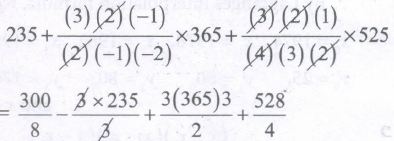
\(=\frac { (2)(1)(-1) }{ (-1)(-2)(-4) } \times 150+\frac { (3)(1)(-1) }{ (1)(-1)(-3) } \times \)
= 37.5 + 235 + 547.5 + 131.25
= 481.25
11.
We know f(x), ∇f(x + h), ∇f(x + 2h),... are the first order differences of f(x).
= f(x) - 2f(x - h) + f(x - 2h)
Consider ∇2f(x) = ∇[∇f(x))]
= ∇[f(x) - f(x - h)]
= ∇ f(X) - ∇ f(x - h)
= [f(x) - f(x - h)] - [f(x - h) - f(x - 2h)]
= f(x) - f(x - h) - f(x - h) - f(x - 2h)
∴ ∇2 f(x), ∇2 f(x + h), ∇2 f(x + 2h) ... are the second order differences of f(x).
12.
We know Δ (f(x)) = f(x + h) -f(x)
Since h = 1, ∆ (f)) = f(x + 1) - f(x)
[∵ (x + 1)3 = x3 + 3x2 + 3x + 1]
⇒ Δ (x3) = (x + 1)3 - x3

⇒ Δ (x3) = 3x2 + 3x + 1
13.
Since three values of f(x) are given, we assume that the polynomial is of degree two.
⇒ Δ3(f(x0)) = 0
⇒ ∆3(yo) = 0
⇒ (E - 1)3 yo= 0
⇒ (E3 - 3E2 + 3E - 1) yo= 0
⇒ y3- 3y2+ 3y1 - yo= 0
⇒ 157 - 3 (126) + 3y1 - 100 = 0
⇒ y1 = 107
∴ The missing term is 107.
14.
By data we have,
x0 = 0, x1 = 1, x2 = 3
y0 = 5, y1 = 6, y2 = 50 and x = 2
Using Lagrange's formula, we get
\(y=\frac { (x-{ x }_{ 1 })(x-{ x }_{ 2 }) }{ ({ x }_{ 0 }-{ x }_{ 1 })({ x }_{ 0 }-{ x }_{ 2 }) } { y }_{ 0 }+\frac { (x-{ x }_{ 1 })(x-{ x }_{ 2 }) }{ ({ x }_{ 0 }-{ x }_{ 1 })({ x }_{ 0 }-{ x }_{ 2 }) } { y }_{ 1 }+\frac { (x-{ x }_{ 0 })(x-{ x }_{ 1 }) }{ ({ x }_{ 2 }-{ x }_{ 0 })({ x }_{ 0 }-{ x }_{ 1 }) } { y }_{ 2 }\)
= \(5\times \frac { (2-0)(2-3) }{ (0-1)(0-3) } +6\times \frac { (2-0)(2-3) }{ (1-0)(1-3) } +50\times \frac { (2-0)(2-1) }{ (3-0)(3-1) } \)
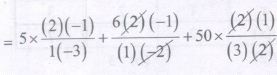
= \(\frac { 10 }{ 3 } -6+\frac { 50 }{ 3 } =\frac { 60 }{ 3 } -6=20-6=14\)
∴ f(2) = 14
15.
Since only two values of yare given, the polynomial which fits the data is of degree 1.
Hence 2nd differences are zeros
∴ Δ2(y0) = 0
⇒ (E-1)2yo=0
⇒(E2 - 2E + 1) yo = 0
⇒y2 - 2y1 +yo = 0
⇒34 - 2y1 + 51 = 0
⇒85 - 2y1 =0
⇒2y1 + 85 ⇒ y1 = \(\frac{85}{2}\)
⇒y1 = 42.5

12th Standard Syllabus & Materials
12th Standard
TN 12th Computer Applications களப்பெயர் முறைமை (DNS) Sample Question Papers Study Material - QB365 Set A
NEW12th Standard
TN 12th Computer Applications வலையமைப்பு எடுத்துக்காட்டுகள் மற்றும் நெறிமுறைகள் Sample Question Papers Study Material - QB365 Set A
NEW12th Standard
TN 12th Computer Applications கணினி வலையமைப்பு ஓர் அறிமுகம் Sample Question Papers Study Material - QB365 Set A
NEW12th Standard
TN 12th Computer Applications PHP-உடன் MySQL-ஐ இணைத்தல் Sample Question Papers Study Material - QB365 Set A



Tamilnadu Stateboard 12th Standard Subjects

Maths

Chemistry

Physics

Biology

Computer Science
Business Maths and Statistics

Economics

Commerce

Accountancy

History

Computer Applications
Biology
Computer Technology
Computer Applications
Computer Science
Business Maths and Statistics
Commerce
Economics
Maths
Chemistry
Physics
Computer Technology
History
Accountancy

Tamil

English

French
Tamilnadu Stateboard Standards
