
 100% FREE ACCESS
12th Standard Syllabus & Materials
12th Standard
TN 12th Computer Applications மின்னணு தரவு பரிமாற்றம் Sample Question Papers Study Material - QB365 Set A
NEW12th Standard
TN 12th Computer Applications மின் - வணிக பாதுகாப்பு அமைப்புகள் Sample Question Papers Study Material - QB365 Set A
NEW12th Standard
TN 12th Computer Applications மின்னணு செலுத்தல் முறைகள் Sample Question Papers Study Material - QB365 Set A
NEW12th Standard
TN 12th Computer Applications மின் - வணிகம் Sample Question Papers Study Material - QB365 Set A
NEW12th Standard
TN 12th Computer Applications திறந்த மூல கருத்துருக்கள் Sample Question Papers Study Material - QB365 Set A
NEW12th Standard
TN 12th Computer Applications வலையமைப்பு வடமிடல் Sample Question Papers Study Material - QB365 Set A

Published on: 01/10/2019
Operations Research
Download Tamil Nadu 12th Standard Business Maths and Statistics question papers, model tests, one-mark questions, important questions, and public exam papers in PDF format. Free study materials and answer keys for TN State Board students.
Questions + Answers key
Take MCQ Business Maths and Statistics Test
1.
Consider the following pay-off matrix
| Alternative | Pay – offs (Conditional events) | |||
| A1 | A2 | A3 | A4 | |
| E1 | 7 | 12 | 20 | 27 |
| E2 | 10 | 9 | 10 | 25 |
| E3 | 23 | 20 | 14 | 23 |
| E4 | 32 | 24 | 21 | 17 |
Using minmax principle, determine the best alternative.
2.
A business man has three alternatives open to him each of which can be followed by any of the four possible events. The conditional pay offs for each action - event combination are given below:
| Alternative | Pay – offs (Conditional events) | |||
| A | B | C | D | |
| X | 8 | 0 | -10 | 6 |
| Y | -4 | 12 | 18 | -2 |
| A3 | 14 | 6 | 0 | 8 |
Determine which alternative should the businessman choose, if he adopts the maximin principle.
3.
Consider the following pay-off (profit) matrix Action States
| Action | States | |||
| (s1) | (s2) | (s3) | (s4) | |
| A1 | 5 | 10 | 18 | 25 |
| A2 | 8 | 7 | 8 | 23 |
| A3 | 21 | 18 | 12 | 21 |
| A4 | 30 | 22 | 19 | 15 |
Determine best action using maximin principle.
4.
Determine how much quantity should be stepped from factory to various destinations for the following transportation problem using the least cost method
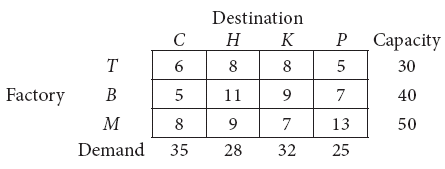
Cost are expressed in terms of rupees per unit shipped.
5.
Obtain an initial basic feasible solution to the following transportation problem using least cost method.
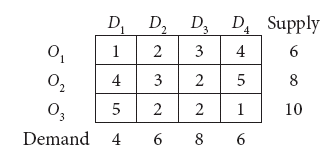
Here Oi and Dj denote ith origin and jth destination respectively.
6.
Determine an initial basic feasible solution to the following transportation problem using North West corner rule.
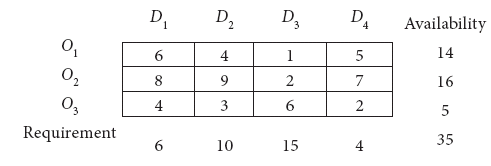
Here Oi and Dj represent ith origin and jth destination.
7.
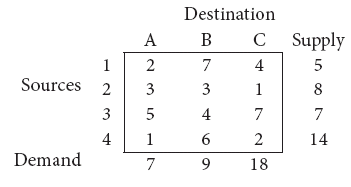
Obtain the initial solution for the following problem
8.
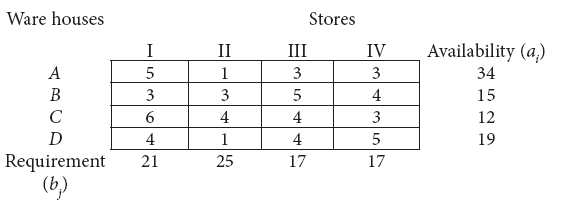
Obtain an initial basic feasible solution to the following transportation problem using Vogel’s approximation method.
9.
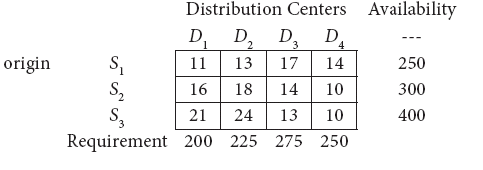
Find the initial basic feasible solution for the following transportation problem by VAM
1.
| Alternative | Pay – offs (Conditional events) | Minimum pay off | |||
| A1 | A2 | A3 | A4 | ||
| E1 | 7 | 12 | 20 | 27 | 27 |
| E2 | 10 | 9 | 10 | 25 | 25 |
| E3 | 23 | 20 | 14 | 23 | 23 |
| E4 | 32 | 24 | 21 | 17 | 32 |
min( 27, 25, 23, 32) = 23. Since the minimum cost is 23, the best alternative is E3 according to minimax principle.
2.
| Alternative | Pay – offs (Conditional events) | Minimum Pay off | |||
| A | B | C | D | ||
| X | 8 | 0 | -10 | 6 | -10 |
| Y | -4 | 12 | 18 | -2 | -4 |
| A3 | 14 | 6 | 0 | 8 | 0 |
Max (–10,–4, 0) = 0. Since the maximum payoff is 0, the alternative Z is selected by the businessman
3.
| Action | States | Minimum | |||
| (s1) | (s2) | (s3) | (s4) | ||
| A1 | 5 | 10 | 18 | 25 | 5 |
| A2 | 8 | 7 | 8 | 23 | 7 |
| A3 | 21 | 18 | 12 | 21 | 12 |
| A4 | 30 | 22 | 19 | 15 | 15 |
Max (5,7,12,15) = 15 ஃ Action A4 is the best
4.
Total Capacity = Total Demand
\(\therefore\) The given problem is balanced transportation problem.
Hence there exists a feasible solution to the given problem.
Given Transportation Problem is
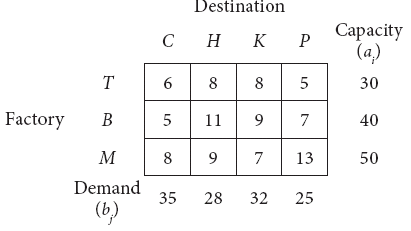
First Allocation:
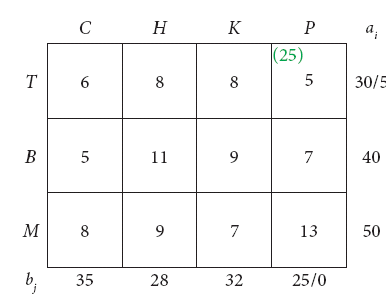
Second Allocation:
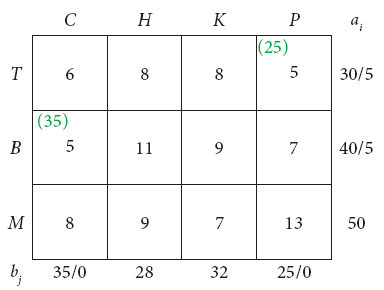
Third Allocation:
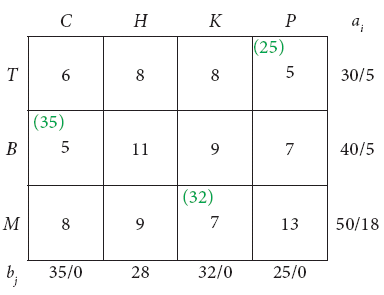
Fourth Allocation:
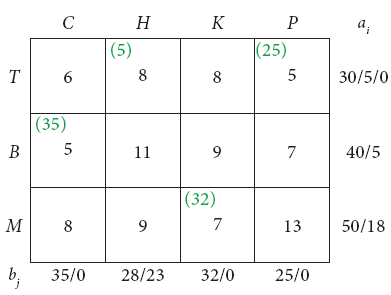
Fifth Allocation:
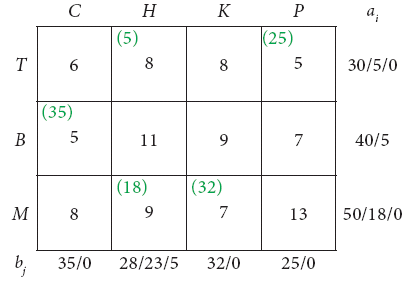
Sixth Allocation:
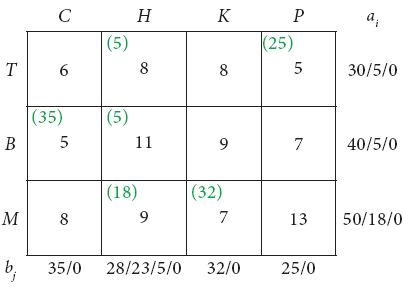
Transportation schedule :
T⟶H,T⟶P,B⟶C,B⟶H,M⟶H,M⟶K
The total Transportation cost = ( 5×8) + (25×5)+ (35×5) + (5×11)+ (18×9) + (32×7)
= 40+125+175+55+162+224
= Rs.781
5.
Total Supply = Total Demand = 24
\(\therefore\)The given problem is a balanced transportation problem.
Hence there exists a feasible solution to the given problem.
Given Transportation Problem is:
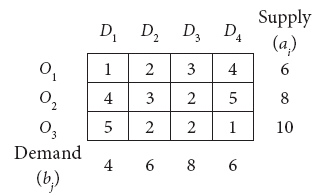
The least cost is 1 corresponds to the cells (O1, D1) and (O3, D4)
Take the Cell (O1, D1) arbitrarily.
Allocatemin (6,4) = 4 units to this cell.
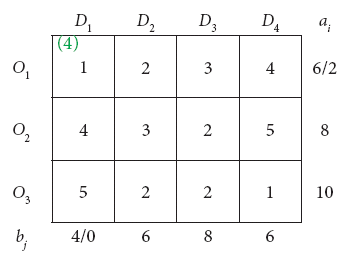
The reduced table is
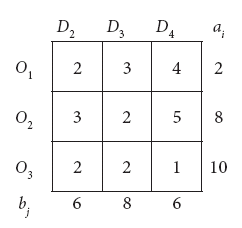
The least cost corresponds to the cell (O3, D4). Allocate min (10,6) = 6 units to this cell.
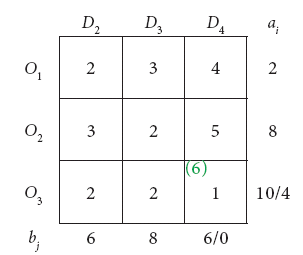
The reduced table is
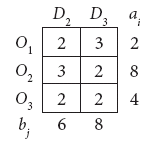
The least costis 2 corresponds to the cells (O1, D2), (O2, D3), (O3, D2), (O3, D3)
Allocate min (2,6) = 2 units to this cell.
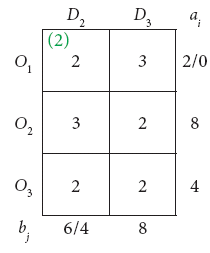
The reduced table is
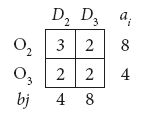
The least cost is 2 corresponds to the cells (O2, D3), (O3, D2), (O3, D3)
Allocate min ( 8,8) = 8 units to this cell.
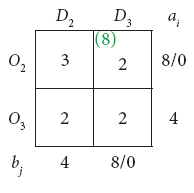
The reduced table is
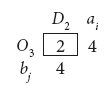
Here allocate 4 units in the cell (O3, D2)
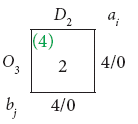
Thus we have the following allocations:
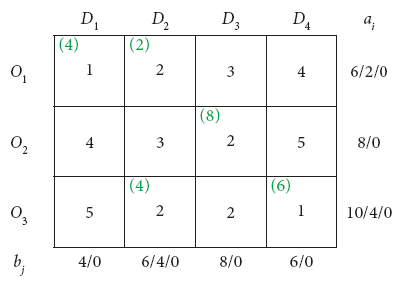
Transportation schedule :
O1⟶D1, O1⟶D2,O2⟶D3,O3⟶D2,O3⟶D4
Total transportation cost
= (4×1)+ (2×2)+(8×2)+(4×2)+(6×1)
= 4+4+16+8+6
= Rs. 38.
6.
Given transportation table is
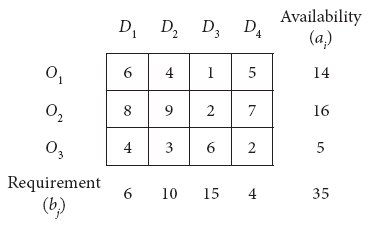
Total Availability = Total Requirement
Therefore the given problem is balanced transportation problem.
Hence there exists a feasible solution to the given problem.
First allocation :
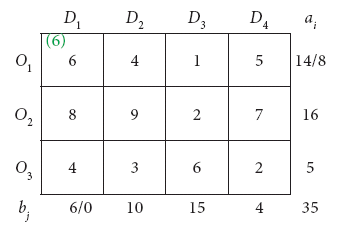
Second allocation :
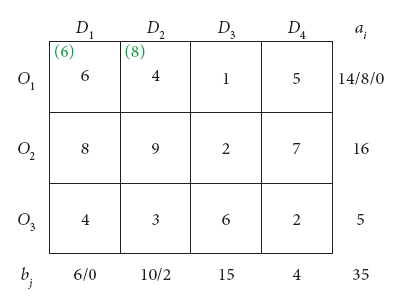
Third Allocation :
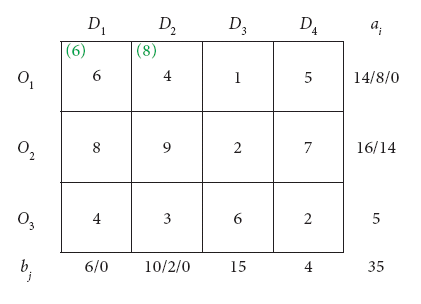
Fourth Allocation :
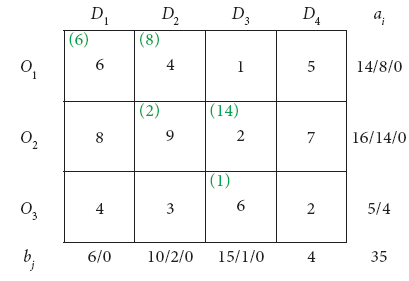
Fifth allocation :
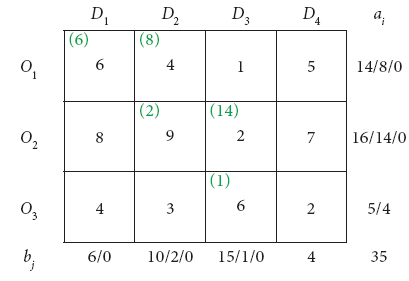
Final allocation :
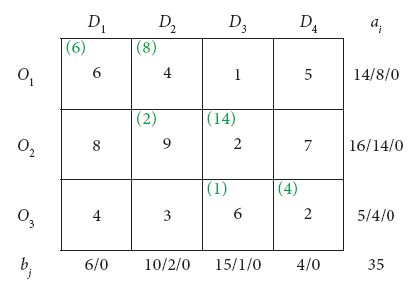
Transportation schedule : O1⟶D1, O1⟶D2, O2⟶D2, O2⟶D3, O3⟶D3,O3⟶D3.
The transportation cost
= (6\(\times\)6)+(8\(\times\)4)+(2\(\times\)9)+(14\(\times\)2)+(1\(\times\)6)+(4\(\times\)2)
= Rs.128
7.
Here total supply = 5 + 8 + 7 + 14 = 34, Total demand = 7 + 9 + 18 = 34
(i.e) Total supply =Total demand
Therefore The given problem is balanced transportation problem.
\(\therefore\) we can findan initial basic feasible solution to the given problem.
From the above table we can choose the cell in the North West Corner. Here the cell is (1, A)
Allocate as much as possible in this cell so that either the capacity of first row is exhausted or the destination requirement of the first column is exhausted.
i.e. x11 = min (5, 7) = 5
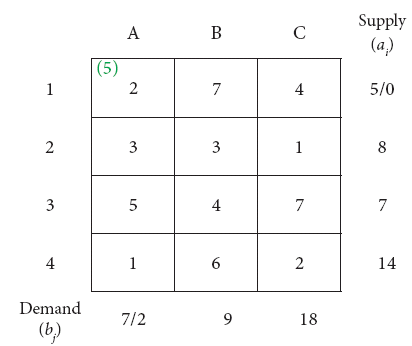
Reduced transportation table is
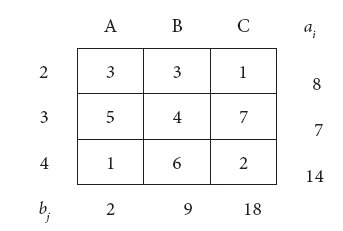
Now the cell in the North west corner is (2, A)
Allocate as much as possible in the first cell so that either the capacity of second row is exhausted or the destination requirement of the first column is exhausted.
i.e. x12 = min (2, 8) = 2
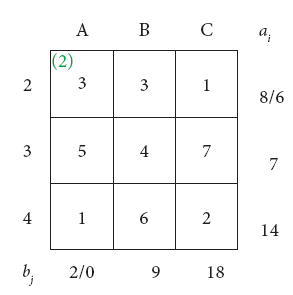
Reduced transportation table is
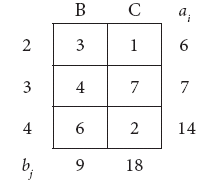
Here north west corner cell is (2, B) Allocate as much as possible in the first cell so that either the capacity of second row is exhausted or the destination requirement of the second column is exhausted.
i.e. x22 = min (6, 9) = 6
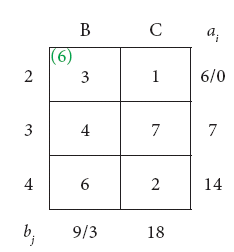
Reduced transportation table is
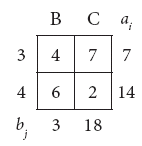
Here north west corner cell is (3,B).
Allocate as much as possible in the first cell so that either the capacity of third row is exhausted or the destination requirement of the second column is exhausted.
i.e. x32 = min (7, 3) = 3
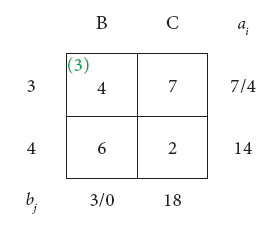
Reduced transportation table is
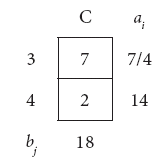
Here north west corner cell is (3,C) Allocate as much as possible in the first cell so that either the capacity of third row is exhausted or the destination requirement of the third column is exhausted.
i.e. x33 = min (4, 18) = 4
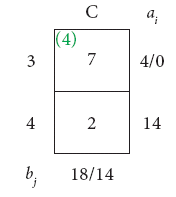
Reduced transportation table and final allocation is x44 = 14
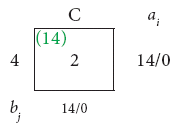
Thus we have the following allocations
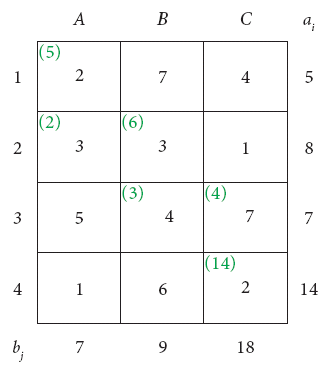
Transportation schedule : 1⟶A, 2⟶B, 3⟶B, 3⟶C, 4⟶C
The total transportation cost.
= (5 \(\times\) 2) + (2 x\(\times\) 3) + (6 \(\times\) 3) + (3 \(\times\) 4) + (4 \(\times\) 7) + (14 \(\times\) 2)
= Rs. 102
8.
Here \(\sum { { a }_{ i }=\sum { { b }_{ j } } =80 } \)
(i.e) Total Availability = Total Requirement
\(\therefore\) The given problem is balanced transportation problem.
Hence there exists a feasible solution to the given problem.
First Allocation:
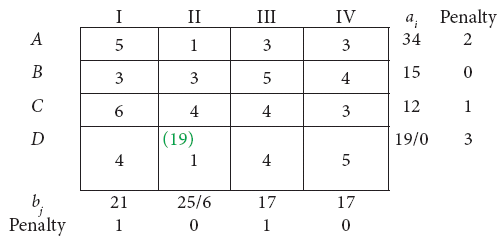
Second Allocation:
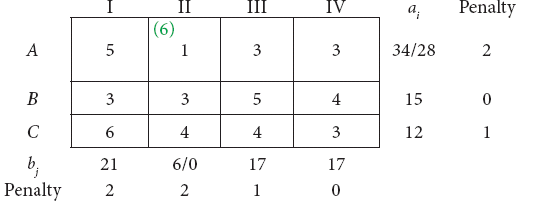
Third Allocation:
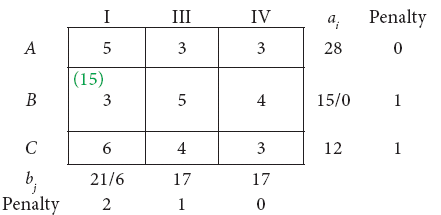
Fourth Allocation:
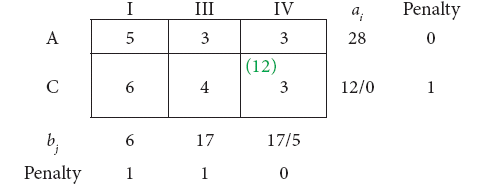
Fifth Allocation:
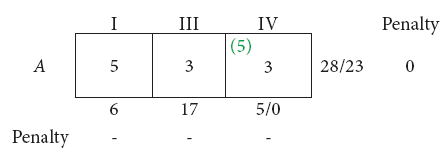
Sixth Allocation:
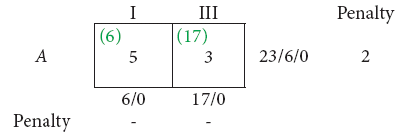
Thus we have the following allocations:
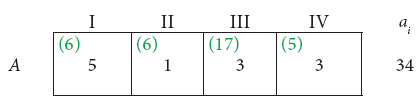
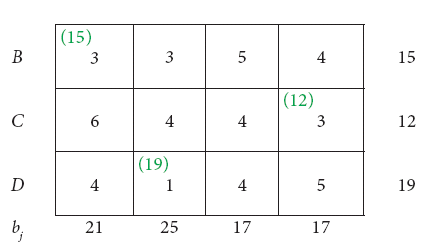
Transportation schedule :
A⟶I, A⟶II, A⟶III, A⟶IV, B⟶I, C⟶IV, D⟶II
Total transportation cost:
= (6×5)+(6+1)+(17×3)+(5×3)+(15×3)+(12×3)+(19×1)
= 30+6+51+15+45+36+19
= Rs.202
9.
Here \(\sum { { a }_{ i }=\sum { { b }_{ j } } =950 } \)
(i.e) Total Availability = Total Requirement
\(\therefore\) The given problem is balanced transportation problem.
Hence there exists a feasible solution to the given problem.
First let us find the difference (penalty) between the first two smallest costs in each row and column and write them in brackets against the respective rows and columns
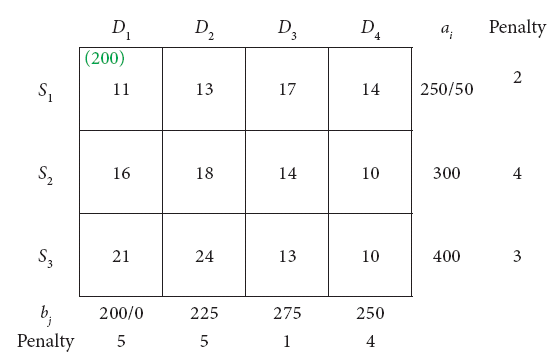
Choose the largest difference. Here the difference is 5 which corresponds to column D1 and D2. Choose either D1 or D2 arbitrarily.
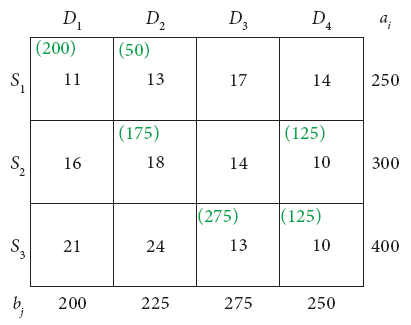
Here we take the column D1. In this column choose the least cost. Here the least cost corresponds to (S1, D1). Allocate min (250, 200) = 200 units to this Cell.
The reduced transportation table is
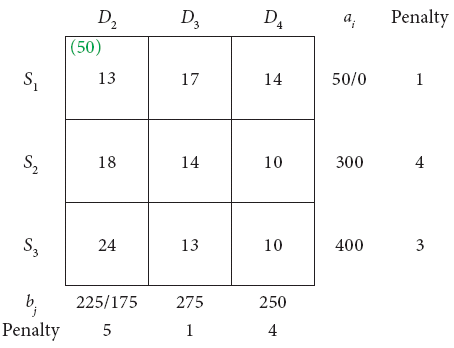
Choose the largest difference. Here the difference is 5 whichcorresponds to column D2. In this column choose the least cost. Here the least cost corresponds to (S1, D2) . Allocate min(50,175) = 50 units to this Cell.
The reduced transportation table is
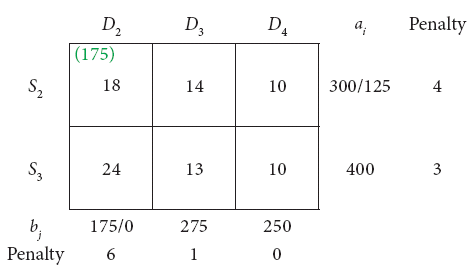
Choose the largest difference. Here the difference is 6 which corresponds to column
D2. In this column choose the least cost. Here the least cost corresponds to (S2, D2). Allocate min(300,175) =175 units to this cell.
The reduced transportation table is
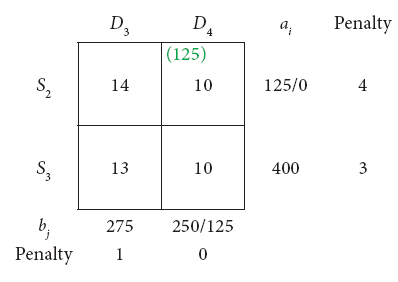
Choose the largest difference. Here the difference is 4 corresponds to row S2. In this row choose the least cost. Here the least cost corresponds to (S2, D4). Allocate min(125, 250) = 125 units to this Cell.
The reduced transportation table is
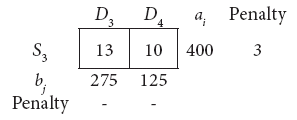
The Allocation is
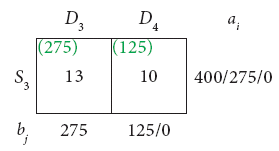
Thus we have the following allocations:
Transportation schedule :
S1⟶D1,S1⟶D2,S2⟶D2,S2⟶D4,S3⟶D3,S3⟶D4
This initial transportation cost
= (200 x 11)+(500 x 13)+(175 x 18)+(125 x 10)+(275 x 12)+(1255 x 10)
= Rs.12,075

12th Standard Syllabus & Materials
12th Standard
TN 12th Computer Applications களப்பெயர் முறைமை (DNS) Sample Question Papers Study Material - QB365 Set A
NEW12th Standard
TN 12th Computer Applications வலையமைப்பு எடுத்துக்காட்டுகள் மற்றும் நெறிமுறைகள் Sample Question Papers Study Material - QB365 Set A
NEW12th Standard
TN 12th Computer Applications கணினி வலையமைப்பு ஓர் அறிமுகம் Sample Question Papers Study Material - QB365 Set A
NEW12th Standard
TN 12th Computer Applications PHP-உடன் MySQL-ஐ இணைத்தல் Sample Question Papers Study Material - QB365 Set A



Tamilnadu Stateboard 12th Standard Subjects

Maths

Chemistry

Physics

Biology

Computer Science
Business Maths and Statistics

Economics

Commerce

Accountancy

History

Computer Applications
Biology
Computer Technology
Computer Applications
Computer Science
Business Maths and Statistics
Commerce
Economics
Maths
Chemistry
Physics
Computer Technology
History
Accountancy

Tamil

English

French
Tamilnadu Stateboard Standards
