
 100% FREE ACCESS
12th Standard Syllabus & Materials
12th Standard
TN 12th Computer Applications மின்னணு தரவு பரிமாற்றம் Sample Question Papers Study Material - QB365 Set A
NEW12th Standard
TN 12th Computer Applications மின் - வணிக பாதுகாப்பு அமைப்புகள் Sample Question Papers Study Material - QB365 Set A
NEW12th Standard
TN 12th Computer Applications மின்னணு செலுத்தல் முறைகள் Sample Question Papers Study Material - QB365 Set A
NEW12th Standard
TN 12th Computer Applications மின் - வணிகம் Sample Question Papers Study Material - QB365 Set A
NEW12th Standard
TN 12th Computer Applications திறந்த மூல கருத்துருக்கள் Sample Question Papers Study Material - QB365 Set A
NEW12th Standard
TN 12th Computer Applications வலையமைப்பு வடமிடல் Sample Question Papers Study Material - QB365 Set A

Published on: 19/09/2019
Probability Distributions
Download Tamil Nadu 12th Standard Business Maths and Statistics question papers, model tests, one-mark questions, important questions, and public exam papers in PDF format. Free study materials and answer keys for TN State Board students.
Questions + Answers key
Take MCQ Business Maths and Statistics Test
1.
Define Standard normal variate.
2.
Write the conditions for which the poisson distribution is a limiting case of binomial distribution.
3.
Write any 2 examples for Poisson distribution.
4.
The mean of a binomial distribution is 5 and standard deviation is 2. Determine the distribution.
5.
A pair of dice is thrown 4 times. If getting a doublet is considered a success, find the probability of 2 successes.
6.
In a family of 3 children, what is the probability that there will be exactly 2 girls?
7.
People’s monthly electric bills in chennai are normally distributed with a mean of Rs.225 and a standard deviation of Rs. 55. Those people spend a lot of time online. In a group of 500 customers, how many would we expect to have a bill that is Rs. 100 or less?
8.
Defects in yarn manufactured by a local mill can be approximated by a distribution with a mean of 1.2 defects for every 6 metres of length. If lengths of 6 metres are to be inspected, find the probability of less than 2 defects.
9.
X is a normally normally distributed variable with mean μ = 30 and standard deviation σ = 4. Find
(a) P(x < 40)
(b) P(x > 21)
(c) P(30 < x < 35)
10.
The time taken to assemble a car in a certain plant is a random variable having a normal distribution of 20 hours and a standard deviation of 2 hours. What is the probability that a car can be assembled at this plant in a period of time .
a) less than 19.5 hours?
b) between 20 and 22 hours?
11.
A manufacturer of metal pistons finds that on the average, 12% of his pistons are rejected because they are either oversize or undersize. What is the probability that a batch of 10 pistons will contain
(a) no more than 2 rejects?
(b) at least 2 rejects?
12.
X is normally distributed with mean 12 and sd 4. Find P(X ≤ 20) and P(0 ≤ X ≤ 12)
13.
In a distribution 30% of the items are under 50 and 10% are over 86. Find the mean and standard deviation of the distribution.
14.
The average number of phone calls per minute into the switch board of a company between 10.00 am and 2.30 pm is 2.5. Find the probability that during one particular minute there will be
(i) no phone at all
(ii) exactly 3 calls
(iii) atleast 5 calls
15.
Derive the mean and variance of poisson distribution.
1.
A random variable Z = \(\frac { X-\mu }{ \sigma } \) follows the standard normal distribution is called the standard normal variate with mean 0 and standard deviation 1. i.e. Z~ N(0,1). Its,probability density function is given by:
\(\varphi(Z)=\frac{1}{\sqrt{2 \pi}} e^{-\frac{Z^{2}}{2}},-\infty< Z< \infty
\)
2.
Poisson distribution is a limiting case of binomial distribution under the following conditions.
(i) n, the number of trials is indefinitely large ie., n⟶∞.
(ii) p, the constant probability of success in each trial is very small ie., p ⟶0.
(iii) np = λ is finite.Thus p = λ/n and q = 1 -(λ/n) where λ is a positive real number.
3.
(i) Number of lightnings per second.
(ii) Number of printing mistakes per page in a textbook.
4.
Given mean of a binomial distribution is 5
np = 5 ....(1)
Also, standard deviation is 2 ⇒ Variance = 22 = 4
∴ npq = 4...(2)
(2) \(\div \) (1) given, \(\frac { npq }{ np } \)=\(\frac { 4 }{ 5 } \)
⇒ q = \(\frac { 4 }{ 5 } \)
p = 1-q = \(1-\frac { 4 }{ 5 } =\frac { 1 }{ 5 } \)
Substituting p = \(\frac { 1 }{ 5 } \) in (1) we get
n\(\left( \frac { 1 }{ 5 } \right) \) = 5 ⇒ n = 25
∴ The binomial distribution is nCx pxqn-x, x = 0,1,2,....n
⇒ 25Cx \(\left( \frac { 1 }{ 5 } \right) ^{ x }\left( \frac { 4 }{ 5 } \right) ^{ 25-x }\), x = 0,1,2,....25.
5.
Let p be the probability of getting doublet in a pair of dice.
∴ p = \(\frac { 6 }{ 36 } \) [∵ favourable events are (1, 1) (2,2) (3,3) (4,4) (5,5) (6,6) and n(S) = 36]
⇒ p = \(\frac { 1 }{ 6 } \) ∴ q=1-p =\(1-\frac { 1 }{ 6 } =\frac { 5 }{ 6 } \)]
∴ P (getting 2 success) = P(X = 2)
=4C2 \(\left( \frac { 1 }{ 6 } \right) ^{ 2 }\left( \frac { 5 }{ 6 } \right) ^{ 2 }\) [∵ p(x) =nCx pxqn-x, n = 4, x = 2 ]
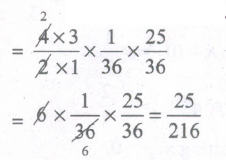
∴ P(X = 2) =\(\frac { 25 }{ 216 } \).
6.
Let p he the probability of getting a girls
∴ p = \(\frac { 1 }{ 2 } \) [∵ one favourable event and total no of events is 2]
⇒ q = 1-p = 1-\(\frac { 1 }{ 2 } \) = \(\frac { 1 }{ 2 } \) and n = 3
∴ (getting exactly 2 girls)
= P(X = 2)
= 3C2\(\left( \frac { 1 }{ 2 } \right) ^{ 2 }\left( \frac { 1 }{ 2 } \right) ^{ 1 }\) [∵ p(x) = nCx pxqn-x, n = 3 and x = 2]
= \(3\left( \frac { 1 }{ 2 } \right) ^{ 3 }=3\times \left( \frac { 1 }{ 2 } \right) ^{ 3 }=3\times \frac { 1 }{ 8 } \) = 0.375
P (getting exactly 2 girls) = 0.375.
7.
Given μ = 225, σ = 55
P(X≤100)
When X = 100, Z = \(\frac { X-\mu }{ \sigma } \)
= \(\frac { 100-225 }{ 55 } \) = -2.272
∴ P(X≤100) = P(Z≤-2.272)
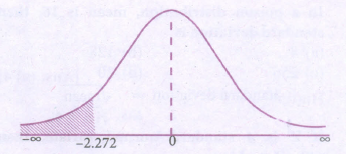
= 0.5-0.4884 = 0.0116
∴ Probability of one customer to have a bill for Rs.100 or less is 0.0116.
∴ Out of 500 customers, the number of persons to have a bill for Rs. 100 or less is 0.0116 x 500 = 5.8 ≌ 6.
8.
Let X be p probability random variable denoting the number of defective yarns.
Mean = np = 1.2, n = 6
6p = 1.2
\(p=\frac{1.2}{6}=0.2\)
q = 1-p = 1-0.2 = 0.8
P(X <2) = P(X = 0)+ P(X = 1)
P(X = x) = nCx px qn-x
P(X<2) = 6C0(0.2)0(0.8)0+6C1(0.2)1 (8)5
= (0.32768)2
= 0.6553
9.
Given μ = 30, σ = 4
(a) P(X < 40)
When X = 40, Z = \(\frac { X-\mu }{ \sigma } \)
=\(\frac { 40-30 }{ 4 } =\frac { 10 }{ 4 } \) = 2.5
∴ P(X<40) = P(Z<2.5)
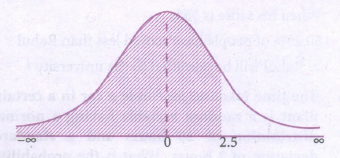
P(X<40) = 0.9938
(b) P(X>21)
When X = 21, Z = \(\frac { 21-30 }{ 4 } \quad \)
= \(\frac { -9 }{ 4 } \) = -2.25
∴ P(X>21) = P(Z>-2.25)
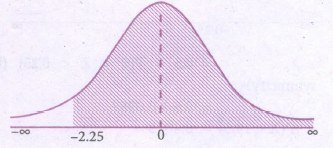
= 0.4878 + 0.5
P(X > 21) = 0.9878
(c) P(30
When X = 35, Z2 = \(\frac { 35-30 }{ 4 } \) = 1.25
P(30
10.
Given μ = 20, σ = 2
a) P(X<19.5)
When X = 19.5, Z = \(\frac { X-\mu }{ \sigma } \)
= \(\frac { 19.5-20 }{ 20 } \) = -0.25
∴ P(Z<-0.25) = P(-∞
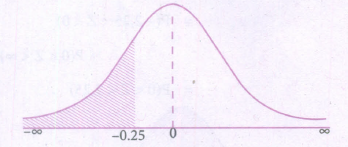
= 0.5-P(0
P(X<19.5) = 0.4013
b) P(between 20 and 22 hours)
= P(20
When X = 22, Z2 = \(\frac { 22-20 }{ 2 } \) = 1
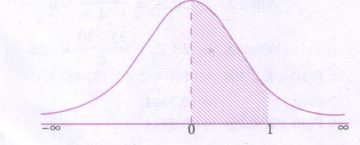
∴ P (20 < X < 22) - P(0 < Z < 1)
∴ P (20 < X < 22) = 0.3413
11.
Let p be the probability getting his piston rejected
Given p = 12% = \(\frac { 12 }{ 100 } \) = 0.12
∴ q = 1-p = 1-0.12 = 0.88
n = 10
(a) P (not more than 2 rejects)
= P(X≤2) = P(X = 0) + P(X = 1) + P(X = 2)
= 10C0(0.12)0 (0.88)10 + 10C1 (0.12)1 (0.88)9 + 10C2 (0.12)2 (0.88)8
[∵ P(x) = nCx pxqn-x]
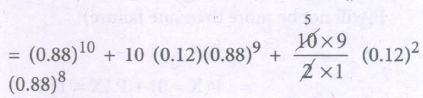
= (0.88)8 [(0.88)2 + 10(0.12) (0.88) + 45 (0.12)2]
= (0.88)8 [0.7744 + 1.056 + 0.648]
= (0.3596) (2.4784) = 0.8913
∴ Probability of not more than 2 rejects = 0.8913
b) P(at least 2 rejects)
= P(X ≥ 2) = 1 - P (X < 2)
= 1 - [P(X = 0) + P (X = 1)]
= 1-[10C0(0.12)0 (0.88)10 + 10C1 (0.12)1 (0.88)9 ]
= 1 - [(0.88)10 + 10 (0.12) (0.88)9]
= 1 - (0.88)9 [0.88 + 1.2] = 1 - (0.31647) (2.08)
= 1 - 0.6583 = 0.34173
P (atleast 2 rejects) = 0.34173
12.
Given μ = 12 and σ = 4
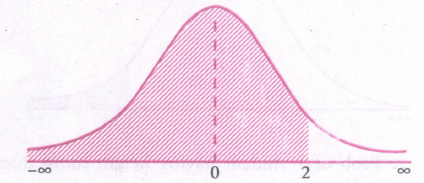
(1) P( ≤ 20)
When X = 20, Z = \(\frac { X-\mu }{ \sigma } \)
= \(\frac { 20-12 }{ 4 } =\frac { 8 }{ 4 } \) = 2
∴ P(X≤20) = P(Z≤2)
= P(-∞
P(X≤20) = 0.9772
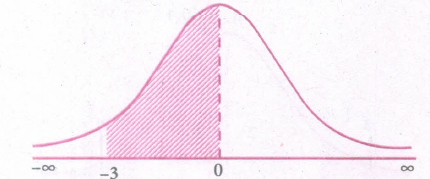
(ii) P(0≤X≤12)
When X=0, Z=\(\frac { X-\mu }{ \sigma } \)
\(\frac { 0-12 }{ 4 } =\frac { -12 }{ 4 } \)=-3
When X=12, Z=\(\frac { X-\mu }{ \sigma } \)
=\(\frac { 12-12 }{ 4 } =\frac { 0 }{ 4 } \)=0
∴ P(0≤X≤12) = P(-3≤Z≤0)
= P(0≤Z≤3) (By symmetry)
P(0≤X≤12) = 0.4987.
13.
Plot the variable X = 50 on the left side and
X = 86 on the right side of the curve.
Given P( -∞< Z1 < -Z1) = 0.3
⇒ P(-Z1 < Z < Z1) = 0.2 [∵ 0.5 - 0.3 = 0.2]
⇒ P(0 < Z < Z1) = 0.2 [By symmetry]
⇒ Z1 = -0.52 [From the normal distribution table 'and it lies on the negative side]
⇒ -0.52 = \(\frac { X-\mu }{ \sigma } \) ⇒ -0.52 σ = 50-μ
⇒ 50-μ = -0.52 σ ....(1)
Also given P(Z2
⇒ Z2 = 1.28 (from the table)
⇒ 1.28 =\(\frac { 86-\mu }{ \sigma } \)
⇒ 86-μ = 1.28 σ ...(2)
Substituting σ = 20 in (2) we get,
86-μ = (1.28)(20)
86-μ = 25.6
μ = 86-25.6
μ = 60.4
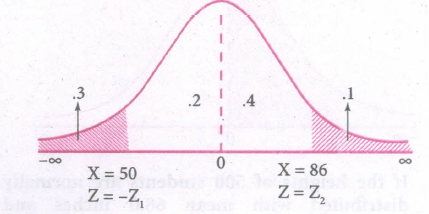
Hence, the mean is 60.4 and standard deviation is 20.
14.
Given average number of phone calls between 10 am and 2.30,pm per minute is 2.5.
∴ λ = 2.5
Hence X follows a Poisson distribution with
p(x, λ) = \(\frac { { e }^{ -\lambda }.{ \lambda }^{ x } }{ x! } \)
(i) P (no phone at all) = P(X = 0)
P(X = 0) = \(\frac { { e }^{ -2.5 }.(2.5)^{ 0 } }{ 0! } \) = e-2.5
= 0.08208 [∵ e-2.5 = 0.08208]
(ii) P (exactly 3 calls)
P(X = 3) = \(\frac { { e }^{ -2.5 }.(2.5)^{ 3 } }{ 3! } \) [∵ λ = 2.5 and x=3]
= \(\frac { (0.08208)(2.5)^{ 3 } }{ 3\times 2 } \) = 0.21375
∴ P(X = 3) = 0.2138
(iii) P (atleast 5 calls) = P(X ≥ 5)
P(X≥5) = 1-P(X<5)
=1 - [P(X = 0) + P(X = 1) + P(X = 2) + P(X = 3) + P(X = 4)]
= 1-\(\left[ \frac { { e }^{ -\lambda }.{ \lambda }^{ 0 } }{ 0! } +\frac { { e }^{ -\lambda }.{ \lambda }^{ 1 } }{ 1! } +\frac { { e }^{ -\lambda }.{ \lambda }^{ 2 } }{ 2! } +\frac { { e }^{ -\lambda }.{ \lambda }^{ 3 } }{ 3! } +\frac { { e }^{ -\lambda }.{ \lambda }^{ 4 } }{ 4! } \right] \)
= 1-e-λ \(\left( 1+\lambda +\frac { { \lambda }^{ 2 } }{ 2 } +\frac { { \lambda }^{ 3 } }{ 6 } +\frac { { \lambda }^{ 4 } }{ 24 } \right) \)
= 1-e-2.5 (1+2.5+\(\frac { ({ 2.5) }^{ 2 } }{ 2 } +\frac { (2.5)^{ 3 } }{ 6 } +\frac { (2.5)^{ 4 } }{ 24 } \))
= 1-e-2.5 (1 + 2.5 + 3.125 + 2.604) + 1.6276)
= 1-e-2.5 (10.8566)
= 1 - 0.08208 (10.8566) = 1 - 0.89111
P(X ≥ 5) = 0.1089.
15.
Mean E(X) =\(\overset { \infty }{ \underset { x=0 }{ \Sigma } } x.p(x,\lambda )\)
= \(\overset { \infty }{ \underset { x=0 }{ \Sigma } } x.\frac { e^{ -\lambda }.\lambda ^{ x } }{ x! } \)
Taking out λ from the numerator and x from the denominator

= \(\lambda .{ e }^{ -\lambda }\overset { \infty }{ \underset { x=1 }{ \Sigma } } \frac { { \lambda }^{ x-1 } }{ (x-1)! } \)
= \(\lambda .e^{ -\lambda }(1+\lambda +\frac { { \lambda }^{ 2 } }{ 2! } +...)\)
= \(\lambda .e^{ -\lambda }.e^{ \lambda }\) [∵ ex =1+x+\(\frac { x^{ 2 } }{ 2! } \)+..]
= λ.e0 =λ(1) =λ
∴ E(X) = λ
E(X2) = \(\overset { \infty }{ \underset { x=0 }{ \Sigma } } p(x,\lambda )\)
= \(\overset { \infty }{ \underset { x=0 }{ \Sigma } } { x }^{ 2 }.\frac { e^{ -\lambda }.{ \lambda }^{ x } }{ x! } \)
=\(\overset { \infty }{ \underset { x=0 }{ \Sigma } } (x(x-1)+x)\frac { e^{ -\lambda }{ \lambda }^{ x } }{ x! } \)
[∵ x(x-1)+x = x2-x+x = x2]
=\(\overset { \infty }{ \underset { x=0 }{ \Sigma } } (x(x-1).\frac { e^{ -\lambda }{ \lambda }^{ x } }{ x! } +\overset { \infty }{ \underset { x=0 }{ \Sigma } } \frac { x.e^{ -\lambda }{ \lambda }^{ x } }{ x! } \)
Taking λ2 from the numerator and x(x-1) from. the denominator we get,
E(X2)=\(\overset { \infty }{ \underset { x=0 }{ \Sigma } } \frac { { \lambda }^{ 2 } }{ x(x-1) } .(x)(x-1).\frac { { e }^{ -\lambda }.{ \lambda }^{ x-2 } }{ (x-2)! } +E(X)\)
= \({ \lambda }^{ 2 }.e^{ -\lambda }\overset { \infty }{ \underset { x=0 }{ \Sigma } } \frac { { \lambda }^{ x-2 } }{ (x-2)! } +\lambda \) [∵ E(X)=λ]
= λ2.e-λ.eλ+λ [∵ eλ =1+λ+\(\frac { { \lambda }^{ 2 } }{ 2! } \)+....]
= λ2+λ
V(X) = E(X2)-[E(X)]2 = λ2+ λ - λ2 = λ
∴ Mean = Variance = λ

12th Standard Syllabus & Materials
12th Standard
TN 12th Computer Applications களப்பெயர் முறைமை (DNS) Sample Question Papers Study Material - QB365 Set A
NEW12th Standard
TN 12th Computer Applications வலையமைப்பு எடுத்துக்காட்டுகள் மற்றும் நெறிமுறைகள் Sample Question Papers Study Material - QB365 Set A
NEW12th Standard
TN 12th Computer Applications கணினி வலையமைப்பு ஓர் அறிமுகம் Sample Question Papers Study Material - QB365 Set A
NEW12th Standard
TN 12th Computer Applications PHP-உடன் MySQL-ஐ இணைத்தல் Sample Question Papers Study Material - QB365 Set A



Tamilnadu Stateboard 12th Standard Subjects

Maths

Chemistry

Physics

Biology

Computer Science
Business Maths and Statistics

Economics

Commerce

Accountancy

History

Computer Applications
Biology
Computer Technology
Computer Applications
Computer Science
Business Maths and Statistics
Commerce
Economics
Maths
Chemistry
Physics
Computer Technology
History
Accountancy

Tamil

English

French
Tamilnadu Stateboard Standards
